What Does a Multimeter Measure
As an Amazon Associate we earn from qualifying purchases.
What does a multimeter measure? A digital multimeter measures voltage, current and resistance, which Fluke’s how-to guide lists as the basic functions. Many models also check continuity and diodes, and some add capacitance, frequency and temperature. Which functions a meter has depends on the model, so the listing or manual for that model is the list that counts. This page explains each function in general terms and then covers what a meter cannot tell you on its own.
Electrical safety comes first
Work on mains circuits can be fatal. Before any reading, confirm that the category rating for your model suits the circuit in front of you, and take that figure from the listing or the manufacturer’s manual rather than from memory. Work inside a breaker panel or on a service connection is a job for a licensed electrician.
The content below stays with low-voltage and bench-level functions. It describes no procedure for live mains, outlets, panels or service wiring.
Fluke’s safety guide explains that a shock happens when a person’s body becomes part of an electrical circuit. It tells readers to assume every electrical component is energized until it has been positively discharged, and to be aware of spikes such as transient overvoltage. Fluke’s how-to guide adds a general warning: never attempt to measure voltage greater than 600V.
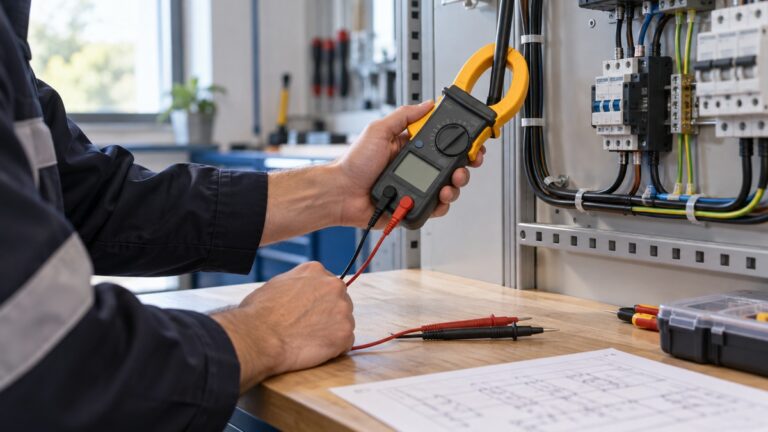
Fluke’s CAT article says the IEC 61010-1 standard defines test tool category ratings. It places CAT II at single-phase loads plugged into a wall outlet, including appliances and portable tools. It places CAT III at 3-phase distribution including switchgear, and CAT IV at the utility connection, outdoor conductors, electricity meters and service entrances. It also notes that CAT markings have no relation to the PPE hazard categories in NFPA 70E.
Ratings differ between models, even within one brand. Klein’s MM600 page lists CAT IV 600V / CAT III 1000V, and its MM400 page lists CAT III 600V. Both pages say the product is no longer in production, so the rating to read is the one for the exact model you hold. Fluke’s safety guide makes the general point that digital multimeters come rated for different electrical parameters, so you need to check for appropriate CAT ratings.
OSHA’s rule on energized work, 29 CFR 1910.333, limits work on energized electric circuit parts to qualified persons. Fluke’s safety guide also warns against working alone near exposed, energized equipment. Both point toward keeping energized work with trained, qualified people.
Quick answer
- Voltage, current and resistance are the basic functions, according to Fluke’s how-to guide.
- Continuity and diode test are functions Keysight’s 34401A data sheet lists among its ten.
- Capacitance, frequency and temperature appear on some models, not all, so check the listing or manual for the model you hold.
- A reading does not show that the meter works or that a circuit is safe to touch.
What each function is for
Purdue’s electrical lab handout explains the name: the DMM is called a “multi-meter” because it is multi-functional and can measure multiple electrical quantities. Each function below is described in general terms. The model listings and data sheets name the functions a particular meter supports, and the sources we opened do not say which function fits a given job. Choose the function that matches the question you are asking about the circuit or component.
Voltage
Voltage is a difference between two points, and the two probes read that difference. Purdue’s electrical lab handout compares voltage to the pressure that pushes water through a hose. The UC Berkeley tutorial for the HP 34401A notes that the meter’s ground is floating, so the two probes read a voltage difference.
Fluke’s how-to guide marks the two voltage settings on the dial: V~ for AC and V- for DC. The Berkeley tutorial says its AC voltage button is used to measure Vrms, a single value for an AC signal. Klein’s MM600 listing states 1000V AC and 1000V DC for its voltage inputs. Keysight’s 34401A data sheet gives 1000 V as its maximum voltage input and 3 A as its maximum current input, so input limits are model-specific.
Use the voltage function when the question is how much voltage is present between two points. The sources we opened do not say how an AC reading behaves on distorted signals, so this page does not extend the claim that far.
Current
Purdue’s lab handout compares current to the velocity of water moving through a hose. Fluke’s how-to guide lists three usual terminals: common (COM), voltage (V) and current (A). Current therefore has its own input, and Klein’s MM600 listing states 10A AC and 10A DC current inputs.
The Berkeley tutorial gives the key caution for this function. It says an ammeter has a very small internal impedance, and that when measuring current you should never place the probes across a voltage source, because high currents may damage the meter. Fluke’s how-to guide adds that the fuse should be checked before a current measurement.
Resistance
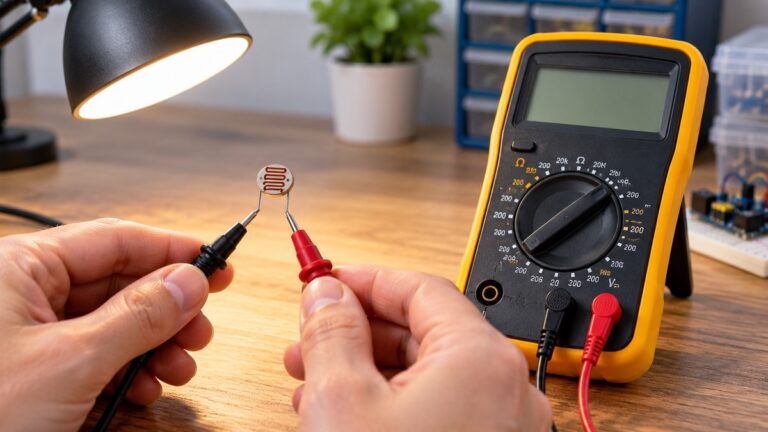
Resistance is measured in ohms. Purdue’s handout lists resistance among the primary modes of its bench meter, and it describes open and short circuits as a theoretical infinite resistance and a theoretical zero resistance. Keysight’s 34401A data sheet lists two-wire and four-wire resistance as functions, and Klein’s MM600 listing states a 40MΩ resistance input.
Continuity
Continuity mode checks whether a path is closed. Fluke’s how-to guide says a beep indicates continuity, meaning the circuit is closed and electricity can flow from one end to the other. If there is no beep, the guide says the circuit is open or broken. Keysight’s 34401A data sheet describes continuity and diode test as functions built in for bench work.
Diode
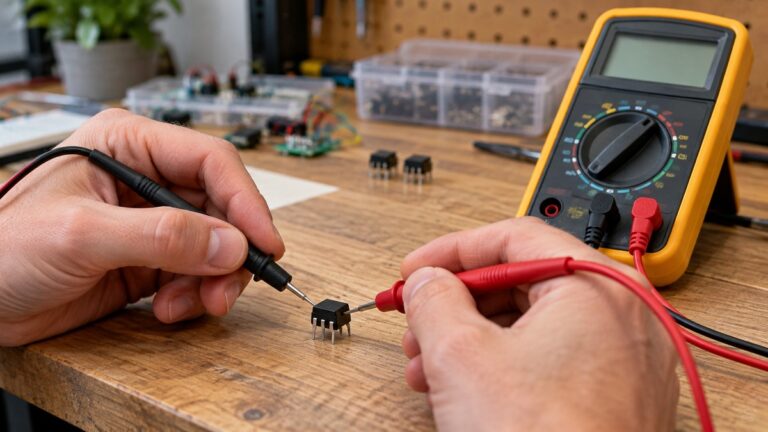
Diode mode checks the condition of a diode. Fluke’s how-to guide says a diode in good condition shows a value on the display, while a diode that is open or shorted shows an overload indication. Keysight’s data sheet lists diode test among its ten functions, and Purdue’s bench meter includes a diode test mode.
Capacitance, on some models
Fluke’s how-to guide says some meters measure capacitance, and Klein’s MM600 listing gives a capacitance range of 1000µF. The Keysight 34401A data sheet lists ten functions, and capacitance is not among them. Before capacitance checks, Fluke’s guide says to turn off circuit power and discharge high-voltage capacitors. For meters aimed at capacitor checks, see our guide to meters for testing capacitors.
Frequency, on some models
Klein’s MM600 listing states a frequency range of 1Hz to 500kHz. Keysight’s 34401A data sheet lists frequency and period as separate functions, and Purdue’s bench meter includes a frequency mode among its primary modes. The sources we opened do not describe how a frequency reading is made or which signal types it suits.
Temperature, on some models
Fluke’s how-to guide lists temperature among the functions that some meters offer. Klein’s MM600 listing states a temperature range of 0° to 1000°F (-18° to 538°C) and includes a thermocouple in the box. Among the sources we opened, only Klein’s listing states a temperature range.
The parts that tie the functions together
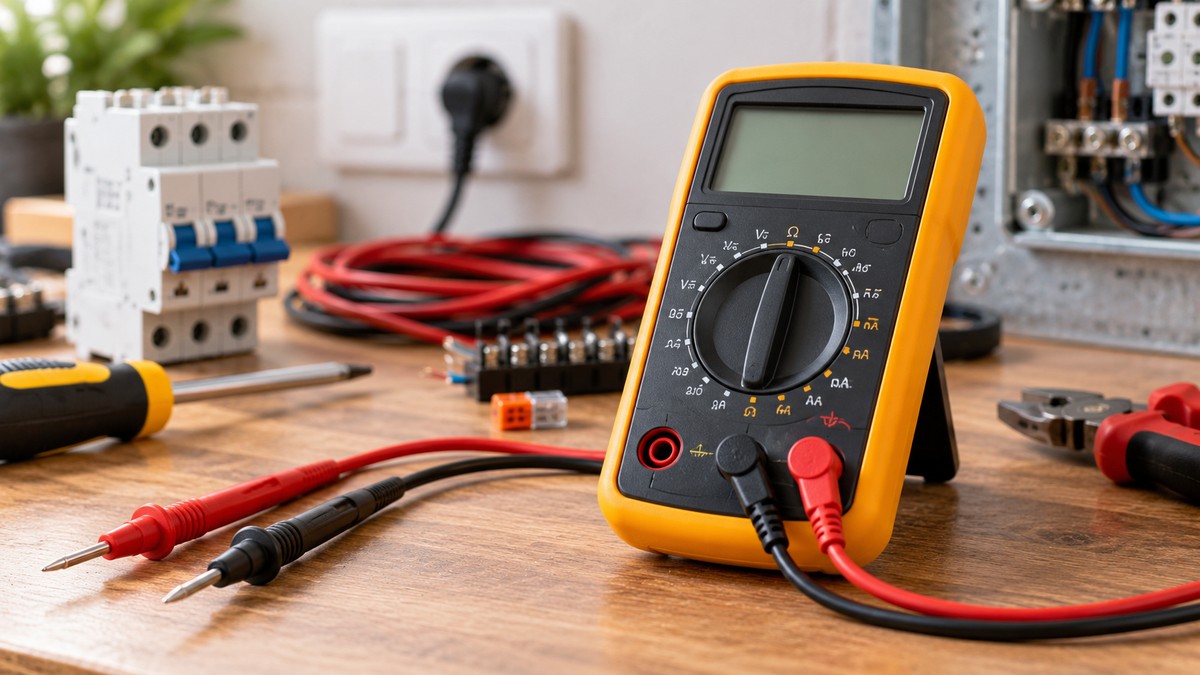
Fluke’s how-to guide describes five parts that all multimeters share: the display, the rotary switch, the input terminals, the buttons and the test leads. The display shows readings and indicators. The rotary switch selects the function and the range. The buttons include power, range and hold. The test leads connect the meter to the device or circuit being checked. The Berkeley tutorial names the buttons on its bench meter as DC V, AC V, 2W for resistance and Freq for frequency.
What a multimeter does not tell you on its own
A function list tells you what a meter can measure. It does not tell you that a reading is accurate, that a circuit is safe to touch, or that the meter itself is working. The points below come from the sources above.
- Accuracy and resolution. Fluke’s how-to guide describes accuracy as how close a reading is to the actual value, and resolution as the smallest increment the meter can measure and display. A function list states neither figure.
- Lead and offset effects. Keysight’s 34401A data sheet describes a Null feature that removes lead resistance and other fixed offsets from measurements.
- Whether the meter works. Fluke’s safety guide says never to assume the meter is working, and to verify it with a known voltage source or a proving unit.
- Which functions a model has. Fluke’s guide notes that some meters add capacitance, frequency, temperature and transistor tests, while the Keysight 34401A list has no capacitance or temperature function.
- Model status. Klein’s MM600 and MM400 pages both say the product is no longer in production. Check the model you hold against its own manual.
A long function list does not replace the manual. Fluke’s how-to guide says to refer to the user manual for specific instructions and safety information. For auto-ranging models, which choose their measurement range automatically, see our auto-ranging meter guide.
Common misreadings
Each point below follows from a fact in the sources above.
- Treating a function list as a safety rating. The Keysight 34401A data sheet lists ten functions and no CAT rating.
- Assuming one brand’s ratings carry across models. Klein lists CAT IV 600V / CAT III 1000V for the MM600 and CAT III 600V for the MM400.
- Reading a continuity beep as a resistance value. Fluke’s guide describes continuity as a yes or no result.
- Putting the meter in current mode across a voltage source. The Berkeley tutorial warns that high currents may damage the meter.
- Assuming every model has capacitance or temperature. The Keysight 34401A list has neither, while Klein’s MM600 lists both.
FAQ
Do all multimeters measure capacitance and temperature?
No. Fluke’s guide treats voltage, current and resistance as the basic functions, and describes capacitance, frequency, temperature and transistor tests as extras that some meters offer. The Keysight 34401A data sheet we opened lists neither capacitance nor temperature.
Can a multimeter measure AC current?
Some do. Purdue’s handout lists AC current among the modes on its bench meter, and Klein’s MM600 listing states 10A AC current. The sources we opened do not say whether a particular model has AC current, so check its listing or manual.
Can a multimeter confirm that a circuit is safe to touch?
No single reading settles that. Fluke’s safety guide asks users to check the meter against a known source, and it treats discharge as a separate step before work on a component.
What does a continuity beep tell me?
A beep means the meter found a closed path. No beep means the path is open or broken, according to Fluke’s guide. The guide does not describe a resistance figure that comes from the beep.
Does a multimeter show a waveform?
The sources we opened describe numeric readings on a display, not waveforms. The Berkeley tutorial describes an AC voltage button that reads Vrms, which is a single value for the signal.
How we chose
The question is about what a digital multimeter measures, so the sources had to name the functions and, where a figure was needed, state it for a specific model. Manufacturer pages from Fluke, Klein and Keysight name the functions and ratings. Purdue University and UC Berkeley describe the functions in general terms in lab material. The US federal rule on qualified persons covers the basis for energized work. Each source is a manufacturer, an education source or a government text, and each page had to open with a 200 response and contain the words it is cited for. The descriptions stay general because input limits, ranges and functions vary by model, and the sources give those figures only for named models.
Each quotation was checked against the fetched text before use. Figures such as ranges and ratings come only from a listing or a data sheet, and general descriptions of functions come from a guide or a lab handout. Pages that returned 403, an empty body, a login redirect or no connection were dropped and are not cited. Every source in the list below was opened on 2026-10-22.
What we could not verify
The sources we opened leave several points open. The list below states them in plain words.
- The sources we opened do not use the words “can kill.” The opening safety line is the site’s required statement, based on the shock and energized-circuit warnings above.
- The sources we opened do not describe licensing rules for electrical work. The licensed-electrician line is a site rule, not a sourced legal requirement.
- The Keysight 34401A data sheet we opened does not state a CAT rating, and its own notice says that model will be discontinued.
- Klein’s frequency, capacitance and temperature figures come from one listing. The sources we opened do not give those figures for other brands, so this page makes no general claim about them.
- The sources we opened do not explain how an AC reading behaves on distorted signals.
- The Keysight blog on DMM principles and the OSHA website both returned 403, so no claim on this page relies on them.
Sources
- Fluke, How to Use a Multimeter: A Comprehensive Guide. https://www.fluke.com/en-us/learn/blog/maintenance-monitoring/how-to-use-a-multimeter-guide
- Fluke, Guide to digital multimeter safety. https://www.fluke.com/en-us/learn/blog/safety/multimeter-guide
- Fluke, IEC Category Ratings: Use the Right Tools for the Job. https://www.fluke.com/en-us/learn/blog/safety/iec-category-ratings-use-the-right-tools-for-the-job
- Klein Tools, MM600 Digital Multimeter, Auto-Ranging, 1000V (product page). https://kleintools.com/product/MM600
- Klein Tools, MM400 Digital Multimeter, Auto-Ranging, 600V (catalog page). https://www.kleintools.com/catalog/multimeters/digital-multimeter-auto-ranging-600v
- Keysight Technologies, 34401A Digital Multimeter data sheet, 5968-0162. https://www.keysight.com/us/en/assets/7018-06774/data-sheets/5968-0162.pdf
- Purdue University, ENGT 181 Electrical Lab 1 handout. https://web.ics.purdue.edu/~rvoyles/Classes/TECH181/Electrical_Lab1.pdf
- UC Berkeley EE105, HP 34401A Digital Multimeter Tutorial. https://rfic.eecs.berkeley.edu/courses/ee105/Tutorials/HP34401A_DMultimeter_Tutorial.pdf
- 29 CFR 1910.333, Selection and use of work practices (2022 edition, via GovInfo). https://govinfo.gov/content/pkg/CFR-2022-title29-vol5/pdf/CFR-2022-title29-vol5-sec1910-333.pdf