Fluke 376 FC: The Specs Fluke Publishes
As an Amazon Associate we earn from qualifying purchases. Details
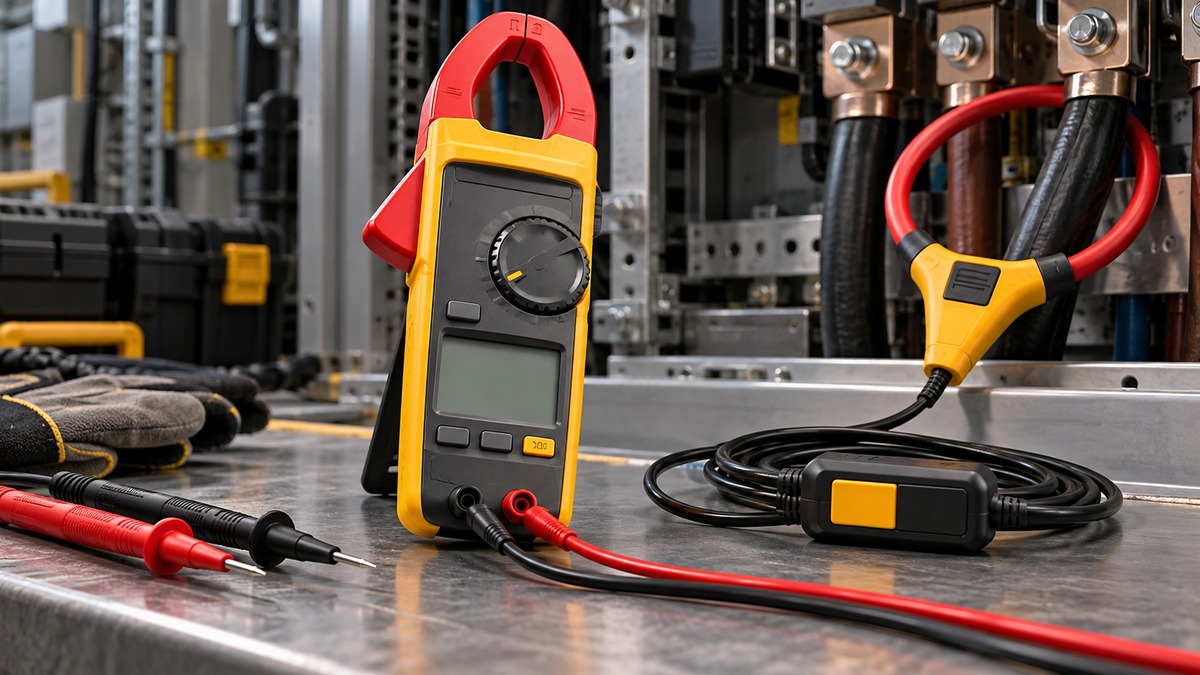
The 376 FC is a true-RMS clamp meter that pairs a standard jaw with a flexible iFlex probe for measuring current on conductors the jaw cannot close around.
Quick answer
- Jaw AC current: the page states a range of 999.9 A with 0.1 A resolution.
- iFlex AC current: the page states a range of 2500 A, with 3% ±5 digits accuracy from 5 to 500 Hz.
- Voltage: AC and DC up to 1000 V, with AC accuracy of 1% ±5 digits from 20 to 500 Hz.
- Safety ratings: the page lists CAT III 1000 V and CAT IV 600 V, citing IEC 61010-2-032 and -033.
What the jaw measures
The standard jaw has a stated opening of 34 mm and a stated AC current range of 999.9 A. The page gives two accuracy figures for this range: 2% ±5 digits from 10 Hz to 100 Hz, and 2.5% ±5 digits from 100 Hz to 500 Hz. Accuracy is the tolerance of the reading, so a reader should compare these figures with the load they expect rather than assume a single number applies at every frequency.
A jaw meter is simple to use on a single cable that fits the opening. The 34 mm figure is the limit. A conductor or bundle larger than that will not close around the jaw, and the iFlex probe is the Fluke answer to that case.
What the iFlex probe adds
The iFlex is a flexible current probe that wraps around a conductor. The page states a range of 2500 A for AC current through the probe. It gives 3% ±5 digits accuracy from 5 to 500 Hz. The accuracy is lower than the jaw’s at the same frequency range, so the flexible probe suits a measurement where its range matters more than the last fraction of a percent.
The page’s description of the probe is brief. It does not give a position-dependent accuracy figure in the text we read, so this post does not state one. If the probe placement matters for a specific job, check the manual for the placement guidance before taking a reading as final.
Voltage and the other functions
The page states that the meter measures AC and DC voltage up to 1000 V. AC voltage accuracy is given as 1% ±5 digits from 20 Hz to 500 Hz. The page’s text we read does not give DC voltage accuracy, so do not infer one from the AC figure. For the resistance, continuity, diode and capacitance functions, the page’s text we read does not provide the full range tables. Check the manual before relying on a specific range for those functions.
Inrush, low-pass filter and Bluetooth
Three features appear on the page and deserve plain explanation. Inrush is a motor-start measurement. The page describes “proprietary inrush measurement technology” that filters noise and captures the starting surge. A low-pass filter reduces the effect of high-frequency content on the reading. The page describes it as an “integrated low-pass filter for accurate measurements of non-linear signals.” A Q&A on the page, dated 2025-03-13, states that the filter is always on for both voltage and current. Bluetooth connects the meter to the Fluke Connect app, which the page describes as letting you log, trend and monitor readings remotely.
Whether these features matter depends on the work. A technician who checks motor starts will look at inrush first. A person who only needs a current reading on a single circuit may never use the app.
Safety ratings: read them against the circuit
The page lists two ratings: CAT III 1000 V and CAT IV 600 V, referenced to IEC 61010-2-032 and -033. These are the category ratings for the meter. A CAT rating tells you the installation category and voltage the meter is designed for, and the category must match the circuit you measure. Do not use a rating from one category as permission to work in a higher category. Panel, service and utility work belongs to a licensed electrician, and this post does not give instructions for live panel work.
The page’s numbers describe the meter. They do not describe the leads, the probe or the accessories you may buy with it. Check the accessory ratings separately before connecting them.
Weight and size
The page states a weight of 395 g. Use that figure to judge how the meter will sit in a tool bag or on a belt. The page does not give a full dimension set in the text we read.
Who the 376 FC suits, based on what the page states
The page does not name the trades it targets. Its features, such as the flexible probe, inrush capture and remote logging, are most relevant to current checks on larger conductors and to repeated monitoring. A homeowner who needs a single current reading on a household circuit may find a simpler, lower-cost clamp is enough. This post does not rank the 376 FC against other models, because no other manufacturer data was gathered for it.
How we chose
This post covers one product and uses the manufacturer’s own page as the only source. The page was opened on 2026-10-27. Its figures are reported as written. No retailer listing, price, rating or review data was used, and no competitor was ranked. Where the page does not state a figure, the post says so instead of filling the gap from memory.
What we could not verify
- DC voltage accuracy and DC current specifications are not in the text of the page we read.
- The full resistance, continuity, diode and capacitance range tables are not in the text we read.
- The position-dependent accuracy of the iFlex probe is not stated in the text we read.
- The page does not give the accessories list or the battery type in the text we read.
Buying checklist
- Confirm the jaw opening of 34 mm covers the conductors you need to clamp, or plan to use the iFlex probe.
- Check the CAT rating you need for your circuit, and confirm the meter’s CAT III 1000 V and CAT IV 600 V ratings match it.
- Decide whether the Bluetooth and logging features are needed before paying for them.
- Read the manual’s accuracy tables for the functions you use most.
Mistakes to avoid
- Using the jaw on a conductor larger than its opening. The page states 34 mm as the opening.
- Reading the iFlex range as the jaw range. The page gives 2500 A for the flexible probe and 999.9 A for the jaw.
- Assuming a category rating covers any circuit. Match the CAT category to the circuit.
- Treating the page as a full data sheet. Several functions have no range table in the text we read.
FAQ
What is the AC current range of the Fluke 376 FC?
The jaw is stated at 999.9 A AC, and the iFlex flexible probe is stated at 2500 A AC.
What is the voltage rating of the 376 FC?
The page states AC and DC voltage up to 1000 V. AC accuracy is given as 1% ±5 digits from 20 Hz to 500 Hz.
What are the CAT ratings?
The page lists CAT III 1000 V and CAT IV 600 V, citing IEC 61010-2-032 and -033.
Does the 376 FC have Bluetooth?
Yes, according to the page. It connects to the Fluke Connect app for logging and remote monitoring.
What is the inrush feature?
The page describes proprietary inrush measurement technology for capturing motor starting current with noise filtering.
Is the 376 FC the best clamp meter for a home?
This post does not rank it against other models. Match the stated current range, ratings and features to the work you do.
Bottom line
Fluke’s page states a 999.9 A jaw, a 2500 A iFlex probe, voltage to 1000 V and CAT III 1000 V and CAT IV 600 V ratings. Match those ratings to the circuit before use, and read the manual for the range tables the page does not give.
Related guides
- Best Fluke Clamp Meter for Automotive Work: how a Fluke clamp fits a car electrical check.
- Best AC Clamp Meters: AC-only clamps for current checks.
- Best True RMS Multimeters: why true RMS matters on non-sine loads.
Sources
- Fluke Corporation, “Fluke 376 FC True-RMS Clamp Meter with iFlex,” https://www.fluke.com/en-in/product/electrical-testing/clamp-meters/fluke-376-fc (opened 2026-10-27; includes a Q&A dated 2025-03-13).