Field Piece SC440: What the Manufacturer Page Confirms
As an Amazon Associate we earn from qualifying purchases. Details
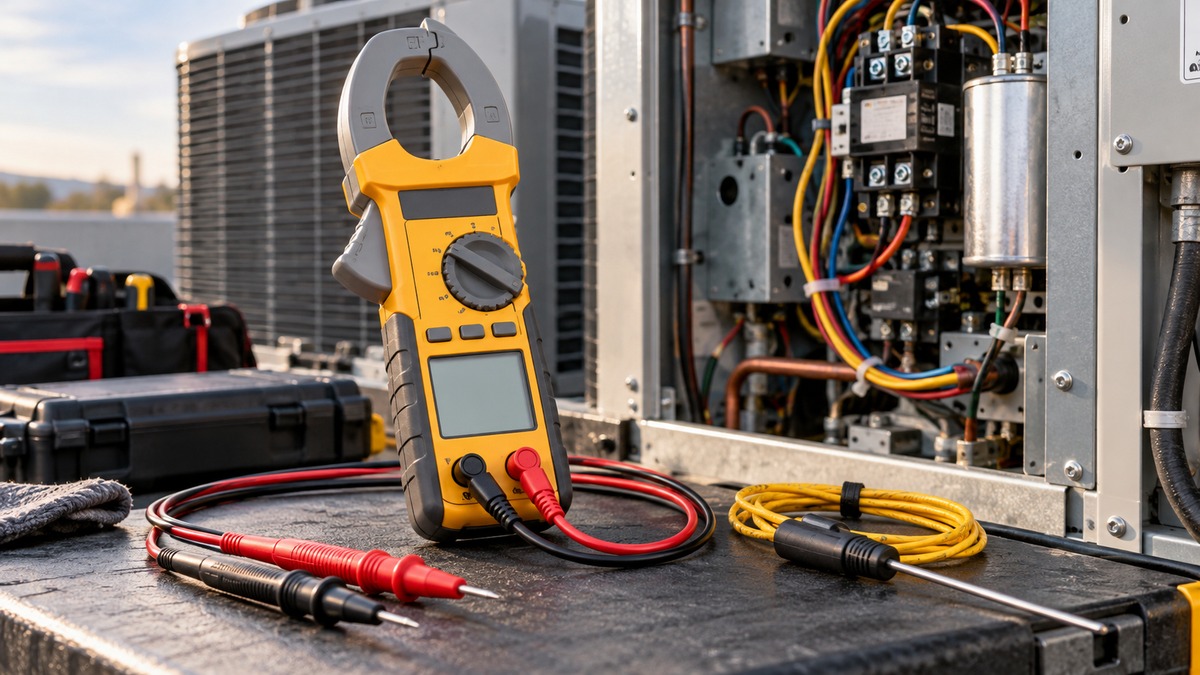
Fieldpiece sells the SC440 as an essential clamp meter for HVAC and electrical work. The sections below separate what the page states from what a buyer should still check.
Quick answer
- Stated current range: the page states “400 amps AC” for the clamp.
- Stated functions: the page lists true RMS, inrush current, duty cycle, temperature, capacitance, microamps DC, non-contact voltage, continuity and diode tests.
- Stated test leads: the page says the leads are “UL61010-031 rated CATIII 600V or above.”
- Not stated on the page: voltage ranges, jaw size, a CAT rating for the meter itself, and frequency response.
What the page says the SC440 measures
The manufacturer page lists about twenty features. The ones that matter most for a clamp meter are the current and voltage functions. For current, the page gives the clamp rating as 400 amps AC. For voltage, the page gives only an overload protection line: “600 VDC or 600VAC rms unless otherwise stated.” That line describes how much overload the input can take without damage, which is a different thing from a measurement range. A reader who needs the measurement range must find it in the manual or the manufacturer data sheet.
The page also lists resistance up to 50 MΩ at 0.1 resolution, continuity, and a diode test. Those functions suit basic checks on wiring, fuses and simple components. Capacitance and temperature are listed as separate functions, so a single meter covers several common checks in one case.
Inrush, duty cycle and microamps
Three functions are less common on entry-level meters and deserve a plain explanation. Inrush current measures the brief surge a motor draws when it starts. The page lists inrush as a feature, which means the meter can capture that starting surge rather than only the steady running current. Duty cycle shows the share of time a signal stays high, which helps when checking a switched or pulsed signal. Microamps DC is listed as a function for measuring small direct currents. The page does not give the accuracy or resolution of these readings, so check the manual before relying on one for a specific job.
Frequency and the non-contact voltage function
The page says the meter reads frequency “via leads and clamp.” It does not state a frequency range. Non-contact voltage detection is listed as a function. A non-contact detector gives a quick indication of whether a conductor is energized, but it is a screening aid, not a measurement. The page does not state the detection range, so treat the function as a quick check and confirm with a rated voltage test before work.
Test leads and the meter’s own rating
The page states a rating only for the test leads: “UL61010-031 rated CATIII 600V or above.” That is the rating of the leads, not a statement that the meter is rated for a given category at a given voltage. Do not assume the meter’s own category from the leads. Find the meter’s CAT rating in the manufacturer’s manual or the manufacturer data sheet. If that document does not state it, the rating is not stated, and the meter should not be used on household mains.
The same caution applies to the clamp: read the manual’s safety section before you clamp any conductor. Work on mains circuits, panels and service equipment belongs to a licensed electrician.
Who the SC440 suits, based on what the page states
The page frames the meter for HVAC and electrical work, and its title calls it an essential HVAC clamp meter. The functions listed, such as current, capacitance and continuity, overlap with the checks those trades make most often. A homeowner who wants to check a single appliance may find some of the same functions useful, but may not need inrush or duty cycle. Choose a meter for the jobs you do most often, and check whether the functions you need are actually listed.
If the main need is a current reading on a single household circuit, a simpler clamp may be enough. The page does not say which tasks the SC440 is best for, so this post does not rank it against other models.
How we chose
This post does not rank the SC440 against other meters. It describes one product using the manufacturer’s own page. The page was opened on 2026-10-27, and it shows a 2026 copyright footer. Figures are reported exactly as the page writes them. No retailer listing, price or review data was used. Where the page is silent, this post says so instead of filling the gap from memory.
What we could not verify
- Voltage ranges and accuracy are not stated on the product page we opened.
- Jaw size is not stated on the product page we opened.
- A CAT rating for the meter itself is not stated; only the test leads carry a stated rating.
- Frequency response and the accuracy of the inrush and microamp functions are not stated.
- The page does not describe how long the battery lasts or what battery type it uses.
Buying checklist
- Confirm the voltage ranges and the meter’s CAT rating in the manual or data sheet, not only on the leads.
- Check that the clamp jaw fits the conductor size you need to measure.
- Check that the functions you need are listed: inrush, duty cycle, microamps, capacitance or temperature.
- Read the manual’s safety section before the first use on any live circuit.
Mistakes to avoid
- Reading the lead rating as the meter rating. The page states the leads’ rating, not the meter’s.
- Treating the overload line as a range. The page’s “600 VDC or 600VAC rms” line is overload protection.
- Relying on non-contact voltage alone. It is a screening check, not a rated measurement.
- Assuming an accuracy figure. The page does not give accuracy for the functions listed.
FAQ
What is the current range of the Field Piece SC440?
The manufacturer page states “400 amps AC” for the clamp. The page does not give a separate DC current range.
Does the SC440 measure voltage?
The page lists voltage functions but does not state the voltage measurement ranges. Check the manual or data sheet for the range before use.
What is the CAT rating of the SC440?
The page states a rating only for the test leads, as CAT III 600V or above. The meter’s own CAT rating is not stated on the page. Do not use the meter on mains unless the manual states a suitable rating.
Can the SC440 measure inrush current?
The page lists inrush current as a function. It does not give the accuracy or resolution, so check the manual for those figures.
Does the SC440 include a test lead set?
The page does not list the accessories in the product description we read. Check the packing list in the manual or with the seller.
Is the SC440 a good first clamp meter?
This post does not make that call. Match the listed functions and the stated current range to your work. Use the related guides below to compare clamp meters.
Bottom line
The Field Piece SC440’s own page confirms a 400 A AC clamp, a long list of functions, and a rating for the test leads. Voltage ranges, jaw size and the meter’s own CAT rating are not on that page, so read the manual before any live work.
Related guides
- Best AC Clamp Meters: how AC-only clamps compare when current is the main job.
- Best Clamp Meters for HVAC: the functions HVAC technicians check most often.
- Best DC Clamp Meters: when you need direct current rather than alternating current.
Sources
- Fieldpiece Instruments, “SC440 – 400A Dual Display Essential HVAC Clamp Meter,” https://www.fieldpiece.com/product/sc440-essential-clamp-meter/ (opened 2026-10-27; footer shows 2026).