What Does Counts Mean on a Multimeter
As an Amazon Associate we earn from qualifying purchases.
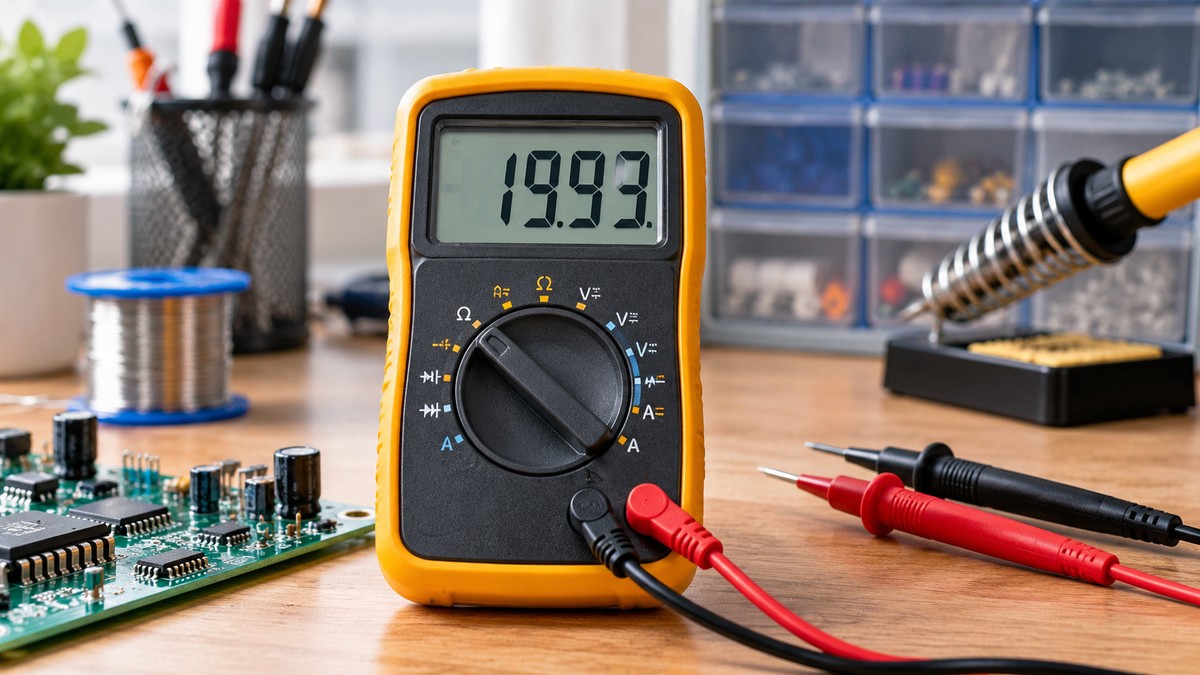
What does counts mean on a multimeter? It is the highest number a digital display can reach before the meter moves to another range, so a 4000-count display runs from 0000 to 3999 on the range in use. Counts describe the display’s resolution, meaning the smallest step the meter can show. They do not describe how close a reading is to the true value, and they say nothing about the meter’s CAT rating. This page explains how counts relate to resolution, why a higher count is not the same as higher accuracy, and what one manufacturer states for a named meter.
Electrical safety first
Working on mains circuits can be fatal. Confirm that the meter’s CAT rating covers the circuit in front of you, and find that rating in the listing or the maker’s manual. Work on panels and service equipment is for a licensed electrician.
The sources explain the danger. OSHA’s table of shock effects places 50 to 150 milliamperes beside the words “Death is possible.” Fluke’s safety guide describes the mechanism as the body becoming a path in a circuit. OSHA’s general industry rule says only qualified persons may work on electric circuit parts that have not been de-energized.
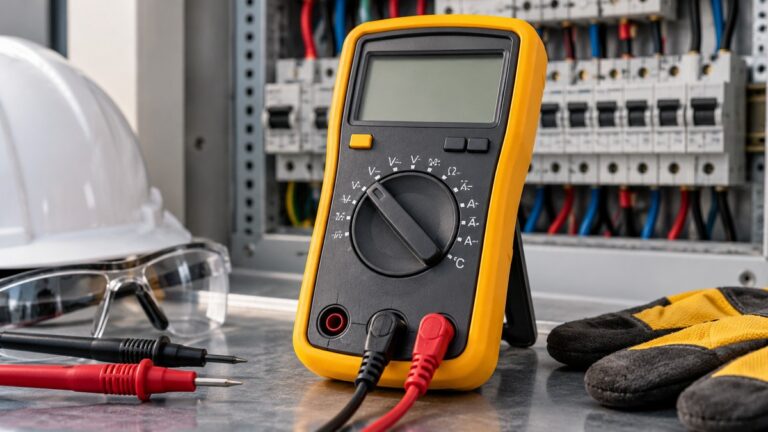
CAT ratings answer a different question from counts. Fluke’s guide defines CAT II, CAT III and CAT IV by the kind of circuit, and it advises choosing a meter rated for the highest category you could meet. The Klein MM400 manual gives its safety rating as “CAT III 600V.” The Keysight 34401A datasheet we opened lists safety design standards but no CAT rating, so the sources we opened do not state a CAT rating for that model.
This page gives no procedure for mains, outlets, fuse panels or service wiring. A count figure cannot establish that a meter is safe on household mains. The licensing sentence above is this site’s advice, and the sources we opened do not address licensing.
Quick answer
- The count is the highest display value before the meter changes range. A 4000-count meter shows 0000 to 3999 on each range.
- Resolution is the smallest step the display can show on the range in use, so the count and the range set it together.
- A higher count gives finer steps. It does not raise accuracy, which is a separate specification.
- A count for a named meter should come from its manufacturer. Klein states 4000 counts for the MM400, while the Keysight 34401A datasheet gives digits only.
What the count means on the display
A count is a limit on what the display can show. B&K Precision’s technical note describes counts as the number a display can show before the instrument moves to the next range. Its example is a 50000-count meter that reads 49.999 V. When the reading reaches 50 V, the meter moves up a range and displays 50.00 V.
The range change has a cost. The B&K note says the move to the next range “generally also means one digit of resolution will be lost.” That is why a single count figure does not describe the finest step a meter can show on every range.
Counts, digits and the 4000 figure
Manufacturers state resolution in counts, in digits, or in both. B&K’s note converts between the two, and Tektronix says “3 3/4-digits becomes 4000 counts.” On the most common reading, a 3 3/4-digit display runs from 0000 to 3999, which gives 4000 counts. Fluke’s ABCs of DMMs guide says a 3 1/2-digit meter shows up to 1,999 counts, and that newer meters of that class may have enhanced resolution of up to 3,200, 4,000 or 6,000 counts.
The label is not always consistent. B&K notes that some manufacturers use the 3/4 for a display that runs from 0000 to 5999, which is 6000 counts. Tektronix also notes that confusion arises when 3 3/4 digits is used to mean 3000 or 5000 counts. The count printed on a listing or manual is therefore more reliable than the digit label.
B&K’s table converts digits to counts as follows.
| Digits (B&K label) | Counts (B&K table) |
|---|---|
| 4 1/2 | 20000 |
| 4 3/4 | 40000 (or 50000) |
| 5 1/2 | 200000 |
| 6 1/2 | 2000000 |
The Keysight 34401A datasheet describes a 6 1/2-digit meter. Applying B&K’s table gives 2000000 counts, but that figure is our own conversion, so it is not a Keysight specification.
Counts, range and the smallest step
Resolution is the smallest change a meter can discern. LibreTexts, a course page from Cañada College, puts it this way: “Resolution refers to the smallest change in measurement that may be discerned.” The same page adds that, for a digital display, that step is limited by the number of digits shown.
The count does not fix the step on its own, because the step depends on the range. Fluke’s ABCs guide gives an example: a 1,999-count meter cannot show a tenth of a volt at 200 V or above, while a 3,200-count meter shows a tenth of a volt up to 320 V. Up to 320 V, the guide says, that matches a more expensive 20,000-count meter.
The Klein MM400 manual shows how the step changes by range. Its DC voltage table lists a resolution for each range, and the table below divides each range’s full scale by that resolution. The arithmetic is our own, using only the manual’s figures.
| DC voltage range (Klein manual) | Resolution (Klein manual) | Full range divided by resolution (our own arithmetic) |
|---|---|---|
| 400.0 mV | 0.1 mV | 4000 |
| 4.000 V | 1 mV | 4000 |
| 40.00 V | 10 mV | 4000 |
| 400.0 V | 100 mV | 4000 |
| 600 V | 1 V | 600 |
On the first four rows, the step equals the range divided by 4000, which is what a 4000-count display gives. The 600 V row lists a 1 V step, which is 600 steps, and the manual does not say why that row differs.
Why a higher count is not higher accuracy
Tektronix puts the point directly: “Additional resolution without a corresponding accuracy improvement is not meaningful.” Its example is a 40000-count DMM with 0.5% accuracy on AC volts, which shows more digits than that accuracy supports. Tektronix also warns that a reading can look stable and still be inaccurate, and it uses the same meter to make the point.
Accuracy is a separate specification. Tektronix says the counts added to an accuracy percentage cover rounding error and noise limits, so they are a different term from the display count. A 6000-count display and a 4000-count display can carry different accuracy figures, or the same one, and the count alone does not show which.
Counts can also change with the function. Tektronix notes that “Fewer counts may be displayed on the same instrument for certain functions,” and gives a 40000-count meter that may show only 4000 counts when measuring capacitance. The same source says the count figure usually applies to the DC volts function.
More digits can also cost time. Tektronix says the 20000- and 40000-count meters need longer settling times, because the far right digits take longer to reach their final value.
A lab manual from Mohawk Valley Community College makes the same distinction in teaching form. It says no measurement device is perfect, and that accuracy, precision and resolution must each be taken into account.
What a manufacturer states for a named meter
Klein Tools describes the MM400 auto-ranging meter with a “4000 Count LCD” display, both in its datasheet and in its instruction manual. The manual also lists a resolution for each range, shown in the table above, and gives the meter’s safety rating as “CAT III 600V.” Those are Klein’s own figures for this model.
Keysight describes its 34401A as a 6 1/2-digit meter. The datasheet we opened says the product will be discontinued on December 1, 2016, and it recommends the 34461A for new purchases. It gives no count figure and no CAT rating for the 34401A, only a list of safety design standards.
Fluke’s published figures in the sources we opened describe families of meters rather than one named model. Its blog says its 3 1/2-digit meters go up to 6000 counts, with 5999 as the highest value shown, and that its 4 1/2-digit meters have 20000 or 50000 counts.
Common mistakes
- Treating a higher count as a higher accuracy. Tektronix’s 40000-count meter has 0.5% accuracy on AC volts, so the count says little about the window around the reading.
- Assuming one count is the same step on every range. The Klein manual’s 600 V DC row lists a 1 V step, while its 4.000 V row lists 1 mV.
- Assuming the count applies to every function. Capacitance can show fewer counts than DC volts, so check the function you need.
- Reading the 3 3/4 label as always meaning 4000 counts. Some makers use the label for a display that runs to 5999, which is 6000 counts.
- Using the count as a safety figure. Counts say nothing about CAT rating. The Klein manual’s “CAT III 600V” is a separate line from its display count.
- Expecting extra digits at no cost. Tektronix notes longer settling times in its 20000- and 40000-count meters.
How to read a count figure
The checklist below uses only the points the sources support.
- Find the count on the listing or manual, and check which function it refers to. Tektronix says the count usually applies to DC volts.
- Convert digits to counts with B&K’s table, and check the count itself, because the digit label can be ambiguous.
- Look at each range’s resolution, because the step depends on the range.
- Keep accuracy separate from the count, and locate the CAT rating in the manual or listing.
How we chose
We started from manufacturer documents that state counts or digits directly: Fluke, Klein Tools, Keysight, B&K Precision and Tektronix. We added two education sources that define resolution for students: a community college lab manual and a Cañada College page hosted on LibreTexts. Each URL was opened with curl on 2026-10-22, the body was saved and stripped of markup, and every quotation was checked against the fetched text. Two URLs were dropped, a guessed Klein product page that returned HTTP 404 and a Mouser datasheet file that did not open as a PDF. Search results only helped find URLs, and no retailer listing supplies a figure in this article.
What we could not verify
The sources we opened do not state a count for the Keysight 34401A. The 2000000 figure for 6 1/2 digits is our own conversion from B&K’s table, and the 34401A datasheet is archived for a discontinued product.
None of the Fluke sources we opened gives a count for a named Fluke model. The Fluke blog gives ranges for families of meters only, and the Fluke ABCs guide uses resolutions as examples.
The Klein manual does not explain why its 600 V DC row lists a 1 V step, and the sources do not give a count for each Klein function. The 4000 count is the display figure the manufacturer states.
The sources do not show that a count figure predicts accuracy. None of them gives a CAT rating for the Keysight 34401A, and the licensing sentence in the safety section is this site’s advice that the sources we opened do not cover.
Frequently asked questions
Does a 6000-count meter have better accuracy than a 4000-count meter?
The count alone does not decide it. Compare the accuracy figure instead, because the sources we opened do not rank meters by count.
Is a 3 3/4-digit meter always a 4000-count meter?
Usually, but not always. A display with the same label can run to 5999 instead, which gives 6000 counts, so check the count itself.
Does the count tell me the CAT rating?
No. Look for the rating in the listing or the manual. The Klein MM400 manual gives “CAT III 600V,” and the Keysight 34401A datasheet we opened gives no CAT rating.
Why does the same count give different steps?
Because the count applies to the range in use, the step changes with the range. The Klein table shows 1 mV on the 4.000 V DC range and 1 V on the 600 V DC range.
Are counts printed on every multimeter?
No. B&K notes that some manufacturers do not specify counts, so the range becomes the next thing to check.
Bottom line
Read the count together with its range, keep accuracy separate from it, and find the CAT rating in the listing or the maker’s manual. A higher count gives finer steps, not a better reading. For related reading, see our hand-held meter picks, the auto-ranging meter picks, the guide to ratings, accuracy and calibration, and the page on what the term digital multimeter means.
Sources
- Fluke, “ABCs of DMMs” (PDF hosted by UConn Environmental Health and Safety), https://ehs.media.uconn.edu/wp-content/uploads/sites/3238/2025/04/FLuke-ABCs-of-DMMs.pdf
- Fluke, “Why Digital Multimeter Accuracy and Precision Matter”, https://www.fluke.com/en/learn/blog/digital-multimeters/accuracy-precision
- Fluke, “Guide to digital multimeter safety”, https://www.fluke.com/en/learn/blog/safety/multimeter-guide
- Klein Tools, MM400 Instruction Manual, https://data.kleintools.com/sites/all/product_assets/documents/instructions/klein/MM400_1390110ART_WEB.pdf
- Klein Tools, MM400 datasheet, https://data.kleintools.com/sites/all/product_assets/documents/brochures/klein/kleintools_datasheet_mm400.pdf
- Keysight, 34401A Digital Multimeter datasheet (archived), https://www.keysight.com/us/en/assets/7018-06774/data-sheets-archived/5968-0162.pdf
- B&K Precision, “Difference Between Counts and Digits”, https://www.bkprecision.com/knowledge/technical-notes/5/difference-between-counts-and-digits
- Tektronix, “Understanding Handheld DMM Specifications” (whitepaper), https://tek.com.cn/document/whitepaper/understanding-handheld-dmm-specifications
- Mohawk Valley Community College, “Laboratory Manual for DC Electrical Circuit Analysis”, https://www2.mvcc.edu/users/faculty/jfiore/Circuits1/labs/LaboratoryManualForDCElectricalCircuits.pdf
- Cañada College via LibreTexts, “2.1.1: Theory Overview”, https://eng.libretexts.org/Courses/Canada_College/Circuits_and_Devices%3A_Laboratory/02%3A_Sources_and_Instruments/2.01%3A_DC_Sources_and_Metering/2.1.01%3A_Theory_Overview
- OSHA, OSHA 3075 booklet on basic electrical safety on the job (2002, revised), https://www.osha.gov/sites/default/files/publications/OSHA3075.pdf
- OSHA, “1910.333 – Selection and use of work practices”, https://www.osha.gov/laws-regs/regulations/standardnumber/1910/1910.333