Testing AC Voltage With a Multimeter: Safe Steps
As an Amazon Associate we earn from qualifying purchases. Details
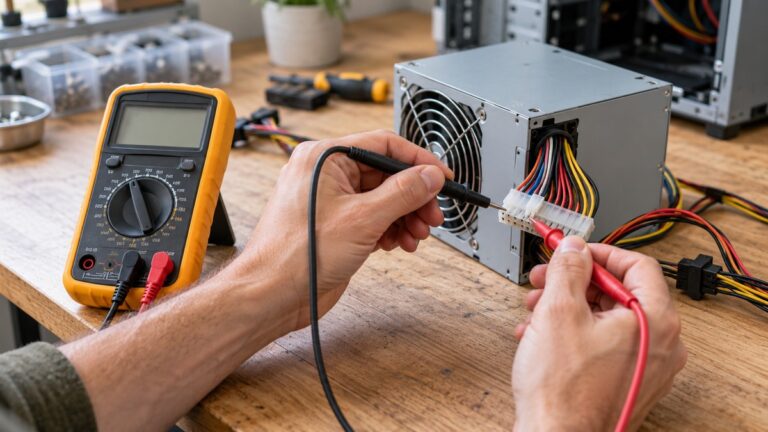
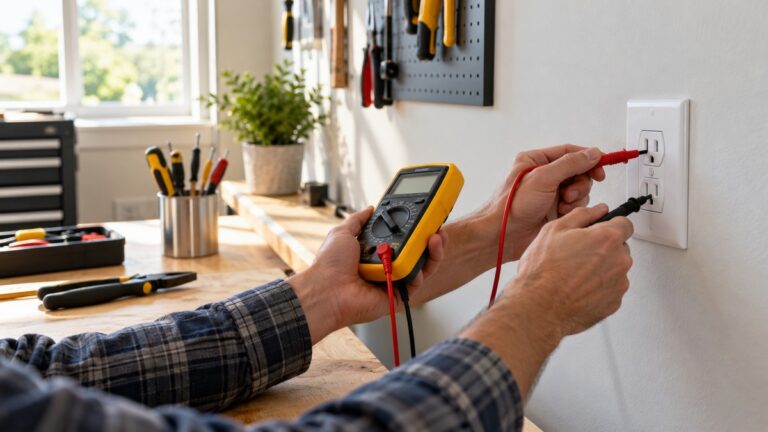
To test AC voltage with a multimeter, set the dial to the AC volts position, choose a range that covers the reading you expect, then touch the two probes to the two points you want to compare. Outlets, cords, switches and appliance inputs all follow the same basic method. If you are unsure of the voltage, start on the highest range and keep your fingers behind the probe guards while the circuit is live.
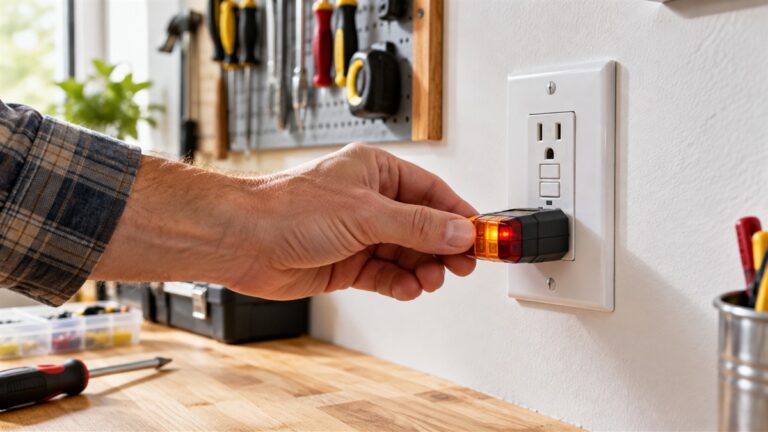
Mains voltage can kill, so the meter’s CAT rating must suit the circuit, and any panel or service work belongs to a licensed electrician. A non-contact detector can warn you that a wire is live, but it does not replace a meter that reads the actual voltage. Follow the instrument manual at every step. The six meters below were checked against their Amazon listings, and anything a listing does not state is marked as not stated.
Quick answer
For simple outlet and cord checks, the AstroAI is the plain manual-dial choice, with AC 200V/600V and a stated CAT II 600 V. The TESMEN TM-510 is the quick auto-mode choice with 4000 counts and CAT II 600V, but its specs say it cannot measure current. The ZMIWNIED FS899L states the highest ratings in this group (Cat.iii 1000v, Cat.iv 600v) plus 6000-count True RMS. The MAYILON clamp meter adds current through its jaw and states Cat III 600v.
The LJPXHHU and ANENG listings do not state a CAT rating, so keep them to low-voltage learning and electronics work rather than household mains.
Comparison table
| Meter | AC voltage stated | Display counts | CAT stated | Ranging and True RMS | Power |
|---|---|---|---|---|---|
| AstroAI AM33D | AC 200V/600V, ±(0.8%+5) | 2000 | CAT II 600 V; CAT III 300 V | Manual range; True RMS not stated | Listing says 2 x 1.5 V AAA but also lists a 9V battery in the box; confirm before buying |
| LJPXHHU XL830L | Range not stated | Not stated | Not stated | Not stated | Battery powered |
| ANENG SZ301 | 200mV to 600V, ±(2.0%+10) | 2000 | Not stated | Not stated | Battery powered |
| ZMIWNIED FS899L | AC range not stated | 6000 | Cat.iii 1000v, Cat.iv 600v | Auto-ranging, True RMS | USB-C rechargeable |
| TESMEN TM-510 | 0.8V to 600V, ±(1.2%+5) | 4000 | CAT II 600V | Auto-ranging in title; True RMS with 40 Hz to 1 kHz response | 2 AAA batteries included |
| MAYILON MY2610D clamp | AC voltage with leads; range not stated | 6000 | Cat III 600v | Auto-ranging and TRMS in title | 2 batteries included |
Product reviews
AstroAI Digital Multimeter Tester, 2000 Counts
A compact manual-range meter that measures AC and DC voltage, DC current, resistance, continuity and diodes. The listing gives AC Voltage 200V/600V ±(0.8%+5), a 2000-count display, CAT II 600 V and CAT III 300 V, and fuse protection of F250 mA/250 V and F10 A/250 V. It weighs 0.15 kg. The listed box contents are the meter, a 9V 6F22 battery, two test leads and a manual, although another line names 2 x 1.5 V AAA batteries.
Who it suits: A beginner who wants a plain dial meter for cords, fuses, batteries and outlet checks that the manual allows.
Pros
- Stated AC accuracy, ±(0.8%+5), is the tightest in this group.
- CAT II 600 V is printed in the listing.
- Fuse values are listed for the mA and 10 A inputs.
Cons
- Manual ranging means you must set the dial and the lead sockets correctly.
- True RMS and auto-ranging are not stated.
- The power wording in the listing is inconsistent.
Skip if: you want auto-ranging or True RMS.
View the AstroAI multimeter on Amazon (affiliate link)
LJPXHHU Digital Multimeter XL830L
A modern-style meter that lists AC and DC voltage, DC current, resistance, continuity, diode and battery tests. It has a 2.7 inch backlit LCD, Data Hold, and a removable rubber cover with a fold-out stand. The listing gives 5.51 x 2.56 x 1.18 inches and 166 g in orange and black.
Who it suits: A student or homeowner learning AC checks on low-risk items, with the manual in hand.
Pros
- Large backlit display.
- Data Hold and a stand make bench reading easier.
- Light at 166 g.
Cons
- No CAT rating, AC range numbers, counts or True RMS are stated.
- Not something to trust on household mains.
Skip if: you need stated CAT and range numbers for outlet work.
View the LJPXHHU multimeter on Amazon (affiliate link)
ANENG SZ301 Digital Multimeter with Case
A multi-function meter with AC voltage from 200mV to 600V (resolution 100mV to 1V, accuracy ±(2.0%+10)), DC voltage to 600V, current, resistance, capacitance, diodes, continuity, live wire and NCV sensing. The display is rated 2000 counts, weight is 155g, and the material is ABS and silicone.
Who it suits: A hobbyist who wants many functions in one meter for electronics and light household troubleshooting.
Pros
- Wide function list including capacitance, live wire and NCV.
- Carrying case is named in the title.
- AC range and accuracy are written out.
Cons
- The listing does not state a CAT rating.
- AC accuracy is looser than the AstroAI and TESMEN listings.
Skip if: you need a stated CAT rating or a simpler dial.
View the ANENG SZ301 on Amazon (affiliate link)
ZMIWNIED FS899L, 6000 Counts True RMS
An auto-ranging True RMS meter with NCV, capacitance, continuity, frequency and live wire functions. It lists Cat.iii 1000v and Cat.iv 600v, a 4.8-inch color screen, a built-in flashlight, Data Hold, heavy-duty alligator clips and USB-C charging (about 2 hours for a full charge).
Who it suits: A DIYer who wants the highest stated ratings and the finest resolution in this group, used strictly as the manual allows.
Pros
- Highest stated CAT ratings here.
- 6000 counts and True RMS.
- Large color screen and flashlight.
Cons
- Rechargeable only, so a flat cell stops work until it is charged.
- The AC voltage range is not stated in the listing facts.
Skip if: you prefer replaceable AAA or 9V batteries.
View the ZMIWNIED FS899L on Amazon (affiliate link)
TESMEN TM-510 Smart Digital Multimeter, 4000 Counts
A smart auto-mode meter that picks the function and range for you for AC and DC voltage, resistance and continuity. The listing gives AC 0.8V to 600V ±(1.2%+5), DC 0.8V to 600V ±(1.0%+5), 4000 counts, CAT II 600V, about 3 samples per second and 0.1 kg. A non-contact voltage check with a visual and audible alarm is included. The box has the meter, two test leads, two AAA batteries, a storage bag and a manual.
Who it suits: A renter or car owner who wants fast AC voltage, resistance and continuity checks without choosing a range.
Pros
- Auto mode removes range mistakes.
- 4000 counts and CAT II 600V stated.
- Batteries and a storage bag are in the box.
Cons
- The specs state CAN’T MEASURE CURRENT.
- Higher CAT categories are not stated.
Skip if: you need current, capacitance or a higher CAT category.
View the TESMEN TM-510 on Amazon (affiliate link)
MAYILON MY2610D Clamp Meter, 6000 Counts
A clamp meter that measures AC and DC current through a 1.02-inch-wide jaw, and AC and DC voltage, capacitance, frequency, duty cycle, resistance, temperature, diode, continuity and live wire tests with leads. It lists Cat III 600v, Pollution Degree 2 and 6000 counts, plus non-contact voltage detection and a backlit LCD. The set is the clamp meter, two test pens, a pouch, a manual and two batteries.
Who it suits: A DIYer who wants AC voltage with leads and also wants current without breaking the circuit.
Pros
- Voltage and current in one tool.
- Cat III 600v stated.
- Pouch and test pens included.
Cons
- The jaw must fit around a single conductor and is tight in crowded boxes.
- Bulkier in a drawer than a probe meter.
Skip if: you only need a pocket probe meter.
View the MAYILON clamp meter on Amazon (affiliate link)
Buying checklist
- Read the AC voltage range and make sure it covers the circuit you will test.
- Find the CAT rating in the listing. If none is stated, do not use the meter on household mains.
- Decide between manual dial and auto-ranging. Auto-ranging is easier, manual is simpler.
- Check True RMS if the load may not draw a clean sine wave.
- Look at what is in the box: leads, batteries, case, manual.
- Check power: replaceable batteries or a built-in rechargeable cell.
- Confirm the manual allows your task, and leave panel or service work to a licensed electrician.
Size and weight check
Weights and sizes in the listings: the LJPXHHU is 5.51 x 2.56 x 1.18 inches and 166 g, the ANENG is 155g, the AstroAI is 0.15 kg and the TESMEN is 0.1 kg. The MAYILON adds a 1.02-inch clamp jaw, so it takes more room than the probe meters.
FAQ
How do I test AC voltage with a multimeter?
Set the dial to AC volts, pick a range above the expected reading if the meter is manual, then touch the probes to the two points. Keep your fingers behind the probe guards and follow the manual. Start on the highest range if you are unsure.
What CAT rating should I look for?
Match the CAT rating to the circuit and the manual. Among these meters, the AstroAI states CAT II 600 V, the TESMEN states CAT II 600V, the MAYILON states Cat III 600v and the ZMIWNIED states Cat.iii 1000v and Cat.iv 600v. The LJPXHHU and ANENG do not state one.
Do I need True RMS for AC voltage?
It helps when the waveform is not a clean sine wave. The ZMIWNIED and MAYILON list True RMS in their titles, and the TESMEN lists True RMS with a 40 Hz to 1 kHz response. The AstroAI does not state True RMS.
Can a clamp meter test AC voltage?
Yes, on the MAYILON. The jaw measures current, and the test leads measure AC and DC voltage. The jaw is 1.02 inches wide, so it can be tight in crowded boxes.
Is a non-contact detector enough?
No. A non-contact detector can flag a live wire, but it does not give a reading. Use a meter when you need the actual voltage.
Which meter here cannot measure current?
The TESMEN TM-510. Its specs say CAN’T MEASURE CURRENT, so it suits voltage, resistance and continuity checks only.
Final note
Choose the AstroAI for a simple manual meter with a stated AC range, the TESMEN for fast auto-mode checks that do not need current, the ZMIWNIED for the highest stated CAT ratings and True RMS, and the MAYILON when you also need current. If a listing does not state a CAT rating, do not use that meter on household mains.
For related reading, see Test an Electrical Outlet With a Multimeter Safely and Best AC Voltmeter: How to Choose One.