What Do Multimeter Test Leads Do
As an Amazon Associate we earn from qualifying purchases.
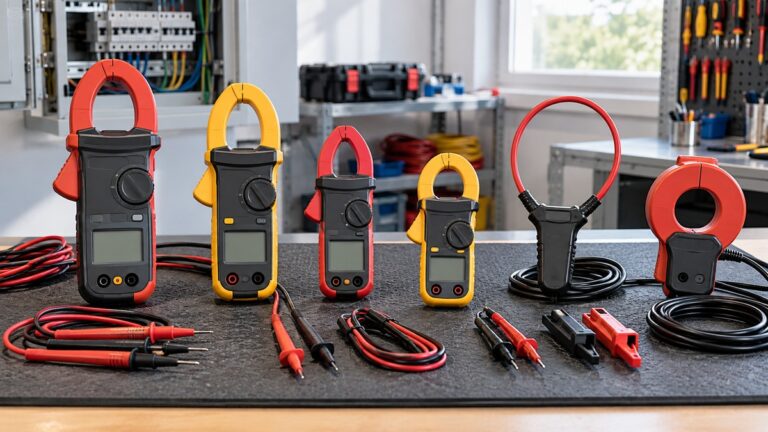
What do multimeter test leads do? They carry the meter’s input to the point you touch, so the meter can read what is there. Each lead has three parts that matter for the job: the cable, the probe and the tip. Each part also has to suit the work, and the lead’s own rating has to match the meter’s category and voltage rating. This article explains those parts, how fused and unfused tips differ, and how to spot a worn lead in general terms. It does not describe measurement steps.
Electrical safety
Household power can injure or kill anyone who touches a live conductor, and a test lead is the link between the meter and that conductor. Fluke’s how-to article on test-lead accuracy and safety says poorly made, worn or under-rated leads can cause inaccurate readings and may pose a serious shock or electrocution hazard. Before you use any lead, check that its CAT rating and voltage rating suit the circuit in front of you, and read those ratings from the lead’s listing or the meter’s manual. A lead that fits the meter does not make the meter safe for household mains. Work inside a panel or on service wiring is a job for a licensed electrician. That last sentence is site policy; none of the sources we opened makes it.
Two more sources point the same way. Klein’s listing for its right-angle replacement set ties its test shield to CAT III and CAT IV measurement locations, and it warns that skipping the shield increases arc-flash risk. Electronics Notes explains that the protected connector at the meter end keeps a terminal from being exposed there, which reduces the chance of accidental contact when high voltages are probed.
Quick answer
- A test lead is a cable with a connector at the meter end and a probe with a tip at the other end.
- The lead’s CAT rating should be at least as high as the meter’s. Fluke’s guidance on test leads says this directly.
- Some probes contain a fuse. The Fluke FTPL-1 listing says its probes still show live voltage if the fuse blows, though those readings are approximate.
- A visual check looks for nicked or cracked insulation and for gaps where the cable meets a plug or probe. Fluke says a visual check cannot guarantee that a lead is safe.
The cable, the probe and the tip
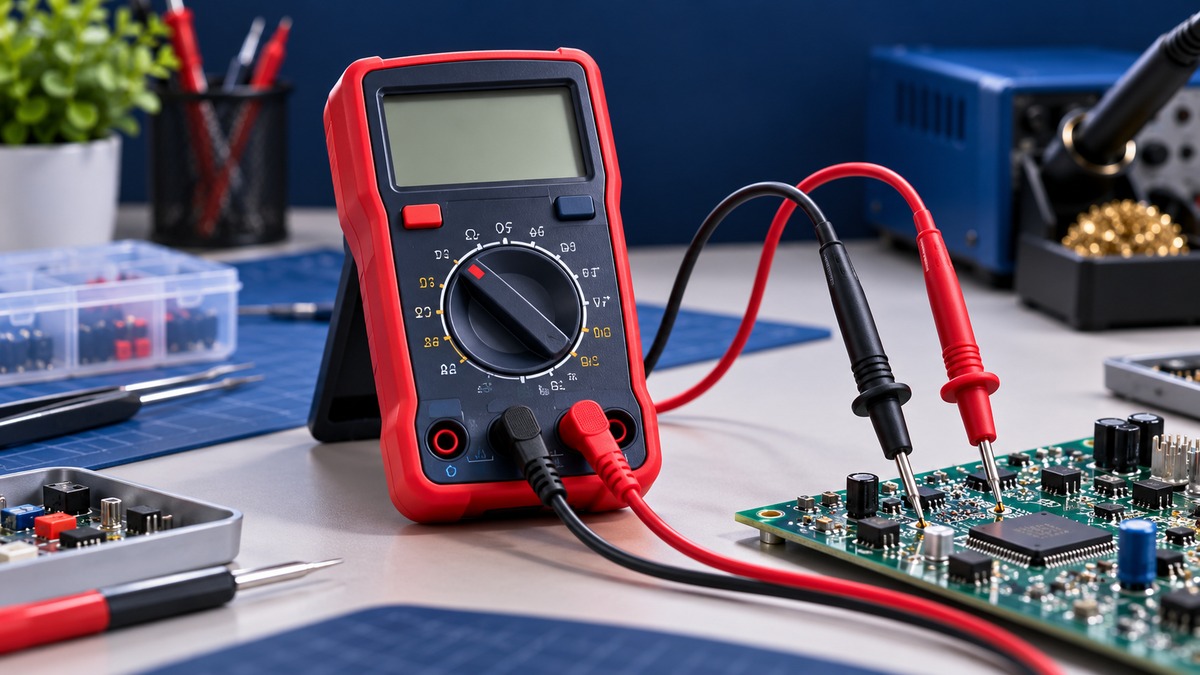
The cable is the insulated wire between the two ends. At the meter end, the connector is usually a protected plug that fits the meter’s input jacks. The Klein 69410 listing describes standard banana-type inputs that fit most multimeters and clamp meters, and it gives a length of 41 inches (1,041 mm). Fluke’s TL224 leads, which ship with the FTPL-1 probes, have a right-angle connector on one end, a straight connector on the other, reinforced strain reliefs and silicone insulation that the listing says resists heat and cold.
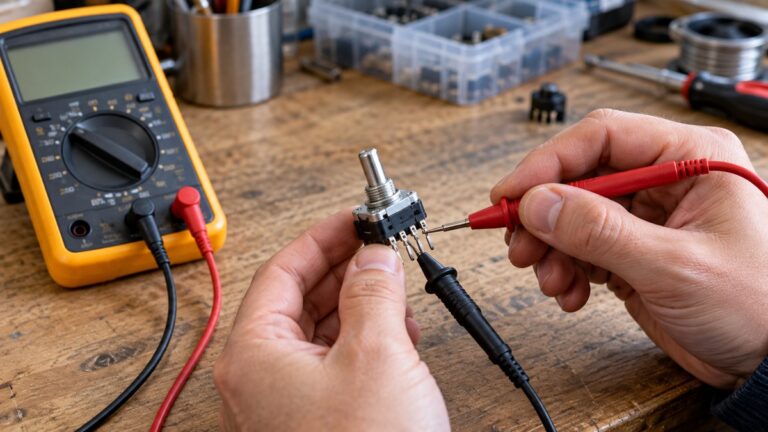
The probe is the part you hold, and it carries the point or contact that touches the item under test. Electronics Notes describes the probe end as the end that normally has a pointed probe for that job. Fluke’s FTPL-1 listing describes 2 mm threaded probe tips with removable 4 mm spring contacts and removable insulated caps, and gives probing closely spaced leads as the purpose of those parts.
The tip is the metal end that makes contact. Fluke’s accessories page lists a probe with very small 1 mm tips for hard to reach test points, and the FTPL-1 probes have removable tip guards for reduced probe tip exposure. Electronics Notes adds that a sharp point is often needed to get through any oxide or dirt on the point being probed. It also says good contact matters: a loose hold can make a resistance reading change erratically. Clips are the other common end. Electronics Notes says clip insulation covers the clip except for the part that makes contact.
Fluke’s accessories page describes its multimeter test leads as offering modular designs, including retractable options and alligator clips. Its TwistGuard article says accessories, including test leads, must be rated for safe use where you work.
Fused and unfused tips
Some probes include a fuse, and the difference matters when something goes wrong. The Fluke FTPL-1 listing describes built-in replaceable fuses rated 1000 V and 11 A with a 20 kA interrupt rating, and it describes them as “Built in fuses for additional measurement protection.” The listing also says the probes still allow the meter to indicate live voltage when a fuse blows, which it presents as a way to avoid misreading a live point as having no voltage.
The same listing gives the limits. Voltage readings with a blown fuse are approximate and vary with the meter’s impedance, and current mode does not work with a blown fuse. The product note also tells users to check the fused probe for a blown fuse before and after each measurement. This article does not describe that check.
The Klein 69410 listing does not state a built-in fuse. That describes the listing, not the lead. The FTPL-1 listing gives a 10 A rating for the probe set and an 11 A rating for the built-in fuses. Both figures come from the listing, and the listing does not explain how they relate.
Why the lead and tip must match the meter’s CAT and voltage rating
The CAT rating describes the environment in which a measurement is made. Fluke says these categories are defined by the IEC 61010 safety standard and run from CAT I to CAT IV. Before starting any job, Fluke advises confirming that the meter and the leads are both rated for the category and voltage level of the environment where they will be used. Each item has its own rating, so the check covers both.
Fluke’s TwistGuard article says leads should carry a CAT rating at least as high as the multimeter they are used with. It also warns that leads which did not come with the meter can compromise safety. Its design example is a lead with adjustable tips. The article describes a twist that retracts those tips in CAT IV and CAT III environments to reduce accidental contact with energized surfaces, and says the tips can be extended in CAT II environments for access to hard-to-reach contacts.
Voltage matters too. Fluke says that for circuits below 30 V, shock concerns are reduced. It also says that high-energy circuits, such as distribution system voltages of 240 V to 600 V, call for leads in good condition with the proper markings and ratings. The article uses those figures as examples of the environment, not as instructions, and this article does not cover work at those voltages.
Fluke’s how-to article adds two requirements. The IEC 61010 requirements include rules on exposed metal probe tips. NFPA 70E requires that test tools used on the job be rated for the environment where they are used, and the article says that applies to both the meter and the leads and probes. So a tip belongs in the rating question, not only the cable.
What to read on a lead listing
A listing is the first place to look, because it is where a lead’s own ratings appear. The items below are what the two listings we opened state, and they are the items to read on any lead listing:
- The connector style, such as the Klein listing’s standard banana-type inputs.
- The safety rating. The Klein 69410 listing states Category III 1000V and Category IV 600V. The FTPL-1 listing states CAT III 1000 V, CAT IV 600 V and a 10 A rating.
- Whether a fuse is built in. The FTPL-1 listing describes built-in fuses, and the Klein listing does not state one.
- The tip design and any guard, such as the FTPL-1’s removable tip guards and removable insulated caps.
- The length and the insulation, such as the 41-inch Klein set and the 1.5 meter silicone-insulated TL224 leads.
How to spot a damaged lead in general terms
This section is a visual check in general terms, not a test procedure. Fluke says the physical condition of the leads is usually the factor that matters most to their performance. The visual points in its how-to article are these:
- Insulation that is nicked or cracked.
- Gaps or cracks where the insulated wire meets a banana plug or a probe, at each end.
- Insulation that has dried out, turned brittle or cracked with age, whether it is PVC or silicone.
Fluke’s TwistGuard article adds that leads pinched in a panel door or kinked by sharp bends lose insulating capability at those stress points. Fluke’s how-to notes that a visual check cannot absolutely guarantee the leads are safe, but it can reveal obvious faults that can lead to injury.
Wear also affects readings, not only safety. Fluke says poorly made, worn or under-rated leads can cause inaccurate readings. The how-to suggests an annual replacement program for leads that see rough or heavy use. Some Fluke leads use an inner layer of a contrasting color that shows once the outer insulation is worn through. The TwistGuard article presents that as a feature of its own leads, not a general rule.
Common mistakes
- Treating a fit as a rating. Klein describes its banana-type inputs as compatible with most multimeters. A fit describes the connector, not the category or voltage rating, and Fluke asks users to confirm both the meter and the leads are rated for the environment.
- Keeping old leads. Fluke says leads accumulated years ago may not have the insulation that today’s electrical environments need.
- Ignoring the grip. Electronics Notes says a loose hold on the leads can make a resistance reading change erratically. Fluke’s FTPL-1 page adds removable tip guards to reduce how much of the probe tip is exposed.
- Reading a blown fuse as no voltage. The FTPL-1 listing says its fused probes still show live voltage when the fuse blows. The same listing says readings taken that way are approximate.
- Taking a clean look as proof. Fluke says a visual inspection cannot guarantee that the leads are safe.
Frequently asked questions
Is a probe the same thing as a test lead?
No. Electronics Notes describes the probe as the end that touches the item under test, while the lead is the cable and connector that link that probe to the meter. Fluke also lists probes, clips and leads as separate items in its accessories range.
Do multimeter test leads have a CAT rating?
Some do, and the rating appears in the listing. The FTPL-1 listing gives CAT III 1000 V, CAT IV 600 V and a 10 A rating for its probe set. Klein’s right-angle set carries a Category III and Category IV safety rating. For any other lead, check that lead’s listing.
Should the lead’s CAT rating match the meter’s?
Fluke says the leads should carry a CAT rating at least as high as the multimeter they connect to. It also advises confirming that the meter and the leads are rated for the category and voltage level of the environment where they will be used.
Is a visual check enough to know a lead is safe?
No. Fluke says the visual inspection cannot absolutely guarantee the leads are safe, but it can reveal obvious faults. Look for nicked or cracked insulation, and for gaps or cracks where the cable meets a plug or probe.
How long should test leads last?
None of the sources we opened gives a service life in years or in uses. Fluke suggests an annual replacement program for leads in rough or heavy use. That is a suggestion for heavy use, not a limit for other leads.
How we chose
We set three rules before drafting. Each claim had to come from a page we opened with curl on 2026-10-22, and ratings had to come from a listing or manual. Each source also had to say something about what a lead, probe, tip or fuse does. We cited six pages: two Fluke product or accessory pages, two Fluke articles on test-lead safety and inspection, one Klein listing, and one electronics tutorial, which is the education source in this article. We left out pages that returned 403 errors, pages that repeated the same product text, and a discontinued Klein listing. A Triplett datasheet came up in search, but we could not extract its text, so it is not cited. Retailer pages and search snippets were not used as evidence.
What we could not verify
Each gap below is a figure or fact that the pages we opened leave out. Where a rating is missing, the listing does not state it.
- No source gives a service life in years or uses for any lead. The only durability figure we found is a bend count: Fluke says the TwistGuard strain reliefs held up to more than 30,000 bends without failure.
- The FTPL-1 listing gives a 10 A probe rating and an 11 A fuse rating. It does not explain how the two relate, or which fault the fuse is meant to stop.
- The Klein set’s listing gives no fuse information. The Fluke accessories page gives a CAT rating for one item, a ScopeMeter probe set, and none for the standard leads it lists.
- We did not open the IEC 61010 standard. The category definitions come from Fluke’s summary of it.
- We did not open a university or extension page on test leads. The education source here is a commercial electronics tutorial.
- One Fluke article says some continuity functions are very forgiving and can beep at up to 15 ohms of resistance in the leads. It presents that as a meter behavior, not as a pass mark for a lead, and none of the sources gives a pass mark.
- The sources do not say which lead suits a given meter model. The meter’s manual and the lead’s listing are the places to check.
For meter-side choices, see our six multimeter picks compared. For lead options, read the Fluke 1507 test lead comparison or the voltmeter cable buying guide.
Sources
- Fluke, FTPL-1 Fused Test Probe Set with Test Leads (product page): https://www.fluke.com/en-us/product/accessories/test-leads/ftpl-1 (opened 2026-10-22)
- Fluke, Multimeter Test Leads and Probes accessories page: https://www.fluke.com/en-us/products/accessories/kits (opened 2026-10-22)
- Fluke, How to Test Multimeter Test Leads for Accuracy and Safety: https://www.fluke.com/en-us/learn/blog/digital-multimeters/testing-your-test-leads (opened 2026-10-22)
- Fluke, How to Use TwistGuard Test Leads for Maximum Safety: https://www.fluke.com/en-us/learn/blog/safety/tech-tips-twist-guard-test-leads (opened 2026-10-22)
- Klein Tools, Replacement Test Lead Set, Right Angle (69410): https://www.kleintools.com/catalog/test-measurement-accessories/replacement-test-lead-set-right-angle (opened 2026-10-22)
- Electronics Notes, Multimeter Test Leads and Probes: what you need to know: https://www.electronics-notes.com/articles/test-methods/meters/multimter-test-leads-probes.php (opened 2026-10-22)