Analog vs Digital Multimeters: What Is the Difference
As an Amazon Associate we earn from qualifying purchases.
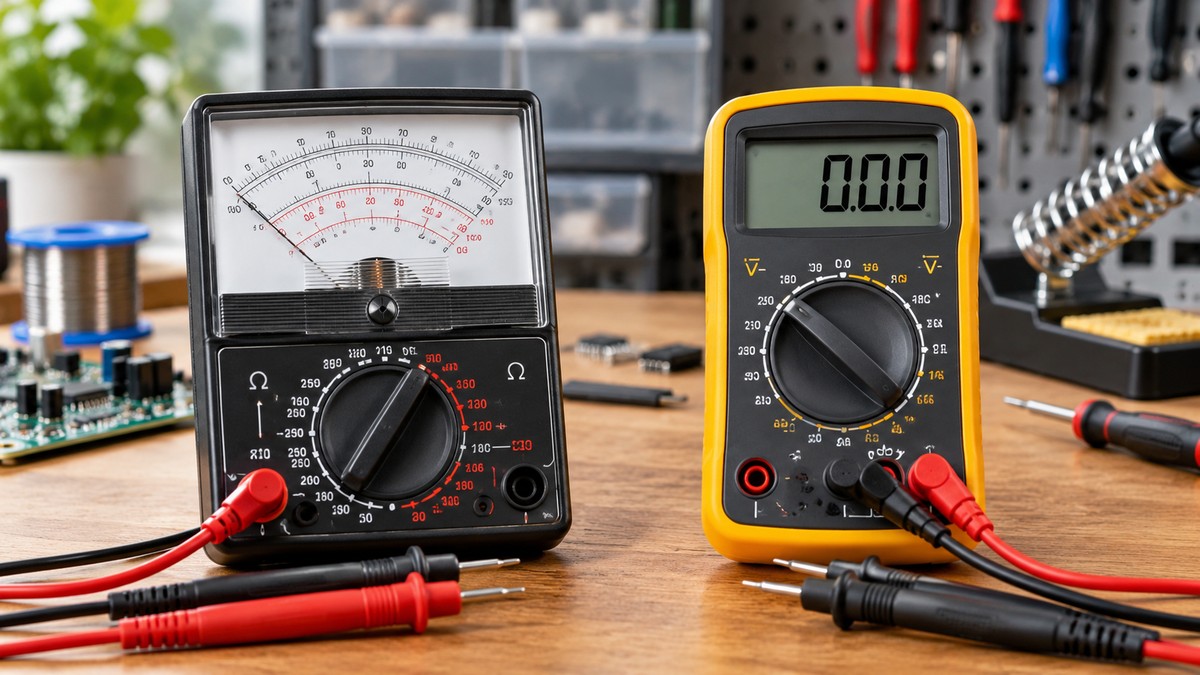
What is the difference between analog and digital multimeter designs? In short, an analog meter moves a needle across a fixed scale, while a digital meter converts the measurement into a number on a display. That one difference shapes the trade-offs: how fine a reading can be, how much error the reader can add, how the meter handles a changing signal, and how much the meter itself pulls on the circuit under test. This article explains those trade-offs in general terms, using manufacturer and university sources we opened. It does not recommend a brand or model.
Electrical safety
Mains circuits are capable of killing. Klein’s manual for one of its meters states that failure to observe its warnings can result in severe injury or death. OSHA’s guide Controlling Electrical Hazards says electricity exposes workers to electric shock, electrocution, burns, fires and explosions, and its table lists 50 to 150 milliamperes as a range where death is possible. Keep every measurement you read about here away from live mains, panels and service wiring.
The meter’s CAT rating must suit the circuit you are testing. A measurement category describes the part of an electrical installation a meter is designed to work on. Fluke’s glossary lists Installation Category I for signal-level equipment, Category II for local-level loads such as appliances and portable equipment, Category III for distribution-level and fixed installations, and Category IV for primary supply levels, including the service entrance of a building. Fluke’s application note asks users to choose a meter that meets the IEC category and voltage rating approved for the environment where the measurement is to be made. Klein’s MM700 manual uses the same categories, describing CAT III as applicable to the distribution part of a building’s low-voltage mains installation and CAT IV as applicable at its source.
Find the rating in the listing or the manufacturer’s manual. This article does not give a CAT rating for any meter. If a listing does not state a CAT rating, treat that rating as unknown, and do not assume a meter is safe for household mains.
Panel and service work calls for a licensed electrician. OSHA’s general industry rule, 29 CFR 1910.333, says only qualified persons may work on electric circuit parts that have not been de-energized. OSHA’s guide says only qualified electricians trained in safe lockout procedures should maintain electrical equipment. Neither OSHA source uses the word licensed, so that wording is this site’s policy rather than a quotation from OSHA.
Quick answer
- A needle meter shows a reading as needle position on a fixed scale. A digital meter shows digits, and some add a bar graph.
- Digital meters show finer detail in counts and, in the sources we opened, have an input near 10 megohms, so they load a circuit less than analog meters do.
- Analog meters remain useful for quick visual checks, such as open-or-closed circuit checks, where a precise number matters less.
How each type shows a reading
An analog multimeter moves a pointer. The working element in the readout of an analog voltmeter is a d’Arsonval, or moving coil, movement, according to the UC Santa Barbara lecture demonstration we opened. Fluke’s glossary describes an analog multimeter as a meter that displays its reading by moving a needle over a fixed scale on a face plate. Fluke’s application note adds that the user judges the reading from the needle’s position on the scale.
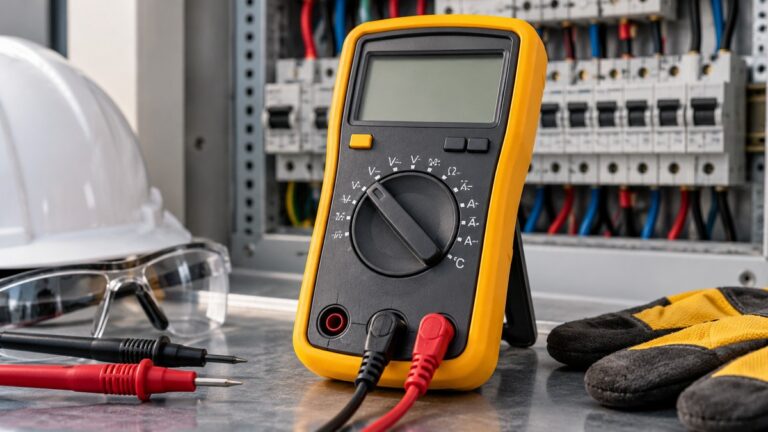
A digital multimeter first turns the input into a number. Fluke’s glossary explains analog-to-digital conversion as the process that turns a sampled analog signal into a digital code representing the amplitude of that sample. The Northwestern University handout we opened describes a digital voltmeter that samples the voltage several times and averages the samples. The result appears as digits. Some digital meters add a bar graph beside the digits, as the Klein and Fluke documents we opened describe.
Display resolution and counts
Resolution is the finest step a meter can show. Fluke’s application note says it is more precise to describe a meter by its counts of resolution than by its digits. A 3½-digit meter can display up to 1,999 counts, and the same note gives 19,999 counts for a 4½-digit meter when measuring resistance. Keysight’s buying guide defines digits of resolution as the level of detail a meter can measure on small signal changes.
An analog needle has a lower effective resolution. Fluke’s note says the reader has to estimate values between the lines on the scale, so the reading is less exact than a digital display that shows the value directly as digits.
Resolution and accuracy are different specifications. Fluke’s note defines accuracy as how close the displayed measurement is to the actual value of the signal being measured. That is a separate question from how many digits the display shows.
Accuracy and reading error
Fluke gives a typical accuracy of about 2 or 3 percent of full scale for an analog meter. Those figures describe the error at full scale, not at the reading you see. At one-tenth of full scale, the same error can reach 20 to 30 percent of the reading.
Fluke’s example shows how a digital specification works. An accuracy of one percent of reading means that a displayed 100 volts could be anywhere between 99 and 101 volts. The note adds that a specification can also include a count-based term on top of the basic accuracy figure.
Reading error also comes from the reader. The Harvey Mudd guide says analog meters use needle reading instead of a digital display, so there is always additional human reading error. The sources we opened do not put a number on it for any reader or meter.
Reading speed and changing signals
Reading speed has two parts: how often the meter updates its number, and how quickly the display shows movement. Keysight’s buying guide defines reading rate as the setting that controls how quickly a meter captures data, and it calls reading rate critical for dynamic signals. The guide maps steady signals to its entry tier, transient events to its middle tier, and high-speed, time-critical work to its top tier.
The trade-off between digits and speed shows up in Keysight’s archived 34401A datasheet. Its table lists 0.6 readings per second for DC volts at 6½ digits and 1,000 readings per second at lower digit settings. On that meter, more digits means slower updates.
A bar graph can update faster than the digits on the same meter. Klein’s MM1000 manual says the bar graph responds much faster than the digital display. Its MM700 manual puts the bar graph at about 3 to 5 times faster than the digits, which can make quick changes easier to see. These statements compare a bar graph with digits on one meter. The sources we opened do not measure a needle’s response, so this article does not rank needle and digital displays for speed.
Changing signals also raise a sampling question. The Northwestern handout gives three reasons not to rely on one measurement: noise on the measured signal, variations in the measuring device, and constantly changing measurements. The same handout describes the digital voltmeter as taking several samples and averaging them.
Input behaviour and circuit loading
Loading happens when the meter draws enough current from a circuit to change the voltage it reads. The Northwestern handout describes it as the error introduced by loading of the measuring instrument upon the applied system, and it says a voltmeter should have a large input impedance. A voltmeter connects in parallel with the circuit, so its input resistance acts across the point being measured. The RIT handout models the meter exactly that way, as a resistor in parallel with the device under test.
Input resistance is where analog and digital meters differ most. The UC Santa Barbara demonstration states that a Simpson 260 analog meter set to DC volts has a resistance of 20,000 ohms per volt. The Harvey Mudd guide says a digital meter’s input impedance of 10 megohms is often at least 50 times higher than an analog meter’s. The Northwestern handout says the digital voltmeter’s input resistance is about 10 megohms, much higher than the analog meter’s, and that its loading does not change with the voltage range. Klein’s MM1000 manual states a nominal input above 10 megohms for one of its meters.
How much the input matters depends on the circuit. The RIT handout says the error stays minimal when the meter’s resistance is substantially larger than the device’s resistance. The UC Santa Barbara demonstration makes the same point from the other side: the lower impedance of a galvanometer can greatly affect the accuracy of its measurements. The Northwestern handout goes further and says its 10-megohm input is high enough that loading can be ignored for many practical circuits.
Battery use
The sources we opened say little about battery use. Klein’s MM700 manual says batteries must be replaced when the low-battery indicator appears on its LCD. Fluke’s application note lists a low battery indicator among the features it describes. Neither source describes how a needle meter uses power, so this article makes no claim about analog battery life.
When each type is the better fit
Digital meters fit tasks that need a precise number, a stated accuracy, or a high input resistance. Fluke’s note favors the digital display for high accuracy and resolution. The Northwestern handout and the Harvey Mudd guide both cite the digital meter’s higher input resistance as an advantage, and the Harvey Mudd guide adds much better precision.
Analog meters fit a narrower set of jobs, according to the sources we opened. The Harvey Mudd guide says an analog meter sometimes gives easier visualization. It also says that for less precise work, such as debugging whether a circuit is open or closed, an analog meter gives a more direct indication. In those cases a quick visual indication matters more than a precise number.
A digital meter’s bar graph covers part of the same need. Fluke’s note says a bar graph on a digital meter shows changes and trends in a signal, and it describes that bar graph as more durable and less prone to damage than a needle. Klein’s MM1000 manual calls its bar graph an approximate analog representation of the measurement. If you want to compare specific digital designs, our auto-ranging digital multimeter guide and our multimeter roundup are the next places to read. Readers who want needle designs can start with our analog multimeter roundup.
Common mistakes
- Reading a needle as if it were precise to the last digit. Fluke’s note says the reader estimates between the scale lines, which lowers the effective resolution.
- Treating a high count as proof of accuracy. Keysight’s guide lists digits of resolution as one factor among several, and Fluke’s note treats accuracy as a separate specification.
- Ignoring loading on a high-resistance circuit. The RIT handout says the error stays small only when the meter’s resistance is substantially larger than the device’s resistance.
- Relying on one reading of a changing signal. The Northwestern handout lists constantly changing measurements as a reason not to rely on a single measurement.
- Assuming a meter is rated for household mains because it works on a bench. Check the CAT category and voltage rating in the listing or manual before you measure anything.
Frequently asked questions
Which is more accurate, an analog or a digital multimeter?
Fluke’s typical analog figure is 2 or 3 percent of full scale. The same note rates the digital display higher for high accuracy and resolution. Each meter’s own specification governs the result.
Is an analog multimeter still useful?
Yes, for some jobs, according to the sources we opened. The Harvey Mudd guide cites open-or-closed circuit checks as a case where a direct indication is enough.
Does a digital multimeter load a circuit less?
Yes, according to the sources we opened. The Harvey Mudd guide says a digital meter’s input impedance is often at least 50 times higher than an analog meter’s.
Are analog meters better for changing signals?
The sources we opened do not compare a needle’s response with a digital display, so they do not settle the question. They do show that a bar graph can respond faster than the digits on the same meter, and that reading rate matters for dynamic signals.
Do analog multimeters need batteries?
The sources we opened do not say whether every function of a needle meter needs a battery. Klein’s MM700 manual and Fluke’s application note describe battery indicators for digital meters, and that is the battery information we could confirm.
How we chose
The sources are manufacturer documents from Fluke, Klein and Keysight, OSHA regulations and guides, and university handouts and demonstrations. We opened each page with curl on 2026-10-22 and checked each quoted sentence against the fetched text, paraphrasing where PDF columns split the wording. Search results served only to locate URLs. Retailer pages, forum posts and reseller comparisons were not used as evidence. We opened sixteen URLs: twelve supplied the cited text, two were opened but not cited, and two did not serve usable content (a Keysight glossary page returned HTTP 403, and an NJIT ECE 291 handout did not connect). We did not rank brands or models.
What we could not verify
- How fast a needle follows a changing signal compared with a digital display. The sources we opened give no response time for a needle movement.
- Battery drain or battery type for analog meters. No source we opened covers it.
- Whether the analog figures apply to current models. The 2 to 3 percent figure comes from Fluke’s note, and the 20,000 ohms per volt figure describes one specific meter. We did not check current listings for either.
- The publication dates of the university handouts. We could not confirm them from the pages we opened.
- A licensed-electrician requirement. OSHA’s sources say qualified persons and qualified electricians, not licensed electricians.
- CAT ratings for any named model. This article names models only as examples of manufacturer wording and gives no CAT rating for any of them.
Sources
- Fluke Corporation, ABCs of DMMs application note: https://media.fluke.com/ade6b718-4577-4b57-903b-b10600664c67_original%20file.pdf
- Fluke Corporation, Digital Multimeter Glossary: https://www.fluke.com/en-us/learn/blog/electrical/multimeter-common-terminology
- Klein Tools, MM1000 instruction manual: https://data.kleintools.com/sites/all/product_assets/documents/instructions/klein/MM1000_Manual_English.pdf
- Klein Tools, MM700 instruction manual: https://data.kleintools.com/sites/all/product_assets/documents/instructions/klein/MM700_1390112ART_WEB.pdf
- Keysight Technologies, Digital Multimeters buying guide: https://www.keysight.com/us/en/assets/7125-1032/buying-guides/Digital-Multimeters.pdf
- Keysight Technologies, 34401A archived datasheet: https://www.keysight.com/us/en/assets/7018-06774/data-sheets-archived/5968-0162.pdf
- OSHA, 29 CFR 1910.333 Selection and use of work practices: https://www.osha.gov/laws-regs/regulations/standardnumber/1910/1910.333
- OSHA, Controlling Electrical Hazards (OSHA 3075): https://www.osha.gov/sites/default/files/publications/OSHA3075.pdf
- Northwestern University, ECE 270 Experiment 2, DC Electrical Measurements: http://www.eecs.northwestern.edu/~plonus/270/270lab2.pdf
- Harvey Mudd College, Uncle Sparky’s Guide to Voltage, Current, and Resistance Measurements: https://pages.hmc.edu/spjut/NewE80/PDFs/Uncle%20Sparky’s%20Guide%20to%20Voltage%20Current%20and%20Resistance%20Measurement.pdf
- Rochester Institute of Technology, Multimeter handout (SIMG 401): https://www.cis.rit.edu/class/simg401/Multimeter.pdf
- University of California, Santa Barbara, Lecture Demonstration 64.45, Digital multimeter vs. galvanometer: https://web.physics.ucsb.edu/~lecturedemonstrations/Composer/Pages/64.45.html