AC vs DC Voltage: What Is the Difference
As an Amazon Associate we earn from qualifying purchases.
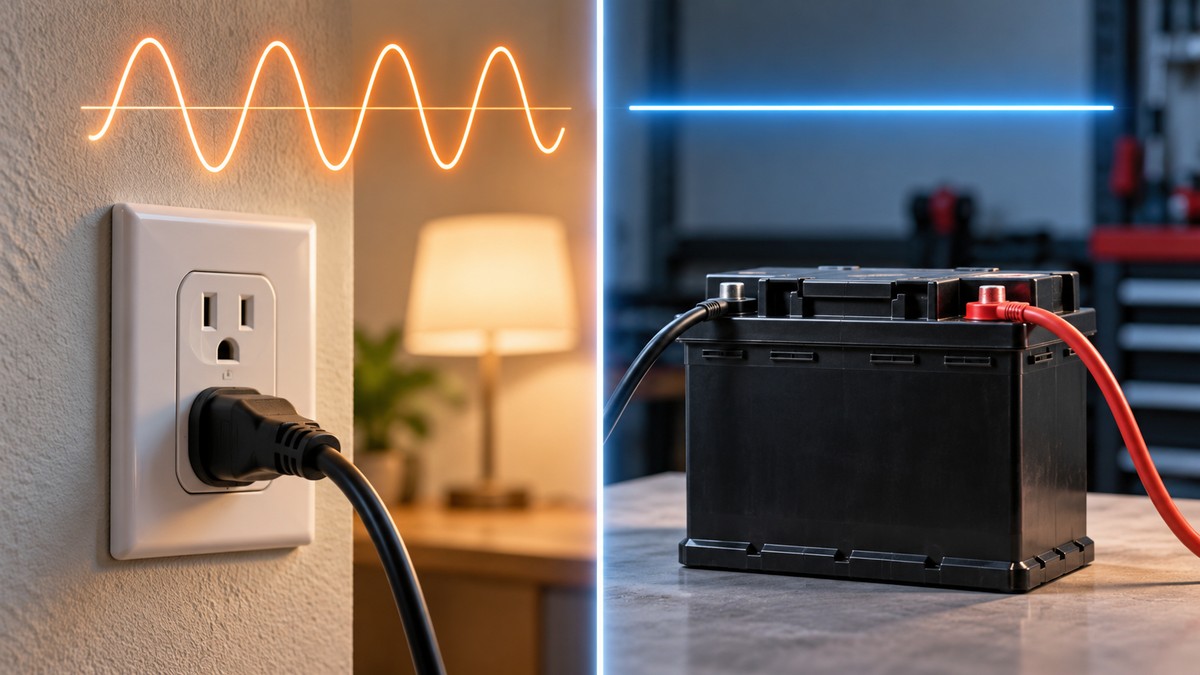
What is the difference between AC and DC voltage? DC voltage stays at a constant level over time, so its current flows in one direction, while AC voltage periodically reverses direction. That single difference changes how a multimeter is set up, how its reading is interpreted, and what its symbols mean. This post explains both types of voltage, what a meter’s AC and DC settings do, how polarity appears on a display, and how to read the symbols on the dial. It is an overview with no test steps, and measurements on mains AC are outside its scope.
Electrical safety
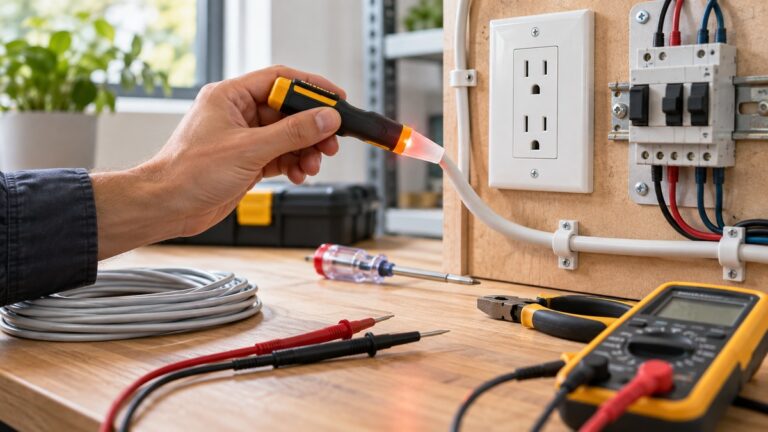
Electricity on mains circuits can kill. Before taking any reading, confirm that the meter’s CAT rating matches the circuit, and take that rating from the listing or the manufacturer’s manual. Work inside a panel or on service wiring should go to a licensed electrician.
This post does not give measurement steps for mains circuits, outlets, panels or service wiring. Mains AC is named here only to say that work on it is outside this post. The low-voltage examples below concern batteries, electronic parts and bench work.
A CAT rating describes the overvoltage installation category a meter is built for. Fluke’s safety guide advises choosing a meter rated for the highest category you could potentially use it in, with a voltage rating that matches or exceeds that situation. The Fluke 175 manual, which covers Models 175, 177 and 179, states that these meters meet CAT III and CAT IV IEC 61010 standards. The Klein MM400 manual gives a safety rating of CAT III 600V and says to use only CAT III or CAT IV rated test leads with the meter. A rating printed in one manual does not carry over to a different model.
The Klein manual also warns that failure to observe its warnings can result in severe injury or death. OSHA’s electrical standards are designed to protect employees from electric shock, electrocution, fires and explosions. OSHA’s booklet on controlling electrical hazards adds that grounding does not guarantee protection from being shocked, injured or killed by an electrical current.
OSHA’s work practice standard says only qualified persons may work on electric circuit parts or equipment that have not been de-energized under its lockout procedures. The same OSHA booklet says only qualified electricians trained in safe lockout procedures should maintain electrical equipment. This post therefore takes the position that panel and service work belongs to a licensed electrician. The sources we opened do not say which license a given state or country requires.
Quick answer
- DC voltage holds a constant level over time, and its current flows in one direction, so it keeps a fixed polarity.
- AC voltage periodically reverses direction, and its sign changes twice in every cycle.
- On the AC setting, a true RMS meter reports an rms value, and the Fluke 175 manual says true RMS meters accurately measure distorted waveforms.
- On Fluke’s symbols page, ∿ V marks AC voltage and ⎓ V marks DC voltage.
What direct and alternating voltage are
Direct voltage (DC)
Fluke describes DC voltage as electrical potential that remains constant over time, which means the current flows in one direction. OpenStax puts it in circuit terms: DC voltage and current are constant in time, once the current is established. Fluke’s DC explainer also lists battery-powered devices among the places where DC voltage matters.
Because the current keeps one direction, a DC source keeps a fixed polarity. One terminal stays the positive side and the other stays the negative side, and the voltage between them does not change sign over time.
Alternating voltage (AC)
OpenStax defines alternating current as the flow of electric charge that periodically reverses direction. AC voltage follows the same pattern. OpenStax describes a circuit as an alternating current circuit when the source varies periodically, particularly sinusoidally, and the potential difference between the terminals of an AC source fluctuates over time.
Fluke’s AC explainer defines frequency as the number of cycles per second in an alternating current sine wave. The LibreTexts copy of the OpenStax University Physics II chapter gives the sinusoidal form as v(t) = V0 sin ωt, where v is the voltage at time t, V0 is the peak voltage, and ω is the angular frequency in radians per second. The OpenStax section defines the frequency f in hertz.
Because the sine function is positive for half of each cycle and negative for the other half, an AC voltage changes sign twice in every cycle. That is the central contrast with DC: a DC voltage holds one polarity, while an AC voltage keeps reversing.
Why AC needs an RMS value
OpenStax defines rms as root mean square, a particular kind of average. For a sinusoidal voltage, the rms value is the peak voltage divided by the square root of two. An AC reading has to summarize a voltage that keeps changing, which is why meters report an rms value for AC. A steady DC level needs no such step.
Fluke’s AC explainer says the need for true-RMS meters has grown as non-sinusoidal waves have become more common in circuits. Fluke’s true RMS facts page adds that most DMMs measure the AC-coupled true-RMS signal and reject the DC component when one is present. A few models, such as the Fluke 189, offer an AC+DC true-RMS option. The same page explains why that option exists: a resistive heater or incandescent lamp responds to the total energy available in the supply, so an AC+DC measurement can indicate how such a load will react more accurately.
The Fluke 175 manual draws the practical line between two kinds of meter. Averaging meters can accurately measure only pure sine waves, while true RMS meters accurately measure distorted waveforms.
AC and DC settings on a meter
Most meters that read voltage have separate AC and DC voltage functions. The Fluke 175 manual has a section titled Measuring AC and DC Voltage, and its specification table lists AC volts and DC volts on separate rows. The same manual lists the input as 1000 V DC or AC RMS for these models. The Klein MM400 manual describes an auto-ranging meter that measures AC/DC voltage, AC/DC current and resistance, and it lists the maximum input as 600V AC RMS or 600V DC.
On the AC setting, the meter reads an alternating signal and, on a true RMS model, reports the rms value described above. On the DC setting, the meter reads a level that stays constant. The dial marks each setting with its own symbol.
The setting is part of the measurement rather than a formality. The two settings have separate rows in the Fluke 175 specifications, so each has its own accuracy figure.
Polarity: how DC and AC differ
On a DC reading, polarity is a sign the meter can show. The Klein MM400 manual says that a minus sign on the display indicates negative polarity. The Fluke 175 manual lists a negative readings symbol and a bar graph polarity indicator. A minus sign on a DC reading therefore reports the polarity of the signal.
On an AC reading, the situation is different. Because an AC signal periodically reverses direction, an AC source has no fixed positive terminal in the way a DC source has. The voltage changes sign twice each cycle, so the idea of one fixed polarity does not apply in the same way. The sources we opened do not describe how a meter displays the sign on an AC reading, so this post does not say what a minus sign means on an AC measurement.
Reading the meter symbols
The symbols on the dial and display tell you which quantity and which setting are active. The table lists each symbol or label as it appears in the sources we opened.
| Symbol or label | Meaning given in the source | Where it appears |
|---|---|---|
| ∿ V | AC voltage | Fluke symbols page |
| ⎓ V | DC voltage | Fluke symbols page |
| ∿ mV | AC millivolts | Fluke symbols page |
| ⎓ mV | DC millivolts | Fluke symbols page |
| DC, AC | Direct current, alternating current | Fluke 175 manual symbol table |
| Negative readings indicator | Negative readings | Fluke 175 manual symbol table |
| “-” on the display | Negative polarity | Klein MM400 manual |
| AC/DC Voltage or Current | One symbol for AC or DC voltage or current | Klein MM400 manual symbol list |
Fluke’s DC explainer describes the DC symbol as a solid line above three short dashes, which distinguishes it from the AC symbol. The Klein manual lists one entry for AC/DC voltage or current, so on that meter a single symbol covers both quantities. The sources do not reproduce a symbol standard such as IEC 60417, so the table reflects only the manufacturer pages and manuals we opened. Check the legend in the manual for the meter you own, because the sources do not say that every brand uses the same glyphs.
Common mistakes
- Treating non-zero digits as a fault. The Fluke 175 manual says non-zero digits shown on a true RMS meter when the test leads are open or shorted are normal, and that they do not affect the specified AC accuracy.
- Reading a minus sign as an error. On the Klein MM400, a minus sign on the display means negative polarity.
- Trusting an averaging meter on a distorted waveform. The Fluke 175 manual says averaging meters can accurately measure only pure sine waves.
- Carrying a rating from one manual over to another meter. Our own assumption: the CAT rating in one manual applies only to the model that manual names.
- Choosing a meter rated for a lower category than the highest one you could work in. Fluke’s guide advises choosing the highest category you could potentially use the meter in.
Frequently asked questions
Is DC voltage always positive?
No. DC voltage keeps its polarity steady over time, so a reading holds the same sign while the source is connected the same way. The Klein manual says a minus sign on the display marks negative polarity.
Does AC voltage have a positive and a negative side?
An AC waveform has both positive and negative half cycles, because the sine function changes sign twice in every cycle. The sources we opened do not describe how a meter labels the polarity of an AC reading.
Why does my AC reading show digits with nothing connected?
A true RMS meter can show non-zero digits when its test leads are open or shorted. The Fluke 175 manual calls these digits normal and says they do not change the specified AC accuracy. The sources we opened do not make the same statement about averaging meters.
What does the AC symbol on my meter mean?
On Fluke’s symbols page, AC voltage is shown as ∿ V, and AC millivolts as ∿ mV. The DC symbols are ⎓ V and ⎓ mV on the same page.
Does a CAT rating make a meter suitable for household mains?
A CAT rating does not, on its own, make a meter suitable for household mains work, and this post does not call any meter safe for mains. The rating describes the installation category the meter is built for, and it must be read from the listing or the manual for that model.
Is this post a how-to for measuring voltage?
No. It is an overview that explains terms and symbols. It gives no test steps and it does not cover measurements on mains. The related guides below cover practical topics.
How we chose
The post relies on three kinds of source: an education physics text (OpenStax, through its LibreTexts copy), manufacturer explainers and manuals from Fluke and Klein, and OSHA pages and standards on electrical hazards and work practices. These were chosen because they define the terms, show the symbols, and state ratings directly. The Klein manual is a copy hosted by a university department, not the manufacturer’s own site. Each URL was opened with curl on 2026-10-22, its text was saved and stripped of HTML tags, and each quoted phrase was checked against that text. A sentence that could not be found in the fetched text was paraphrased or removed. Retailer listings were not used for any fact. Three candidate pages were not counted: a DigiKey CAT explainer returned HTTP 403, a HyperPhysics AC/DC page returned HTTP 404, and an eCFR page returned a CAPTCHA instead of the rule text. A distributor’s CAT page was opened but not cited. The licensed electrician rule is this site’s guidance; the OSHA sources support the qualified-person requirement, and this post claims no more than that.
What we could not verify
The sources we opened do not cover the points below, and this post does not fill those gaps with outside claims.
- A symbol standard. The sources do not reproduce IEC 60417 or a symbol table from a standards body, so the symbol meanings come from two Fluke pages, two Fluke manuals and one Klein manual.
- The polarity display on AC readings. The sources do not say what a meter shows for the sign of an AC reading.
- Ratings for other models. The listing does not state a CAT rating for models that the manuals we opened do not name, and the 1000 V and 600V figures apply only to the models in those manuals.
- Error on distorted signals. The sources do not give a figure for how far an AC reading moves on a given non-sine waveform.
- Licensing. The sources do not say which license a state or country requires for panel or service work.
- Current editions. The Fluke 175 manual is the May 2003 edition and OSHA 3075 is the 2002 revision. The sources do not show whether newer editions change any statement.
Related guides
For the true RMS side of the topic, see the true RMS clamp meter buying guide. For a plain explanation of the low-voltage detection side, see how voltage testers work. For the category system used in the safety section, see what a 600V CAT III rating means on a multimeter.
Sources
- OpenStax, College Physics, section 20.5, Alternating Current versus Direct Current: https://openstax.org/books/college-physics/pages/20-5-alternating-current-versus-direct-current
- LibreTexts, University Physics II (OpenStax text), section 15.2, AC Sources: https://phys.libretexts.org/Bookshelves/University_Physics/University_Physics_(OpenStax)/University_Physics_II_-_Thermodynamics_Electricity_and_Magnetism_(OpenStax)/15%3A_Alternating-Current_Circuits/15.02%3A_AC_Sources
- Fluke, What Is DC Voltage?: https://www.fluke.com/en-us/learn/blog/electrical/what-is-dc-voltage
- Fluke, What Is AC Voltage?: https://www.fluke.com/en-us/learn/blog/electrical/what-is-ac-voltage
- Fluke, The Dials, Buttons, Symbols, and Display of a Digital Multimeter: https://www.fluke.com/en-us/learn/blog/digital-multimeters/multimeter-dial-button-jacks-display
- Fluke, Facts about true-RMS measurement: https://www.fluke.com/en-us/learn/blog/digital-multimeters/facts-about-true-rms-measurement
- Fluke, Guide to digital multimeter safety: https://fluke.com/en-us/learn/blog/safety/multimeter-guide
- Fluke, Models 175, 177, 179 True RMS Multimeters Users Manual (May 2003): https://assets.fluke.com/manuals/175_____umeng0000.pdf
- Klein Tools, MM400 Instruction Manual (copy hosted by UBC EOAS): https://www.eoas.ubc.ca/courses/atsc303/Instruments/manuals/0_Klein-Tools-MultiMeter-MM400-UsersManual.pdf
- OSHA, OSHA 3075, Controlling Electrical Hazards (2002 revision): https://www.osha.gov/sites/default/files/publications/osha3075.pdf
- OSHA, Electrical topic page: https://www.osha.gov/electrical
- OSHA, 29 CFR 1910.333, Selection and use of work practices: https://www.osha.gov/laws-regs/regulations/standardnumber/1910/1910.333