Fluke 1503
As an Amazon Associate we earn from qualifying purchases.
Fluke 1503 Insulation Tester: Specs, Safe Use and What to Check
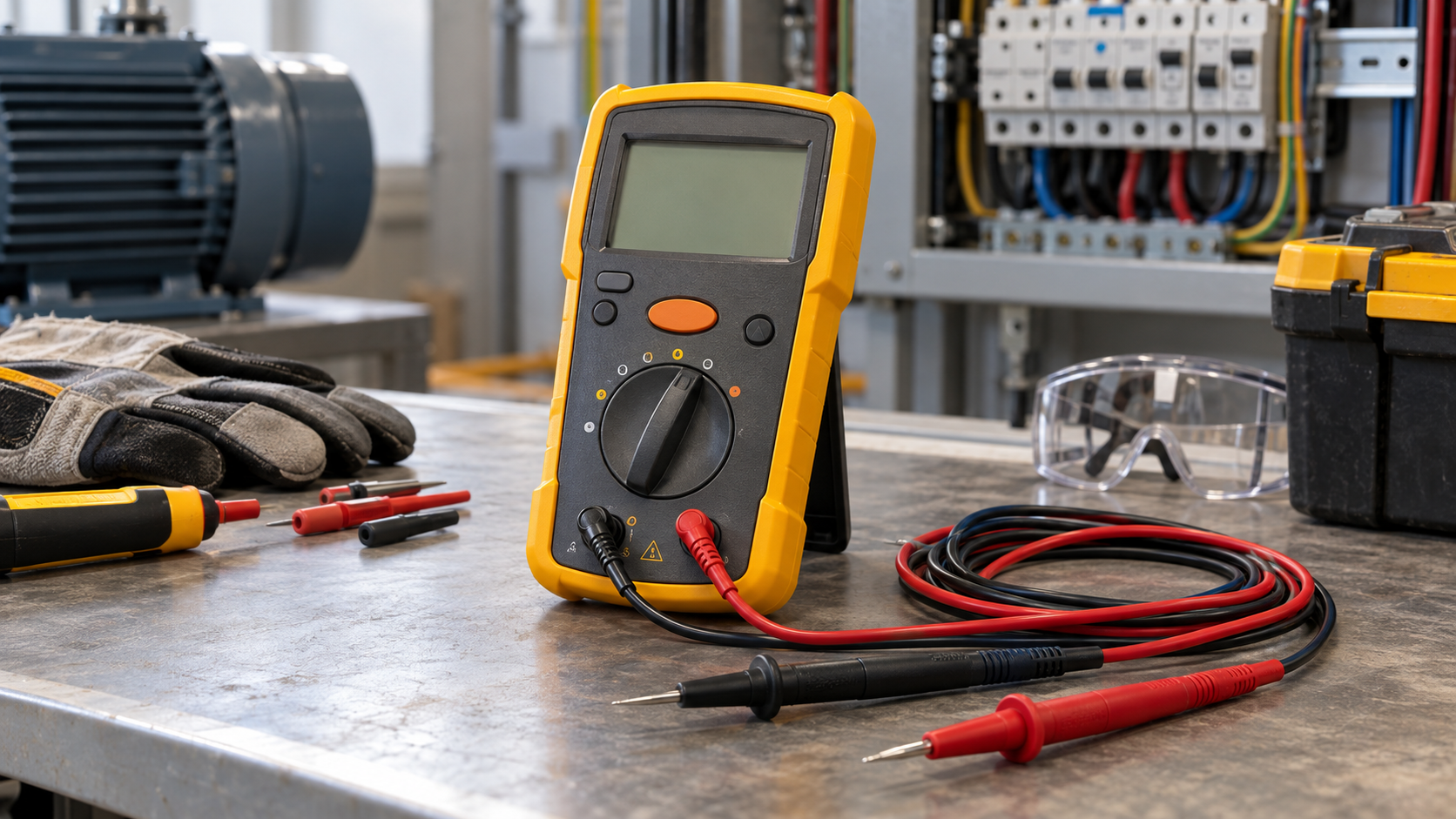
The Fluke 1503 is an insulation resistance tester. It applies a test voltage to cable or equipment insulation and reads the resistance in megohms. Fluke’s product page states two insulation test voltages, 500 V and 1000 V, a measurement range from 0.01 MΩ to 2000 MΩ, and a CAT IV 600 V overvoltage category rating. This article explains those published figures, shows how to use the tool safely in general terms, and lists what to check before you buy. Insulation testing involves voltages that can injure or kill, so if you are not trained for it, hire a licensed electrician.
Quick answer
- The Fluke 1503 measures insulation resistance at 500 V and 1000 V test voltages, according to Fluke’s product page.
- Fluke states an insulation range of 0.01 MΩ to 2000 MΩ and a voltage input range of 0.1 V to 600 V.
- The page states a CAT IV 600 V overvoltage category rating. Read the rating as a limit: it does not make any circuit safe to test.
- Before buying, confirm the test voltages and CAT rating you need against the manual for your own equipment, and confirm the included accessories on the product page.
What an insulation tester does
An insulation tester checks whether the insulation around a conductor is holding. A healthy insulator resists current flow strongly, so the reading is high. Falling insulation resistance can point to moisture, contamination, or aging. The instrument does this by applying a DC test voltage well above the normal working voltage of a multimeter and measuring the small leakage current that results. This is why an insulation tester is a different tool from a standard multimeter, which measures resistance with a low internal test current and cannot be used as a substitute for an insulation test.
A simple way to think about the reading: a higher megohm figure means the insulation is conducting less current at the test voltage. The reading depends on the test voltage used, the temperature, and the condition of the cable or equipment, so a single number on its own does not tell the whole story. Fluke’s product page does not give a pass or fail threshold for any particular cable, so use the limits in the standard or equipment documentation that applies to your job.
Stated specifications for the Fluke 1503
The table below uses only the figures Fluke’s product page states. Where the page does not give a figure, the cell says so.
| Item | What Fluke’s product page states |
|---|---|
| Safety rating | “Features CAT IV 600 V overvoltage category rating” |
| Insulation test voltages | “Offers two insulation test voltages: 500 V and 1000 V” |
| Test voltage accuracy | “+ 20%, – 0%” (as listed in the spec sheet) |
| Insulation range | “0.01 MΩ to 2000 MΩ” |
| AC/DC voltage input | “600.0 V” range; “Measures AC/DC voltage from 0.1 V to 600 V” |
| Maximum voltage on any terminal | “600 V AC rms or DC” |
| Included accessories | “TL224 Test Leads, TP74 Test Probes, clips PN 1958654 (red) and PN 1958646 (black), holster and remote probe” |
| Warranty | “one-year warranty” |
The product page does not state battery type, weight, or ingress rating in the sections we opened, so this article does not give those figures.
What the CAT IV 600 V rating means
The Fluke page states the meter “Features CAT IV 600 V overvoltage category rating.” In simple terms, overvoltage categories describe where a measurement is taken in an electrical installation. CAT IV is the category for work at the origin of the installation, such as the service entrance. A meter rated for CAT IV is designed for those points, but the rating applies only when the meter is used within its stated limits and with leads and probes in good condition. Treat this as a simplification. The full definition and the conditions are in the safety section of the Fluke manual and in the IEC 61010 standard the product page refers to.
A rating is not a promise that the meter will survive any fault. It is a limit. Use leads that match the rating, inspect them for cracks and exposed metal before each use, and never use a tester whose case or leads are damaged.
How to use an insulation tester safely: general steps
The steps below are general practice for insulation testing, not procedures copied from Fluke’s manual. Follow your site’s lockout and testing procedure and the instructions in the Fluke manual for the 1503.
- Confirm the equipment is de-energized and locked out. An insulation test is not a live-circuit test. Testing a live conductor can cause serious injury.
- Check the tester first. Inspect the leads, probes, clips, and holster for damage. Use only the leads supplied or leads specified for the meter.
- Verify the circuit is de-energized with a voltage tester before connecting the insulation tester.
- Select the test voltage that suits the equipment and the job, from the two the 1503 offers: 500 V or 1000 V.
- Connect the leads to the conductor and the reference point as the manual describes, keeping hands clear of the probe tips during the test.
- Start the test and read the result only after the reading has settled.
- Discharge the conductor after the test before disconnecting. Stored charge in cable or equipment can remain after the test voltage is removed. Follow the discharge steps in the manual.
These steps assume the equipment owner or your employer has authorized the test. Many insulation tests are done on motors, cables, and feeders, and those jobs carry their own procedures.
What to check before you buy
- Test voltage needed. The Fluke 1503 offers 500 V and 1000 V according to its product page. If your equipment or the test standard calls for a different voltage, the 1503 may not fit the job.
- Insulation range. The page states 0.01 MΩ to 2000 MΩ. Check that this covers the readings your application needs.
- CAT rating. The page states CAT IV 600 V. Compare this with the category of the points you will test.
- Accessories. The page lists TL224 test leads, TP74 test probes, clips, a holster, and a remote probe. Check whether these match what you need, and whether you need extra leads.
- Warranty. The page states a one-year warranty.
How we chose
This article covers the Fluke 1503 only and is built from three Fluke product pages, one each for the US, Australian, and Irish regional sites, all opened on 2026-10-27. We used the figures those pages state. We did not compare the 1503 with other insulation testers, and we did not pick it as a recommendation.
What we could not verify
The product pages we opened do not state battery type, weight, ingress protection, altitude limits, or earth bond resistance ranges in the text we read. Those figures are not in this article. The Fluke user manual was not among the sources we opened as readable text, so details of procedure and safety warnings come from general practice and the product page wording only.
Other Fluke tools to consider
If you need a clamp meter for live current readings, read our guide to Fluke clamp testers and safe use. For a broader view of Fluke multimeters, see the Fluke multimeter lineup. Test leads matter for insulation work, and our guide to Fluke 1507 test leads covers what to check.
FAQ
What is the Fluke 1503 used for?
It measures insulation resistance, which is used to check whether cable, motor windings, or other equipment insulation is holding. Fluke’s page states test voltages of 500 V and 1000 V and a range from 0.01 MΩ to 2000 MΩ.
Is the Fluke 1503 a multimeter?
No. It is an insulation tester. Fluke’s page lists an AC/DC voltage input from 0.1 V to 600 V, but the main function is insulation resistance testing. A standard multimeter is a different tool.
What CAT rating does the Fluke 1503 have?
Fluke’s product page states CAT IV 600 V. Use the rating only within its stated limits, and check the manual for conditions.
Which test voltage should I use?
The 1503 offers 500 V and 1000 V. Choose the voltage required by the equipment documentation or your job’s test standard. The product page does not give a rule for choosing between them.
Does the 1503 come with leads?
Fluke’s page lists TL224 test leads, TP74 test probes, clips, a holster, and a remote probe as included accessories. Confirm the exact kit contents with your seller before buying.
Bottom line
The Fluke 1503 is a dedicated insulation tester with published 500 V and 1000 V test voltages, a 0.01 MΩ to 2000 MΩ range, and a CAT IV 600 V rating. Buy it if those figures match your work, and do not use it on live equipment.
Sources
- Fluke Corporation, “Fluke 1503 Insulation Resistance Tester,” product page, https://www.fluke.com/en/product/electrical-testing/insulation-testers/fluke-1503 (opened 2026-10-27).
- Fluke Corporation, “Fluke 1503 Insulation Resistance Tester,” regional product page, https://fluke.com/en-au/product/electrical-testing/insulation-testers/fluke-1503 (opened 2026-10-27).
- Fluke Corporation, “Fluke 1503 Insulation Resistance Tester,” regional product page, https://fluke.com/en-ie/product/electrical-testing/insulation-testers/fluke-1503 (opened 2026-10-27).