Klein Cl900
Klein CL900 Clamp Meter: Features, Safety and Checks
As an Amazon Associate we earn from qualifying purchases.
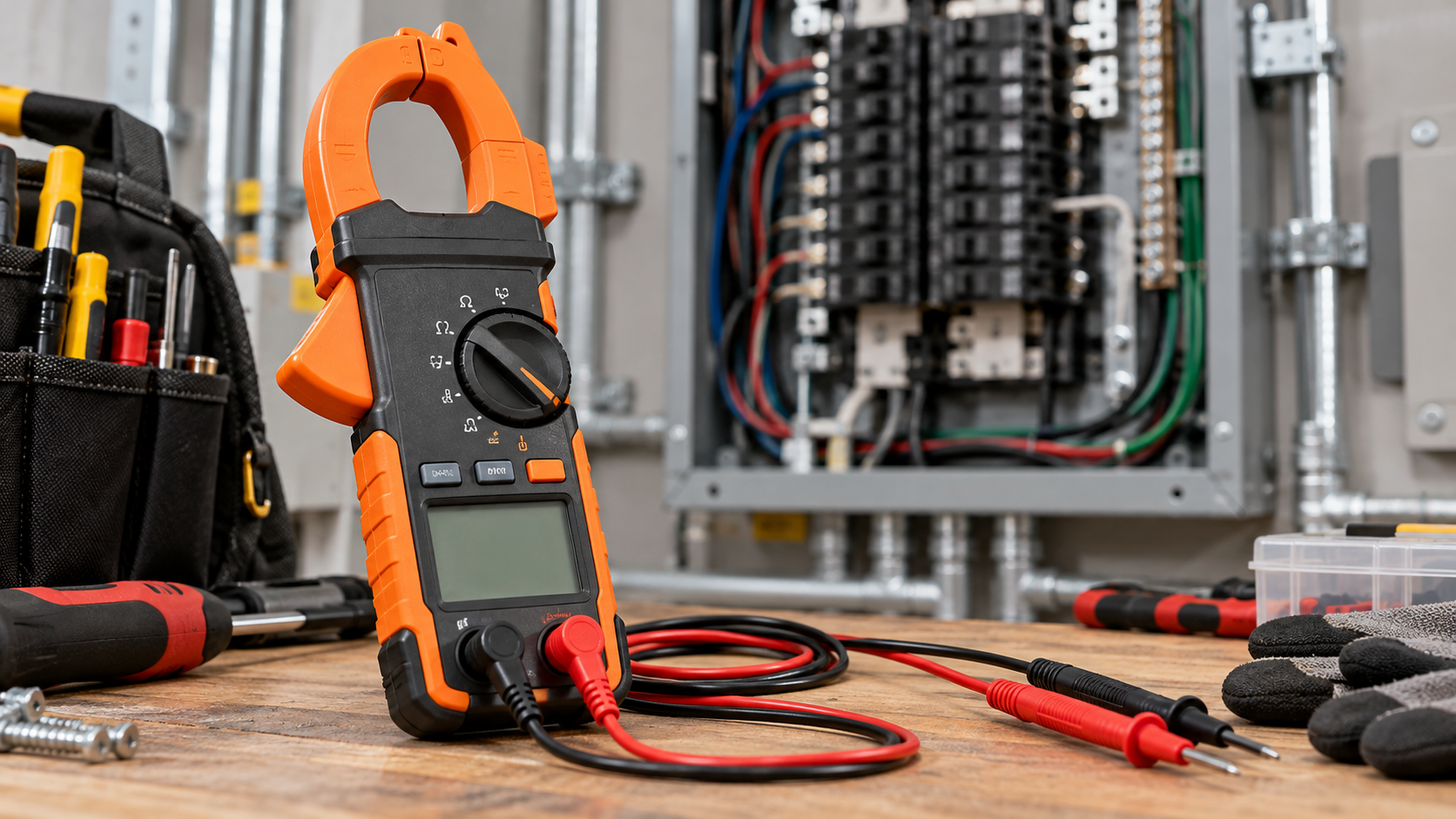
The Klein CL900 is a 2000 A AC/DC clamp meter with auto-ranging true RMS readings, a low impedance mode for ghost voltages, and a dedicated inrush current mode. This guide explains what the klein cl900 measures, what its CAT ratings allow, how to use it safely, and which points to check before buying. Each specific figure below comes from Klein’s manual, Klein’s sell sheet, or Klein’s product page. General electrical safety points are labeled as such.
Quick answer
- The klein cl900 clamps around a conductor to read AC and DC current up to 2000 A. Its test leads read AC and DC voltage up to 1000 V, according to the manual.
- Its safety ratings are CAT IV 600 V and CAT III 1000 V. The rating must suit the point on the circuit where you measure.
- Work inside service panels, on energized equipment, or on mains wiring belongs to a licensed electrician.
- Before buying, check the rating, the features you need, and whether the included accessories match your work.
What the klein cl900 measures
A clamp meter reads current by sensing the magnetic field around a conductor, so the circuit does not need to be opened. The manual describes the CL900 as an auto-ranging, true RMS digital clamp meter with a 6000 count LCD. The current clamp reads AC and DC current up to 2000 A. Voltage input reads AC and DC voltage up to 1000 V through the test leads, and the manual lists a maximum input of 1000 V AC RMS or 1000 V DC for voltage.
The meter also covers resistance, continuity, diode tests, frequency, and duty cycle. The manual gives a diode test with a maximum of 1.5 mA and an open circuit voltage of about 3.0 V DC. The continuity check is audible. A separate non-contact voltage detection function is rated for readings above 90 V AC.
Current with the clamp
To read current, open the jaw, place it around one conductor, and read the display. Clamping around two conductors that carry current in opposite directions gives a reading near zero, which is a common source of confusion. Keep the jaw closed fully and keep the conductor centered for a steady reading. The manual notes that the SEL/DC ZERO button toggles between AC and DC in current and low impedance modes, and that holding it for more than one second in DC current starts a DC zero offset correction.
Voltage and resistance
For voltage, the manual says the leads must be firmly pressed into the input jacks. Results can show intermittent readings if they are not seated. For resistance and continuity, the test leads and meter are used with the circuit de-energized. Do not use the resistance or continuity function on a live circuit. This is a basic rule of electrical work and is not specific to the CL900.
Low impedance mode for ghost voltages
The manual describes the low impedance (LoZ) mode as a way to identify and eliminate ghost or stray voltages. A ghost voltage is a small reading on a conductor that is not connected to a live source, often picked up by nearby wiring. The manual lists the low impedance input as more than 3 kΩ, with a maximum input of 600 V RMS in this mode. Simplification: a low or zero reading in LoZ mode is a prompt to verify, not proof that a conductor is de-energized. Confirm with a known live source before you rely on a result.
Inrush current mode
The inrush mode captures a short current surge, such as a motor starting. The manual says to press the INRUSH button before the event. The manual says the display shows dashes while the meter waits for the event. The button is for capturing a surge, not for a steady load reading.
Non-contact voltage detection
The CL900 includes a non-contact voltage detector. The manual rates it for detection above 90 V AC. A non-contact detector gives a presence indication, not a measured value, and it can miss voltage through insulation or shielding. Use it as a first check only, and confirm with the meter’s voltage mode before touching conductors.
Safety ratings: CAT IV 600 V and CAT III 1000 V
Measurement categories describe where a meter can safely be used in a building’s electrical system. The manual defines CAT III as circuits connected to the distribution part of the building’s low-voltage mains installation. It defines CAT IV as circuits connected at the source of the low-voltage mains installation. The CL900 is rated CAT IV 600 V and CAT III 1000 V, according to the manual and product page.
In plain terms, a higher category rating means the meter is designed for higher energy levels at the point of measurement. The rating applies to the meter and its accessories together. The manual also says the test lead shield must be pressed firmly in place for CAT III and CAT IV locations. It warns that failure to use the shield increases arc-flash risk. For CAT II locations, such as standard wall outlets, the manual says the shields may be removed to reach recessed conductors. Take care not to lose them.
Choose the category by the location, not by the price or the brand. Work at a service entrance or main panel needs a meter and leads rated for that location, and that work belongs to a licensed electrician. This guide does not give instructions for live panel work.
Working safely with the klein cl900
Start with a check of the meter and leads. Do not use the meter if it looks damaged, and do not use leads with cracked insulation or loose connectors. Insert the leads fully into the jacks. The manual warns that improperly seated leads can cause intermittent readings.
Select the function before you connect to the circuit. Connect the leads in the correct order for the measurement, keep fingers behind the finger guards, and keep the leads away from moving parts. For current, clamp around one conductor at a time. Never open a live circuit to insert the meter. Clamp meters are designed to measure without breaking the circuit, and that is one of their main safety features.
The meter powers off after about 30 minutes of inactivity by default, according to the manual and product page. The manual also describes how to disable the auto power off. Leave it enabled unless you have a specific reason to change it, so the meter does not stay on unattended.
Buying checklist
- Confirm the CAT rating. The CL900 is listed as CAT IV 600 V and CAT III 1000 V. Match it to the circuit you will measure.
- Check the current range. The CL900 clamps up to 2000 A AC and DC, which is much larger than a typical household circuit.
- Decide whether you need inrush capture or low impedance mode. Both are listed features of the CL900.
- Check what is included. The product page lists a carrying case, straight test leads, a manual, and 2 AAA batteries.
- Confirm the drop rating and water or dust rating if you work in harsh conditions. The manual lists a 2 m drop protection and IP40.
Mistakes to avoid
- Using the meter with the wrong category for the location. A CAT III or CAT IV rating is not a license to work inside panels.
- Trusting a zero reading in low impedance mode without a second check. Verify with a known live source.
- Leaving the CAT III or CAT IV shield off when the manual calls for it.
- Assuming a non-contact detector confirms the absence of voltage. It gives an indication only.
- Clamping around both conductors of a cable and expecting a current reading. A clamp reads the net current through the jaw.
How we chose
The model comes from the keyword list for this article. The sources are Klein documents: the CL900 instruction manual, the CL900 sell sheet, and the CL900 product page. All three were opened on 2026-10-27. The article covers only the features and ratings those sources state. It does not rank the CL900 against other clamp meters, and it does not recommend a purchase.
What we could not verify
The sources opened do not state real-world accuracy for a particular circuit, cable size, or environment. The manual lists accuracy formulas, but this guide does not interpret them as performance claims. The sources do not say how the low impedance mode behaves on every installation, and they do not compare the CL900 with another meter. The product page lists a 30 minute auto power off, and the manual gives the same figure. The sources do not state the battery life.
Where a source is silent on a point, this article says so instead of filling the gap. Check the manual that ships with your unit and the rating label on the meter before you rely on any figure here.
Related reading: for a wider view of Klein clamp meters, see the Klein digital clamp meter roundup, and for DC current readings in general, see the DC clamp meter roundup.
Frequently asked questions
Does the klein cl900 measure DC current?
Yes. The manual and product page list AC and DC current measurement through the clamp, up to 2000 A. Use the SEL/DC ZERO button to toggle between AC and DC in current mode, as the manual describes.
What does the CAT IV 600 V rating mean?
It means the meter is rated for measurements at the source of a building’s low-voltage mains installation, up to 600 V. The rating is a limit for the location. It does not mean the work is safe for an untrained person.
Why does the meter show a voltage when nothing is connected?
The manual describes ghost voltages as stray readings on conductors that are not connected to a live source. Switching to low impedance mode can help identify them. Verify the circuit with a known live source before drawing a conclusion.
How long does the klein cl900 stay on?
The manual says the meter powers off after about 30 minutes of inactivity by default. The backlight turns off after 3 minutes of inactivity, according to the same manual.
Is the klein cl900 suitable for home electrical work?
The ratings support many household measurements, but the rating is only one factor. The meter is designed for measurements in the listed categories, and the manual’s safety warnings apply to every use. Household panel work, service entrance work, and energized equipment belong to a licensed electrician.
Bottom line
Match the klein cl900 rating to the measurement location before you clamp anything, keep the leads and shields in good condition, and leave panel work to a licensed electrician.
Sources
- Klein Tools, CL900 instruction manual, https://data.kleintools.com/sites/all/product_assets/documents/instructions/klein/CL900_Instructions_web.pdf (opened 2026-10-27)
- Klein Tools, CL900 2000A AC/DC digital clamp meter sell sheet, https://data.kleintools.com/sites/all/product_assets/documents/brochures/klein/96533_CL900_2kA_Clamp_Meter_Sell_Sheet_revB_WEB.pdf (opened 2026-10-27)
- Klein Tools, Digital Clamp Meter, AC Auto-Range TRMS, Low Impedance (LoZ), 2000 Amp, CL900 product page, https://www.kleintools.com/catalog/clamp-meters/digital-clamp-meter-ac-auto-range-trms-low-impedance-loz-2000-amp (opened 2026-10-27)