Klein Ncvt3
As an Amazon Associate we earn from qualifying purchases.
Klein NCVT-3 Explained: What It Detects and How to Use It Safely
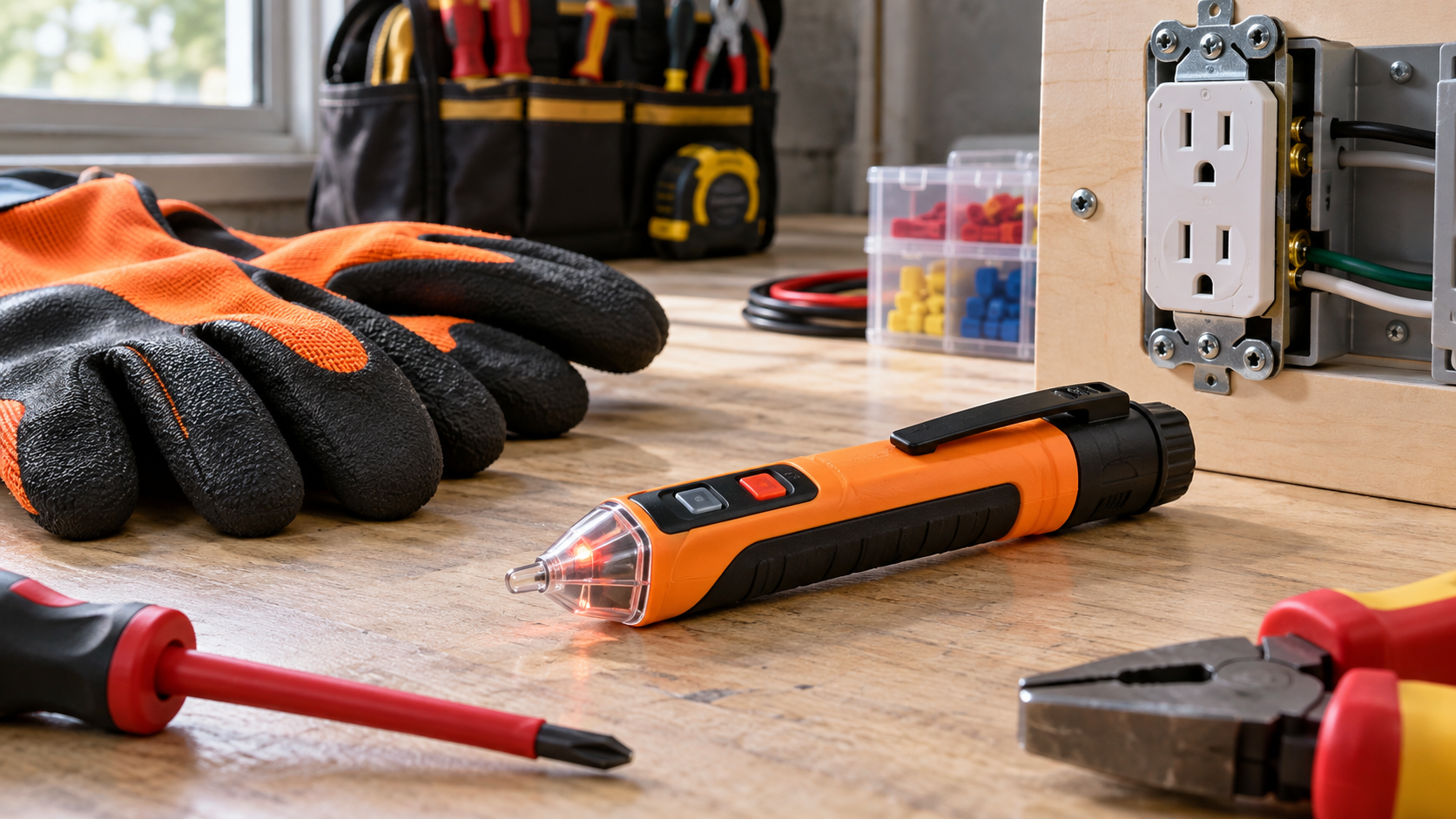
The Klein NCVT-3 is a pocket non-contact voltage tester with a built-in flashlight. Klein’s instruction sheet for the NCVT-3 says it detects AC voltage from 12 to 1000 V, using visual and audible indicators, and carries a CAT IV 1000 V rating. It is a voltage detector only. It does not measure current, resistance, or the exact value of a voltage. Check it on a known live source before and after each use, and treat a silent tester as unproven rather than as proof of no voltage.
Quick answer
- Detects AC voltage from 12 to 1000 V. Klein’s sheet gives a frequency range of 50 to 500 Hz.
- Rated CAT IV 1000 V and IP67 (dust and water protection), according to the NCVT-3 instruction sheet.
- Runs on 2 AAA alkaline batteries. The sheet gives 15 hours of continuous NCVT use and 6 hours of flashlight use.
- It is a detector, not a meter. Use a meter rated for the circuit to confirm readings.
What the NCVT-3 is and what it does
The NCVT-3 has a non-contact sensing tip. When you bring the tip near an AC source, the tester gives a visual indication on an LED bar graph and an audible beep. The stronger the detected voltage, the more LEDs light and the faster the beep. The instruction sheet describes the tester type as a non-contact voltage detector, and it says the unit can work as a non-contact voltage tester, as a flashlight, or as both.
The flashlight is independent of the voltage detection function. The sheet says the flashlight can be used on its own, and that it turns off automatically after 20 minutes if no button is pressed. Before it switches off, the unit chirps for 10 seconds. Pressing the flashlight button during the chirp resets the 20-minute timer.
A non-contact tester is useful for a quick first check: finding which conductor in a cable is live, or confirming that a receptacle or fixture has voltage present. It is not a substitute for a meter, and it does not tell you which conductor is neutral, which is ground, or how much current a circuit can deliver.
How to use it safely, step by step
Klein’s sheet gives a short operating sequence. Follow it in this order each time you use the tester.
- Check the tester first. The sheet says to test the tester on a known live circuit before use to verify that it works. If it does not respond on a source you know is live, do not use it to decide that a circuit is dead.
- Power it on. Press and release the NCV button. Listen for a single beep and watch for the blue PWR LED to light and stay lit.
- Bring the tip close to the source. Place the tip near the AC voltage. If voltage is sensed, the unit beeps and the proximity sensor shows the strength of the detected voltage on the LED bar graph.
- Check again after you finish. Test the tester on the known live source once more. A silent result on a live source means the tester is not working, not that the circuit is safe.
The sheet also warns that voltages above 30 V AC can present a shock hazard. A single blinking LED or a steady LED with a beep means voltage is present. If there is no indication, voltage could still be present. Treat any silent result as unconfirmed until you have checked with a meter rated for the circuit.
Work on mains panels, service entrances and any circuit you are not sure about belongs with a licensed electrician. A non-contact tester does not make a live panel safe to open.
Printed specifications from the Klein sheet
The table below lists only figures stated in Klein’s NCVT-3 instruction sheet. The sheet has no printed document code or revision date, so the table cannot be matched to a revision.
| Item | What the NCVT-3 instruction sheet says |
|---|---|
| Detection range | 12 to 1000 V AC |
| Frequency range | 50 to 500 Hz |
| Safety rating | CAT IV 1000 V |
| Ingress protection | IP67 (dustproof and waterproof) |
| Drop protection | 6.6 ft (2 m) |
| Pollution degree | 2 |
| Batteries | 2 x AAA 1.5 V alkaline |
| Battery life | NCVT: 15 hours continuous use; flashlight: 6 hours continuous use |
| Dimensions | 5.83 x 0.96 x 1.16 in (148 x 24 x 29 mm) |
| Weight | 2.5 oz (72 g) |
| Operating altitude | Up to 6562 ft (2000 m) |
| Relative humidity | Below 95%, non-condensing |
| NCVT auto power-off | After 4 minutes of non-use |
| Flashlight auto power-off | After 20 minutes on |
| Low battery | At about 20% capacity the flashlight is disabled and the unit chirps |
| Standards listed | ANSI/ISA-61010-1 3rd ed.; EN 61010-1:2010; IEC 61010-1 3rd ed.; EN 61010-2-30:2010; IEC 61010-2-030 1st ed. |
The sheet also marks the unit as double insulated and lists its tester type as a non-contact voltage detector. Read these figures as the maker’s printed values. They describe the NCVT-3 instruction sheet we opened, not any other Klein model.
When the NCVT-3 can miss voltage
The sheet lists conditions under which the tester will not detect voltage and conditions under which it may not. Knowing them matters more than any single spec, because a silent result is where most mistakes happen.
- The wire is shielded.
- The user is not holding the tester.
- The field from the voltage source is blocked, dampened, or otherwise interfered with.
- The frequency of the voltage is not a clean sine wave between 50 and 500 Hz.
- The tester is outside the operating conditions listed in the specifications.
- The tester is not in its normal operating conditions.
The sheet also notes that in bright light the LED indicators are harder to see, so the beep is the more reliable cue in sunlight. It adds that damage to the O-ring on the battery cap can affect the IP67 rating but not operation. Both points are worth checking on a tester that has been dropped or left outdoors.
NCVT-3 and NCVT-3P are different products
Klein also publishes an NCVT-3P, and the two are easy to confuse. The NCVT-3P web manual describes a dual-range tester with a 70 to 1000 V AC mode and a 12 to 1000 V AC mode. The NCVT-3 instruction sheet describes a single 12 to 1000 V AC range. Klein’s current sell sheet, Rev. 05/20, lists the NCVT-3P, not the NCVT-3, and gives different dimensions and weight for the NCVT-3P: 5.70 x 0.93 x 1.09 in and 1.7 oz (48.1 g), compared with 5.83 x 0.96 x 1.16 in and 2.5 oz (72 g) on the NCVT-3 sheet.
Because the figures do not carry over from one model to the other, read the printed model number on the tester itself and match it to the sheet you are using. If your job needs a dual-range tester, the NCVT-3 sheet is not the right document to rely on.
Battery and storage
The sheet says to replace the two AAA batteries while observing polarity. When the battery drops to about 20% of capacity, the flashlight is disabled so the batteries can keep the voltage detection working. Remove the batteries if the tester will sit unused for a long time, which prevents leakage from damaging the body. The tester has no user-serviceable parts inside, so a fault beyond batteries and the O-ring is a reason to replace the unit rather than open it.
How we chose
This article covers one product, because the keyword names it. We opened three Klein documents and built the explanation from what they state: the NCVT-3 instruction sheet, the NCVT-3P web manual (used only to explain how the two models differ), and Klein’s NCVT product sell sheet, Rev. 05/20. We did not compare the NCVT-3 with tools from other brands. All three sources were read on 2026-10-27.
What we could not verify
- The NCVT-3 instruction sheet has no printed document code or revision date, so we cannot say which revision your unit’s sheet matches.
- The sources we opened do not show whether Klein still sells the NCVT-3 as a current product. The sell sheet lists the NCVT-3P instead.
- The sheet’s stated distance for detection is not repeated here in full, because the text we read was split across columns and we did not want to misquote it.
- Whether the tester detects voltage through insulated walls or inside conduit is not stated beyond the listed conditions above.
- Retailer listings were not used for any figure in this article.
Buying checklist
- Confirm the model on the tester is NCVT-3, not NCVT-3P, before using any figure in this article.
- Check that CAT IV 1000 V is the rating you need for the work you plan to do.
- Confirm you have a known live source you can use for the check before and after each use.
- Keep spare AAA batteries, and check the battery indicator before a job.
- Choose a meter for any measurement beyond detecting AC voltage, including DC voltage, current, and resistance.
Mistakes to avoid
- Treating silence as proof of no voltage. The sheet lists several conditions where voltage can be present and the tester does not indicate it.
- Skipping the known-live check. The sheet calls for it before use, and it confirms the unit responds at all.
- Expecting DC detection. The NCVT-3 sheet describes AC voltage detection. Use a meter for DC.
- Mixing up NCVT-3 and NCVT-3P figures. The two sheets give different dimensions, weights and ranges.
- Working on energized equipment. A non-contact tester is a first check, not a lockout procedure.
FAQ
Does the Klein NCVT-3 detect DC voltage?
The NCVT-3 instruction sheet describes AC voltage detection only, from 12 to 1000 V AC. It does not state that the tester detects DC. For DC, use a multimeter rated for the circuit.
Is the NCVT-3 rated for mains work?
The sheet lists a CAT IV 1000 V safety rating and the standards it was built to. A rating describes the tester’s own design limits. It does not make a live panel safe to open, and panel or service work belongs with a licensed electrician.
Why did the tester stay silent next to a wire I know is live?
The sheet lists several cases where the tester will not or may not detect voltage. The common ones are a shielded wire, a tester that is not held, a blocked field, a waveform that is not a clean 50 to 500 Hz sine wave, and a tester outside its operating conditions. Check the tester on a known live source before trusting it again.
How long do the batteries last?
The sheet gives 15 hours of continuous NCVT use and 6 hours of continuous flashlight use on two AAA alkaline batteries. When the battery drops to about 20% capacity, the flashlight is disabled and the unit chirps.
Is the NCVT-3 the same as the NCVT-3P?
No. The NCVT-3P web manual describes a dual-range tester with 70 to 1000 V and 12 to 1000 V modes. The NCVT-3 sheet describes one 12 to 1000 V range. Klein’s Rev. 05/20 sell sheet also gives different dimensions and weights for the two models.
Does the tester work in bright light?
It can, but the sheet notes that the LED visual indicators are less visible in bright light. Rely on the audible beep in those conditions and confirm with a meter.
Bottom line
Use the Klein NCVT-3 as a quick AC voltage detector. Check it on a known live source before and after each use, read a silent result as unconfirmed, and confirm absence of voltage with a meter rated for the circuit.
Related guides
- NCVT non-contact voltage testers explained
- Non-contact voltage testers compared
- NCVT1P voltage tester: picks compared by listed fit
Sources
- Klein Tools, “NCVT-3 Non-Contact Voltage Tester with Flashlight” instruction sheet (PDF, maker-hosted). https://data.kleintools.com/sites/all/product_assets/documents/instructions/klein/NCVT-3_Instructions.pdf (opened 2026-10-27; no printed document code or date.)
- Klein Tools, “NCVT-3P Dual-Range Non-Contact Voltage Tester with Flashlight” web manual (PDF, maker-hosted). https://data.kleintools.com/sites/all/product_assets/documents/instructions/klein/NCVT-3P_WEBMANUAL.pdf (opened 2026-10-27; used only to explain the NCVT-3P difference.)
- Klein Tools, NCVT product sell sheet, document 82909, Rev. 05/20 (PDF, maker-hosted). https://data.kleintools.com/sites/all/product_assets/documents/brochures/klein/82909_NCVT2P3P_SellSheet_WR.pdf (opened 2026-10-27.)