Klein Et250
As an Amazon Associate we earn from qualifying purchases.
Klein ET250 Explained: What It Measures and How to Use It Safely
The Klein ET250 is a handheld, battery-powered digital AC/DC voltage and continuity tester. Klein’s own manual says it measures AC and DC voltage up to 600 V, checks continuity, and tests GFCI-protected circuits. It is not a multimeter: the manual’s specifications do not list current or resistance measurement. If you need to measure amps or resistance, the ET250 is the wrong tool. If you need to know whether a receptacle or circuit has voltage, and whether a GFCI device trips when its test button is pressed, it is designed for exactly that job.
Quick answer
- Measures AC voltage from 2 to 600 V (45 to 400 Hz) and DC voltage up to 600 V, according to Klein’s manual.
- Rated CAT IV 600 V in Klein’s manual and sell sheet. Check this rating against the circuit you plan to test.
- Runs on 3 x 1.5 V AAA batteries. It has a GFCI test function for receptacles.
- Klein rates it IP53. Check the warnings in the manual about the test lead jacks before relying on that rating.
What the ET250 measures
The ET250 is a voltage and continuity tester. Klein’s manual describes it as a solid-state, digital voltage and continuity tester that measures AC and DC voltage up to 600 V and tests for continuity. The manual lists the AC voltage range as 2 to 600 V AC RMS across 45 to 400 Hz, and the maximum measurable voltage as 600 V RMS. The test current for voltage measurement is listed as less than 0.3 mA at 120 V AC RMS or 120 V DC. Klein also publishes an accuracy figure of plus or minus 2 percent plus 2 V for voltage readings.
Continuity is shown with an audible tone, which lets you check a conductor or a fuse without looking at the display. The sell sheet also lists a backlight and an integrated flashlight, which are useful in a dim panel or under a sink. These features are described by Klein; they are not claims about how the tester performs in any particular job.
Because the ET250 does not measure current, it cannot tell you how many amps a circuit draws. That matters for clamp-meter comparisons: a clamp meter is the right tool for current, and an ET250 is the right tool for checking whether a conductor is live.
How the GFCI test works
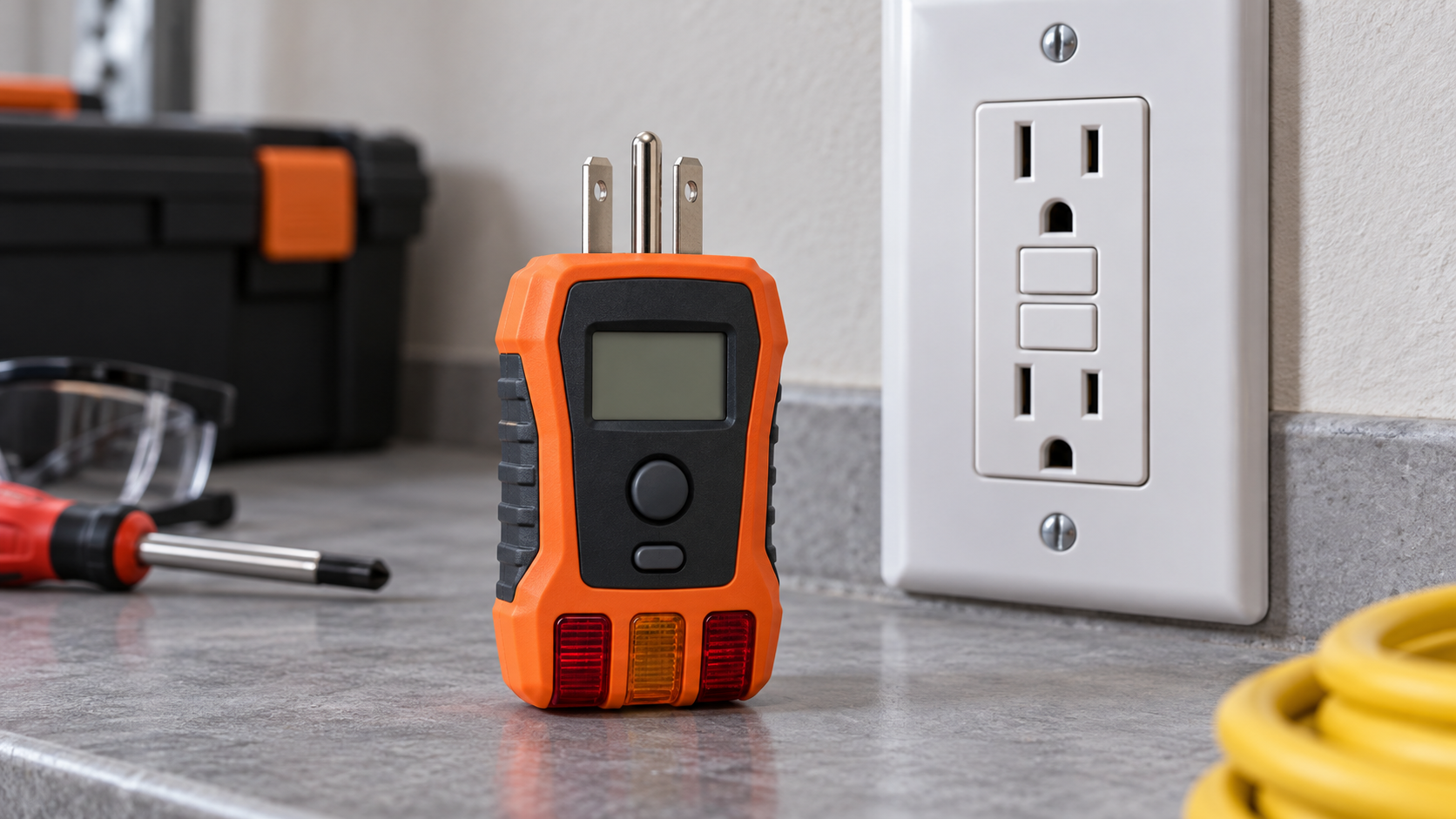
The ET250 includes a GFCI test. Klein’s manual describes applying the leads to the hot and ground terminals of a GFCI-protected receptacle and then pressing the GFCI test button on the tester. The manual gives a nominal voltage range for GFCI testing of 10 to 135 V AC at 50 or 60 Hz, and lists the GFCI test current as more than 6 mA when the button is pressed. The 135 V figure is the top of the nominal GFCI test range, so the test is meant for circuits within that range.
This test checks whether the GFCI device trips. It does not replace the test button on the receptacle, and it does not check the wiring. If a GFCI receptacle does not trip when tested, the outlet needs a closer look from a qualified electrician. Repeatedly resetting a GFCI device to see whether it holds can hide a fault, so do not treat a reset as a repair.
How to use it safely, step by step
Read the manual before the first use. Klein’s manual is written as a safety document, and the safety steps below come from it and from general electrical practice.
- Check the tester first. Confirm the tester reads voltage on a known live source, such as a receptacle you know is energized. A tester that shows nothing on a live circuit cannot prove a circuit is dead.
- Inspect the leads. Look for cracked insulation, exposed metal, or damaged tips. Replace damaged leads before use.
- Check the batteries. Klein’s manual says to replace batteries when the low battery indicator appears, because a low battery can give false readings that could lead to electric shock.
- Use the correct category. Do not use the tester on a circuit rated above its CAT IV 600 V rating. Klein’s manual says the tester must be rated at least CAT IV 600 V for the circuits you plan to test.
- Test the circuit, then test the tester again. After you find no voltage, test the tester on a known live source again to confirm it still works.
Mains circuits can kill. Work on energized panels, service equipment, or anything you cannot verify belongs to a licensed electrician. A voltage tester helps you check a circuit; it does not make the work safe, and it does not replace a lockout procedure.
Power, build, and durability
The ET250 takes three AAA batteries, according to Klein’s manual and sell sheet. The sell sheet lists its weight at 6.0 ounces and its dimensions at 6.06 by 2.33 by 1.64 inches. Klein rates the tester IP53 and lists a 3-meter drop protection on the sell sheet. The manual also includes an auto power-off feature, which turns the tester off after a period of no use, so the batteries last longer. The exact timing is in the manual and can differ by firmware or revision, so check the printed manual you receive.
How we chose
This article covers one model, the Klein ET250, because it was the keyword requested. It draws only on Klein’s manual and sell sheet, which are the manufacturer documents we opened and read on 27 October 2026. We did not compare the ET250 with other testers in this article, and we did not rank it. Where a sentence is about what the ET250 is for, it reflects what Klein states about the product.
What we could not verify
- The sources we opened do not give a measurement accuracy for DC voltage separately from AC voltage.
- The sources do not state how long the batteries last in hours of use.
- The sources do not state a price, and this article does not cover price.
- The sources do not describe how the tester behaves on every type of GFCI receptacle, or on every wiring fault.
Buying checklist
- Confirm you need voltage and continuity rather than current or resistance. If you need current, look at a clamp meter instead.
- Check that the CAT rating matches the circuits you will test. The ET250 is rated CAT IV 600 V according to Klein.
- Confirm the battery type (3 x AAA) and keep spares on hand.
- Check that the GFCI function fits your need. It tests GFCI devices between 10 and 135 V AC.
Mistakes to avoid
- Using the tester as a current meter. The ET250 does not measure current.
- Skipping the check on a known live source before and after a test.
- Ignoring a low battery indicator. Klein’s manual warns that low batteries can give false readings.
- Treating a GFCI test as a full inspection of the receptacle wiring.
Related guides
- Best voltage tester pens: a comparison for quick voltage checks on a single circuit.
- Best multimeters for AC voltage: the right tool if you need readings with more detail than a tester gives.
FAQ
Is the Klein ET250 a multimeter?
No. Klein describes it as a digital voltage and continuity tester. It does not measure current or resistance according to the manual’s specifications.
What voltage can the ET250 measure?
Klein’s manual lists AC voltage from 2 to 600 V and DC voltage up to 600 V.
What CAT rating does the ET250 have?
Klein’s manual and sell sheet state CAT IV 600 V. Check that this rating covers the circuit you plan to test.
Can the ET250 test a GFCI outlet?
It has a GFCI test function. Klein’s manual describes a test on GFCI-protected circuits with a nominal range of 10 to 135 V AC. It does not replace the receptacle’s own test button or a full inspection.
What batteries does the ET250 use?
Klein’s manual lists 3 x 1.5 V AAA batteries.
Does the ET250 work in wet conditions?
Klein rates it IP53, which the manual describes as dust and water resistant. Read the manual’s warnings about the test lead jacks before relying on that rating.
Bottom line
The Klein ET250 is a voltage and continuity tester with a GFCI test function. It is useful for checking whether a circuit has voltage and whether a GFCI device trips. It is not a multimeter, and it does not replace a clamp meter or a multimeter for current or resistance. Confirm the CAT IV 600 V rating matches your work, and check the test on a known live source before and after every use.
Sources
- Klein Tools, ET250 Instruction Manual (English), https://data.kleintools.com/sites/all/product_assets/documents/instructions/klein/ET250-Manual-%20WEB.pdf (opened 27 October 2026)
- Klein Tools, ET250 Instructions (low-resolution copy), https://data.kleintools.com/sites/all/product_assets/documents/instructions/klein/ET250-INSTRUCTIONS-LOW%20RES.pdf (opened 27 October 2026)
- Klein Tools, ET60 and ET250 Voltage Testers Sell Sheet, https://data.kleintools.com/sites/all/product_assets/documents/brochures/klein/96486_ET60-ET250VoltageTestersSellSheet.pdf (opened 27 October 2026)