Fieldpiece Sc66
As an Amazon Associate we earn from qualifying purchases.
Fieldpiece SC66 Explained: What It Measures and How to Use It Safely
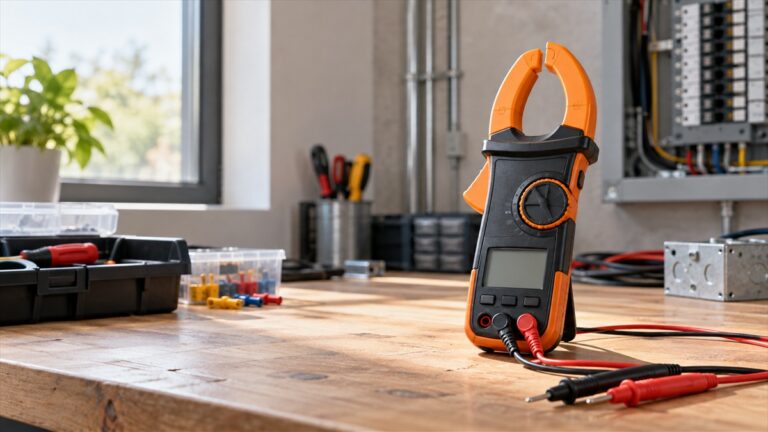
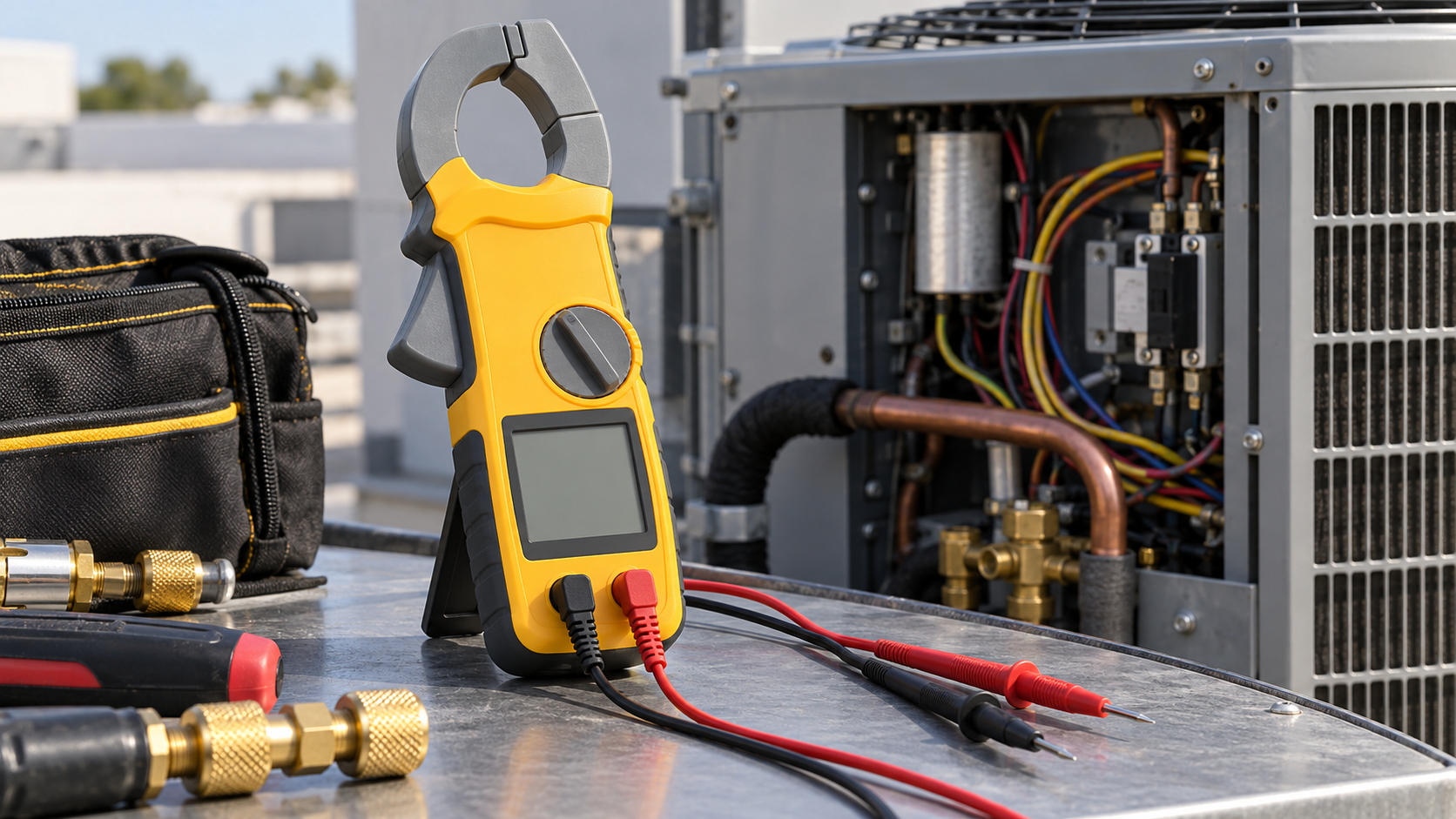
The Fieldpiece SC66 is a manual-ranging digital clamp meter. You turn a rotary dial to pick the function, then clamp the jaws around a single conductor to read current, or use the probes for voltage, resistance, continuity, diode and capacitance checks. Fieldpiece’s operator’s manual covers the SC66 together with the SC67 and rates the meter Cat III 600 V. Read the ratings and warnings before you connect it to any circuit, and keep the jaws around one conductor at a time.
Quick answer
- Voltage ranges are rated to withstand up to 600 V DC or 600 V AC, according to the Fieldpiece manual.
- Rated Cat III (600 V) and pollution degree 2 for indoor use, per the same manual.
- Runs on one 9 V NEDA 1604 battery. The manual gives about 150 hours typical with carbon-zinc cells.
- Includes a non-contact voltage function and a K-type thermocouple input for temperature.
What the SC66 measures
The manual’s specification section lists AC and DC voltage, AC and DC current, resistance, continuity, diode test, capacitance, frequency and temperature. The clamp handles AC current, and the manual lists an AAC 200 range. The DC current input the manual lists is for microamps, below 200 uADC. Use the clamp for current on the conductor you enclose, and use the probes for voltage and resistance on the terminals you can reach safely.
Temperature readings use a K-type thermocouple, and the manual says one is included. The temperature accuracy in the table is given for the range from -4 degrees F to 750 degrees F, with a wider band to 1000 degrees F. The manual also lists a Hi-V indicator that lights when a voltage above 30 V is present in any VAC or VDC range.
The non-contact voltage function is described as sensing AC voltage from about 24 V AC up to 600 V AC, for example on thermostat wiring. A non-contact check helps you find live conductors, but it does not measure voltage and it does not replace a probe measurement.
Printed specifications from the Fieldpiece manual
The table below lists only figures stated in Fieldpiece’s operator’s manual for the SC66 and SC67, opened from Fieldpiece’s own host. The manual’s accuracy table is split across columns in the PDF text, so the table here gives the range and the top-line rating for each item, not every accuracy band.
| Item | What the Fieldpiece manual says |
|---|---|
| Voltage withstand | All voltage ranges withstand up to 600 V DC or 600 V AC |
| Safety category | Cat III (600 V for SC66 and SC67), class 2, pollution degree 2, indoor use |
| Standards | IEC/EN 61010-1 and IEC/EN 61010-2-032; UL listed to UL 3111 |
| AC current range | AAC 200 (accuracy 3% plus 5 counts, resolution 0.1 A) |
| Microamps DC | Protected by a PTC resistor, not a fuse; disconnect from the circuit for 30 seconds to reset after an overload |
| Capacitance | Listed to 1000 uF (1% plus 1.5 counts) |
| Frequency | 50 Hz to 500 Hz for AC voltage measurement (footnote in the accuracy table) |
| Temperature input | K-type thermocouple, one included; accuracy 1 degree F with field calibration |
| Hi-V indicator | Lights at more than 30 V in any VAC or VDC range |
| Battery | One 9 V NEDA 1604; about 150 hours typical with carbon-zinc |
| Auto power off | About 60 minutes |
| Operating temperature | 32 degrees F to 122 degrees F; relative humidity below 80% |
| Storage temperature | 0 degrees F to 140 degrees F with batteries removed |
| Warranty | One year from date of purchase, per the manual |
The manual’s warning text says that on the microamps range, an overload can blow the fuse, and in another place it says the protection is a PTC resistor. The two statements do not agree. Treat the protection on the microamps input as a PTC that resets after 30 seconds off the circuit, and check the manual’s wording before relying on that behaviour.
Safe use, step by step
- Check the rating against the circuit. The meter is Cat III 600 V. Do not use it on any circuit above that rating, and do not connect the probes to a source above 600 V AC or DC.
- Set the dial before you connect. The manual says not to apply voltage to the jacks when the dial is on a microamps setting, and that even low voltages can cause an overload.
- Clamp one conductor at a time. The jaws should enclose a single wire for current readings. Enclosing two conductors that carry opposite currents gives a wrong reading.
- Keep your fingers behind the finger guards. The manual calls for this on the probes.
- Do not measure resistance on a powered circuit. Disconnect the circuit first.
- Discharge capacitors before measuring them. The manual gives a procedure for discharging before the capacitance function is used.
Work on mains panels, service entrances and energized equipment belongs with a licensed electrician. A clamp meter rated Cat III 600 V is a measuring tool for circuits within its rating, not a way to make live work safe.
Battery and maintenance
The manual says to replace the battery when the meter shows the low-battery indicator. Remove the back case to reach the 9 V battery and use a NEDA 1604 replacement. Auto power off is set to about 60 minutes to save battery. Clean the exterior with a clean, dry cloth, and store the test leads in their holder so the probes are protected.
How we chose
This article covers one product, because the keyword names it. We read Fieldpiece’s operator’s manual for the SC66 and SC67 from Fieldpiece’s own host, checked Fieldpiece’s user manuals index to confirm which manual is listed for the SC66, and cross-checked the figures against a third-party copy of the same manual. We did not compare the SC66 with other clamp meters. The sources were read on 2026-10-27.
What we could not verify
- The Fieldpiece manual has a version marker in its specification header, but no printed revision date. We cannot say which production date the manual matches.
- The sources we opened do not state whether the SC66 is still sold new. Check current availability with Fieldpiece before buying.
- The manual gives the microamps protection two different descriptions (a PTC resistor and a fuse). We report both and do not resolve the conflict.
- The manual does not state a CAT rating for the clamp beyond Cat III 600 V, and it does not give a current rating for the probes.
- The manual does not describe how the meter performs in specific HVAC equipment, so this article does not claim suitability for any one system.
Buying checklist
- Confirm the model on the meter is SC66, and that the manual you are reading is the one for your unit.
- Check that Cat III 600 V is the rating you need for the work you plan to do.
- Decide whether you need a thermocouple input, and whether the included K-type probe meets your work.
- Confirm you have a spare 9 V battery and a holder for the test leads.
- If you need DC current on a larger range or a higher CAT rating, compare other meters before buying.
Mistakes to avoid
- Setting the dial to microamps and then connecting to voltage. The manual warns that low voltages on the microamps setting can overload the input.
- Clamping two conductors at once. A single-conductor reading needs one conductor inside the jaws.
- Measuring resistance on a live circuit. Disconnect power first.
- Relying on the non-contact function as a measurement. It indicates presence of voltage, not its value.
- Ignoring the battery. A weak battery affects the readings, so replace it when the indicator shows.
FAQ
Does the Fieldpiece SC66 measure DC current?
The manual lists an AC current range (AAC 200) and a DC input for microamps, below 200 uA. The lines of the manual we read do not list a DC amps range, so check the specification table in the manual you have before relying on DC amps.
What voltage is the SC66 rated for?
Fieldpiece’s manual says all voltage ranges withstand up to 600 V DC or 600 V AC. The meter is rated Cat III 600 V, which means it is not rated for higher-energy locations or for circuits above 600 V.
Is it safe for home electrical work?
The manual rates the meter for indoor use at Cat III 600 V. That is a measuring rating, not a guarantee. Work on a live panel or service entrance belongs with a licensed electrician, and you should check a circuit with the right tool before you touch it.
Why does the manual mention both a PTC and a fuse?
The manual says the microamps input is protected by a PTC resistor, which resets after 30 seconds off the circuit. Its warning text also says an overload can blow a fuse. The two statements do not match, and the manual does not explain which applies to a given unit.
Does it read temperature?
Yes. The manual includes a K-type thermocouple input and says one thermocouple is included. Disconnect the test leads before plugging the thermocouple in, as the manual instructs.
How long does the battery last?
The battery figure in the manual is a typical value for a carbon-zinc cell. The meter also powers itself off after about 60 minutes of inactivity, which helps the battery last between uses.
Bottom line
Use the Fieldpiece SC66 as a Cat III 600 V manual-ranging clamp meter. Set the dial before you connect, clamp one conductor at a time, and keep the probes and jaws within the rating on the label. Confirm availability with Fieldpiece before buying.
Related guides
- Best Fieldpiece clamp meters
- Best digital clamp meters compared
- NCVT non-contact voltage testers explained
Sources
- Fieldpiece Instruments, “Digital CLAMP Meters SC66 SC67 Operator’s Manual” (PDF, maker-hosted). https://resources.fieldpiece.com/wp-content/uploads/2020/12/Opman-SC66_67-web.pdf (opened 2026-10-27; specification header marked v37; no printed revision date.)
- Fieldpiece Instruments, user manuals index. https://www.fieldpiece.com/user-manuals/ (opened 2026-10-27; lists “SC66 – Basic Manual Ranging Clamp Meter” and links the manual above.)
- Third-party copy of the same SC66/SC67 operator’s manual, hosted by manualsdir.com (not the maker). https://www.manualsdir.com/manuals/766309/fieldpiece-sc66-basic-manual-ranging-clamp-meter.html (opened 2026-10-27; used only to cross-check the maker’s text.)