Best Earth Ground Meter: Picks and Key Limits
As an Amazon Associate we earn from qualifying purchases. Details
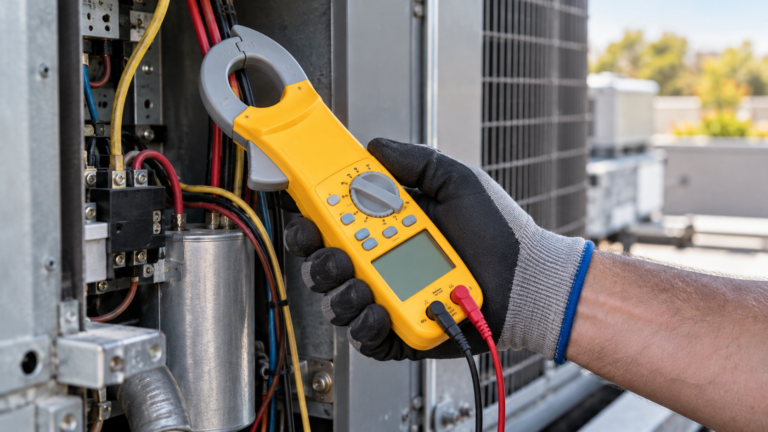
An earth ground meter measures how well a grounding path connects to the earth. The six meters here split into two families: stake-and-lead testers that use a 3-wire or 2-wire method, and clamp-on meters that read a grounding loop without auxiliary electrodes. This guide compares their stated ranges, test methods and sizes so you can match one to the job.
Ground testing can involve live circuits and buried conductors. Follow the manual, disconnect equipment where the procedure requires it, and leave grounding system installation and fault repair to a licensed electrician.
Quick answer
For a general-purpose ground resistance test with both 3-wire and 2-wire modes, start with the 0.03-2000 ohm earth ground resistance tester. If you cannot drive test stakes or break the grounding lead, look at the clamp-on ETCR2100A+ (0.010 to 200 ohm) or the EITAI2000A-S (0.01 to 500 ohm). For soil resistivity work, the 0.03-2000 ohm soil resistivity tester lists the four-pole method. The VC4105A is a handheld with three resistance ranges, and the earth ground tester kit adds a 0-30V AC earth voltage reading in an IP54-equivalent case.
Earth ground meters compared
| Meter | Type | Stated range | Size or weight | Notable feature |
|---|---|---|---|---|
| 0.03-2000 ohm tester | Digital, 3-wire or 2-wire | 0.03-2000 ohm; AC below 600V; DC below 1500V | Not stated | One-button auto measurement |
| ETCR2100A+ | Digital clamp-on | 0.010-200 ohm, 0.001 ohm resolution | 1160 g; 32mm clamp | No auxiliary electrodes |
| Earth ground tester kit | 3-wire or simplified 2-wire | 0-2000 ohm; 0-30V AC earth voltage | 5.8 x 3.9 x 2.4 inches; 3 pounds | IP54 equivalent, 3 1/2 digit LCD |
| Soil resistivity tester | Digital, 3-wire, 2-wire, four-pole | 0.03-2 / 0.03-20 / 0.3-200 / 3-2000 ohm | Not stated | Soil resistivity 0.2-3768 ohm-m |
| EITAI2000A-S | Digital clamp-on | 0.01-500 ohm, 0.001 ohm resolution | 1.8 pounds; 55 x 32mm jaw | Fits flat busbars and round rods |
| VC4105A | Digital handheld | 20 / 200 / 2000 ohm; AC up to 750V | 7.28 x 4.53 x 2.56 inches; 680 g | Backlit LCD, data hold |
The six meters
0.03-2000 ohm earth ground resistance tester
This is a battery-powered digital tester listed as an ohmmeter, voltmeter and resistivity meter, and the listing mentions 6 pieces of 1.5V batteries. It supports precise 3-wire measurements or simpler 2-wire measurements. Beyond ground resistance it reads AC voltage (earth voltage, below 600V) and DC voltage (solar voltage, below 1500V). Press the Test button and it measures automatically, then stops when the value stabilizes. The listing names agricultural equipment distribution wires, indoor wiring, power systems, electrical equipment and lightning conductors as uses. Specifications met are CE and RoHS.
Suits: someone who wants the usual stake-based test with a simple one-button routine plus voltage checks.
Pros: 3-wire and 2-wire modes; auto measurement; AC and DC voltage tests.
Cons: weight and dimensions are not stated.
Skip if: you need a clamp-on meter or a published size before you buy.
View on Amazon (affiliate link)
ETCR2100A+ digital clamp ground resistance meter
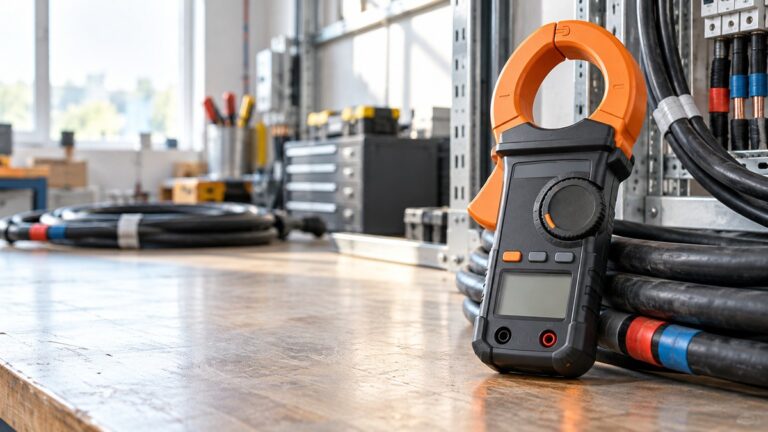
A battery-powered clamp meter listed at 0.010 to 200 ohm with 0.001 ohm resolution and a 32mm clamp. Per the listing, you do not have to break down grounding leads or use auxiliary electrodes for loop system measurements, and it measures the combined resistance of the grounding body and lead. The listing names power, meteorology, oilfield, construction and industrial electrical equipment as uses. It weighs 1160 g.
Suits: loop measurements where the grounding lead must stay connected.
Pros: no auxiliary electrodes; fine 0.001 ohm resolution; 32mm clamp.
Cons: the 200 ohm ceiling is the lowest of the six; at 1160 g it is heavier than the 680 g VC4105A.
Skip if: you need to read above 200 ohm or want a stake-based test.
View on Amazon (affiliate link)
Professional digital earth ground tester kit
This kit measures earth ground resistance from 0 to 2000 ohm and detects AC earth voltage from 0 to 30V, with a stated accuracy of plus or minus 2% of reading. It offers the standard 3-wire method or a simplified 2-wire method for places where driving auxiliary rods is impractical, such as existing metal pipes or building grounds. The casing is described as dustproof and wet-proof (IP54 equivalent), with a 3 1/2 digit LCD, Power and OK LED indicators and a HOLD function. The listed operating temperature is 0 to 40 degrees C. Specifications met are UL 61010-1, IEC 61010-2-030, CE and RoHS. It measures 5.8 x 3.9 x 2.4 inches and weighs 3 pounds.
Suits: field work where a sealed case and a published size and standards list matter.
Pros: 2-wire fallback; AC earth voltage reading; IP54-equivalent casing.
Cons: it weighs 3 pounds, so check your carry space.
Skip if: you want clamp-on measurement without driving auxiliary rods.
View on Amazon (affiliate link)
Earth resistance tester with soil resistivity function
Like the first tester, it supports 3-wire and 2-wire measurements and reads AC voltage up to 600V, DC voltage up to 1500V and AC interference voltage. It also works as a soil resistivity tester using the four-pole method, with a soil resistance range of 2 to 2000 ohm and a test range of 0.2-3768 ohm-m. Four resistance ranges are listed: 0.03-2, 0.03-20, 0.3-200 and 3-2000 ohm. It has a backlit LCD and data hold, and the listing mentions test cables, ground rods and AA batteries as compatible items. Specifications met are UL 61010-1, CE and RoHS.
Suits: buyers who need soil resistivity as well as ground resistance.
Pros: four-pole soil resistivity function; four resistance ranges; data hold.
Cons: weight and dimensions are not stated.
Skip if: you only need a clamp-on loop reading, or you need a stated size.
View on Amazon (affiliate link)
EITAI2000A-S Gen2 clamp ground resistance meter
A battery-powered, non-contact clamp-on meter with a 0.01 to 500 ohm range and 0.001 ohm resolution. The listing says contactless measurement needs no grounding lead breakage or auxiliary electrodes. The 55 x 32mm clamp jaw is described as measuring flat steel busbars and round ground rods without disassembly, and the target uses include power grids, telecom base stations and lightning protection networks. It weighs 1.8 pounds, and the seller states English customer service and technical support.
Suits: clamp-on loop testing on busbars or rods, with a wider range than the ETCR2100A+.
Pros: 500 ohm ceiling; large jaw; no auxiliary electrodes.
Cons: the 500 ohm ceiling is lower than the 2000 ohm testers.
Skip if: you need to read above 500 ohm.
View on Amazon (affiliate link)
VC4105A earth resistance tester
A yellow and black digital handheld with three resistance ranges (20, 200 and 2000 ohm) at 0.01 ohm precision, and AC voltage measurement up to 750V with 1V resolution. The backlit LCD has a maximum reading of 1999, and the data hold function lets you capture a reading. It measures 7.28 x 4.53 x 2.56 inches and weighs 680 g (the listing also says 1.5 lbs, which is the same weight).
Suits: a compact handheld with three ranges that cover low and high readings.
Pros: three ranges; backlight; data hold; the lightest of the meters that state a weight.
Cons: its test method is not described in the details quoted here, so confirm it on the product page.
Skip if: you need a clamp-on meter or a 2-wire mode confirmed.
View on Amazon (affiliate link)
Buying checklist
- Write down the test method first: stake-based 3-wire, 2-wire, or clamp-on loop.
- Check the top of the range against your expected reading. The clamp meters stop at 200 ohm and 500 ohm.
- Confirm voltage ranges if you also want earth voltage or solar voltage readings.
- Check size and weight where the listing gives them. Two of the six do not.
- Confirm what is in the box, such as leads, rods and batteries, on the product page.
- Read the maker’s instructions before use, and leave panel and service work to a licensed electrician.
Related reading on this site: earth resistivity meters, the Fluke 1630 ground resistance meter, and earth leakage meters (a related but different measurement).
FAQ
What is the difference between a clamp-on and a 3-wire earth ground meter?
A 3-wire tester uses test leads and stakes, and the 0.03-2000 ohm tester, the kit and the soil resistivity tester also offer a simpler 2-wire mode. The ETCR2100A+ and EITAI2000A-S clamp onto the grounding path, and their listings say no auxiliary electrodes or lead disconnection are needed.
Which meter covers the widest resistance range?
Four of the six list a top range of 2000 ohm: the 0.03-2000 ohm tester, the earth ground tester kit, the soil resistivity tester and the VC4105A. The EITAI2000A-S stops at 500 ohm and the ETCR2100A+ at 200 ohm.
Can any of these measure soil resistivity?
Only the soil resistivity tester lists it. It uses the four-pole method with a soil resistance range of 2 to 2000 ohm and a test range of 0.2-3768 ohm-m. The other listings do not state a soil resistivity function.
Do these meters also test voltage?
Yes, some do. The 0.03-2000 ohm tester lists AC below 600V and DC below 1500V, the soil resistivity tester lists AC up to 600V and DC up to 1500V, the kit lists 0-30V AC earth voltage, and the VC4105A lists AC up to 750V.
Is it safe to test a ground myself?
Follow the manual and disconnect equipment only where the procedure says to. Ground testing can involve live circuits, so leave grounding system installation, panel work and fault repair to a licensed electrician.
Bottom line
Pick the method first, then the range. The 0.03-2000 ohm tester is the all-round stake-based choice, the ETCR2100A+ and EITAI2000A-S suit clamp-on loop tests, the soil resistivity tester adds the four-pole method, the kit adds a sealed case and a 30V AC earth voltage reading, and the VC4105A is the lightweight handheld. Where a listing leaves out a size, weight or method, check the product page rather than guessing.
Sources
- Electrical safety reference: supports the safety guidance used in this article