UEi DL479 Clamp Meter: What It Measures and What to Check
As an Amazon Associate we earn from qualifying purchases. Details
The UEi DL479 is a handheld True RMS clamp meter, not a bench multimeter. Its jaw clamps around a conductor to read AC current up to 600 A, and the same meter also reads AC and DC voltage, resistance, capacitance, frequency, temperature and diodes. The manufacturer rates it CAT IV 600V and CAT III 1000V. The sources below do not state the meter’s suitability for every job, so the checks at the end of this guide matter as much as the feature list.
Quick answer
- What it is: a True RMS AC clamp meter with a 600 A AC jaw, sold as the AC 600A TRMS HVAC/R Clamp Meter.
- Safety rating (stated): CAT IV 600V / CAT III 1000V, per the UEi data sheet and product page.
- Best fit by the stated specs: AC current checks on motors, lines and HVAC/R equipment, plus basic voltage, resistance and continuity work.
- Check before buying: the jaw size, the CAT rating against your circuit, the DC current range (the data sheet lists only AC amps on the jaw), and the test leads you will use.
What the DL479 measures
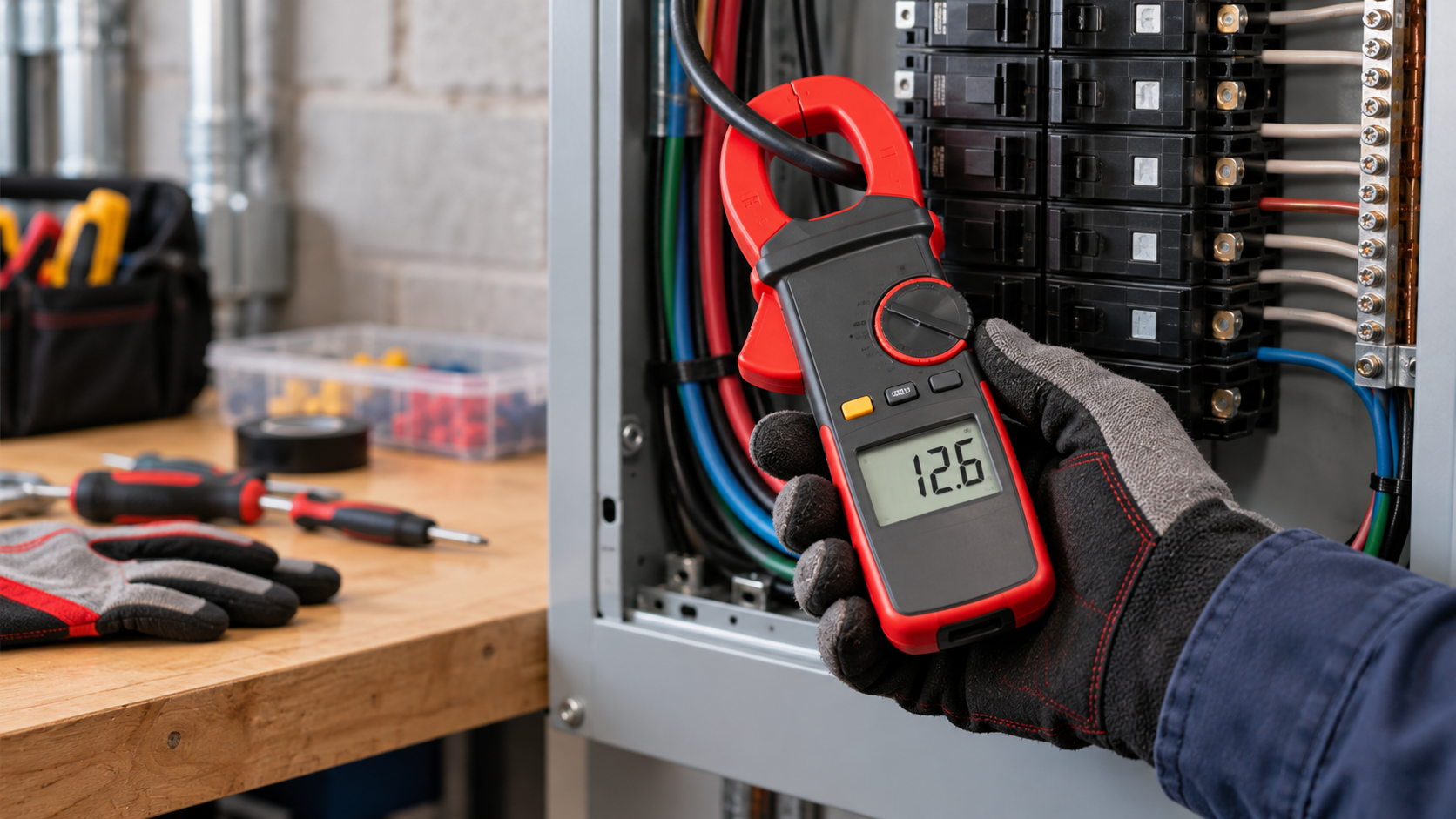
A clamp meter reads current without breaking the circuit. You open the jaw, close it around one insulated conductor, and read the current on the display. Clamping around two conductors that carry current in opposite directions returns a net value, so clamp around one conductor at a time when you are checking a single load. The UEi data sheet lists the DL479 with an AC current range of 60 A, resolution 0.01 A, and accuracy of ±(2.0% + 8 digits) on that range. The 600 A range is listed with a resolution of 0.1 A. The data sheet describes the current input as “AC Amps – Jaw Input,” so this meter’s jaw measurement is an AC measurement.
For voltage, the data sheet lists AC volts from 600 mV up to 750 V, with True RMS, sine frequency range 50 Hz to 400 Hz, and DC volts from 600 mV up to 600 V. Resistance covers 600 Ω up to 60 MΩ. Capacitance runs from 60 nF up to 2000 µF. Frequency is listed up to 9.999 kHz, and duty cycle is listed for 0.5% to 95% over 60 Hz to 400 Hz. Continuity and a diode test are included, and so is a non-contact voltage detection function with an approximate on-voltage of 25 V AC.
The DL479 also has a temperature function that uses the thermocouple probe supplied with the meter. The data sheet lists a range of -31 °F to 752 °F (-35 °C to 400 °C) and notes that stated accuracy does not include thermocouple accuracy. The UEi product page lists the low end as -14 °F, so the two UEi sources disagree on the low end of the temperature range. Use the figure printed on the meter’s own data sheet when you need the exact number.
DC current: what the sources state
This is the spec most buyers misread. The DL479 data sheet lists a “DC Low Amps” function with a range of 600 µA and a 2000 µA range, both in microamps. It does not list a DC clamp current range in amps. If your task is measuring DC current in a vehicle or a solar array with a clamp, the sources below do not support that use, and you should look for a meter whose data sheet states a DC clamp current range.
How we chose
This guide does not rank the DL479 against other meters. It describes the meter using three UEi sources: the English data sheet, the English instruction manual, and the UEi product page. All three were opened on 2026-10-27. The figures below come from those documents and are labelled with the source they came from.
Safety ratings, in plain words
A CAT rating tells you the installation category the meter is built to be used in, and it caps the voltage the meter should see at that location. The DL479 manual lists “CAT Rating: CAT IV 600V / CAT III 1000V” and states that the meter carries the IEC 61010-1, 61010-2-032 and 61010-2-033 certifications. The manual also says: “Never use the meter on a circuit with voltages that exceed the category” of the meter. A higher number does not mean the meter is safe on any circuit. It means the meter’s ratings cover that category and voltage. Check the circuit’s category before you connect anything.
The manual calls out the test leads separately. It says to use CAT III test leads or higher, and it describes lead protection as applying only to the leads, not to the meter’s own rating. The manual also notes that the test leads should meet EN 61010-031, rated CAT III 1000V or better. If a lead is worn, cracked, or missing its shield, replace it before you use the meter.
The manual’s warnings are direct. It says that failure to observe the warnings “can result in severe injury or death.” It also says to replace the batteries when the low battery indicator appears, because a low battery can give false readings that lead to shock.
Features the sources list
- True RMS AC and DC voltage and current readings, with the bandwidth limits printed in the data sheet.
- 6000-count backlit display, with min/max capture listed at 25 ms fast capture.
- Non-contact voltage detection with an audible voltage indicator.
- Magnetic mount, data hold, and manual ranging option.
- Two AAA batteries, with a low battery indicator and battery compartment latches.
- A 2-year limited warranty, as stated on the data sheet.
The data sheet’s kit list includes test leads with alligator clips, a thermocouple temperature probe, a zippered pouch, two AAA batteries, and the manual. Optional accessories listed by UEi include alternative test lead tips and a test lead kit carrying case.
Where the listings disagree
The UEi sources do not agree on every figure, so the list below gives both values.
- Temperature low end: the data sheet lists -31 °F; the product page lists -14 °F.
- Resistance: the DL479 data sheet lists 60 MΩ as the top range. The sister DL469 sheet on the same document lists 40 MΩ. Do not carry the DL469 figure over to the DL479.
- Display counts: the data sheet lists a 6000-count display for the DL479, and the DL469 is listed at 4000 counts. Use the DL479 figure only for the DL479.
What we could not verify
- The sources do not state the jaw opening in inches or millimetres in the sections we opened, so jaw size is not confirmed here. Check the product page before buying if jaw size decides the purchase.
- The sources do not state a DC clamp current range in amps.
- The sources do not state a safety rating for battery life or a runtime figure.
- The sources do not say how the meter performs on any particular motor, vehicle or HVAC system. The specs describe the meter itself, not the results on a given machine.
Buying checklist
- Match the CAT rating to the circuit. The DL479’s stated rating is CAT IV 600V / CAT III 1000V. If your work is on a system above that category or voltage, pick a meter rated for it.
- Confirm the jaw can close around the conductor you need. The sources do not state the jaw diameter, so measure your conductor and check the product page.
- Decide whether you need DC current. If you do, the DL479’s stated specs do not cover it.
- Check the test leads. The manual requires CAT III leads or higher for this meter.
- Keep two spare AAA batteries on hand, since low batteries affect readings.
Mistakes to avoid
- Clamping two conductors together. The clamp reads the net current through the jaw, so one conductor at a time gives the reading for that conductor.
- Trusting a reading on a low battery. The manual warns that a low battery can produce false readings.
- Assuming the meter reads DC current in amps. The stated DC range is in microamps.
- Using the DL469 figures for the DL479. The two models have different ranges in the same UEi document.
Frequently asked questions
What is the UEi DL479?
It is a True RMS AC clamp meter with a 600 A AC jaw and a 6000-count display. It is marketed as the AC 600A TRMS HVAC/R Clamp Meter. It also reads voltage, resistance, capacitance, frequency, temperature and diodes, as listed in the UEi data sheet.
What does CAT IV 600V / CAT III 1000V mean?
It is the meter’s stated installation category rating. The manual pairs CAT IV with 600 V and CAT III with 1000 V. The manual says the meter should not be used on circuits that exceed the category. Read the full rule in the manual before you work on any live system.
Does the DL479 measure DC current?
Only the microamp ranges on the DC Low Amps function are listed, so a DC clamp reading in amps is not supported by these sources.
Is the DL479 a multimeter?
It is a clamp meter with multimeter functions. It reads voltage, resistance and other values, but its primary function is clamp current measurement.
What batteries does it use?
The data sheet lists two AAA batteries, and the manual lists battery type as AAA x 2.
Can I check whether a wire is live?
The DL479 includes a non-contact voltage function. The data sheet gives an approximate on-voltage of 25 V AC. A non-contact check is a quick indication only. Confirm a circuit is dead with a rated voltage test before you touch conductors.
Bottom line
Choose the DL479 when its stated AC clamp current range, CAT rating and True RMS voltage functions match your work, and check the DC current and jaw size before you buy. If the circuit is above the stated category, do not use this meter on it.
Related guides
For the basics of taking a reading with a meter, read How Do You Use a Multimeter Step by Step. To compare clamp meters that read AC current, see Best AC Clamp Meter.
Sources
- UEi Test Instruments, “DL469 DL479 WDS” data sheet (English). https://www.ueitest.com/ecommerce/site/content/PDFs/DL469/DL469_DL479_WDS_L384.pdf (opened 2026-10-27)
- UEi Test Instruments, “DL479 AC 600A TRMS HVAC/R Clamp Meter” instruction manual (English). https://www.ueitest.com/ecommerce/site/content/PDFs/DL479/DL479_MAN_ENG.pdf (opened 2026-10-27)
- UEi Test Instruments, DL479 product page. https://www.ueitest.com/ECommerce/product/dl479/trms-single-display-hvacr (opened 2026-10-27)