Fluke 177
As an Amazon Associate we earn from qualifying purchases.
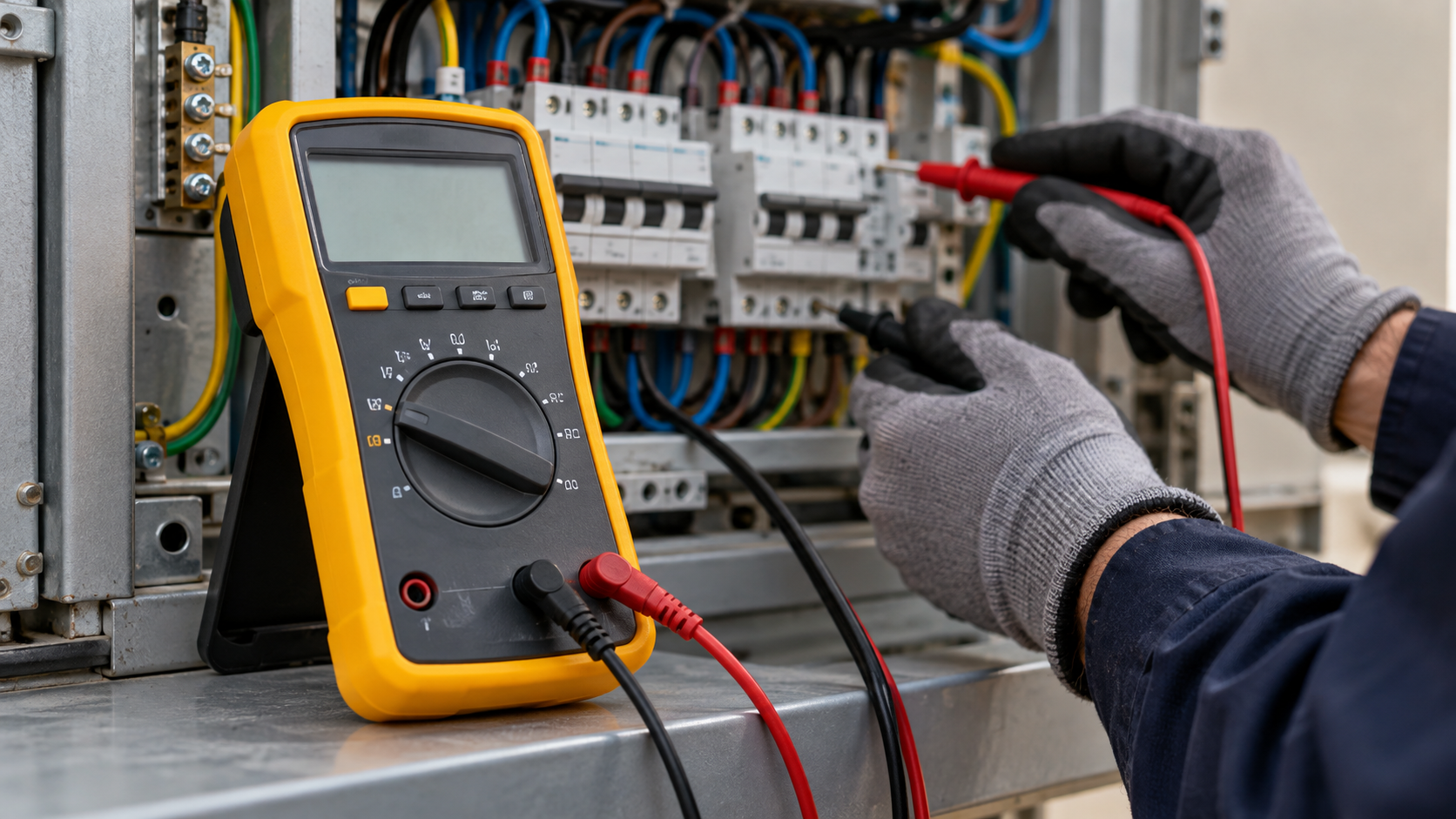
The Fluke 177 is a handheld true-RMS digital multimeter for measuring voltage, current, resistance, capacitance, frequency, continuity and diodes. Fluke publishes it with a CAT III 1000 V and CAT IV 600 V safety rating. It suits electricians, technicians and serious DIYers who work on wiring, panels and equipment. The published documents do not say it is the right choice for every task, so match the rating to the circuit before you buy or use it.
Quick answer
- The Fluke 177 is a true-RMS multimeter with AC and DC voltage up to 1000 V, plus current, resistance, capacitance, frequency, continuity and diode tests.
- Fluke rates it CAT III 1000 V and CAT IV 600 V. Use it only on circuits whose category and voltage fall within that rating.
- It offers manual and automatic ranging, a display hold, and a min/max-average recording mode.
- Before any measurement on mains wiring, check the category rating, the probes, and the fuse status, and treat panel or service work as a job for a licensed electrician.
What the Fluke 177 measures
A multimeter is a single instrument that switches between several measurement functions. On the Fluke 177 the main functions, as Fluke’s product page lists them, are AC and DC voltage up to 1000 V, true-RMS AC current and voltage, frequency, capacitance, resistance, continuity and diode checks. The page also lists current measurement up to 10 A for both AC and DC. True-RMS refers to how the meter computes the value of an AC signal. A true-RMS reading stays meaningful when the waveform is not a clean sine wave, while a meter that only assumes a sine wave can read low on distorted signals. The Fluke product page lists true-RMS AC current and voltage measurements for the 177, so that reading method applies to those functions.
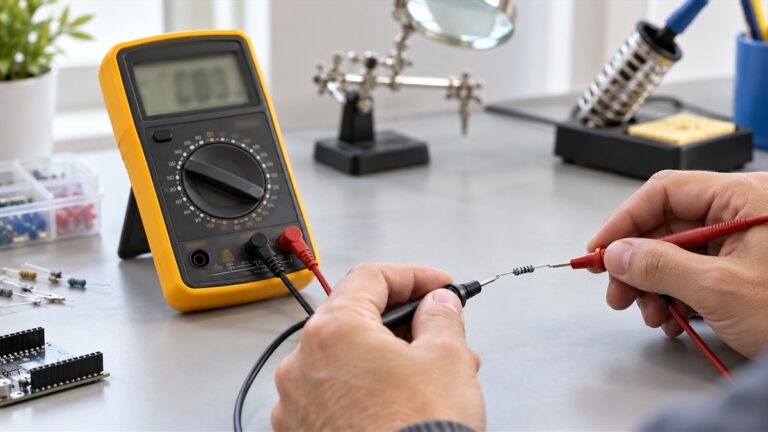
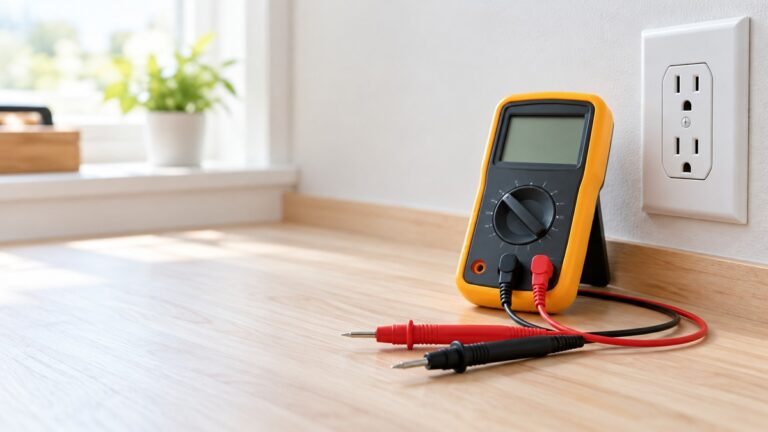
For a homeowner, the most common uses are checking whether a receptacle has voltage, measuring the voltage of a battery or low-voltage supply, testing continuity in a cord or fuse, and checking a resistor or a simple circuit. For an electrician, the same functions apply to fixed wiring and equipment, but the category rating matters much more, as explained below.
Safety ratings: CAT III 1000 V and CAT IV 600 V
Measurement category ratings describe where in an electrical installation a meter can be used safely. Fluke’s safety guide states the working rule plainly: choose a tool rated for the highest category you could potentially use it in, and select a voltage rating to match or exceed those situations.
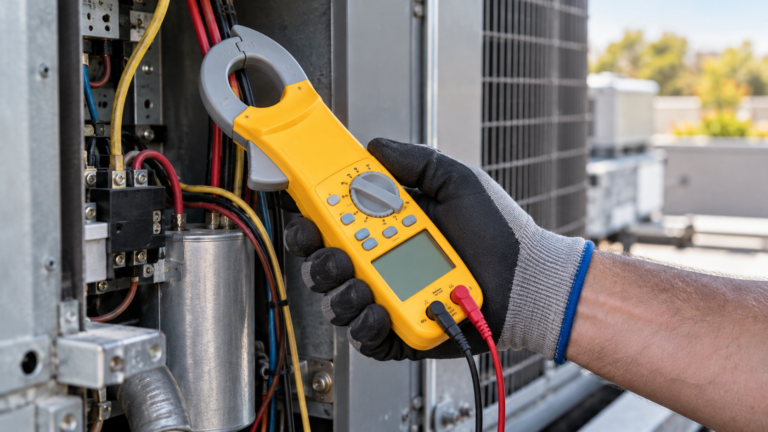
The guide describes the categories this way. CAT IV covers the origin of an installation, where the connection to utility power is made, including electricity meters and primary overcurrent protection. CAT III covers fixed building distribution, such as three-phase distribution, switchgear and polyphase motors, and the feeders and short branch circuits fed from distribution panels. CAT II covers single-phase receptacle-connected loads, such as appliances and portable tools plugged into an outlet.
The guide also gives a worked example. For a 480 V distribution feeder panel, the meter must be at least CAT III 600 V rated, and a CAT III 1000 V or CAT IV 600 V rating could also work. The Fluke 177 product page states CAT III 1000 V and CAT IV 600 V, so under that example the rating covers the feeder-panel case. Fluke’s documents do not describe the meter as suitable for every installation in every category, so do not extend the rating beyond what the page says.
The rating applies to the whole setup, not only the meter. The guide notes that test probes should match or exceed the meter’s rating. Check the leads and any clips before use, and replace leads that show cracks, exposed metal or damaged insulation.
How to use the Fluke 177 safely
Use the steps below as a general sequence, then follow the Fluke users manual for the exact menu and button behavior of your unit.
- Read the labels first. Confirm the function on the dial and the input jack before you connect anything. The users manual warns that an incorrect terminal can blow a fuse or damage the meter.
- Test the meter on a known source. Use a known live source to confirm it reads voltage before you rely on a zero reading, and confirm continuity on a known short before you trust an open reading.
- Choose the range. Autoranging picks the range for you. Manual ranging lets you override it. The manual notes that autoranging is disabled in the MIN MAX AVG mode, so set the range by hand in that mode.
- Keep your hands behind the probe guards. Connect the common lead first when that is the normal practice on your job, and remove the live lead first when disconnecting.
- Use display hold for readings you cannot see. Display hold and AutoHOLD freeze the reading so you can read it after you remove the probes.
For current, use the fused current input only with the circuit and the meter’s current range in mind. The current range on the product page runs up to 10 A. Do not put the probes across a live source in a current position. The manual has a chapter titled Test the Fuses and another on replacing the battery and fuses, which you should read before your first use.
Published specifications that matter before buying
The Fluke product page publishes accuracy and range figures for each function. For DC voltage it lists an accuracy of plus or minus 0.09 percent of reading plus 2 counts, and for AC voltage plus or minus 1.0 percent plus 3 counts. Resistance is listed up to 50 MΩ, and capacitance up to 10,000 µF. The page lists the meter at 420 g and 43 x 90 x 185 mm, powered by a 9 V battery, with alkaline battery life of about 200 hours without the backlight. Fluke lists a lifetime limited warranty.
Those figures are the manufacturer’s published values. They are not a claim about how the meter performs in your hands. Use them to compare the Fluke 177 against other meters on the same functions, not as a promise about any single reading.
How we chose
This article covers one model. We did not compare it with other meters in this article, and we did not rank it against a list of competitors. The sources we opened were the Fluke product page, the Fluke 175/177/179 users manual in its Rev. 3 (4/23) edition, and Fluke’s multimeter safety guide. We read each for the function list, ratings, safety wording and category examples, and we summarize only what those documents state.
What we could not verify
- The sources we opened do not state how the Fluke 177 performs on a specific installation. Check the installation’s category and voltage yourself.
- The product page and the manual give different frequency limits for the frequency function. This article does not quote a frequency limit for that reason. Read the range table in the manual that matches your unit.
- The sources we opened do not compare the Fluke 177 with other meters, so this article makes no claim about which model is better for any task.
- The current accuracy figures on the product page are listed for the 10 A range. For other ranges, check the manual’s specification table.
Who the Fluke 177 suits
The Fluke 177 suits people who need a full-function meter with a 1000 V voltage range and a published CAT III and CAT IV rating. It is a good fit for technicians who move between residential, commercial and industrial sites, and for anyone who wants a single instrument for voltage, current, resistance and continuity. Its size and weight are published, so check both against your tool bag. A homeowner who only needs to check batteries or a simple outlet may find a lower-cost meter enough, but any meter used on mains should still carry a category rating that matches the circuit.
Buying checklist
- Confirm the CAT III 1000 V and CAT IV 600 V rating matches the highest category you will work on.
- Check that the probes and accessories carry a rating equal to or higher than the meter.
- Confirm the functions you need are on the published list: current, frequency, capacitance and diode tests.
- Check the battery type and the replacement procedure in the manual before you need it.
- Read the warranty terms on the product page, which list a lifetime limited warranty.
Mistakes to avoid
- Using a meter on a circuit above its category. The guide says to pick the highest category you could reach. A CAT II-only meter does not belong on a feeder panel.
- Trusting a zero reading without a test. Confirm the meter reads a known source before you accept that a circuit is dead.
- Measuring current with the probes in the voltage position. The manual warns that an incorrect terminal can blow a fuse or damage the meter.
- Taking readings in the MIN MAX AVG mode with autoranging assumed. The manual says autoranging is disabled in that mode.
Frequently asked questions
Is the Fluke 177 safe for household mains?
Fluke rates the Fluke 177 CAT III 1000 V and CAT IV 600 V. The guide’s examples place single-phase receptacle-connected loads in CAT II, and the Fluke 177 rating is higher than that. The rating only describes what the meter can withstand. It does not make unsafe work safe, and work inside a panel or on service wiring belongs to a licensed electrician.
What is the difference between CAT III and CAT IV?
According to Fluke’s guide, CAT IV covers the origin of the installation, where the utility connects to the building, and CAT III covers fixed distribution such as switchgear and distribution panels. The Fluke 177 is rated for both categories, at the voltages the product page states: CAT III 1000 V and CAT IV 600 V.
Does the Fluke 177 measure true RMS?
Yes. The Fluke product page lists true-RMS AC current and voltage measurements. True-RMS readings are most useful on non-sinusoidal waveforms.
What does the display hold do?
Display hold freezes the reading on the screen so you can read it after you remove the probes. The manual describes both a display hold mode and an AutoHOLD mode.
How long does the battery last?
Fluke lists alkaline battery life of about 200 hours without the backlight, using a 9 V battery. Actual life depends on use and on the backlight.
Bottom line
Buy the Fluke 177 when you need a true-RMS meter with a published CAT III 1000 V and CAT IV 600 V rating and the functions listed in the product documents. Match the rating to the highest category you will reach, check the probes, and treat panel and service work as a job for a licensed electrician.
Sources
- Fluke Corporation, “Fluke 177 True-RMS Digital Multimeter,” product page. https://www.fluke.com/en-us/product/electrical-testing/digital-multimeters/fluke-177 (opened 2026-10-27)
- Fluke Corporation, “175/177/179 True-rms Multimeters Users Manual,” Rev. 3, 4/23. https://media.fluke.com/4d153033-ae82-4c9e-8226-b10800c13c70_original%20file.pdf (opened 2026-10-27)
- Fluke Corporation, “Guide to digital multimeter safety.” https://fluke.com/en-us/learn/blog/safety/multimeter-guide (opened 2026-10-27)
Related guides: Fluke multimeters and best Fluke clamp meter for automotive work, and Fluke 179 accessories.