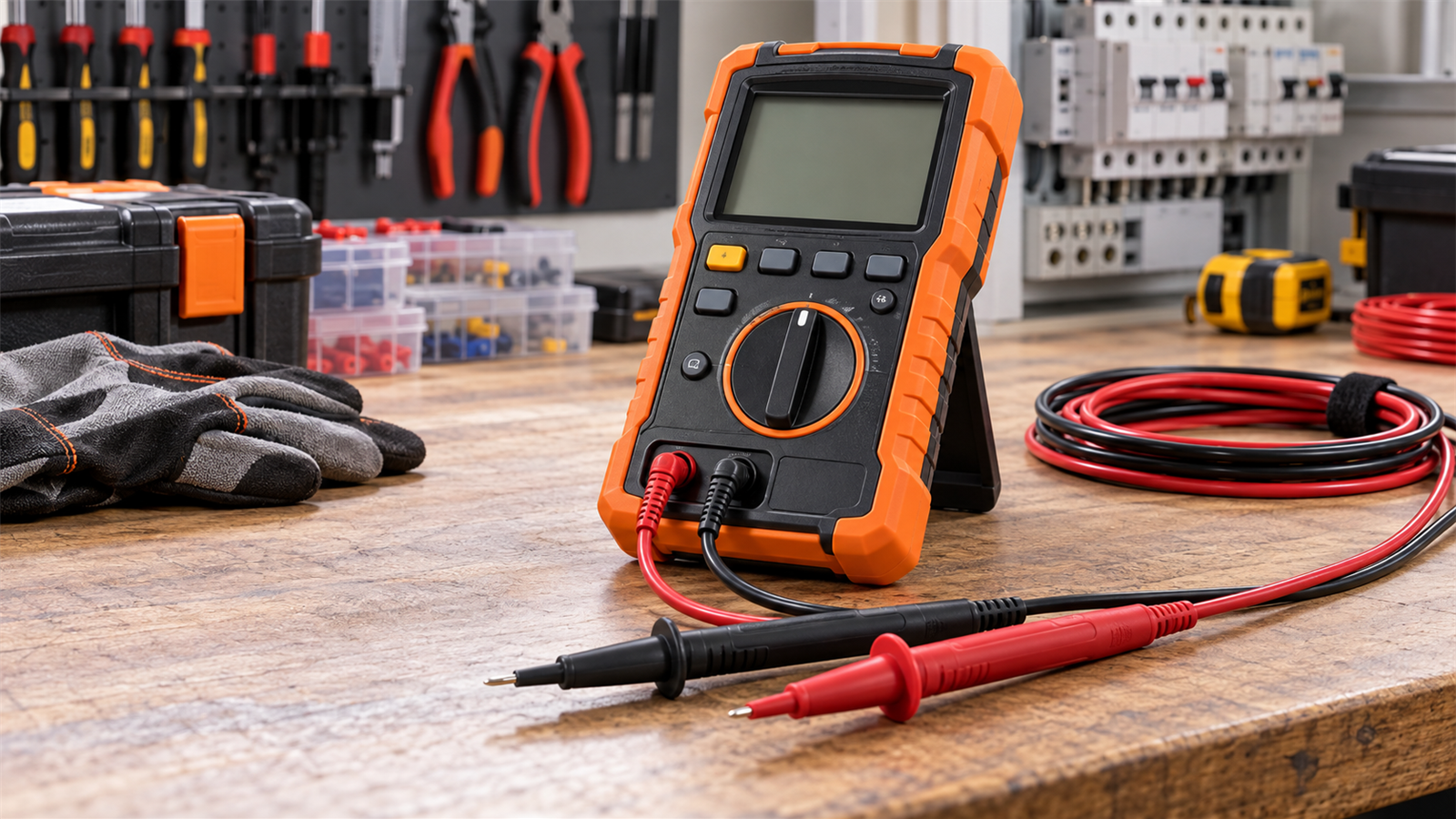
Klein Et600
As an Amazon Associate we earn from qualifying purchases.
The Klein ET600 is an insulation resistance tester that also measures AC and DC voltage, low resistance and continuity. Klein describes it for electricians and maintenance professionals who install, troubleshoot and maintain wiring and equipment. Klein publishes a CAT IV 600V and CAT III 1000V safety rating for it. It is a specialist instrument, so it sits beside a standard multimeter rather than replacing one.
Quick answer
- The ET600 applies a test voltage of 125 V, 250 V, 500 V or 1000 V DC and reads insulation resistance up to 4000 MΩ.
- It also measures AC and DC voltage up to 1000 V, low resistance and continuity.
- Klein rates it CAT IV 600V and CAT III 1000V. Use it only on circuits within those ratings.
- Insulation tests are made on de-energized circuits. Discharge the circuit before you disconnect the leads.
What an insulation resistance test does
An insulation resistance test applies a DC voltage between conductors, or between a conductor and earth, and measures the very small current that leaks through the insulation. The result is shown as a resistance in megohms. A high reading suggests the insulation is in good condition, and a falling reading over time can point to moisture or deterioration. The test is used on motors, cables and equipment, not on live supply lines.
Klein’s press release says the ET600 tests insulation resistance up to 4000 MΩ at 125 V, 250 V, 500 V and 1000 V DC. It also says the instrument measures up to 1000 V AC and DC, low resistance and continuity, and that it uses automatic ranging true-RMS technology. The release also states that the ET600 is tested for conformity to EN 61557-1, -2 and -4, which are the standards for insulation and earth-resistance testers.
The test voltage is the key choice. Use the test voltage that suits the equipment, and check the equipment’s own rating before you apply a high voltage. A 1000 V test on low-voltage equipment can damage it, and the manual’s guidance on test voltages should govern the choice.
Safety ratings: CAT IV 600V and CAT III 1000V
Klein’s press release states the safety rating as CAT IV 600V and CAT III 1000V. Measurement category ratings describe where in an installation a meter can be used safely. Fluke’s safety guide gives the working rule: choose a tool rated for the highest category you could potentially use it in, and select a voltage rating to match or exceed those situations.
The guide describes CAT IV as the origin of the installation, where the connection to the utility is made, including electricity meters and primary overcurrent protection. CAT III covers fixed building distribution, such as switchgear, distribution panels and feeders. The ET600’s CAT IV 600V rating therefore covers the origin of an installation at 600 V, and its CAT III 1000V rating covers distribution-level work up to 1000 V.
The manual states a voltage rating of CAT III 1000V or CAT IV 600V or better for the leads used in measurement locations, and it has a section titled Testing in CAT III / CAT IV Measurement Locations. Read that section before working near the origin of an installation. Test leads must match or exceed the meter’s rating, so check the leads’ category markings before use.
How to use the ET600 safely
- Confirm the circuit is de-energized. The manual warns against insulation resistance testing if voltage is present on the circuit. Verify the absence of voltage with the meter’s voltage function first, and lock out the supply as your workplace requires.
- Select the test voltage. Choose 125 V, 250 V, 500 V or 1000 V DC to suit the equipment under test. Check the equipment’s own rating before you choose a higher voltage.
- Connect the leads. Use the leads that carry a CAT III or CAT IV rating, and keep your fingers behind the guards.
- Run the test. Press the test button to start the insulation test. The manual describes a Lock button for hands-free testing, which holds the test running while you read the display.
- Discharge the circuit before removing the leads. The manual says to make sure the circuit is fully discharged after an insulation resistance test before you remove the leads.
Insulation testing stores a charge in the equipment under test, so the discharge step is a safety requirement, not an option. Follow the manual’s discharge procedure and keep the leads connected until the circuit is discharged.
Published specifications that matter before buying
The manual states an accuracy reference of 18 to 28 °C (65 to 83 °F). Outside that range it applies a temperature coefficient of 0.1 times the quoted accuracy for each degree above 28 °C. It lists a storage range of -20 to 60 °C (-4 to 140 °F) and an operating altitude of up to 2000 m (6562 ft). Klein’s press release lists a backlit display with a bar graph, auto power-off, a high-voltage icon, max/min and hold icons, and a built-in stand with an optional magnetic holder.
For voltage, the manual lists AC accuracy of plus or minus 1.0 percent plus 5 digits below 400 V and plus or minus 1.2 percent plus 5 digits above 400 V, over 50 to 60 Hz, with a 1000 V maximum input. These are the manufacturer’s figures. Read the full accuracy table in the manual for the function and range you plan to use.
How we chose
This article covers one model and does not rank it against other testers. The sources we opened were Klein’s 2019 press release on the ET600, the ET600 instruction manual in PDF form, and Fluke’s multimeter safety guide for the category definitions. We read each for the test functions, ratings, environmental limits and safety wording, and we summarize only what those documents state.
What we could not verify
- The Klein product page for the ET600 did not appear in our search, so this article relies on the 2019 press release and the manual for the published figures.
- The manual copy we opened is hosted on a retail site. Check the Klein site for the current revision before you rely on a figure.
- The manual gives storage temperature figures that differ from some retailer listings. This article uses the manual’s figures.
- The sources we opened do not describe the ET600’s performance on a specific installation, so check the test voltage and category yourself.
Who the ET600 suits
The ET600 suits electricians and maintenance workers who need to check insulation on motors, cables and equipment, and who also need a meter that reads voltage and continuity. It does not replace a general-purpose multimeter for everyday fault-finding, and a homeowner with no insulation testing need will rarely use it. Buy it when insulation testing is part of the job.
Buying checklist
- Confirm the test voltages (125 V, 250 V, 500 V and 1000 V DC) cover the equipment you test.
- Confirm the CAT IV 600V and CAT III 1000V rating matches the highest category you will reach.
- Check that the test leads and any accessories carry a rating equal to or higher than the meter.
- Read the manual’s storage and operating temperature limits, and the altitude limit, before you store or use it outdoors.
- Check the battery and fuse replacement steps in the manual before you need them.
Mistakes to avoid
- Testing a circuit that is still energized. The manual warns against insulation testing when voltage is present.
- Removing the leads before discharging. The manual says to discharge the circuit fully after the test.
- Choosing a test voltage above the equipment’s rating. Check the equipment’s rating first.
- Using a meter’s voltage reading as proof of a safe circuit. Confirm absence of voltage with a proper test before you start.
Frequently asked questions
What is the ET600 used for?
Klein describes it for electricians and maintenance professionals who install, troubleshoot and maintain electrical wiring and equipment. Its main use is insulation resistance testing, with voltage, low resistance and continuity measurement as secondary functions.
What test voltages does it offer?
Klein lists 125 V, 250 V, 500 V and 1000 V DC, and reads insulation resistance up to 4000 MΩ.
Is the ET600 safe for household mains?
The published rating covers the work the tester is designed for, but it does not make unsafe work safe. Work inside a panel or on service wiring belongs to a licensed electrician.
Does it need a special lead set?
The manual requires leads with a CAT III or CAT IV rating in measurement locations. Use the leads supplied or leads with equal or higher ratings.
Does the ET600 turn itself off?
Klein lists an auto power-off feature on the ET600.
Bottom line
Buy the Klein ET600 when insulation resistance testing is part of your work and you need the published CAT IV 600V and CAT III 1000V ratings. Test only de-energized equipment, choose the test voltage to suit the equipment, and discharge the circuit before removing the leads.
Sources
- Klein Tools, “Klein Tools Launches Insulation Resistance Tester” press release, Dec. 18, 2019. https://www.kleintools.com/content/klein-tools-launches-insulation-resistance-tester (opened 2026-10-27)
- Klein Tools, “ET600 Insulation Resistance Tester” instruction manual, PDF copy. https://trutechtools.com/content/brands/klein/documents/klein-et600-manual.pdf (opened 2026-10-27)
- Fluke Corporation, “Guide to digital multimeter safety.” https://fluke.com/en-us/learn/blog/safety/multimeter-guide (opened 2026-10-27)
Related guides: Klein Tools ET310 circuit breaker finder, Klein Tools multimeter lineup, and best Klein non-contact voltage detector.