Best Outlet and GFCI Testers
As an Amazon Associate we earn from qualifying purchases. Details
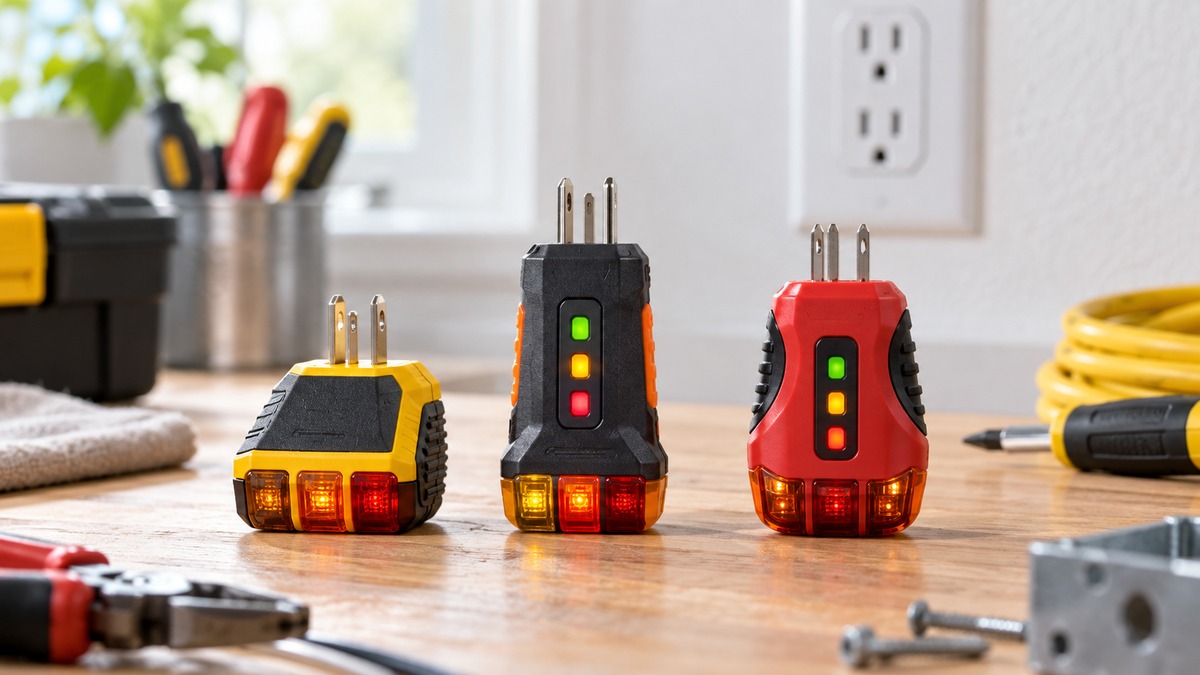
The person typing “outlet and gfci tester” wants a small tool that plugs into a wall receptacle, shows whether it is wired correctly, and checks that a GFCI outlet trips. Our research file holds five Amazon listings that fit: one classic plug-in kit and four breaker-finder kits that include an outlet and GFCI tester. Every figure below comes from those listings (checked 2026-10-11 and 2026-10-13), from the Klein RT210 manufacturer page we opened, or from a CPSC checklist we opened. Where a listing conflicts with itself, we show both numbers.
Quick answer
For a plug-in check of a standard or GFCI receptacle, the Klein Tools 80025 Outlet Tester Kit is the best-supported pick. It pairs the RT210 GFCI tester with a non-contact voltage pen, and the RT210’s manufacturer page states 110/125V AC and CAT II 300V. If you also want to find which breaker feeds an outlet, the Vansdon BF-2000 is the breaker-finder kit that states CAT II 300V in a specification field and lists a GFCI trip test.
A listing states a rating; it does not prove one. Work on mains circuits can kill, and panel or service work belongs to a licensed electrician.
How we chose
The research file holds exactly five listings for this search, and we kept all five. The criteria were:
- The listing says the product tests standard outlets, GFCI outlets, or both.
- The listing has specification fields and bullets we can quote with a check date.
- A voltage range or CAT rating is stated in the listing or on a manufacturer page we opened. Where none is stated, we say so.
What the listings do not state: none names an independent test lab and certificate. Two give no CAT rating at all (KUYTN, SwiftStep), and the Klein kit listing gives none either (its rating comes from the RT210 page). Four of the five are breaker-finder kits, which also include a transmitter and receiver. Five products is a short list, and we did not add more to pad it.
Comparison table
Figures come from the listings or, where marked, from the Klein RT210 page opened on 2026-10-17. “Not stated” means the listing does not say.
| Product | Type | Voltage range stated | CAT rating stated | Wiring conditions named | GFCI test, per listing |
|---|---|---|---|---|---|
| Klein Tools 80025 | Plug-in tester plus non-contact voltage pen | Kit listing: not stated. RT210 page: 110/125V AC | Kit listing: not stated. RT210 page: CAT II 300V | Kit listing: “common wiring problems.” RT210 page: five conditions | Confirms ground fault protective devices operate |
| focemta FTCT 01 | Breaker finder kit with outlet and GFCI tester | 90-135V AC | “CAT II 135V” (bullet); Specification Met: ETL | Six common wiring faults | Verifies GFCI protection status |
| KUYTN V100X | Breaker finder, GFCI tester and multimeter | GFCI tester “max 300V detection”; meter “up to 600V” (bullets) | Not stated | Open ground, open neutral, open hot, reversed polarity, hot/ground reversal | Built-in GFCI testing |
| SwiftStep RIV001 | Breaker finder with GFCI outlet tester | 90-120V AC (title) | Not stated; Specification Met: “UL Listed” | Seven states on the LCD | Named in the title |
| Vansdon BF-2000 | Breaker finder with outlet and GFCI test | 90-150 V (bullet) and 90-120V AC (bullet), conflicting | “Cat II 300v” (spec field and bullet) | Seven common wiring faults | GFCI trip test function |
Product cards
1. Klein Tools 80025 Outlet Tester Kit: best for a simple plug-in check
Specs (from the listing, checked 2026-10-11): Model 80025; kit of two: a GFCI Outlet Tester (Cat. No. RT210) and a Non-Contact Voltage Tester Pen (NCVT1P); dimensions 15 x 10 x 3 inches; Power Source field “Corded Electric,” with no battery type; warranty “See Manufacturer Website.” Bullets: detects common wiring problems in standard and GFCI receptacles; confirms the proper operation of ground fault protective devices; green LED for status, red LED and tone for voltage detection on the pen.
Specs (from the RT210 manufacturer page, opened 2026-10-17): 110/125V AC at 50/60 Hz in a 3-wire outlet; CAT II 300V; a chart maps light patterns to open ground, reverse polarity, open hot, open neutral and hot/ground reversed. The page says the tester works on GFCI outlets and confirms the ground fault protective device operates. It does not describe the test procedure.
Pros: The RT210 has a manufacturer page that names its range, rating and conditions. The kit adds a voltage pen. Cons: The kit listing itself states no voltage range or CAT rating, so confirm the kit ships with the RT210 before relying on the page. The power-source field is unexplained.
Best for: plug-in checks of standard and GFCI receptacles. Skip if: you need to find which breaker feeds an outlet.
View on Amazon (affiliate link)
2. Vansdon BF-2000: best for a stated CAT II 300V with a GFCI trip test
Specs (from the listing, checked 2026-10-13): Model BF-2000; battery powered; Specification Met: “Cat II 300v”; warranty “2 Years Manufactuer” (as printed); weight 0.49 kg. Bullets: 3-in-1 breaker locator, outlet tester and GFCI tester; GFCI trip test function; seven common wiring faults on the LCD; auto-hold; non-contact voltage test on the receiver; flashlight; low-battery alert and auto shut-off; a line saying the circuit tracer “complies with the CAT II 300V safety standard.” Included: transmitter, receiver, 3-to-2 prong adapter, light socket adapter, alligator clip adapter, 4 batteries.
Pros: The rating is in a specification field and a bullet, and the listing names a GFCI trip test. Cons: The voltage range conflicts: one bullet says 90-150 V, another says 90-120V AC. The Item Dimensions field reads 10 x 2 x 50 inches, which does not look right for a handheld tool, and the manufacturer field names a company (Oudong) that differs from the brand.
Best for: breaker finding plus outlet and GFCI checks once the voltage range is confirmed. Skip if: your circuit may read above 120V and you cannot confirm the range.
View on Amazon (affiliate link)
3. focemta FTCT 01: best for a listed 90-135V range and CAT II 135V
Specs (from the listing, checked 2026-10-11): Model FTCT 01 (the Part Number field reads “ST06 with accessory,” so the two identifiers do not match); battery powered; weight 3 ounces; Specification Met: ETL. Title and bullets: 90-135V AC; the screen shows voltage and signal strength; six common wiring faults; GFCI protection status; a bullet reads “ETL-certified CAT II 135V rating.” Included: transmitter, receiver, 9V and 2 AAA batteries (bullet), screwdriver, manual, carrying case, light socket adapter, 3-prong to 2-prong adapter, alligator clip adapter.
Pros: A voltage range and a CAT figure sit in the same listing. Cons: The 135V CAT II figure is lower than the 300V on other cards and comes from the listing only. The listing does not say whether the rating covers the GFCI tester.
Best for: 120V household circuits inside the range the listing states. Skip if: the circuit you test is outside 90-135V.
View on Amazon (affiliate link)
4. SwiftStep RIV001: best for a written list of wiring states
Specs (from the listing, checked 2026-10-13): Part Number RIV001; battery powered; four 1.5V batteries listed; weight 8 ounces; Specification Met: “UL Listed”; Compatible Devices: circuit breaker panels; title gives 90-120V AC; the “Maximum Alternating Current” field reads 100 milliamps and the listing does not explain it. Bullets: the LCD names seven states (Correct Wiring, Open Ground, Open Neutral, Missing Live, Live & Ground Reversed, Live & Neutral Reversed, and Live & Ground Reversed with Open Ground); live voltage and frequency in Hz; NCV; flashlight; light socket adapter, 3-prong to 2-prong adapter and alligator clip adapter.
Pros: The LCD names each wiring state in words. Cons: No CAT rating is stated, and “UL Listed” is not a CAT rating. The 100 milliamp field is unexplained. The listing does not state how the GFCI test is run.
Best for: reading the wiring state in words on 90-120V circuits. Skip if: you need a CAT rating before you use it, or the circuit reads above 120V.
View on Amazon (affiliate link)
5. KUYTN V100X: best if you want a meter in the same case, after you confirm the rating
Specs (from the listing, checked 2026-10-13): Part Number V100X; battery powered; style “Industry.” The title describes a circuit breaker finder kit with a digital multimeter and GFCI outlet tester, a 3-piece set. Bullets: the GFCI tester has “max 300V detection supported”; the multimeter “supports up to 600V detection”; the GFCI test reports open ground, open neutral, open hot, reversed polarity and hot/ground reversal; NCV detection. The Included Components field reads only “adapter.” No CAT rating is stated.
Pros: One case holds a breaker finder, GFCI tester and meter. Cons: No CAT rating is stated. The Included Components field does not match the 3-piece description, and the listing gives no model number.
Best for: buyers who want everything in one case, once the seller or manual confirms a CAT rating. Skip if: you cannot get a CAT rating in writing. Until then, the listing does not establish that the meter is rated for household mains.
View on Amazon (affiliate link)
Which one fits the job
- Plug in and read the outlet’s wiring: Klein 80025.
- Find the breaker and check the outlet, with a stated CAT II 300V: Vansdon BF-2000, once the range is confirmed.
- Stay inside a listed 90-135V range: focemta FTCT 01.
- Wiring states in words on the LCD: SwiftStep RIV001.
- One case with a meter: KUYTN V100X, only after a CAT rating is confirmed.
Worked example: suppose your outlet reads 125 V. That sits inside the focemta range of 90-135V AC (10 V below the top). It is above the SwiftStep range of 90-120V AC by 5 V, so that listing rules the circuit out. It is exactly at the 125V figure on the Klein RT210 page. The Vansdon listing gives both 90-150 V and 90-120V AC, so 125 V is inside one range and outside the other, and you would need the seller to say which is right. Compare your reading with the range on the listing before you choose.
Testing a GFCI outlet
The U.S. Consumer Product Safety Commission’s Home Electrical Safety Checklist (Pub 513, July 2008) says to test every GFCI once a month according to the manufacturer’s instructions. If you do not have the instructions, it gives a fallback: plug a light into the outlet and turn it on, press the test button and check that the light goes out, then press the reset button and check that it comes back on. If either step fails, the checklist says to replace the GFCI. The checklist is 18 years old, so check the instructions printed with your outlet first.
Safety first
Work on mains circuits can kill. The CAT rating of any tester must suit the circuit you test, and a listing that gives no CAT rating does not make a tool safe for household mains. Klein’s RT210 page says to consult a qualified electrician to resolve wiring problems. A plug-in tester only shows the condition at the outlet. If it shows a fault, stop and call a licensed electrician. Panel or service work belongs to a licensed electrician, not to a beginner with a breaker finder.
Mistakes to avoid
- Trusting a listing with conflicting numbers. The Vansdon listing gives two voltage ranges.
- Assuming the RT210’s CAT II 300V applies to other kits. The rating comes from Klein’s page, not from the other listings.
- Treating “UL Listed” or “ETL” as a CAT rating. They are different claims.
- Skipping the monthly GFCI test the CPSC checklist recommends.
- Working inside a panel because a breaker finder makes it look simple.
Who should skip buying
- Anyone who needs a CAT rating stated before use. The KUYTN and SwiftStep listings give none.
- Anyone whose circuits are not standard North American 120V outlets. The ranges here top out at 135V or 150V.
- Anyone planning to work inside a panel without a licensed electrician.
Frequently asked questions
What does an outlet and GFCI tester show?
Klein’s RT210 page says a light chart maps patterns to open ground, reverse polarity, open hot, open neutral and hot/ground reversed. The SwiftStep listing says its LCD names seven states, including Correct Wiring and Missing Live.
How often should I test a GFCI outlet?
The CPSC checklist says to test every GFCI once a month according to the manufacturer’s instructions. Its fallback steps use a light plugged into the outlet, the test button and the reset button.
Do I need a CAT rating on an outlet tester?
Look for one. Klein’s RT210 page states CAT II 300V, the Vansdon listing states Cat II 300v and the focemta listing states CAT II 135V. The KUYTN and SwiftStep listings state none, so check the manual or ask the seller before using them on household mains.
Does a breaker finder kit replace an outlet tester?
The four breaker-finder listings here each say the kit includes an outlet or GFCI tester, so one kit can do both jobs. The Klein kit is the only one here built around the plug-in tester alone.
Can I use these testers on any outlet?
No. The Klein RT210 page states 110/125V AC in a 3-wire outlet, and the other listings state ranges of 90-120V, 90-135V or 90-150V. Check your circuit against the listed range, and do not use them on 240V outlets.