GFCI Open Ground Testers: Six Practical Picks
As an Amazon Associate we earn from qualifying purchases. Details
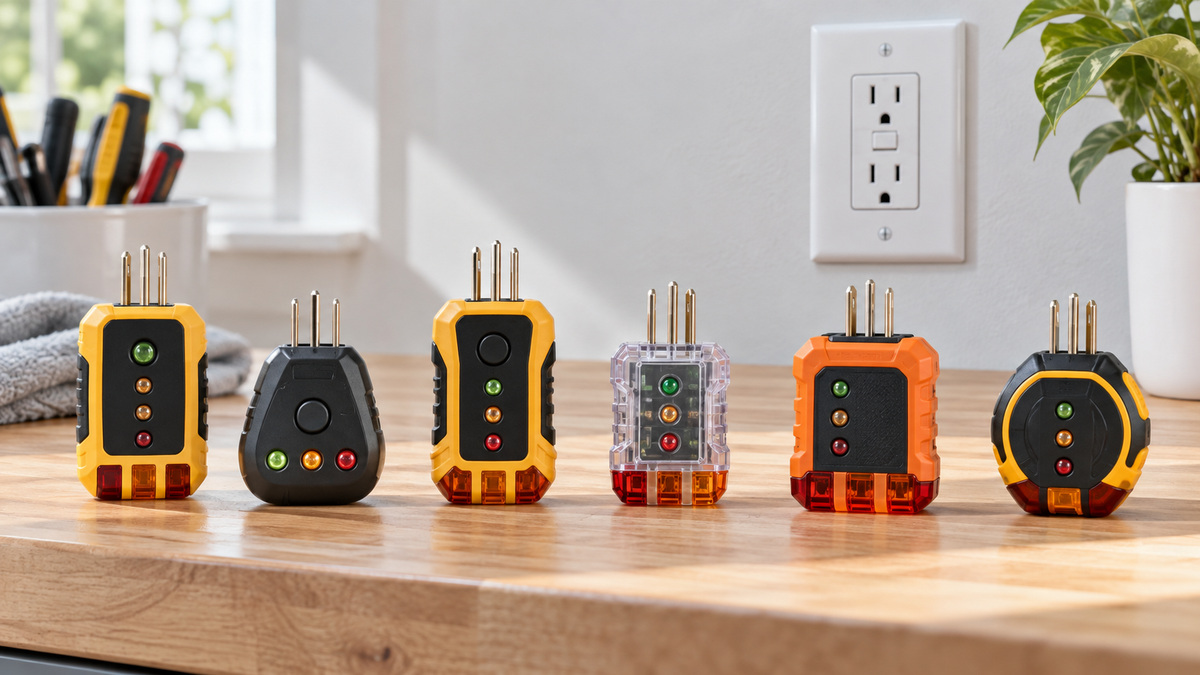
A GFCI open ground tester checks a receptacle for an open ground and related wiring faults, and many models also help you verify that a GFCI outlet trips when it should. An open ground means the outlet is not connected to a working earth path, which can leave metal parts unsafe during a fault. The test shows the condition at the outlet, not the whole circuit behind the wall.
Read the tester’s light pattern against its manual, and press a GFCI test button only as the manual describes. A clean result is not a guarantee, so treat any unexpected pattern as a reason to stop and call a licensed electrician. Never use an outlet that buzzes, shows scorch marks or runs warm.
At a glance: the 6 picks, by their own spec fields
| Pick | Power source | GFCI test? | Notable feature |
|---|---|---|---|
| Klein Tools RT110 | Hand Powered | Not named as a feature | Standard receptacle tester for North American outlets |
| Goldeep GFCI Outlet Tester | Battery Powered | Yes | Named ground testing in title; timings/currents in bullets should be confirmed in manual |
| Yellow Grounding Outlet Tester | Corded Electric | No | Plain grounding check only |
| Sperry STK001 | Battery Powered | Yes, plus non-contact voltage detection | Only kit in the group pairing NC voltage tester + GFCI tester |
| Southwire (Newer Model) | Corded Electric | Yes — push-button | Push-button test design |
| Fluke ST120+ | Corded Electric | Yes | LEDs plus audible beeper |
Specs are from each product’s Amazon listing, checked 2026-10-10 (full citations and individual write-ups in this guide’s sources section). Only one pick (Klein RT110) doesn’t name a GFCI test feature. Confirm the exact configuration and any bare figures in the bullets against the manufacturer’s manual before ordering.
Quick answer
Start with the Klein Tools RT110 when you want a tester titled for North American outlets, with bullets that mention 125V and 60Hz. The Goldeep is the alternative when you want a GFCI outlet tester whose bullets mention timings and currents such as 10 seconds, 6mA, and 9mA. Use the yellow grounding outlet tester for a plain grounding check, the Sperry STK001 for a kit that pairs non-contact voltage testing with a GFCI tester, the Southwire for a push-button test, and the Fluke ST120+ for LEDs, a GFCI test, and a beeper. Do not transfer a capability from one model to another. Before choosing, write down the one requirement that would make a model unusable, then compare it against the exact selected variant.
What matters when choosing a GFCI open ground tester
Match the product type to the job
The title and feature statements should describe the job directly. A related accessory, a replacement part, or a broad-purpose tool is not an equivalent choice for a GFCI open ground tester. These listings mix plain grounding testers, GFCI testers, and a kit with a non-contact voltage tester, and only some name an open ground or a GFCI test directly. Reject any model whose own wording changes the product type from the one you set out to buy.
Check range and operating context
Fit is the first pass/fail test. Match the stated measurement purpose and range to the circuit or equipment you will test, and never infer a safety category or compatibility that the listing does not state. The Klein Tools RT110 and Goldeep fields mention 125V, 60Hz, and 120V, which point to North American outlets, so confirm that matches yours.
Readout, access, and handling
A feature matters only when it changes daily use. Consider whether you can see the display or indicator, whether you can position a probe, clamp, or plug at the test point, and whether the tool can be handled safely while you read it. Prefer explicit feature wording over a guess from a photograph. The Fluke ST120+ style field names LEDs and a beeper, and the other listings do not name how results are shown, so read each manual against the light pattern you expect.
Power and included pieces
Separate the main product from what arrives with it. Batteries, probes, leads, and cords count only when the selected variant explicitly includes them, and the working environment should be confirmed before you commit. The Klein Tools RT110 lists Hand Powered, the Goldeep and the Sperry STK001 list Battery Powered, and the yellow grounding tester, the Southwire, and the Fluke ST120+ list Corded Electric.
Stated limits
Missing information is a real limitation. An unstated safety category, voltage range, or compatibility statement should not be filled in by assumption. If the unknown affects your intended use, choose the model whose listing answers it.
Related reading
Read gfci open neutral for the core task, best open ground on outlet tester for the closest neighboring topic, and checking gfci outlet when your setup crosses into a different use case. These guides separate neighboring searches without treating their products as interchangeable.
The six GFCI open ground tester models at a glance
Klein Tools RT110: best overall
The Klein Tools RT110 is titled as an AC electrical receptacle tester for North American outlets. The listing gives the power source as Hand Powered, the style as Standard, and the color as Factory. Its fields give a 1.8 inch dimension, and bullets mention 125V, 60Hz, and a bare figure, 1436 a, which you should read as listed. Confirm the Klein Tools RT110 in its selected configuration before ordering, because another variant can carry different details.
Goldeep tester: best for a GFCI test
The Goldeep is titled as a plug-in GFCI outlet tester, receptacle tester, and outlet ground tester. The listing gives the power source as Battery Powered, the style as GFCI Outlet Tester, and the color as Green. Its fields give a 2.88 ounce weight, a 1.18 inch dimension, and 120V in the highlight, and bullets mention 10 seconds, 6mA, 9mA, 3 seconds, and 3 minutes, which you should confirm in the manual. Confirm the Goldeep tester in its selected configuration before ordering, because another variant can carry different details.
Yellow grounding outlet tester: best for grounding checks
This tester is titled as an electrical receptacle and socket tester for North American outlets, in yellow. The listing gives the power source as Corded Electric, the style as Grounding, and the color as Yellow. Its style is Grounding and its title names North American outlets, with no weight or dimension in the fields shown here. Confirm the Yellow grounding outlet tester in its selected configuration before ordering, because another variant can carry different details.
Sperry STK001: best for non-contact detection plus GFCI
The Sperry Instruments STK001 is titled as a non-contact voltage tester (VD6504) and GFCI outlet and receptacle tester. The listing gives the power source as Battery Powered, the style as NC Tester & GFCI Tester Kit, and the color as Yellow and Black. Its title pairs a non-contact voltage tester with a GFCI tester, so it is the only kit in the group. Confirm the Sperry STK001 in its selected configuration before ordering, because another variant can carry different details.
Southwire tester: best for a push-button test
The Southwire is titled as a push-button GFCI receptacle tester for fast and accurate wiring checks. The listing gives the power source as Corded Electric, the style as Newer Model, and the color as black. Its title describes a push-button test, and its style field says Newer Model. Confirm the Southwire tester in its selected configuration before ordering, because another variant can carry different details.
Fluke ST120+: best for LEDs and a beeper
The Fluke ST120+ is titled as a GFCI socket tester with an audible beeper. The listing gives the power source as Corded Electric, the style as SOCKET TESTER WITH LEDS, GFCI TEST, BEEPER, and the color as yellow. Its style field names LEDs, a GFCI test, and a beeper, and the fields shown here give no weight or dimension. Confirm the Fluke ST120+ in its selected configuration before ordering, because another variant can carry different details.
1. Klein Tools RT110 Outlet Tester, AC Electrical Receptacle Tester for North American Outlets (Best overall)
Specs from the listing (checked 2026-10-10):
- Power Source: Hand Powered
- Style: Standard
- Color: Factory
Pros
- Listed power source: Hand Powered
- Listed style: Standard
Cons
- The bare 1436 a figure in the bullets should be confirmed in the manual
Best for: Buyers who want a receptacle tester titled for North American outlets
Skip if: You need a battery-powered tool or a GFCI button
View on Amazon (affiliate link)
2. Goldeep GFCI Outlet Tester Plug in,Receptacle Tester Outlet Ground Tester (Best for a GFCI test)
Specs from the listing (checked 2026-10-10):
- Power Source: Battery Powered
- Style: GFCI Outlet Tester
- Color: Green
Pros
- Listed power source: Battery Powered
- Listed style: GFCI Outlet Tester
Cons
- The timings and currents in the bullets should be confirmed in the manual
Best for: Buyers who want a plug-in GFCI outlet tester that also names ground testing
Skip if: You need a corded tester
View on Amazon (affiliate link)
3. Outlet Tester with Electrical Receptacle Test,Socket Tester for North American Outlets (Yellow) (Best for grounding checks)
Specs from the listing (checked 2026-10-10):
- Power Source: Corded Electric
- Style: Grounding
- Color: Yellow
Pros
- Listed power source: Corded Electric
- Listed style: Grounding
Cons
- Application-specific limits are left for you to verify in the manual
Best for: Buyers who want a plain corded grounding check
Skip if: You need a GFCI test
View on Amazon (affiliate link)
4. Sperry Instruments STK001 Non-Contact Voltage Tester (VD6504) & GFCI Outlet / Receptacle Tester (Best for non-contact detection plus GFCI)
Specs from the listing (checked 2026-10-10):
- Power Source: Battery Powered
- Style: NC Tester & GFCI Tester Kit
- Color: Yellow and Black
Pros
- Listed power source: Battery Powered
- Listed style: NC Tester & GFCI Tester Kit
Cons
- Application-specific limits are left for you to verify in the manual
Best for: Buyers who want non-contact voltage testing and a GFCI tester in one kit
Skip if: You need a single plug-in tester
View on Amazon (affiliate link)
5. Southwire GFCI Receptacle Tester – Push-Button Outlet Tester for Fast & Accurate Wiring Checks (Best for a push-button test)
Specs from the listing (checked 2026-10-10):
- Power Source: Corded Electric
- Style: Newer Model
- Color: black
Pros
- Listed power source: Corded Electric
- Listed style: Newer Model
Cons
- Application-specific limits are left for you to verify in the manual
Best for: Buyers who want a push-button GFCI test
Skip if: You need a battery-powered tool
View on Amazon (affiliate link)
6. Fluke ST120+ GFCI Socket Tester with Audible Beeper (Best for LEDs and a beeper)
Specs from the listing (checked 2026-10-10):
- Power Source: Corded Electric
- Style: SOCKET TESTER WITH LEDS, GFCI TEST, BEEPER
- Color: yellow
Pros
- Listed power source: Corded Electric
- Listed style: SOCKET TESTER WITH LEDS, GFCI TEST, BEEPER
Cons
- Application-specific limits are left for you to verify in the manual
Best for: Buyers who want LEDs, a GFCI test, and a beeper
Skip if: You need a battery-powered tool
View on Amazon (affiliate link)
Measured details worth comparing
For the Klein Tools RT110, the listing mentions item dimensions l x w x h 1.8 inches; feature bullet 2 1436 a; feature bullet 5 125V and 60Hz. For the Goldeep tester, the listing mentions item weight 2.88 ounces; item dimensions 1.18 inches; item highlight 120V; feature bullet 3 10 seconds; feature bullet 4 6mA and 9mA and 3 seconds; feature bullet 5 3 minutes. Keep each figure with the model that states it; none is a shared specification.
Numbers with different units answer different questions. A dimension cannot substitute for capacity, and a voltage range cannot establish a safety category. Build the comparison around the unit that controls your use.
Three ways to narrow the shortlist
When space or access is tight
Measure the space or the route to the test point, then compare it with the stated product dimensions. The Klein Tools RT110 lists a 1.8 inch dimension and the Goldeep lists 1.18 inches and 2.88 ounces, so you can judge how much room each needs beside a crowded outlet. A product can fit the footprint yet remain awkward to reach, so favor the model whose relevant dimensions and handling are explicit.
When the task changes often
Prioritize clear feedback and clearly stated compatibility. A push-button test (the Southwire), LEDs and a beeper (the Fluke ST120+), and a non-contact kit (the Sperry STK001) suit different habits, so choose the one whose feedback you will read correctly under time pressure. Extra features without a defined use should not outweigh a missing essential specification.
When one requirement is nonnegotiable
Use a pass/fail screen before comparing secondary details. That requirement might be a GFCI test, an open ground check, a non-contact voltage function, or a design that needs no batteries. Eliminate every model that does not state it, and only then compare convenience features among the survivors.
Narrowing six choices
Say you compare 6 models across 4 checks: type, fit, access, and included pieces. That creates 6 times 4 = 24 checks. Rechecking the multiplication gives 4 times 6 = 24 checks. Suppose 3 models fail the fit check. Then 6 minus 3 = 3 models remain; reversing the arithmetic, 3 plus 3 = 6 models. If each survivor needs 10 minutes of verification, 3 times 10 minutes = 30 minutes. A second calculation, 10 minutes times 3 = 30 minutes, confirms the total. This matters because it puts the pass/fail requirement first and limits detailed comparison to plausible choices. It is an illustration, not a product claim.
Common mistakes to avoid
Treating the category name as proof of fit
A broad label such as GFCI open ground tester can hide differences in size, range, power source, or handling. Use the exact variant details.
Comparing unlike measurements
Keep every number with its unit and field. Do not rank a weight against a dimension or a voltage range against an item count.
Borrowing a feature from another model
Each model stands on its own wording. A material, accessory, rating, or capability stated for one product does not carry across the table.
Ignoring an unstated limit
Silence is not confirmation. If your use depends on an absent rating, compatibility statement, or range, pause the purchase and check the manual.
Forgetting the selected variant
Changing a size, pack, style, or color can also change specifications and included pieces. Review the final selection immediately before ordering.
Use and care boundaries
Work on mains circuits can kill. Use only equipment whose stated category and voltage rating suit the circuit. Do not treat an unstated category as approval for household mains. Panel and service work belongs to a licensed electrician. Follow the manufacturer’s manual for connections, operating sequence, inspection, and storage. Stop if the tool, leads, enclosure, or instructions appear damaged or unclear.
For non-mains equipment, stay within the stated purpose and range. A familiar shape does not establish compatibility. Keep readings, ranges, and included accessories tied to the exact model selected.
FAQ
What should I check first when comparing GFCI open ground tester models?
Start with the requirement that would make a product unusable: whether the tester detects an open ground and whether it tests a GFCI. Remove any model that does not clearly address it, then compare convenience details among the remaining products.
Can I rely on the product title alone?
No. Use the title to confirm the basic type, then read the selected variant’s specifications. For example, the Sperry STK001 title names a non-contact voltage tester and a GFCI tester, while the Klein Tools RT110 title names only a receptacle tester. The title may not resolve dimensions, included components, operating limits, or installation details.
How should I handle a missing specification?
Treat it as unknown. If that fact controls safety, compatibility, fit, or installation, do not infer it from photos or another model. The yellow grounding outlet tester gives no weight or dimension in the fields shown here. Choose a clearer model or ask the manufacturer for confirmation.
Are all measurements directly comparable?
Only measurements describing the same attribute and using compatible units should be compared. A 2.88 ounce weight, a 1.18 inch dimension, and a 120V highlight are three different numbers for the Goldeep. Keep dimensions, weight, range, and quantity apart so one kind of number does not stand in for another.
Why does the exact variant matter?
A size, pack, color, or style selection can change specifications or included pieces. The Sperry STK001 lists Yellow and Black while the Klein Tools RT110 lists Factory, so confirm the finish you select. Reopen the details after selecting the final variant and verify every requirement again.
When should I skip a product?
Skip it when an essential requirement is missing, contradicted, or attached only to a different variant. Skip the Klein Tools RT110 if you need battery power, because its listing says Hand Powered. A longer feature list cannot make up for a failed pass/fail check.
How many products should reach the final comparison?
Keep only the models that pass your essential requirement. A requirement for a GFCI test, for example, appears in the Goldeep, Sperry, Southwire, and Fluke ST120+ titles. A short comparison of viable choices is more useful than ranking every product despite unresolved fit or compatibility questions.
Bottom line
Choose the Klein Tools RT110 when a receptacle tester titled for North American outlets matches your essential requirement. Choose the Goldeep, the Southwire, or the Fluke ST120+ when a GFCI test is part of the job, and the Sperry STK001 when you also want non-contact voltage testing. For a GFCI open ground tester the rule is simple: exact type first, pass/fail fit second, convenience third. Reject any model that requires you to invent a critical specification.
Sources
- Measurement category: explains why CAT classification and a displayed voltage range answer different safety questions.