Best Surface Resistivity Tester: 5 Meters Compared
As an Amazon Associate we earn from qualifying purchases. Details
A surface resistivity tester measures how easily a surface conducts or resists electrical charge, and the figures are given in ohms. This page compares five meters that came up for a surface resistivity search. One result, a home mold test kit, was not a resistivity meter and is left out. The five meters in the group differ sharply in how much they say, and only three of them give an ohm range. Listing figures were checked between 11 and 16 October 2026, and each is shown as the seller states it.
Quick answer
Three of the five listings state an ohm range of 10 to the 3rd power through 10 to the 12th power, which is the same span on each. The CINARIS HZR-100 is the only handheld meter here that states an accuracy figure (plus or minus 10 percent), a battery and an operating temperature range. The Generic electrostatic analyzer is the only one that states its test voltages, 10 V and 100 V, and it uses a concentric ring electrode. The two listings with identical titles give almost no figures, so they cannot be compared on specification.
Comparison table
| Listing (ASIN) | Range stated | Accuracy or repeatability stated | Test voltage stated | Power and included items |
|---|---|---|---|---|
| CINARIS HZR-100 (B0HHRRF2RD) | 10^3 to 10^12 ohms | Plus or minus 10 percent | Not stated | Battery powered, 9V battery included |
| ONYGKRJBY (B0HFSSC1F9) | 1 kilohm to 1,000,000 megohm | Plus or minus 5 percent repeatability | Not stated | Not stated in bullets read |
| Generic electrostatic analyzer (B0HK7KQZ17) | 10^3 to 10^12 ohms | Not stated | 10 V and 100 V | Battery powered; electrode weighs about 2.3 kg |
| QBDJHWBT (B0DBDB6W4T) | Not stated in bullets read | Not stated | Not stated | Weight 50 g in specs |
| WITPKKL (B0GKVFXQN3) | Not stated in bullets read | Not stated | Not stated | Not stated |
How we chose these listings
The search returned six results. The Kayenqo Mold Test Kit (B0D7CWD63N) is a home mold kit with twelve test plates, a mold guide and swabs, and it does not measure surface resistance, so it is excluded. The other five are presented as surface resistance or resistivity meters, although their titles and bullets vary in detail. The figures below come from the bullets and specification fields that each listing shows. A blank value means the listing data read for this page did not state it, and no figure has been filled in from another product.
1. CINARIS Portable Handheld Surface Resistivity Meter ESD Tester (B0HHRRF2RD)
This is a handheld meter that the bullets say measures from 10 to the 3rd power through 10 to the 12th power ohms. The stated accuracy is plus or minus 10 percent, and the automatic range selection adjusts to the reading. Three LED indicators are described: one for a conductor, one for ESD anti-static compliance, and one for a fully insulated surface. The listing says a single 9V battery is included and gives more than 40 hours of continuous testing on it. The operating conditions are 5 to 49 degrees Celsius and 5 to 90 percent relative humidity. The specification fields list the model as HZR-100, the item weight as 6.88 ounces and the dimensions as 5 by 2.8 by 1 inches, with a 1-year warranty.
View the CINARIS listing on Amazon
2. ONYGKRJBY Surface Resistance Tester (B0HFSSC1F9)
The title for this listing is long and mixes several product types: it calls the device a capacitance meter, a surface resistance tester, a resistivity LCR meter and an antistatic instrument. The bullets narrow it down. They describe the meter as designed for electrical DIY work and for simple static electricity lab tasks, and they give a repeatability of plus or minus 5 percent. A measuring range is listed from 1 kilohm to 1,000,000 megohms. That upper figure equals 10 to the 12th power ohms, which matches the range on the other listings in this group. The listing gives no dimensions, weight or power source in the fields read, and the brand is ONYGKRJBY. The capacitance wording in the title is not supported by any bullet read for this page.
View the ONYGKRJBY listing on Amazon
3. Electrostatic Analyzer Resistivity Meter, Surface Resistance Tester (B0HK7KQZ17)
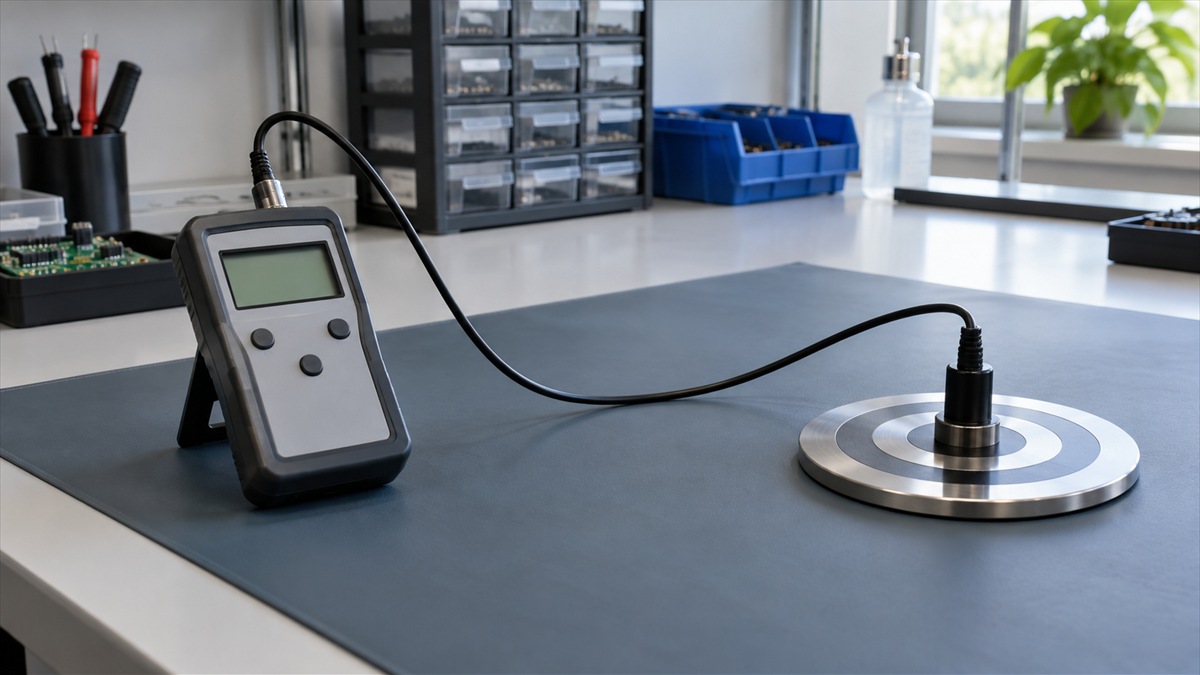
This listing is the most detailed of the group on its method. It uses concentric ring electrodes, which the bullets say distribute current evenly across the test area. The electrode weighs about 2.3 kilograms and gives a steady downward pressure without extra hand force, according to the listing. Two test voltages are selectable: 10 V and 100 V. The bullets say these suit a range of conductive, static-dissipative and insulating materials, and they name ESD mats, work surfaces, flooring and packaging. The measurement range is listed as 10 to the 3rd power through 10 to the 12th power ohms. The brand is listed as Generic and the model as CBCTJAJAJ. The listing does not state an accuracy figure.
View the electrostatic analyzer listing on Amazon
4. ESD Surface Resistance Resistivity Meter, QBDJHWBT (B0DBDB6W4T)
The title is the same as the next listing’s title, and the brand here is QBDJHWBT. The bullets read for this page give only a category heading, Ammeters, and the title. No range, accuracy, test voltage or battery is stated in the fields read. The specification field gives a weight of 50 g and a color of black. Because the bullets do not describe the meter, this page cannot say what range or test voltage the device uses, and the listing should be read on its own page before any purchase decision.
View the QBDJHWBT listing on Amazon
5. ESD Surface Resistance Resistivity Meter, WITPKKL (B0GKVFXQN3)
This listing uses the same title as the QBDJHWBT listing, with a different brand and ASIN. The bullets read give the same single category heading, Ammeters, and the title. The specification field lists the brand as WITPKKL and the color as black. No weight, range, accuracy, test voltage or power source appears in the fields read. Two listings with the same title and no differing specification figures make it impossible to tell from this data whether the products differ, so this page treats them as two separate listings with no figures to compare.
View the WITPKKL listing on Amazon
Worked example: what plus or minus 10 percent means at 1,000 megohms
Suppose a surface reads 1,000 megohms on the CINARIS meter. The listing gives an accuracy of plus or minus 10 percent, so the reading is within 10 percent of 1,000 megohms in either direction. Ten percent of 1,000 megohms is 100 megohms, which gives a range from 900 megohms to 1,100 megohms. A reading of 1,050 megohms is inside that range, while 1,120 megohms is outside it. The example uses a figure picked for the arithmetic, and the listing does not say how the accuracy is measured.
The ONYGKRJBY listing gives plus or minus 5 percent, but that figure is repeatability, not accuracy. Repeatability describes how close repeated readings of the same surface come to each other, so the two figures should not be compared directly. A repeatability figure can look tighter than an accuracy figure for the same reading, even when the meter is less accurate overall.
What we could not verify
Most of the group is thin on figures. Two of the five listings give only a title and a category heading, and the ONYGKRJBY capacitance wording in its title is not backed by a bullet. The Generic listing gives no accuracy figure. The CINARIS operating range and battery life come from the bullets, and this page does not confirm them. No listing in the group states a standard it meets, such as a named ESD test method. The mold test kit that came up in the search is excluded because it is not a resistivity meter.
Frequently asked questions
Which of these meters state an ohm range?
The CINARIS and the Generic analyzer state 10 to the 3rd power through 10 to the 12th power ohms. The ONYGKRJBY bullet gives 1 kilohm to 1,000,000 megohms, which is the same span. The two listings with the matching titles do not state a range in the fields read.
Which meter states a test voltage?
Only the Generic electrostatic analyzer states test voltages, 10 V and 100 V, which it lets you select. The CINARIS listing gives an accuracy but no test voltage, and the other listings do not state one in the fields read.
Is a battery included with each meter?
The CINARIS listing says a 9V battery is included and gives more than 40 hours of continuous use. The Generic listing describes a battery-powered meter, but the included items are not stated in the fields read. The other three do not give a power source in the fields read.
Which of these mention ESD mats or work surfaces?
The Generic listing names ESD mats, work surfaces, flooring and packaging as materials it suits. The CINARIS listing has an LED indicator for ESD anti-static compliance. The ONYGKRJBY bullets refer to static electricity lab tasks, and the two identical-title listings give no use case in the fields read.
Can the two identical-title listings be compared?
Not on specification. Both show the same title and the category heading Ammeters, with no range, accuracy or test voltage in the fields read. The brands and ASINs differ, but the data read for this page cannot show whether the products differ.
Conclusion
For a handheld meter with a stated accuracy, a battery and an operating temperature range, the CINARIS HZR-100 gives the most figures in this group. For a meter that states test voltages and a concentric ring electrode, the Generic electrostatic analyzer is the listing to read first, although it gives no accuracy figure. The two identical-title listings give too little data to choose between. Confirm the range, test voltage and warranty on each product page before you buy. For related reading on resistance meters, see best megohmmeter tester, megohmmeter and best soil resistivity meter.
Listings on Amazon: CINARIS HZR-100, ONYGKRJBY, electrostatic analyzer, QBDJHWBT, WITPKKL.