Best Pocket Toner Coaxial Cable Tester: 3 Kits Compared
As an Amazon Associate we earn from qualifying purchases. Details
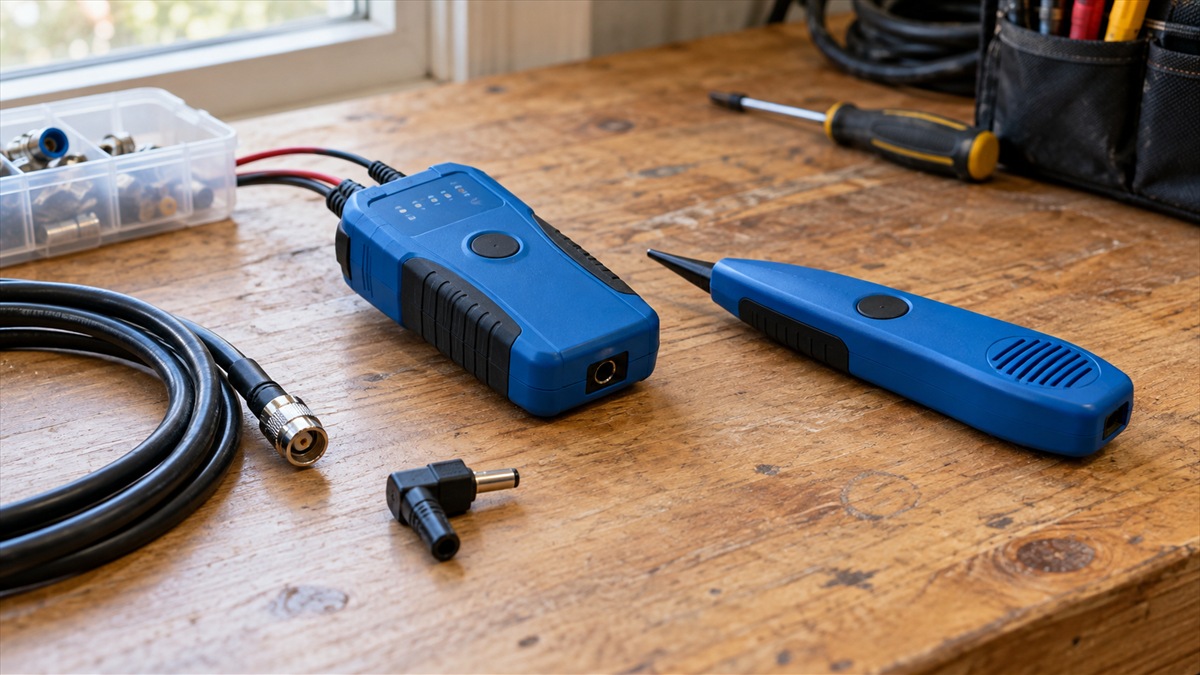
A pocket toner coaxial cable tester is a small tracer that helps you find one coax line among many. You clip a transmitter to the end of the cable and a tone detector follows the signal through walls, ceilings and floors. This guide compares three pocket kits from their product listings. The kits differ on the battery that comes with them, the connectors in the box and how the listing describes the tool. A coax job often happens near cable boxes and wall plates, and sometimes near mains wiring. Treat any box with mains wiring as off limits for a toner job, and leave mains work to a licensed electrician.
Quick answer
Pick THE CIMPLE CO if you want the most in one kit: a battery, a barrel connector and a toner, plus a 10 year warranty. Pick BOFNION if you want AAA batteries included and a slim 0.5 by 0.5 inch body, but check its count fields first, because they disagree. Pick groword for a pocket tracer with a right angle connector, and plan to buy one AAA battery with it. All three use the same basic toner signal, so the battery and the connector set usually decide the choice.
What matters for this keyword
A pocket toner is a narrow tool, so only a few details change the decision. Check each one against the way you plan to trace cables.
- Battery in the box. The kits differ here. THE CIMPLE CO lists a battery, BOFNION lists AAA batteries, and groword says it contains no battery and needs one AAA battery.
- Connector set. Each listing names a right angle barrel connector or a push-on connector. A tracer with the right connector saves a trip to the store for an adapter.
- Measurement type. Each listing gives a category, and the categories differ. Read the measurement type next to the bullets, since the bullets describe the tracing job.
- Compatible devices. Only THE CIMPLE CO names the devices it works with, including modems, satellite receivers, CCTV and RCA, BNC, SMA and F-pin systems.
- Size and weight. Pocket size matters when the cable runs through a narrow space. The listings give weights of 0.11 kg, 22.68 g and 1.92 ounces. THE CIMPLE CO lists its size as 4 x 0.5 x 0.5 inches and BOFNION lists 0.5 x 0.5 x 5 inches, so the two sizes differ mainly in length.
How to choose
Choose the kit by the job in front of you, not by the longest list of features.
- Choose THE CIMPLE CO if you want a battery, a barrel connector and a toner in one box, and you value the listed 10 year warranty. Its specs list the lightest item weight in this set.
- Choose BOFNION if you want batteries included and a compact body. Confirm the item count on the listing before you buy, because its fields disagree.
- Choose groword if you already keep AAA batteries on hand and want a right angle male connector for tight spaces. Its bullets say it works through ceilings, under floors and interior walls.
Before you buy, check three things on the listing: the battery, the connector set and the compatible devices. If the listing does not name a device or a connector you use, assume the kit may not fit that job.
1. THE CIMPLE CO Coaxial Cable Signal Tester Tool with Toner and Connector Bundle – Pocket Tracer (Complete kit with battery)
Specs from the listing (checked 2026-10-16):
- Included Components: Tool, Toner, Battery, and Adapter
- Compatible Devices: Antennas, Modem, Set Top Box, Televisions
- Item Weight: 22.68 g
- Warranty Description: 10 Year Warranty for THE CIMPLE CO products. See manufacturer website for more information.
Pros
- Bullets list one toner, one coaxial barrel connector and one battery in the kit
- Bullets describe tracing long cable runs, detecting continuity, and finding short and open circuits
- Bullets list compatibility with modems, satellite receivers, CCTV, and RCA, BNC, SMA and F-pin systems
- At 22.68 g, the lightest item weight among the three kits
Cons
- Specs label the measurement type as an ohmmeter while the bullets describe a toner, and the listing does not explain the difference
- The listing does not say which battery size comes with the kit
Best for: Carrying one compact kit that already includes a battery and a barrel connector
Skip if: Anyone who wants a clear measurement type, since the specs and bullets describe the tool differently
View on Amazon (affiliate link)
2. Coax Cable Tester,Coax Tester,Coax Cable Toner,Coaxial Pocket Toner Pocket Continuity (Batteries included)
Specs from the listing (checked 2026-10-16):
- Item Weight: 1.92 ounces
- Item Dimensions: 0.5 x 0.5 x 5 inches
- Included Components: AAA Battary
- Specification Met: CE
Pros
- Bullets list included AAA batteries, so no separate battery purchase is noted
- Body measures 0.5 x 0.5 x 5 inches and weighs 1.92 ounces
- Bullets say a beep and an illuminated LED indicate a correct connection
Cons
- Specs show Number of Items as 50 while Unit Count says 1 Count, so the two fields contradict each other and neither count is relied on here
- The specs name CE as the only specification met, with no other standard listed
Best for: Tracing a coaxial run with batteries already in the box
Skip if: Anyone who needs a clear item count, since the listing gives two different counts
View on Amazon (affiliate link)
3. Coaxial Pocket Toner Pocket Continuity Tester(Tracer) and Toner with Light&Buzzer Voltage Toner (Pocket tracer with right angle connector)
Specs from the listing (checked 2026-10-16):
- Item Weight: 0.11 kg
- Measurement Type: Toner
- Included Components: NO
- Specification Met: Beep
Pros
- Bullets describe tracing through ceilings, under floors and interior walls with an audio alert
- Includes a right angle barrel connector, a detachable tone detector and a female push-on connector
- Right angle male push-in connectors that fit in a pocket, according to the bullets
Cons
- The listing says no battery is included and that one AAA battery must be bought separately
- The title names coax types such as RG6 and RG59, but the bullets do not give a range of cable types
Best for: Tracing a single coaxial run through walls and ceilings in a tight space
Skip if: Anyone who wants a kit with a battery already installed
View on Amazon (affiliate link)
How to use a toner as the listings describe it
The listings describe the same basic sequence, so you can follow it with any of the three kits. First, connect the transmitting end of the toner to the connector, cable, wall plate or adapter at one end of the cable. Second, apply the tone detector to the cable at the other end. A beep and a lit LED show a correct connection, according to the groword and BOFNION bullets. The groword bullets add that the toner can track through obstacles without finding the exact location of the cable first. Follow the manual that comes with the kit for any step the listing does not describe, and mark the cable at each end once you have traced it.
If you also need to confirm whether a line is open or shorted, the continuity testers guide covers meters built for that check, and the wire tester pen guide covers a different style of tracing tool.
Reading the tone and the LED
The listings tie the signal to two cues: a beep and a lit LED. The groword and BOFNION bullets say that a beep with the LED on means the cable is connected correctly. The THE CIMPLE CO bullets describe clear signals from solid internal materials, but they do not describe the cue itself. When you hear nothing, check the battery and the connection at the transmitter end before you move the detector. Change one thing at a time, so you know which step fixed the signal. Keep the detector on the cable you want to follow, and move it slowly along the run, since a fast sweep can miss a faint tone.
Connectors and adapters
Each kit comes with a connector that suits its own cable end. groword lists a right angle barrel connector, a detachable tone detector and a female push-on connector. THE CIMPLE CO lists a coaxial barrel connector, and its bullets name RCA, BNC, SMA and F-pin systems as things it works with. BOFNION describes a right angle male push-in connector and an adapter for the cable. The listings do not give adapter sizes, so check the connector type on your cable against those names before you start. If the connector on the cable does not match the one in the kit, buy the matching adapter first rather than forcing a fit.
Working around walls and long runs
The groword and BOFNION bullets say the audio signal lets you trace a cable through ceilings, under floors and interior walls without finding its exact position first. That is the core value of the tool. None of the three listings states a maximum cable length, though THE CIMPLE CO’s bullets mention long cable runs. Test the kit on a short run you already know before you rely on it for a long run through a wall. Note where the tone fades, because that spot is often a point to open the wall or check a connector.
A short checklist before you start
Work through the same short list every time, so a missed step does not cost you a whole session. Confirm the battery is installed and fresh before you connect anything. Match the connector on the cable with the connector in the kit, or with a matching adapter. Keep the detector and the transmitter in the same kit so nothing gets mixed up between jobs. Only then start the trace, and write the result in your log as soon as you have it.
For other electrical checks that go beyond cable tracing, the electrical tester guide covers a wider group of tools.
Labeling a box of coax lines
Tracing is only half the job. Label each line at both ends as soon as you confirm it, using the same label on the cable and in your notes. Write down the room, the wall plate or outlet, and the connector type. A simple log lets you find a line later without tracing it again, and it shows which cables you have already checked. Store the toner with its battery removed when it is not in use, so the battery does not run down in the kit.
Worked example: sorting a box of unlabeled coax
Label each line as soon as you trace it, so you do not trace the same line twice.
Now split the same box into two sessions. If one session runs into a wall you cannot open, the other session can still finish its six lines, so the work does not stop. Plan the second session for the lines you have already partly traced.
Mistakes that make a trace unreliable
- Buying a kit without its battery. The groword listing says it contains no battery and needs one AAA battery. Check the battery line before you start a job, not during one.
- Trusting one count field. The BOFNION listing gives Number of Items as 50 and Unit Count as 1 Count. The two fields contradict each other, so rely on neither count and check the box.
- Mixing up the measurement type. The THE CIMPLE CO specs say Ohmmeter while the bullets describe a toner. A toner traces a signal; a multimeter measures voltage, resistance and current, according to the Wikipedia overview of multimeters. Use the toner for tracing and a meter for measurement.
- Ignoring the connector. A right angle connector fits tight spaces, but it does not fit every connector type. Check the connector on the listing against the one on your cable.
- Assuming a beep is the whole answer. The listings describe a beep and LED as a sign of a correct connection. That confirms the signal reaches the detector, not the cable’s condition, so check the cable’s continuity with a meter if you need that result.
FAQ
Does a pocket toner work through walls?
The groword and BOFNION bullets say the toner can trace a cable through ceilings, under floors and interior walls. The tone travels through the cable itself, so the detector follows the cable rather than the wall. Results depend on the route, so test a short run before you trust a long one.
Do I need a battery for a pocket toner?
Yes. The groword listing says it has no battery and needs one AAA battery. BOFNION lists AAA batteries as included, and THE CIMPLE CO lists a battery in its kit contents. Check the battery line before you order.
Which connector do I need?
Look at the connector on your cable first. groword and BOFNION describe right angle male push-in connectors, and THE CIMPLE CO describes a coaxial barrel connector in its kit contents. Compare those descriptions with the connector you have.
Can a pocket toner check continuity?
The THE CIMPLE CO bullets say its kit helps with detecting continuity, and its title says it checks continuity. A multimeter also measures resistance, which the Wikipedia overview of multimeters describes as one of its basic functions. For a measured continuity result, use a multimeter with the manual’s steps.
How far can the toner trace a cable?
None of the three listings states a maximum cable length. THE CIMPLE CO mentions long cable runs in its bullets without giving a figure. Test the kit on a short run first, and note where the tone fades before you rely on it for a long run.
Which kit suits a beginner?
BOFNION includes batteries and describes a simple three-step use, which makes it easy to start. Check the item count on the listing first, because its fields do not agree.
What is the difference between a toner and a tracer?
The listings use both words for the same kind of tool: a transmitter and a detector that help you follow a cable. Use the name the kit uses, and read the manual for the signal type it produces.
Does the toner need a licensed electrician?
Tracing coax cable is different from mains work. Leave any work on mains wiring, boxes or panels to a licensed electrician, and do not open a box with mains wiring to reach a coax line.
Bottom line
Choose THE CIMPLE CO for a complete kit with a battery and a listed 10 year warranty. Choose BOFNION for included AAA batteries and a compact body, after you confirm its count. Choose groword if you have AAA batteries and want a right angle connector for tight spaces. Confirm the battery, the connector and the compatible devices on the listing before you order, and treat mains boxes as off limits.
Sources
- Multimeter: a multimeter is a measuring instrument that can measure voltage, resistance and current