Best Electric Tester for Home, Car and Outlet Checks
As an Amazon Associate we earn from qualifying purchases. Details
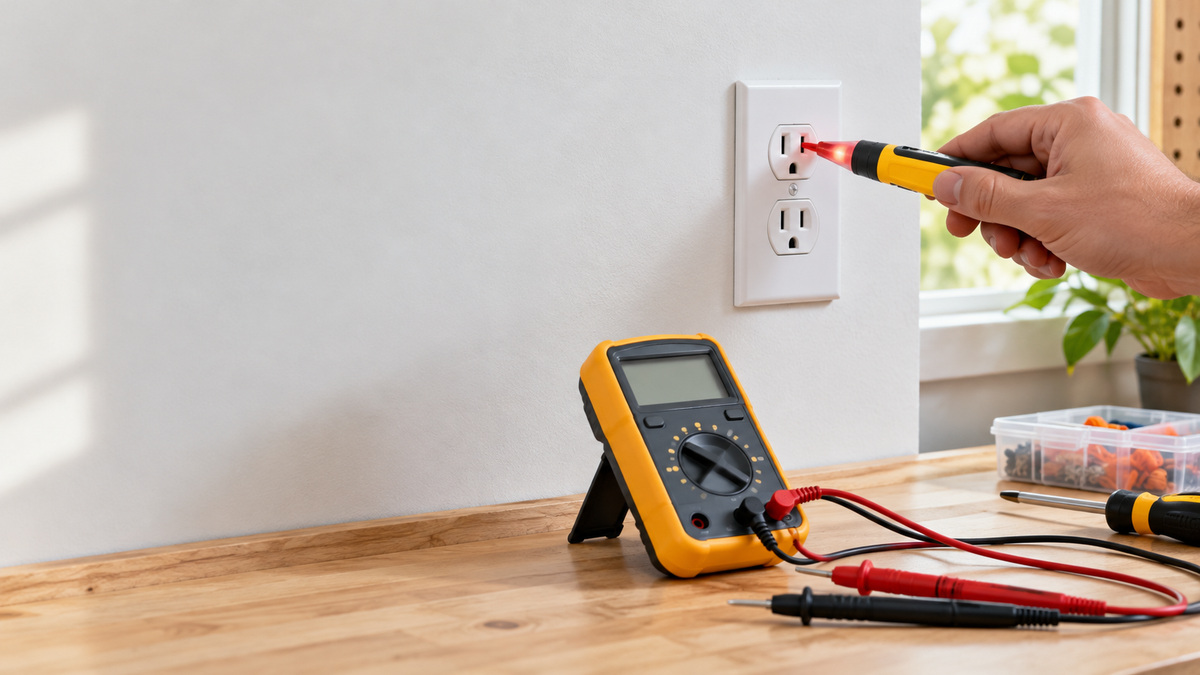
Electric tester covers a lot of ground, from a pen that beeps near live voltage to a multimeter that gives you numbers. This guide compares six testers by job: quick live-wire screening, outlet wiring and GFCI checks, and measured volts, current and continuity for batteries and car circuits.
No single tool does everything, so start with the question you need answered. Work on mains circuits can kill. Match the CAT rating to the circuit and leave panel or service work to a licensed electrician.
Quick answer
For fast live-wire screening, use a non-contact pen. The Neoteck lists 12-1000V AC, the Fluke 1AC II lists 90 to 1000 V AC, and the MXCOIRTP has three adjustable sensitivity levels. For outlet wiring and GFCI checks, the Klein Tools 80025 kit pairs an outlet tester with a pen. For measured values on batteries, fuses, continuity or car circuits, use a multimeter such as the AstroAI or the LJPXHHU. Pens in this group read AC only, so they will not check a car battery.
Comparison table
| Model | Type | What it covers | Shows a number? | Rating wording |
|---|---|---|---|---|
| Neoteck | Non-contact pen | AC 12-1000V | No | CAT III600V in a bullet; Specification Met lists CE |
| Klein Tools 80025 | Outlet tester plus pen | Receptacle wiring, GFCI test, voltage presence | No | No CAT rating or range stated |
| AstroAI | Digital multimeter | DC and AC voltage, DC current, resistance, continuity, diode | Yes, 2000 counts | CAT II 600 V; CAT Ill 300 V (as written) |
| Fluke 1AC II | Non-contact pen | Nominally 90 V AC to 1000 V AC | No | CAT IV mentioned; check the tool marking |
| MXCOIRTP MT01 | Non-contact pen | AC 12V/48V/70V-1000V in three levels | No | Not stated |
| LJPXHHU | Digital multimeter | Voltage, current, ohm, continuity per title | Yes | Not stated on this card |
The six testers
Neoteck 12-1000V AC pen: first safety checks
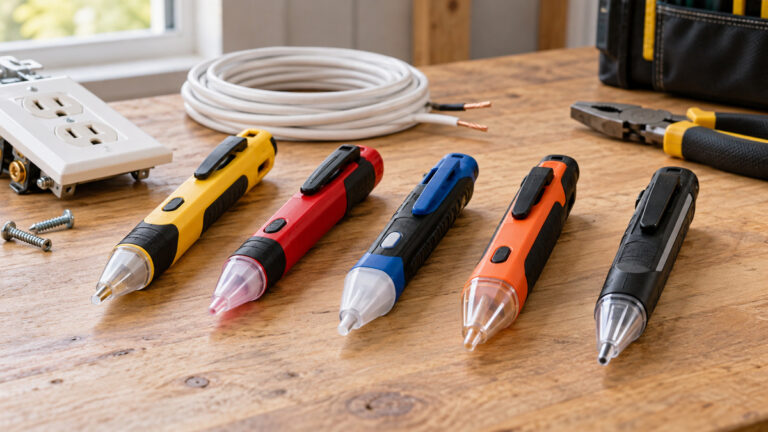
This battery-powered pen screens for AC voltage without touching metal. It weighs 65 g, measures 6.3 x 0.79 x 0.79 inches and uses two AAA batteries. It has an LED flashlight, a beeper and a pocket clip, and the bullets say it tells live from null wires with different beeps and LED levels. It suits renters, homeowners and DIY users who want a check before changing a lamp, switch cover or outlet plate.
Pros
- Low stated start voltage of 12V AC
- Flashlight and pocket clip
- Works near breakers, fixtures, switches, outlets and wires per the bullets
Cons
- It shows no volts and no DC
- The listing says it is not suitable for Christmas light testing
- A bullet says CAT III600V while Specification Met lists only CE, so confirm in the manual
Skip if: you need numbers, DC readings or outlet diagnosis.
Neoteck voltage detector on Amazon (affiliate link)
Klein Tools 80025 kit: outlet and GFCI answers
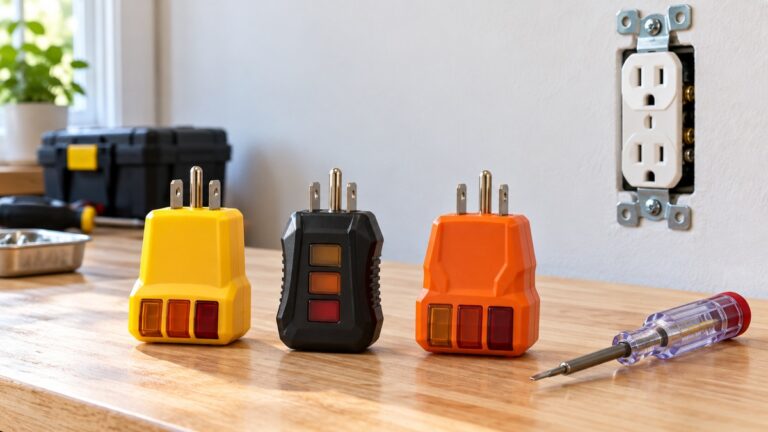
This two-piece kit pairs a GFCI outlet tester (Cat. No. RT210) with a non-contact voltage pen. The bullets say it finds wiring faults in standard and GFCI receptacles and confirms that ground fault protection works. The pen detects voltage in cables, breakers, fixtures and switches, with a green LED, a red LED and a warning tone. It suits home inspectors, landlords and buyers checking outlets.
Pros
- Checks receptacle wiring, which a pen alone cannot do
- Includes a pen for quick voltage presence checks
Cons
- No CAT rating, voltage range, counts or True RMS is stated
- It gives no measured volts
Skip if: you need measured volts or car DC work.
Klein Tools 80025 kit on Amazon (affiliate link)
AstroAI multimeter: measured values on a budget
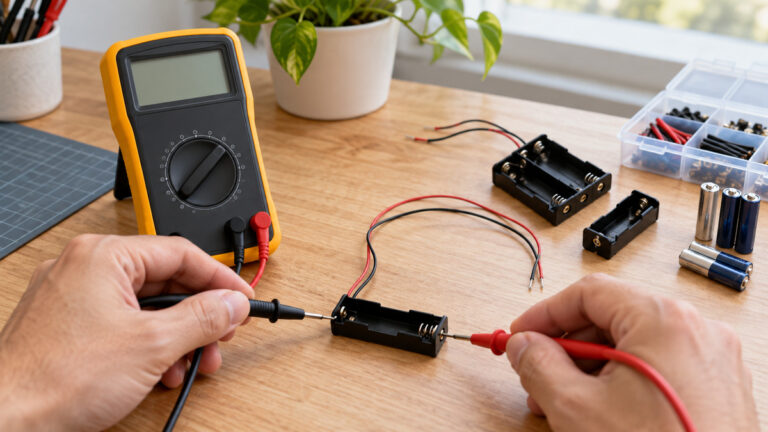
This compact multimeter has manual range selection and a 2000-count display. Listed ranges are DC voltage 200mV/2V/20V/200V/600V, AC voltage 200V/600V and DC current 200µA/200mA/10A, with fuses of F250 mA/250 V and F10 A/250 V. The Environmental Conditions field reads CAT II 600 V; CAT Ill 300 V. It suits students, car owners and beginners who need readings, not just an alert.
Pros
- Reads volts, current, resistance and continuity
- Covers DC for batteries and car circuits as well as AC
Cons
- Range selection is manual, so you must set the dial and jacks correctly
- Battery wording conflicts: the specs say two AAA batteries, the box list says a 9V battery. Check the listing before buying spares
Skip if: you want non-contact screening only or auto-ranging. Related reading: Voltage Meter Testers.
AstroAI digital multimeter on Amazon (affiliate link)
Fluke 1AC II VoltAlert: pocket pen for simple AC checks
This pocket-sized detector lists a sensing range of nominally 90 V AC to 1000 V AC. It weighs 59 g, has one high-intensity red LED tip and a beeper, and comes with two AAA alkaline batteries with typical life of more than one year. The bullets add continuous self-test and an audible or silent mode. It suits anyone who wants a minimal pen for quick presence checks.
Pros
- Self-test while on
- Silent mode
- Batteries included
Cons
- It does not measure volts, continuity or current, and lists no DC coverage
- The higher 90 V AC start means it will not sense below that
- CAT IV is mentioned, but confirm the exact marking on the tool and manual
Skip if: you need numbers, outlet fault codes or car testing. Compare with Fluke Non Contact Voltage Testers.
Fluke 1AC II on Amazon (affiliate link)
MXCOIRTP MT01: adjustable-sensitivity pen
This compact pen lists three AC ranges, 12V, 48V and 70V to 1000V, selected with an S button and confirmed by buzzer counts. It has a detection light, a tail flashlight and a pocket hook, and it warns when battery voltage falls below 2.5V. It suits DIY users who get too many alerts from a fixed-sensitivity pen and want to step sensitivity up or down.
Pros
- Three sensitivity levels
- Flashlight and low-battery warning
Cons
- The listing does not state a CAT rating, counts or measured accuracy, so do not rely on it for household mains on rating alone
Skip if: you need outlet diagnosis or DC readings. See also Best Wire Tester Pen.
MXCOIRTP voltage tester on Amazon (affiliate link)
LJPXHHU multimeter: continuity, ohm, volt and amp functions
The title of this battery-powered multimeter lists battery voltage, continuity, ohm, volt, amp, and DC and AC current functions. The listing card gives only the brand, power source and style, so check the product page for exact ranges and the CAT rating. It suits readers who want another multimeter option for car and household low-voltage work.
Pros
- Broad function list in the title
Cons
- No ranges or CAT rating are given on this card
Skip if: you need confirmed ranges or a stated CAT rating before you buy.
LJPXHHU multimeter on Amazon (affiliate link)
Buying checklist
Match the tool to the question
Live or not? Use a non-contact pen. Wired correctly? Use an outlet tester. How many volts, and is the path continuous? Use a multimeter. A pen does not replace a meter when you need resistance or DC current.
Check AC and DC coverage
The pens here list AC voltage only. They will not read a battery. The multimeters list DC voltage and current, which suits car and battery work.
Think about car versus home
For a car, you need DC voltage and continuity, which means a multimeter such as the AstroAI or LJPXHHU. Disconnect and handle batteries safely, and stay away from airbag wiring and high-voltage hybrid or EV systems. For a home, a pen is a good first screen, and an outlet tester answers wiring questions. For vehicle-specific tools, see Wire Tester for Car. For general circuit checks, see Best Circuit Tester.
Read the CAT rating
CAT classifies live circuits by the energy available and by impulse voltages. Category II covers circuits directly connected to the low-voltage installation, and category IV covers the source of the installation. Quote CAT only from the listing or the tool marking. If a listing does not state one, do not treat the tool as safe for household mains.
Check size and carry
The Neoteck lists 6.3 x 0.79 x 0.79 inches and 65 g, and the Fluke lists 59 g. Compare those with the pocket or bag where you will carry the tester. For more on pens, see Contactless Voltage Testers.
FAQ
Should I choose contact or non-contact detection?
Choose non-contact for fast screening of outlets, switches and cords, because you do not touch bare metal. Choose a multimeter, which needs probe contact, when you need a measured number or a continuity check. A pen cannot do the multimeter’s job.
What voltage range must an electric tester cover?
Cover the circuit you plan to check. The pens here list 12-1000V AC or 90 V AC to 1000 V AC, and the AstroAI lists DC to 600V and AC to 600V.
How do CAT ratings affect the choice?
CAT ratings limit where a tester may be used. If a listing does not state one, do not treat the tool as safe for household mains.
Can a tester identify continuity or only voltage?
The non-contact pens only indicate voltage. Continuity needs a digital multimeter with leads, such as the AstroAI, which lists continuity and diode functions.
What battery and alert features are useful?
Look for a flashlight, a beeper and a low-battery warning. The MXCOIRTP warns when battery voltage is lower than 2.5V, and the Fluke has continuous self-test.
When is an electric tester not enough?
When you need a number or a measured path. Use a multimeter for volts, continuity or DC current, and a licensed electrician for panel work.
Closing note
Use a pen such as the Neoteck or Fluke for fast AC screening, the Klein 80025 kit for receptacle wiring and GFCI checks, and a multimeter such as the AstroAI when you need measured values. If a listing does not state the CAT rating your circuit needs, check the product page before buying.
Sources
- Reference source: an overview of measurement categories and CAT ratings