Non Contact Voltage Checker for Home Electrical Checks
As an Amazon Associate we earn from qualifying purchases. Details
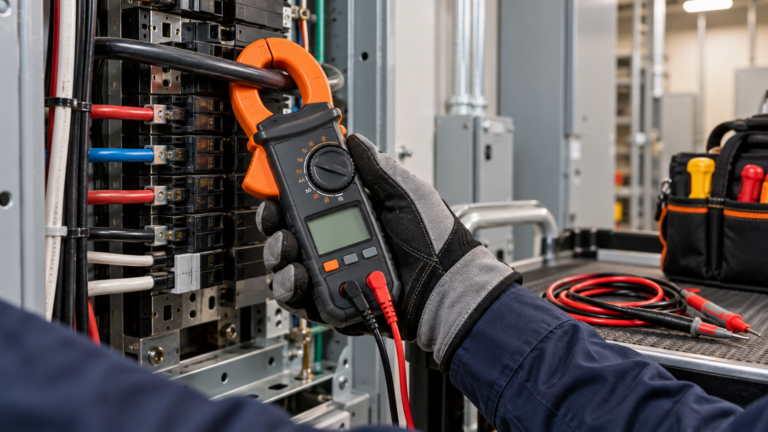
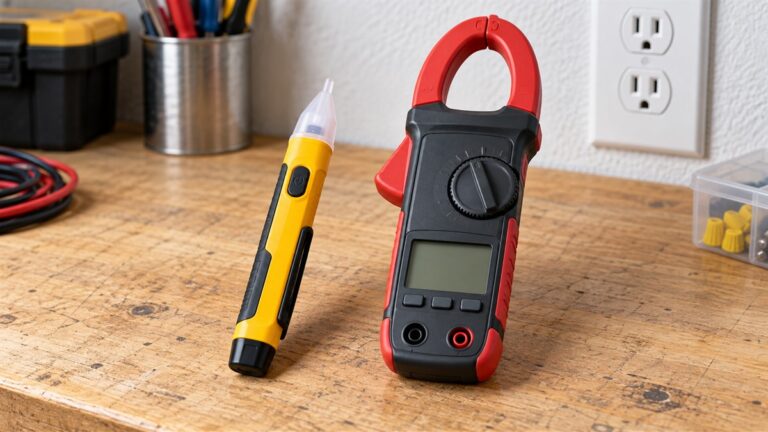
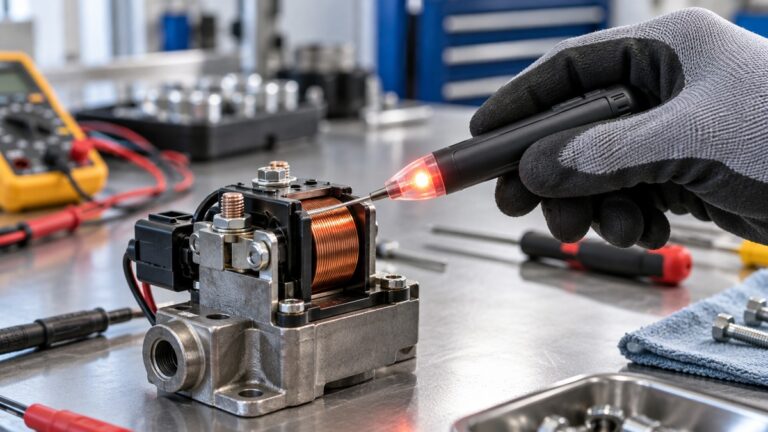
A non contact voltage checker tells you whether an AC wire, outlet, or switch may be live before you touch it. It senses the field around an energized conductor and signals with a light, a beep, or both. Use it as a quick first check at home, then confirm with a meter when the job calls for an actual voltage reading.
Compare detection range, sensitivity modes, alert types, power source, and CAT rating. Where a detail is missing, confirm it before you buy. A quiet tester is not proof that a circuit is dead, because shielding, distance, and placement all affect detection. Panel or service work belongs to a licensed electrician.
At a glance: the 6 picks, by sensing range and CAT rating
| Pick | Sensing range | CAT rating | Notable feature |
|---|---|---|---|
| Fluke 1AC II VoltAlert | 90V-1000V AC — no low-voltage sensing | CAT IV 1000V (per listing flags) | Pocket-sized, 59g, >1-year battery life |
| Neoteck PM8908C | 12V-1000V AC, single range | CAT III 600V (CE) | LED flashlight, 65g |
| yowexa YW-322 | High 12V-1000V, Low 48V-1000V (dual sensitivity, select before detection) | CAT III 1000V, CAT IV 600V | Breakpoint find, flashlight, lightest single-pen weight (45g) |
| VENLAB VD-200 | High 12V-1000V, Low 48V-1000V | Not stated in listing data | Color-coded tip (red/yellow) and beep-rate cues |
| Klein Tools NCVT7 | 12V-1000V AC | Not stated in listing data | LCD signal-strength bar graph, 3-color LED tip |
| Sperry STK001 Kit | 50V-1000V AC (detector) — no low-voltage sensing | CAT III 1000V, IV 600V (detector); CAT III 300V (GFCI tester) | Two-tool kit: detector + GFCI outlet tester, 10ft drop rated |
Specs are from each product’s Amazon listing, checked 2026-10-10 (full citations and individual write-ups in this guide’s sources section). Two of the six listings (VENLAB, Klein NCVT7) do not state a CAT rating in the data held — confirm directly on the current listing before relying on either for mains work.
Quick answer
If you want a simple non contact voltage checker for standard home wiring, choose a model with a 90-1000V AC range, red tip glow, and audible beeper. If you need to check doorbells, thermostats, or low-voltage control wiring, choose a dual-range non contact voltage sensor with a low-voltage high-sensitivity mode. For dark boxes and panels, choose a non contact voltage pen with a flashlight and strong visual alarm. Always test the checker on a known live source first, then test the circuit, then retest the checker. For any panel, service, or unknown wiring, call a licensed electrician.
What matters for a non contact voltage checker
1. AC detection range and sensitivity modes
A voltage checker only responds to AC voltage within its stated range. A 90-1000V AC tool fits standard household outlets, switches, and breakers. A low-voltage capable tool adds detection for thermostats, doorbells, and control circuits. Some tools add a second low-sensitivity mode such as 48-1000V AC or 70-1000V AC to reduce false alarms near crowded wires. Choose single-range if you only check mains wiring. Choose dual-range if you move between low-voltage and mains circuits. Check the listing for the exact range before you buy.
2. Alert style you can see and hear
You need a clear yes-or-no signal in a bright room or a dark box. Look for tip glow, LED bar, screen indication, beeper, and vibration. Some tools change beep rate or light color with signal strength. That helps you find the live wire in a bundle. If you work in noisy shops, visual alerts matter more. If you work in bright attics, audible alerts matter more. Confirm whether the tool has silent mode, low-battery warning, and auto shutoff.
3. CAT rating and intended circuit
A CAT rating tells you which kind of circuit a tester is built to be used on. The IEC groups circuits by how much energy is available at that point and how large a voltage spike can show up there. CAT II is meant for circuits wired straight from the low-voltage installation, while CAT IV is meant for work at the supply source of the installation. A higher CAT number does not make a tool universal. Match the listing CAT rating to your circuit. If the listing does not state a CAT rating, do not call the meter safe for household mains.
4. False positives and verification habit
A non contact voltage pen senses an electric field, so nearby live wires can trigger it. That is why listings describe live and neutral wire identification by comparing signal strength, not by one touch. A common rule of thumb is to test a known live outlet, test the dead circuit, then test the known live outlet again. This live-dead-live check is a simplification, but it catches dead batteries and wrong sensitivity settings. If you need to confirm zero voltage, use a contact tester compared with a multimeter.
5. Size, power, and extra tools
Most pens use 2 AAA batteries, include a pocket clip, and add a flashlight. Weight matters if you carry the tool daily. Listed weights here run from 45 g to 65 g for the pens listed in grams, plus models listed in ounces and kilograms. Extra tools change the choice: a GFCI tester helps check outlet wiring, a screwdriver tip helps open plates, and an LCD bar helps judge distance. For outlet checks at home, see a guide to the best voltage tester for home use. For pen-style tools, compare the best voltage tester pen.
Top non contact voltage checker picks by use
1. Fluke 1AC II VoltAlert Non-Contact Voltage Tester, Pocket-Sized, 90-1000V AC, Audible Beeper, CAT (Best overall)
Specs from the listing (checked 2026-10-10):
- Brand: Fluke
- Power Source: Alkaline
- Style: ACV DETECTOR 90-1000V
Pros
- Pocket-sized, with a 90-1000V AC range and an audible beeper
- Runs on alkaline batteries
Cons
- The low end starts at 90 V AC, so low-voltage sensing is not supported.
Best for: Homeowners wanting one simple pen for outlets, cords and switches.
Skip if: You need low-voltage or thermostat detection.
View on Amazon (affiliate link)
2. Neoteck Non Contact Voltage Detector 12-1000V AC Voltage Tester (Best compact fit)
Specs from the listing (checked 2026-10-10):
- Brand: Neoteck
- Power Source: Battery Powered
- Style: AC 12-1000V
Pros
- Lists a 12-1000V AC range that reaches low-voltage AC circuits
- Battery powered, with an LED flashlight
Cons
- It lists one AC range and CAT III 600V language, not dual modes.
Best for: DIYers wanting a 12-1000V AC pen with an LED flashlight.
Skip if: You need dual sensitivity or a stated CAT III 1000V rating.
View on Amazon (affiliate link)
3. Non Contact Voltage Tester Pen, AC 12/48-1000V Electric Tester Pen (Best stated feature set)
Specs from the listing (checked 2026-10-10):
- Brand: yowexa
- Power Source: Battery Powered
- Style: non-contact voltage tester
Pros
- Dual sensitivity, 12V and 48V lower limits
Cons
- Sensitivity must be selected before detection, not during it.
Best for: Users with false alarms in crowded boxes, using 12-1000V high or 48-1000V low sensitivity.
Skip if: You want single-button simplicity.
View on Amazon (affiliate link)
4. VENLAB Voltage Tester, Non Contact Voltage Detector, Circuit Tester Dual Range Voltage Sniffer (Best simple option)
Specs from the listing (checked 2026-10-10):
- Brand: VENLAB
- Power Source: Battery Powered
- Style: Voltage Tester
Pros
- High and low modes, color and sound cues
Cons
- The listing data does not state a CAT rating.
Best for: Beginners wanting color and sound cues for the 12V-1000V high and 48V-1000V low modes.
Skip if: You need a stated CAT rating.
View on Amazon (affiliate link)
5. Klein Tools NCVT7 Non-Contact Voltage Tester with LCD Signal Strength Display, 3-Color LED Tip (Best flexible setup)
Specs from the listing (checked 2026-10-10):
- Brand: KLEIN TOOLS
- Power Source: Battery Powered
- Style: Non-Contact Voltage Tester
Pros
- LCD bar graph for signal strength and a 3-color LED tip
Cons
- The listing data does not state a CAT rating, and it needs periodic battery changes.
Best for: Users who want an LCD bar graph and a 3-color LED tip near wire bundles.
Skip if: You need a stated CAT rating or dislike battery pens.
View on Amazon (affiliate link)
6. Sperry Instruments STK001 Non-Contact Voltage Tester (VD6504) & GFCI Outlet / Receptacle Tester (Best alternative)
Specs from the listing (checked 2026-10-10):
- Brand: SPERRY
- Power Source: Battery Powered
- Style: NC Tester & GFCI Tester Kit
Pros
- Includes a GFCI outlet tester
Cons
- Two-tool kit with a larger carry size, and the detector low end is 50V AC.
Best for: Homeowners wanting a non-contact detector plus a GFCI outlet tester.
Skip if: You want a pocket pen only.
View on Amazon (affiliate link)
Fluke 1AC II VoltAlert — simple mains checker
This Fluke non contact voltage checker is a pocket-sized AC detector for standard mains checks. The listing states a nominal 90 V AC to 1000 V AC sensing range, flat-tip probe, one high intensity red LED, and beeper sound when voltage is detected. It runs on 2 AAA alkaline batteries included, with typical battery life stated as greater than 1-year. Listed item weight is 59 g and listed dimensions are 10.24 x 7.5 x 1.46 inches. The listing flags mention CAT IV 1000 V and CAT IV Rating.
It fits homeowners who want one simple non contact voltage tester for outlets, cords, and switches on standard household systems. Continuous self-test and audible or silent mode help you confirm the tool is active before a check. Learn the basic steps in how to use a non contact voltage detector.
Who should skip it: skip if you need low-voltage or thermostat detection. The low end starts at 90 V AC, so the listing does not support low-voltage sensing. Check the listing for full CAT details and manual steps.
Neoteck PM8908C — low-voltage AC range with flashlight
This Neoteck non contact voltage detector lists 12-1000V AC range, audible beeps, LED alerts, and LED flashlight. The listing states item weight of 65 g, item dimensions of 6.3 x 0.79 x 0.79 inches, and 2×1.5V AAA batteries as included components. The bullets list CE CAT III 600V RoHS Certificate and describe live and null wire identification through alarm sound and LED level. It is styled as AC 12-1000V and orange in color.
It fits DIYers who want a non contact voltage pen for breakers, lighting fixtures, switches, outlets, and wires where low-voltage detection helps. The flashlight helps in dark boxes, and the pocket clip helps carry. The same range concept appears in guides to the best 12 volt non contact voltage detector.
Who should skip it: skip if you need dual sensitivity control or a stated CAT III 1000V rating. This listing states one AC range and CAT III 600V language, not dual high and low modes. Check the listing for manual and limits.
yowexa YW-322 — dual sensitivity for crowded boxes
This yowexa non contact voltage checker lists high sensitivity 12-1000V and low sensitivity 48-1000V at 50Hz/60Hz, with sound and light alarm. The listing states item weight of 45 g, item dimensions of 5.95 x 1 x 1.1 inches, safety level of CAT.III 1000V and CAT.IV 600V, and power supply of 2 x 1.5V AAA batteries included. Other functions listed are breakpoint find and flashlight, plus auto shutoff and low-battery alert.
It fits users who get false alarms in crowded switch boxes and want to switch sensitivity before detection. Faster beeps and more lights indicate stronger or closer AC source, which helps compare live and neutral wires. The 45 g listed weight is the lightest single-pen weight in this group.
Who should skip it: skip if you want single-button simplicity. You must select sensitivity before detection and avoid switching during detection. Check the listing for exact alarm behavior and CAT use limits.
VENLAB VD-200 — high and low modes with color tip
This VENLAB voltage checker lists high mode for 12V-1000V and low mode for 48V-1000V, with tip glow and beeper. The listing states blue color, item weight of 0.05 kg, model VD-200, and included components of 1 voltage tester and 2 AAA batteries. Bullets say red tip and high-frequency beep for high voltage, plus yellow light and low-frequency beep for low voltage. It also lists flashlight and red pointing light.
It fits beginners who want clear color and sound differences between strong and weak signals. That makes the choice easier when you check lamps, outlets, and switches that stopped working. The two-mode design also helps when you read about non contact voltage tester false positives.
Who should skip it: skip if you need a stated CAT rating in the listing. The listing data here does not state a CAT rating, so do not treat it as proven for household mains. Check the listing and manual for rating and use limits.
Klein Tools NCVT7 — LCD bar and 3-color tip
This Klein Tools non contact voltage checker lists 12-1000V AC detection in cables, cords, breakers, fixtures, switches, outlets, and wires. Bullets list LCD bar graph for signal strength, audible alert that changes rate with the bar graph, and 3-color LED tip where blue means low signal, red means high signal, and green means no voltage detected. The listing states item dimensions of 5.7 x 1.14 x 0.93 inches, item weight of 1.6 ounces, and slim pocket clip.
It fits users who want the most visual guidance while tracing non contact voltage near bundles. The bar graph helps you judge closer versus farther, and green gives a clearer no-voltage indication than a dark tip. For other Klein options, see the best Klein non contact voltage tester with laser distance.
Who should skip it: skip if you need a stated CAT rating in the listing data. The listing here does not state a CAT rating, so check the product listing and manual before mains use. Skip also if you dislike battery-powered pens that need periodic battery changes.
Sperry STK001 Kit — detector plus GFCI outlet tester
This Sperry kit pairs a VD6504 non-contact detector with a GFI6302 GFCI outlet tester. The detector bullets list 50-1000V AC sensitivity, 360-degree visual and beeping audio detection, and patented battery self-test feature. The outlet tester bullets list bright color-coded neon lights for visual indication. The listing states CAT Rating III 300V for GFI6302 and CAT Rating III 1000V, IV 600V for VD6504, plus 10 ft drop and 250 lb crush language. Item dimensions are 2 x 6 x 9 inches.
It fits homeowners who want both a non contact voltage sensor and an outlet wiring check in one buy. The GFCI tester helps spot common outlet miswiring, while the pen helps check for presence of AC voltage before troubleshooting. For outlet-focused work, compare the best voltage detector tester.
Who should skip it: skip if you want a pocket pen only. This is a two-tool kit with larger carry size, and the detector low end is 50V AC, not low-voltage sensing. Check the listing for GFCI tester limits and detector manual.
It fits pros and serious DIYers who work in loud, wet, or dusty places and want vibration plus light and sound. The lower low end helps with more control circuits than a mains-only tool, while the standard mode suits outlets. The rugged housing and self-test design suit daily carry.
Who should skip it: skip if you want the smallest pen or lower low-end sensing. At 7.95 x 1.77 x 2.48 inches and 4 ounces, it is larger than slim pens, and the low end stops at 24V. Check the listing for full CAT manual details.
How to choose a non contact voltage checker
Match the tool to the circuit you actually check. For standard home outlets and lights, 90-1000V AC is enough. For thermostats, doorbells, irrigation controls, and furnace circuits, look for low-voltage AC sensing or check the listing for the exact low end. Remember this is a voltage checker, not a multimeter. It tells you voltage may be present. It does not tell you the exact volts. If you need numbers, read non contact voltage tester vs multimeter.
Use sensitivity the right way. High sensitivity finds weak fields but also picks up nearby live wires. Low sensitivity such as 48-1000V AC or 70-1000V AC reduces nuisance alarms. Set sensitivity before you test. Keep the tip position steady. Move slowly along the wire. Compare both conductors. A stronger signal on one wire suggests live, while a weaker or absent signal suggests neutral, but no alarm alone does not prove dead.
Treat CAT ratings as limits, not marketing. The impulse voltage a tester must survive climbs with the category, from 500 V for CAT II 50 V up to 12,000 V for CAT IV 1000 V. That spread shows why location matters. An outlet inside the home and the service entrance do not see the same transient energy. Under IEC 61010-1, the maker must tell the user what transient withstand capability the tool has. If the listing does not state a CAT rating, write it down as unknown and do not use the tool to justify touching mains parts.
Size and pocket-carry check
Size and weight decide whether a detector rides in a shirt pocket or a tool bag. Listed weights run from 45 g for the yowexa and 59 g for the Fluke to 65 g for the Neoteck, 1.6 ounces for the Klein NCVT7 and 0.05 kg for the VENLAB. Pens near 6 inches long, such as the Neoteck at 6.3 x 0.79 x 0.79 inches and the yowexa at 5.95 x 1 x 1.1 inches, are the easiest to carry in a pocket clip.
Read the dimensions with care. The Fluke listing gives 10.24 x 7.5 x 1.46 inches, which is larger than a pocket pen and may describe packaging, and the Sperry kit lists 2 x 6 x 9 inches for two tools. Use the actual listing dimensions and the measurements of your space before ordering, and expect a two-tool kit to take more room than a single pen.
Common mistakes to avoid
Common mistakes include trusting silence as proof that a wire is dead, skipping the known-live check before and after, switching sensitivity during a reading, and assuming a pen has a CAT rating the listing never states. Do not compare a package measurement with an installed one, and do not let a flashlight or silent mode overrule the range and CAT fit for your circuit. Confirm the current listing, package contents and instructions for the exact pen you buy.
FAQ
Which non contact voltage checker suits standard home wiring?
The Fluke 1AC II lists a nominal 90 V AC to 1000 V AC range, a flat-tip probe, one high intensity red LED and a beeper with silent mode. That suits outlets, cords and switches on standard household systems. Its low end starts at 90 V AC, so it does not detect low-voltage AC, and it weighs 59 g.
How does the Neoteck differ for non contact voltage checker?
The Neoteck PM8908C lists 12-1000V AC, audible beeps, LED alerts and an LED flashlight, with 2×1.5V AAA batteries included and a weight of 65 g. Its bullets list CE CAT III 600V RoHS, and it offers one AC range rather than dual high and low modes. Check the listing for the manual and limits.
How does the yowexa differ for non contact voltage checker?
The yowexa YW-322 lists high sensitivity 12-1000V and low sensitivity 48-1000V at 50Hz/60Hz, with sound and light alarm, a flashlight, auto shutoff and a low-battery alert. Its safety level is CAT.III 1000V and CAT.IV 600V. You must select sensitivity before detection and not switch during it.
How does the VENLAB differ for non contact voltage checker?
The VENLAB VD-200 lists a high mode for 12V-1000V and a low mode for 48V-1000V, with a red tip and high-frequency beep for high voltage and a yellow light for low voltage. It also lists a flashlight and weighs 0.05 kg. The listing data here does not state a CAT rating, so do not treat it as proven for household mains.
How does the KLEIN TOOLS differ for non contact voltage checker?
The Klein Tools NCVT7 lists 12-1000V AC detection, an LCD bar graph for signal strength, an audible alert that changes rate with the bar graph and a 3-color LED tip. It measures 5.7 x 1.14 x 0.93 inches and weighs 1.6 ounces. The listing here does not state a CAT rating, so check the product listing and manual before mains use.
How does the SPERRY differ for non contact voltage checker?
The Sperry STK001 kit pairs a VD6504 non-contact detector, rated 50-1000V AC with a CAT Rating III 1000V, IV 600V, with a GFI6302 GFCI outlet tester. The detector low end is 50V AC, so it is not for low-voltage sensing, and the kit is larger than a single pen at 2 x 6 x 9 inches.
Bottom line
Choose the Fluke 1AC II for a simple 90-1000V AC pen on standard household wiring, the Neoteck for a 12-1000V AC pen with a flashlight, and the yowexa or VENLAB when you want switchable high and low sensitivity. Choose the Klein NCVT7 for an LCD bar graph and the Sperry STK001 if you also check outlets. If a listing does not state the CAT rating you need, check the product page before using the pen near mains.
Sources
- Measurement category: an overview of measurement categories and CAT ratings