Klein CL700 Clamp Meter: Specs, Uses and Buying Checks
Klein CL700 Clamp Meter: Specs, Uses and Buying Checks
As an Amazon Associate we earn from qualifying purchases.
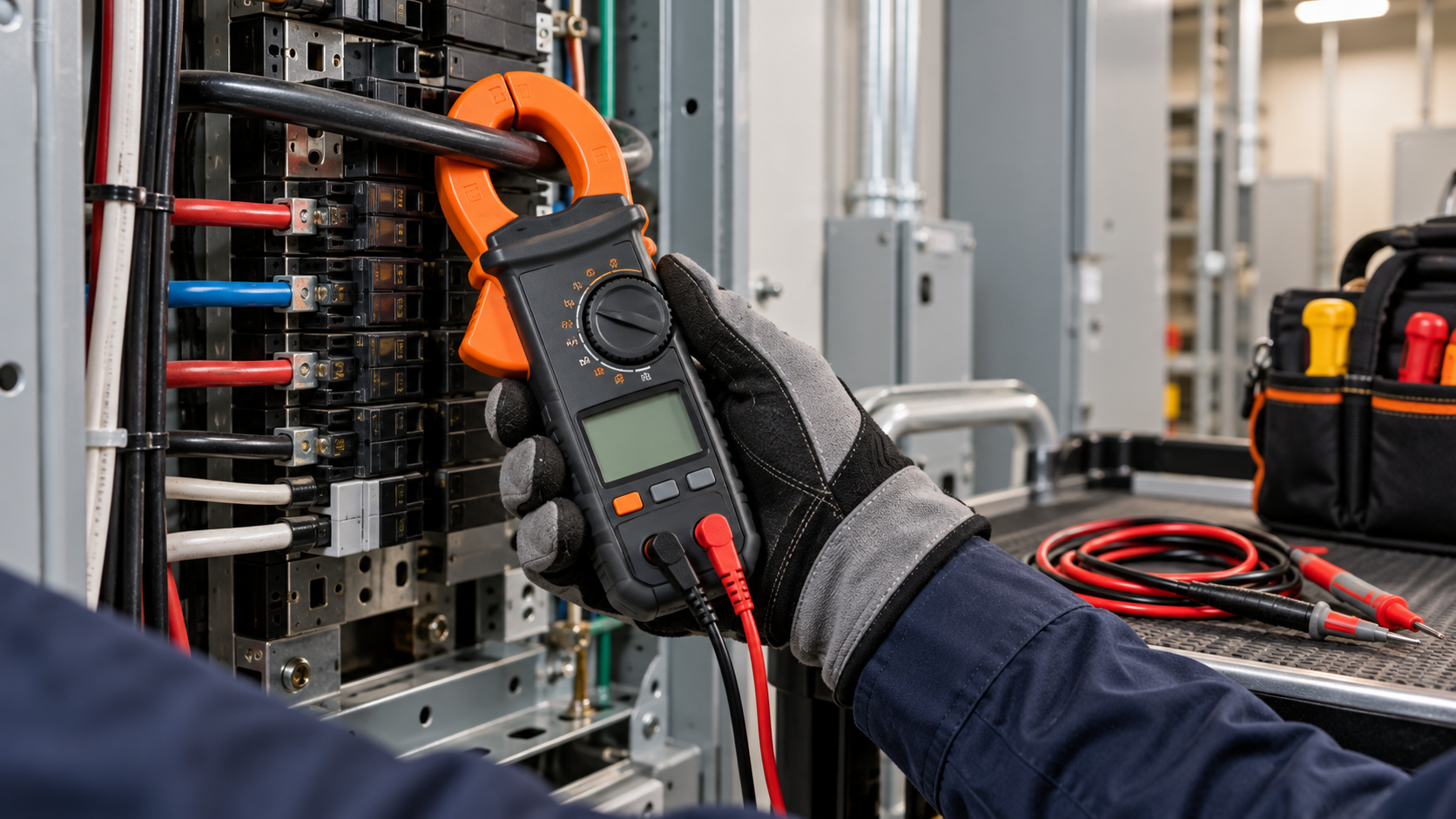
The Klein CL700 is an auto-ranging true RMS clamp meter. You clamp its jaws around a single insulated conductor to read AC current without breaking the circuit. Klein’s own product page for the CL700 now states that the model is no longer in production and points to a newer model. That matters before you buy, so this guide covers the specifications the manual states, the safety limits, and the buying checks that apply to a discontinued meter.
Quick answer
- The Klein CL700 measures AC current through its clamp, up to 600A, and measures AC and DC voltage, resistance, continuity, frequency, capacitance, and diodes through its test leads.
- Its stated ratings are CAT IV 600V and CAT III 1000V, Class 2, double insulation.
- The manual says clamping is not suitable for cables that contain both live and neutral wires, and recommends a line splitter for those.
- Klein’s product page says the CL700 is no longer in production. Check availability and the replacement model before you buy.
What the CL700 measures
The manual describes the CL700 as an automatically ranging true RMS digital clamp meter. It measures AC current through the clamp. It measures AC and DC voltage, resistance, continuity, frequency, and capacitance through its test leads. It tests diodes through the test leads and reads temperature when a thermocouple probe is used. It also has a Low Impedance mode, which Klein describes as a way to identify and eliminate ghost or stray voltages.
The Klein 2023 Clamp Meter Selection Guide lists the CL700 with a 600A AC current range and no DC current range. That matches the manual’s description. If you need to measure DC current, the CL700 is not the model to choose on that basis. For a broader look at clamp types, see the best clamp meter roundup and the clamp meter versus multimeter guide.
True RMS means the meter calculates the heating-equivalent value of a waveform, so readings on non-sinusoidal loads are more meaningful than with an average-responding meter. Klein’s manual uses the term without a long explanation, so treat it as a description of the meter’s type, not a promise about every load.
Ratings Klein publishes
The figures below come from the manual, the product page, and the selection guide. They are manufacturer figures, not measurements taken for this article.
- Safety rating: CAT IV 600V and CAT III 1000V, Class 2, double insulation, pollution degree 2.
- AC current: up to 600A, as stated in the selection guide and product page.
- Voltage: the product page lists 1000V AC and 1000V DC. The manual lists AC voltage ranges up to 1000V.
- Jaw size: 1.38 inch (3.5 cm), as stated on the product page.
- Operating temperature: 0 to 40 C (32 to 104 F). Storage: -10 to 60 C (14 to 140 F).
- Operating altitude: up to 2000 m (6562 ft). Relative humidity below 80 percent, non-condensing.
- Dimensions: 231 x 97 x 39 mm (9.09 x 3.82 x 1.54 in). Weight: 335 g (11.8 oz) including batteries.
- Drop protection: 2 m (6.6 ft). Calibration: stated as accurate for one year.
- Auto power-off: after about 30 minutes of inactivity, according to the manual.
The manual’s accuracy table gives a percentage of the reading plus a number of least significant digits, and it notes that the accuracy applies between 18 and 28 C. Outside that range, a temperature correction applies. Read the table for the function you plan to use, because the figures differ by function and range.
What CAT IV and CAT III mean for this meter
The CAT rating describes where the meter is designed to be used. The manual defines CAT III as circuits connected to the distribution part of the building’s low-voltage mains installation. It defines CAT IV as circuits connected at the source of that installation. The CL700 is rated CAT IV 600V and CAT III 1000V, which means its rating depends on the location and the voltage.
In practice, a higher CAT rating is not a promise that the meter is safe in any place. The rating is a limit. Work at the service entrance, on a utility feed, or inside a panel is for a licensed electrician who has the right equipment and training. Use the CL700 only within the category and voltage the manual states.
Safety limits from the manual
The CL700 manual includes several warnings that affect how you use it on a daily basis. These are the points that matter most for a home or trades user.
- Use caution when working with voltages above 25V AC RMS or 60V DC. The manual gives this as a caution point, and it applies every time you measure voltage.
- Do not use the clamp on a cable that contains both live and neutral conductors. The manual says clamping is not suitable for those cables, and recommends a line splitter, Klein Cat. No. 69409, for that job.
- Measure current only on a single conductor, as the manual specifies, with the jaws fully closed around it. Keep fingers clear of the probe tips, as the manual advises.
- Do not measure in CAT III or CAT IV locations with the shields removed. The manual says removing the shields in those locations increases arc-flash risk, and that shields may be removed only for CAT II locations.
- Keep the meter within the humidity limit the manual gives, below 80 percent and non-condensing.
Electrical work carries real risk. A clamp meter reading tells you current on one conductor. It does not tell you that a circuit is de-energized, that a connection is safe to touch, or that a panel is correctly wired. Those checks belong to a licensed electrician when the work is in a panel or on a service feed.
Auto power-off and the leads
The CL700 turns itself off after about 30 minutes of inactivity, according to the manual. The manual also explains how to deactivate that feature at power-on. If you leave the meter on in a live reading, check that the auto power-off has not ended the reading before you take it as final.
The test leads are used for voltage, resistance, continuity, diodes, and capacitance. The clamp is used for AC current. Keep the two functions separate in your head, because connecting leads to a circuit and clamping a conductor are different actions with different risks.
Low Impedance mode
The manual describes Low Impedance mode for identifying and eliminating ghost or stray voltages. A ghost voltage is a reading that appears on a de-energized conductor because of capacitive coupling from nearby live wiring. Low Impedance mode lowers the input impedance so that the reading drops when the voltage is not real. This is a useful check, but it is a diagnostic aid. It does not replace a proper voltage test on a circuit you are about to work on.
Buying checklist for a discontinued meter
- Check whether the CL700 is still in stock with a seller you trust. Klein’s product page says the model is no longer in production.
- Read the replacement model on the same page before you choose. This guide does not cover the replacement, and its specifications are not part of this article.
- Confirm the CAT IV 600V and CAT III 1000V ratings match the work you do.
- Confirm you do not need DC current. The selection guide lists no DC current range for the CL700.
- Check the jaw size against the conductors you need to clamp, using the 1.38 inch figure from Klein’s page.
- Check that the manual and the line splitter are available for the work you plan to do.
Mistakes to avoid
- Clamping a cable with both live and neutral inside. The manual says the reading is not suitable and recommends a line splitter.
- Treating a high CAT rating as permission to work inside a panel. The rating is a limit, not a license.
- Buying for DC current. The CL700 is listed for AC current through the clamp.
- Assuming a discontinued model will have the same availability or support as a current one. Check the seller and the replacement model.
- Reading ghost voltage as a real hazard or as proof of safety. Use the Low Impedance mode to interpret the reading, and then confirm with the right test.
How we chose
This guide does not rank the CL700 against other clamp meters, and it does not claim the model is a top pick. It covers one model using Klein’s own documents: the CL700 instruction manual, the product page that states the model is no longer in production, and the 2023 Clamp Meter Selection Guide. The criteria are the questions a buyer is likely to ask: what the meter measures, what its CAT ratings are, what the manual says about safe use, and whether the model is still sold. Each figure in this article comes from one of the three documents, and the Sources section gives the URL and the date each was opened.
What we could not verify
The documents do not give independent measurements of the CL700, and this guide does not state accuracy as a measured result. The sources do not say how the meter performs on every load, in every installation, or against other clamp meters. The product page does not give a price, a stock status, or a last-sold date, so this guide does not state them. The product page names the CL710 as the newer model, but this guide did not open the CL710 documents, so its specifications are not covered here.
FAQ
Is the Klein CL700 still made?
Klein’s product page says the CL700 is no longer in production and lists the CL710 as its newer model. Check current availability before you buy.
What is the maximum AC current the CL700 measures?
The selection guide and product page list 600A AC. The manual describes AC current measurement through the clamp.
Can the CL700 measure DC current?
No. The selection guide shows no DC current range for this model, so choose a different clamp if DC current is part of your work.
What is the CAT rating of the CL700?
The manual and product page state CAT IV 600V and CAT III 1000V, Class 2, double insulation.
Can I clamp a cable that has live and neutral in it?
The manual says clamping is not suitable for cables that contain both live and neutral wires. It recommends a line splitter, Klein Cat. No. 69409.
When does the CL700 turn off?
The manual states that it turns off after about 30 minutes of inactivity, and that the feature can be deactivated at power-on.
Bottom line
The Klein CL700 is a documented AC clamp meter with CAT IV 600V and CAT III 1000V ratings. Before you buy, confirm that it is still available, since Klein’s page says it is no longer in production. Use the line splitter for cables with live and neutral, and treat the CAT rating as a limit, not a license for panel work.
Sources
- Klein Tools, CL700 600A AC Auto-Ranging Digital Clamp Meter instruction manual. https://data.kleintools.com/sites/all/product_assets/documents/instructions/klein/CL700_Instructions_web.pdf (opened 2026-10-27)
- Klein Tools, Digital Clamp Meter, AC Auto-Ranging TRMS, Low Impedance (LoZ) Mode, CL700 product page. https://www.kleintools.com/catalog/clamp-meters/digital-clamp-meter-ac-auto-ranging-trms-low-impedance-loz-mode (opened 2026-10-27)
- Klein Tools, 2023 Clamp Meter Selection Guide, Rev. E. https://data.kleintools.com/sites/all/product_assets/documents/brochures/klein/2023%20Clamp%20Meter%20Selection%20Guide_RevE.pdf (opened 2026-10-27)