Clamp Meter vs Multimeter: Which One Do You Need?
As an Amazon Associate we earn from qualifying purchases. Details
Updated 19 October 2026
Author: Editorial team, bestmultimeter2020.com
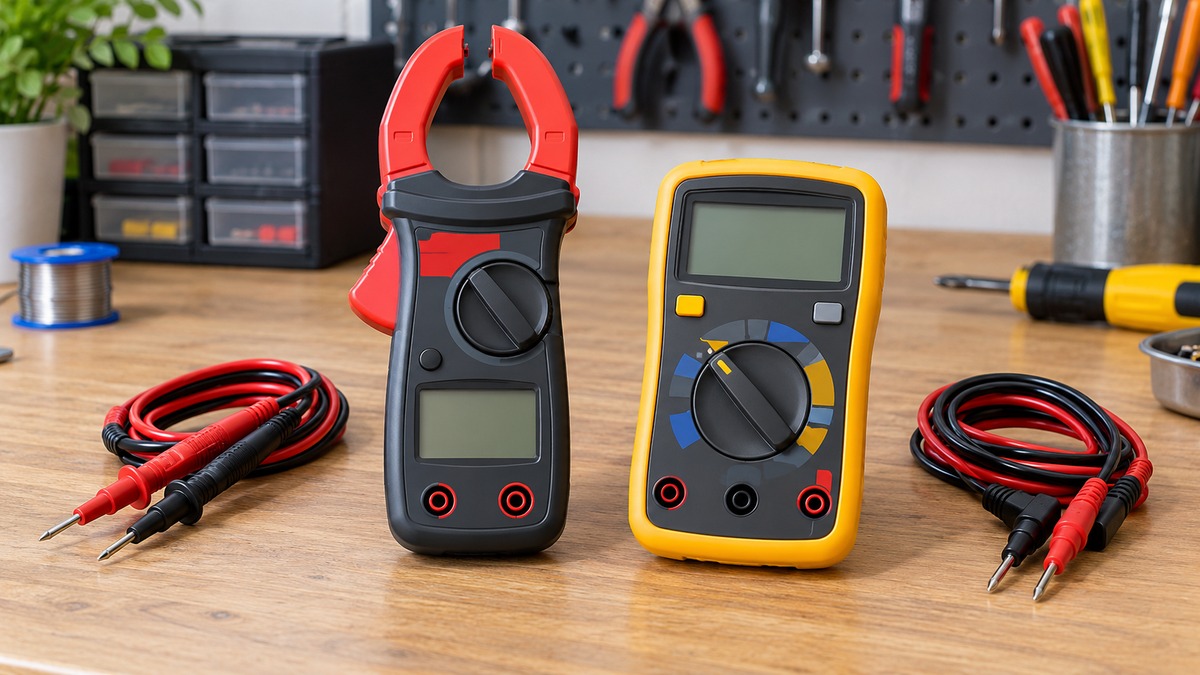
If you are comparing a clamp meter vs multimeter, the first question is whether you need to read current without opening the circuit. A clamp meter measures current through the magnetic field around a wire, so you clamp the jaws around one conductor and read the display. A digital multimeter reads current only if you break the circuit and place the meter in series, or if you add a clamp accessory. Each tool has a job the other does poorly, so the decision comes down to the measurement you need, not to which tool sounds more capable.
Quick answer
- Pick a clamp meter when you need current without breaking the circuit, and the wire is accessible enough to enclose.
- Pick a multimeter when you need fine resolution, resistance, continuity, diode checks, or a current reading in a series path.
- Many jobs need both. A clamp accessory lets a digital multimeter read current, and a clamp meter can also read voltage, so check the features on the model you are buying.
What each tool does well
The table below sets out the main differences in plain terms. The entries come from the Fluke comparison article and the Fluke clamp accessory guide, with the multimeter entries drawn from Fluke’s and the LibreTexts ammeter explanation.
| Job | Clamp meter | Digital multimeter |
|---|---|---|
| Current without breaking the circuit | Yes. The jaws enclose a conductor and read the current | Only with a clamp accessory attached, or by breaking the circuit |
| Fine steps on small values | Coarser. The Fluke comparison says a clamp usually reads to the nearest tenth or hundredth of a unit | Finer. The same article says a DMM measures in milliunits |
| Resistance, continuity and diodes | Not the main function | Yes, these are standard functions |
| Voltage | Some clamp meters have voltage functions | Yes |
| Current in a series path | No. The clamp does not open a wire for you | Yes, with the meter placed in series |
| DC current | Only with a clamp that reads DC, or both AC and DC | Only with an accessory that reads DC, or by placing the meter in series |
The Fluke comparison article describes the clamp this way: “A clamp allows you to measure current without breaking the circuit and get a current reading.” The same article says a multimeter “can measure higher currents if a plug-in clamp accessory is attached.” That second line is worth noting. A multimeter with a clamp accessory is a clamp meter in function, and the accessory’s own specification sets the current range.
How a clamp reads current
The Fluke clamp accessory guide gives a sequence. First, determine whether the current is AC or DC. The guide’s words are “Determine if the current to be measured is ac or dc.” Second, select a clamp that is designed for that current, or one that can measure both AC and DC. Third, read the value, with the clamp and the meter set to match. The guide also reminds the reader to check whether the clamp outputs a current level or a voltage level, because an accessory’s output must match the meter’s input setting.
The clamp’s DC capability is the detail most often missed. A clamp that reads only AC will show nothing useful on a DC circuit, and the display gives no warning that the reading is wrong. Read the clamp’s label and manual before you start, so the function you select matches the current you measure.
How a multimeter reads current
A multimeter measures current by putting the meter into the circuit. The LibreTexts ammeter explanation puts it this way: break the circuit open and insert the meter in series so that all the current flows through it. The reading then shows the current in that path.
The same explanation warns about the opposite mistake. “Consequently, an ammeter will act as a short circuit if placed in parallel (across the terminals of) a substantial source of voltage.” A meter in current mode across a voltage source creates a short, and the surge can blow the meter’s internal fuse. The fuse protects the meter, not the circuit, and the meter is out of service until the fuse is replaced.
The LibreTexts guide also advises a sequence for a manually ranged meter: start on the highest current range, then step down until the reading is strong without going over the range. Many modern digital meters range automatically, but the cautions about series connection and the fuse still apply.
Resolution: a calculation with the numbers
Resolution tells you the smallest step the meter can show. The counts figure is the number of steps across a range, and the formula is simple:
Resolution = measuring range divided by counts.
The Fluke ABCs document describes meters with resolutions of up to 3,200, 4,000, or 6,000 counts, so a 6,000-count multimeter is a realistic example. We apply it below with two numbers from the sources: a 600 mA range for the multimeter, and the clamp comparison’s step of 0.01 A, which is the hundredth-of-a-unit level the clamp article describes.
- Multimeter step on a 600 mA range with 6,000 counts = 600 mA divided by 6,000 = 0.1 mA per count.
- Clamp step at the hundredth-of-an-amp level = 0.01 A, which is 10 mA per count.
- Ratio of clamp step to multimeter step = 10 mA divided by 0.1 mA = 100.
On this example the multimeter steps 100 times finer than the clamp. These numbers are our arithmetic from the stated counts and step sizes. They are not readings from any product, and a real clamp or meter may differ from these figures.
The same arithmetic shows why the difference matters at a given current. Take a 0.5 A current, a value in the range the clamp article describes.
- Clamp step as a share of the reading = 0.01 A divided by 0.5 A = 0.02, or 2 percent.
- Multimeter step as a share of the reading = 0.0001 A divided by 0.5 A = 0.0002, or 0.02 percent.
The multimeter gives a finer step at this size, but only on a range and in a path where you can place it in series. For a quick reading on a live conductor, the clamp gives the answer with no break in the circuit. Choose by the trade-off in front of you.
Choosing for a real measurement
Three examples show how the choice works in practice. They are illustrations of the trade-off, not product advice.
First, suppose you want the current in a running motor’s supply conductor. The clamp fits this job because the Fluke comparison says a clamp “allows you to measure current without breaking the circuit.” A multimeter would need the circuit opened, and the sources we opened give no reason to open a live motor circuit for a reading.
Second, suppose you want the current drawn by a small battery-powered device, in the milliamp range. The LibreTexts guide describes this kind of measurement, with the meter in series and the current in thousandths of an amp. The multimeter is the better fit, because its series mode and finer steps suit a small current in a path you can open.
Third, suppose you need voltage and current at the same time to troubleshoot a load. The Fluke comparison says effective troubleshooting often needs one meter for current and another for voltage. A clamp meter with a voltage function can cover both on some models, so check the specification before you buy, and do not assume every clamp reads voltage.
One clamp and one multimeter to compare
The two picks below come from the product data for this keyword. They are not a ranking. One is a clamp meter and the other is a multimeter, so each card shows one side of the choice. The card lists what the listing says about each, and where the listing is silent we say so rather than fill the gap.
1. Klein Tools CL120 Digital Clamp Meter, Auto-Ranging 400 Amp AC (Clamp side: AC current without opening the circuit)
Specs from the listing (checked 2026-10-11):
- Measurement Type: Ammeter, Voltmeter, Ohmmeter
- Specification Met: Double Insulation Safety Rating, Ce Certified
Pros
- Auto-ranging AC current clamp, listed as 400 Amp AC in the title
- Test leads with CAT III and CAT IV safety caps are included
- Also reads AC and DC voltage, resistance and continuity through the test leads
Cons
- The listing gives the clamp's current function as AC and does not state DC current through the jaws
- Non-contact voltage detection is built into the jaw, which does not replace a voltage tester check
Best for: AC current on a conductor you cannot open, with voltage and continuity checks from the leads
Skip if: You need DC current through the clamp, because the listing does not state that capability
View on Amazon (affiliate link)
2. AstroAI Digital Multimeter Tester 2000 Counts with DC AC Voltmeter and Ohm Volt Amp Meter; Measures (Multimeter side: voltage, resistance, diode and small current)
Specs from the listing (checked 2026-10-11):
- Environmental Conditions: CAT II 600 V; CAT Ill 300 V
- Range Selection: Manual
- Fuse Protection: mA: F250 mA/250 V Fuse;10 A: F10 A/250 V Fuse
Pros
- The bullets list AC and DC voltage, DC current, resistance and diode functions
- Double fuse on the mA and 10 A current inputs, F250 mA/250 V and F10 A/250 V
- Batteries, test leads and a user manual are included according to the listing
Cons
- The listing gives CAT II 600 V and CAT III 300 V, not a CAT III 600 V rating
- Manual range selection with 2000 counts gives a coarser step than a 6000-count meter
Best for: Voltage, resistance, diode and small DC current checks where the meter can go in series
Skip if: You need a CAT III 600 V rating or higher, or a 6000-count display for fine steps
View on Amazon (affiliate link)
The clamp card shows the first limit to check before you buy a clamp: the listing states AC current through the jaws and does not state DC current. A DC reading from a clamp needs a model that says it reads DC. The multimeter card shows the other limit. Its listing gives CAT II 600 V and CAT III 300 V, so a job that calls for a higher CAT rating needs a different meter, and its 2000-count display gives a coarser step than the 6000-count meters in the same product set.
Put the two cards next to the trade-off from earlier. A clamp takes the current reading without a break in the circuit. A multimeter takes the finer step and the resistance and diode checks, but for current it needs a series path or a clamp accessory. A kit with one of each covers both needs, provided each piece carries a rating that fits the job.
Safety for both tools
Use the CAT rating before you measure, whichever tool you choose. The Fluke ruggedness article says clamp meters that are not CAT-rated “should never be used in high-energy, three-phase electrical work environments.” That is a limit on the clamp’s use, and it applies to a multimeter with a clamp accessory too. The rating is usually printed near the input jacks, according to the same article, so read it before connecting the meter.
Do not place a multimeter in current mode across a voltage source. The LibreTexts explanation describes the short and the blown fuse, and a blown fuse leaves the meter unable to read current until it is replaced. If a current range stops reading, check the meter’s fuse before you blame the circuit.
Panels, service equipment and other high-energy work are outside this guide. A licensed electrician should do or direct that work, whichever meter the job suggests. The sources we opened also do not cover clamp work inside a panel, so do not treat a clamp reading as a reason to open one.
How we chose
We chose the Fluke pages because they compare the two tool types directly, and because they describe the clamp accessory and the current measurement steps. The LibreTexts ammeter explanation covers the series connection and the fuse in more depth than the manufacturer pages do, so we used it for the multimeter side. The Fluke ruggedness article covers the CAT rating point. We did not use retailer, review or blog pages, and we did not use Wikipedia for any safety or procedure claim. The guide lists no products and gives no prices.
What we could not verify
- The sources we opened do not give clamp accuracy figures or resolution for any specific clamp or multimeter model. The resolution calculation above uses stated counts and step sizes, not a product’s measured performance.
- The sources do not say how a clamp behaves on a conductor that sits in a bundle with other conductors, so we do not make a claim about that.
- The sources do not give current ratings for specific clamp models. Check the manual for each tool.
- The sources do not compare brands. Fluke’s pages describe Fluke tools, and the LibreTexts text is an open textbook, not a product test.
FAQ
Can a multimeter measure current without a clamp?
Yes, but the usual method is to break the circuit and place the meter in series, as the LibreTexts ammeter explanation describes. A multimeter can also read current with a plug-in clamp accessory, which the Fluke comparison article notes. Either way, check the meter’s current range and fuse before you start.
Can a clamp meter measure DC current?
Some can, and some cannot. The Fluke clamp accessory guide tells the reader to select a clamp designed for the current, or one that measures both AC and DC. Read the clamp’s label and manual, because a clamp that reads only AC will not give a usable DC reading.
Why does a clamp meter show a coarser reading than a multimeter?
The Fluke comparison article says a clamp usually reads to the nearest tenth or hundredth of a unit, while a multimeter works in milliunits. Using the resolution formula above, a clamp step of 0.01 A is 100 times coarser than a 0.1 mA step from a 6,000-count multimeter on a 600 mA range.
Which should a homeowner buy first?
It depends on the first job. If the work is checking circuits without opening them and reading current on a running load, a clamp meter is the more direct tool. If the work is continuity, resistance, diodes and small currents in an open path, a multimeter is the better first buy. Check the CAT rating on either meter before you use it on mains.
Is a clamp meter safer than a multimeter for current?
The sources we opened do not say one is safer in every case. The clamp avoids breaking the circuit, which the Fluke comparison describes as an advantage, but the CAT rating still limits where either tool may be used. Neither tool replaces a licensed electrician for panel or service work.
Bottom line
Use a clamp meter when you need current without breaking the circuit, and a multimeter when you need fine steps, resistance, diodes or a series current reading. Check the CAT rating and the current function before you measure, and leave panel and service work to a licensed electrician.
For the basic clamp steps, read how to use a clamp meter. For a quick voltage check before any meter reading, the non-contact voltage tester vs multimeter comparison covers that choice.
Sources
- Fluke learn: Clamp meters vs digital multimeters: clamp versus DMM current, the clamp accessory, and the resolution comparison in milliunits and tenths or hundredths
- Fluke learn: How to measure current with a digital multimeter plus clamp accessory: the AC or DC step, the clamp selection rule and the output-type check
- LibreTexts: How to Use an Ammeter to Measure Current (Kuphaldt): the series connection, the parallel short and the internal meter fuse
- Fluke learn: Why ruggedness matters in a clamp meter: the CAT rating definition, the rating location near the input jacks and the rule for non-CAT-rated clamp meters
- Fluke learn: Digital multimeters, ABCs of DMMs (PDF): the counts figures used in the resolution example