Small Voltmeter
As an Amazon Associate we earn from qualifying purchases. Details
A search for a small voltmeter can mean two different products: a tiny LED panel meter that you wire into a project, or a pocket-size multimeter that you carry. The listings below cover both. Three are panel voltmeters for DC projects and vehicles, two are pen-style multimeters, and two are pocket multimeters. Specifications come from the Amazon listings, checked 2026-10-17. The RataKoapa listing gives two different system voltages in its title and bullets, so we show that conflict instead of choosing for you.
Quick answer
For a permanent readout on a DC project, the bayite 3-wire panel meter reads from 0.00 to 30V, while the diymore 2-wire meters need a minimum of 2.5V to 3.2V to power up. For a vehicle or boat battery, the RataKoapa round gauge lists 8-48V. For a meter you carry, the allsun EM3085 is auto-ranging with a listed CAT II 600V rating, and the allsun mini folding meter is manual-range.
Panel voltmeter or pocket meter?
A panel voltmeter shows one thing, DC voltage, all the time. It has no probes. You wire it to the circuit and mount it. A pocket multimeter measures voltage, resistance and more, but only while you hold the probes on the circuit. If you want to watch a battery or power supply continuously, take a panel meter. If you want to check voltages in different places, take a pocket meter or a pen meter.
Seven small voltmeters compared
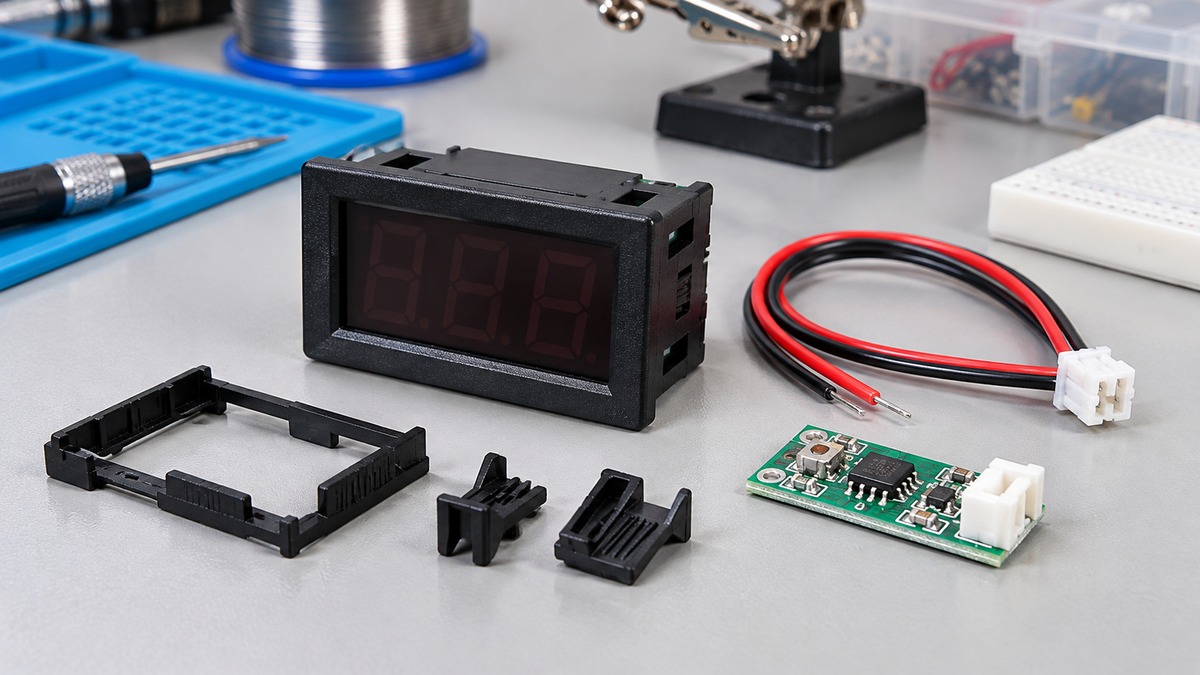
- diymore 8-pack 0.28 inch 2-wire (B08RYPRZFF): DC 2.5V to 30V, four LED colors, reverse polarity protection.
- bayite 5-pack 3-wire (B00YALV0NG): DC 0 to 30V, 0.36 inch blue display, calibratable.
- RataKoapa round gauge (B0GHRHWPYB): DC 8-48V, 0.1V resolution, waterproof, 1.1 inch mounting hole.
- ALLOSUN EM3085 (B08HK295HK): pocket multimeter, auto-range, NCV, CAT II 600V, one AAA battery.
- allsun mini folding multimeter (B07BRFN9FY): manual range, DC and AC volts, no auto off.
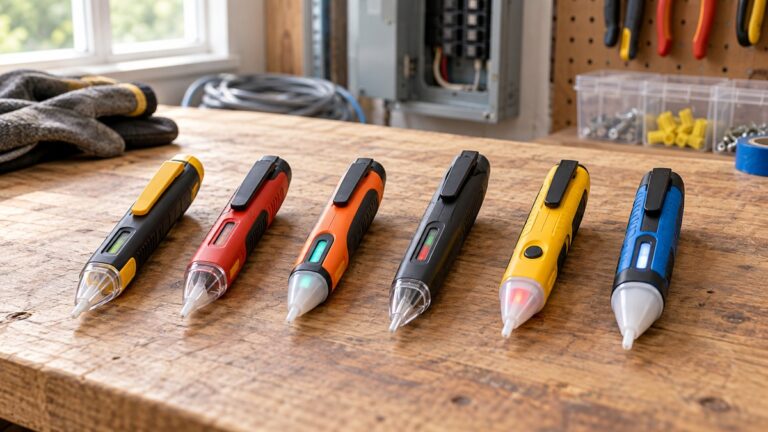
- SNAKOL SK216 pen multimeter (B0D69TGPHS): DC/AC 2V to 600V, NCV, backlit.
- ANENG A3005 pen multimeter (B0BX3QXM31): 4000 count, NCV, flashlight, 5 minute auto shutdown.
Panel voltmeters
1. bayite 5-pack 3-wire DC voltmeter: best for readings from 0V
Specs (from the listing, checked 2026-10-17): three-wire connection; 0.00 to 30V; accuracy 0.01 from 0.01 to 9.99V and 0.1 from 10.0 to 30.0V; three 0.36 inch LED digits in blue; calibratable by a screw on the back; reverse polarity protection (the screen shows nothing if connected backward). The listing says two-wire meters cannot measure below 3V.
Pros: reads from 0V, calibration screw, five meters in the pack. Cons: the listing says it will be damaged above 30V; three-wire hookup is more work than two-wire.
Best for: projects that need to show low voltages. Skip if: your supply can exceed 30V.
View on Amazon (affiliate link)
2. diymore 8-pack 0.28 inch 2-wire voltmeter: best for the simplest wiring
Specs (from the listing, checked 2026-10-17): two-wire connection; 0.28 inch display; maximum input DC 30V; reverse polarity protection; accuracy 0.01V below 10V and 0.1V above 10V. The listing gives different minimum voltages by color: red 2.5V, yellow and green 2.6V, blue 3.2V, all up to 30V.
Pros: two wires, small, eight in the pack. Cons: the meter is powered by the circuit it measures, so it cannot show anything below its color’s minimum voltage.
Best for: a quick readout on a 5V, 12V or 24V project. Skip if: you need to read below 2.5V.
View on Amazon (affiliate link)
3. RataKoapa round 12V/24V battery voltmeter: best for vehicles and boats
Specs (from the listing, checked 2026-10-17): DC 8-48V; 0.1V precision; 3-digit blue LED; waterproof structure; mounts in a 1.1 inch hole with the included panel and nylon nut; wires and screws included.
Listing conflict: the title says 12 Volt, 24 Volt and 36 Volt, while the bullets say it “works perfectly with DC 12V and 24V power systems” and give a range of DC 8-48V. A 36V pack falls inside 8-48V, but the bullets do not name 36V systems. Check the product page if you need it.
Pros: waterproof, mounting parts included, wider range than the 30V meters. Cons: 0.1V resolution only.
Best for: cars, motorcycles, RVs and boats. Skip if: you need 0.01V resolution.
View on Amazon (affiliate link)
Pocket and pen multimeters
4. ALLOSUN EM3085: best for an auto-ranging pocket multimeter
Specs (from the listing, checked 2026-10-17): 3 3/4 digits, auto-range, pocket size; measures DC and AC voltage, DC and AC current, resistance, continuity, diode, capacitance and frequency; non-contact AC voltage detection; data hold; automatic power-off; one 1.5V AAA battery (not included); built-in 500mA/250V fuse; designed according to IEC 61010 with a measurement category of CAT II 600V and pollution degree 2.
Pros: a stated CAT rating and fuse, many functions in a small body. Cons: the battery is not included.
Best for: a pocket meter that still lists a category rating. Skip if: you only need a fixed DC readout.
View on Amazon (affiliate link)
5. allsun Mini Digital Multimeter (folding): best for a glove box meter
Specs (from the listing, checked 2026-10-17): manual range; no auto off; not auto-ranging; DC volts, AC volts, ohms, amps and continuity with tone. The listing says to remove the tape insulating the battery before first use, and that it is “not made for commercial use or handling large loads and heavy use.”
Pros: folds small; the listing names battery checks and continuity as uses. Cons: you pick the range yourself, and no category rating is listed.
Best for: a spare meter for a car or tool box. Skip if: you want auto-ranging.
View on Amazon (affiliate link)
6. SNAKOL SK216 pen multimeter: best for a pen shape with a backlit LCD
Specs (from the listing, checked 2026-10-17): DC/AC volts from 2V to 600V; resistance 4k ohm to 40M ohm; continuity buzzer for resistance below 50 ohm; NCV with an analog bar and beeps; backlit LCD; low-battery indicator; built-in light; includes 2 x 1.5V AAA batteries, a probe and a manual.
Pros: batteries included, NCV and live/null wire detection. Cons: the listing states no category rating.
Best for: a pocket pen that does voltage and basic continuity. Skip if: you need current measurement.
View on Amazon (affiliate link)
7. ANENG A3005 pen multimeter: best for capacitance and a flashlight in a pen
Specs (from the listing, checked 2026-10-17): 4000 count; AC/DC voltage, resistance, continuity, capacitance and diode testing; live wire detection; NCV; built-in flashlight; large backlit screen; pen clip and cap; automatic shutdown after 5 minutes; includes a test lead and 2 x 1.5V AAA batteries.
Pros: capacitance is listed, batteries included, auto shutdown. Cons: the listing gives no maximum voltage and no category rating.
Best for: a pen meter with a flashlight. Skip if: you need a stated voltage ceiling before you buy.
View on Amazon (affiliate link)
How to choose: a worked example
Say you want to watch a 12V battery. A diymore or bayite meter will read it, and because the reading is above 10V, both list 0.1V accuracy, so a battery sitting at 12.6V would show as 12.6. If the same project runs a 36V pack, the 30V meters (diymore and bayite) are out, because both listings warn about input above 30V. The RataKoapa listing covers 8-48V, so 36V is inside its range, though its bullets name only 12V and 24V systems. For a reading at the bench instead of a fixed display, move to the pocket meters.
Related guides
- DC voltmeter covers meters for direct current readings.
- Digital voltmeter covers voltmeters with digital displays.
- USB voltmeter covers small voltmeters for USB lines.
FAQ
What is the smallest voltmeter?
Of these listings, the 0.28 inch diymore panel meter has the smallest display. It is a panel meter that reads DC only, up to 30V.
Why does my two-wire voltmeter not show anything?
The diymore listing gives a minimum voltage by color: 2.5V for red, 2.6V for yellow and green, and 3.2V for blue. The bayite listing says two-wire meters cannot measure below 3V. Below its minimum, a two-wire meter has too little power to light.
Can a small voltmeter read AC?
The panel meters here read DC. The pocket meters (ALLOSUN, allsun, SNAKOL, ANENG) list AC voltage as well.
Do any of these list a CAT rating?
Only the ALLOSUN EM3085 lists one, CAT II 600V. The other listings do not state a category.
Conclusion
For a fixed DC readout, choose between 0-30V panel meters (bayite for 3-wire from 0V, diymore for 2-wire) and the 8-48V RataKoapa gauge for vehicles. For a meter you carry, the ALLOSUN EM3085 is the one with a listed CAT II 600V rating. Check each listing for the range and power details that its own text contradicts, and check current pricing on the product page.