Best Wire Short Detector
As an Amazon Associate we earn from qualifying purchases. Details
A wire short detector helps you follow a wire and find the spot where a circuit shorts to ground or breaks open, which is a different job from reading a voltage with a multimeter. This guide compares five low-voltage DC wire tracers that all list a 6 to 42 volt range, using only what each Amazon listing says about its indicators, sensitivity, continuity mode and box contents. Where a listing contradicts itself, the conflict is shown instead of hidden. These are car, truck and trailer tools, not household wiring tools, so read each listing before you buy.
Quick answer
All five listings give the same 6 to 42 volt DC range, so confirm your circuit sits inside it first. For a transmitter that flashes green for an open and red for a short, the AWBLIN listing describes exactly that. For green OPEN and red SHORT bars on the receiver plus three sensitivity levels, the Ansbell is the one to read. For the biggest kit, with test leads, alligator clips, 9V batteries, tape and a carrying case, look at the CrysGuard. For adjustable sensitivity and a flexible receiver, the Solderstick TrueTrace fits. For the lightest unit at 9.6 ounces, the UT-LNTELA is the one listed.
Five listings side by side
| Listing | How a fault is shown | Sensitivity | Continuity mode | Weight (listing) |
|---|---|---|---|---|
| UT-LNTELA EM415Pro | Audible receiver feedback; display colors not described | Not listed | Not listed in the bullets | 9.6 ounces |
| CrysGuard EM415PRO | Audio and LED feedback; Tone and Continuity modes | Not listed | Yes, CONT mode | 15.2 ounces |
| AWBLIN 681 | Green transmitter flash for open, red for short | Three receiver function modes | Yes, CONT mode | 12 ounces |
| Solderstick TrueTrace | Audible signal guidance; LED colors not described | Adjustable | Not listed in the bullets | 15.8 ounces |
| Ansbell YDS-681 | Green OPEN bars and red SHORT bars, plus beeping | Three levels | Yes, CONT mode | 12 ounces |
What decides the right wire short detector
Four factors change the answer more than the maker does.
Voltage range. Every listing here covers DC 6 to 42 volts. The Ansbell listing adds that its tester must never be connected to circuits above 42V DC or to AC power. That is the first filter: a 12 volt car or trailer circuit fits, a wall outlet does not.
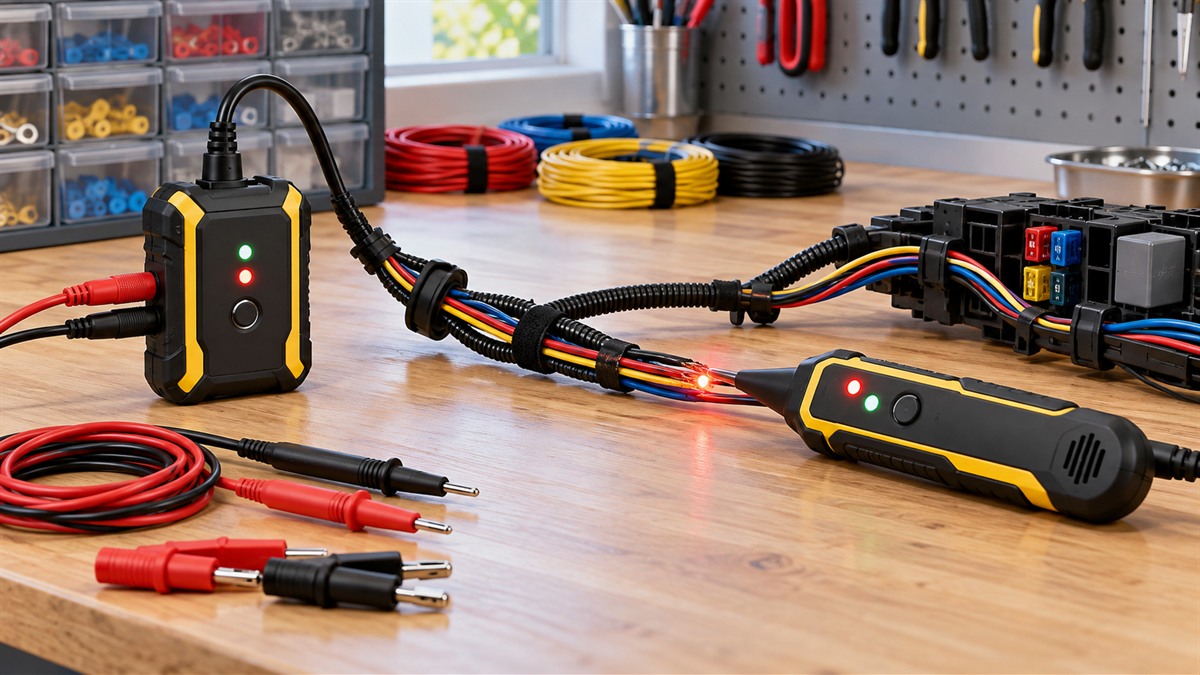
Open versus short. A short is an unintended path, often to ground. An open is a break, so current cannot pass. The AWBLIN listing says the transmitter shows a flashing green light for an open and a flashing red light for a short. The Ansbell receiver shows green OPEN bars and red SHORT bars. The other three listings say they locate both faults but do not describe the display colors.
Sensitivity. Bundled harnesses make a tracer pick up neighbouring wires. The Ansbell lists three levels, low, medium and high, and says to try level 3 if the receiver has trouble detecting a signal. The TrueTrace lists adjustable sensitivity. The AWBLIN receiver lists three function modes of different intensity. The UT-LNTELA and CrysGuard bullets do not mention a sensitivity control.
Continuity mode. Continuity means checking that a wire is unbroken from end to end. The AWBLIN, CrysGuard and Ansbell listings each describe a CONT mode on the transmitter, with clips on both ends of the wire. If you already own a multimeter, our continuity test with a voltmeter guide covers the meter route.
The five listings in detail
1. UT-LNTELA EM415Pro Automotive Wire Tracer (Lightest listed)
Specs from the listing (checked 2026-10-17):
- Voltage range: 6 to 42 volts DC
- Probe: 7 inch flexible
- Item Weight: 9.6 ounces
- Item Dimensions: 10.04 x 4.92 x 1.38 inches
- Included Components: Receiver x 1, Transmitter x 1
- Part Number: A02
Listing conflicts: the detail fields read Measurement Type: Voltmeter and Specification Met: UL, while the bullets describe a wire tracer with a transmitter and an audible receiver. The title also says Voltage Detector and Circuit Breaker Finder, but the listed range is DC 6 to 42 volts, so it is not a mains breaker finder.
Pros
- Audible receiver feedback and a transmitter signal are listed
- 7 inch flexible probe reaches dashboards, fuse boxes and connectors
- Lowest listed weight of the five
Cons
- No sensitivity control or continuity mode is mentioned in the bullets
- The listing does not say how an open and a short are shown
- Only a receiver and transmitter are listed in the box
Best for: A car or trailer DC circuit where you want an audible signal and a small unit
Skip if: You want color-coded fault indicators or a continuity mode
View on Amazon (affiliate link)
2. CrysGuard EM415PRO Circuit Tracer and Wire Tracker (Biggest kit)
Specs from the listing (checked 2026-10-17):
- Voltage range: 6 to 42 volts DC
- Probe: flexible, 7 inch
- Modes: Tone and Continuity (CONT)
- Item Weight: 15.2 ounces
- Specification Met: CE, RoHS, UL (as listed by the seller)
- Included Components: Signal Transmitter, Receiver Probe, Test Leads, 9V Batteries, Tape, Case, Manual
Listing conflicts: the EM415PRO label is the same as the UT-LNTELA product above, but this is a different brand, a different weight and a different kit, so do not treat them as one item. The compliance marks are the seller’s statement and were not checked against any certificate.
Pros
- Continuity testing in CONT mode is listed
- Most accessories: test leads, alligator clips, 9V batteries, insulation tape and a carrying case
- Operating guide in the description: connect the red and black clips, pick Tone or Continuity, follow the sound
Cons
- No sensitivity control is mentioned
- Heavier than the UT-LNTELA at 15.2 ounces
Best for: A buyer who wants everything in one case for cars, trailers, RVs and boats on DC 6 to 42 volts
Skip if: You want a sensitivity adjustment for crowded harnesses
View on Amazon (affiliate link)
3. AWBLIN Wire Tracer Automotive Short & Open Finder (Color-coded transmitter)
Specs from the listing (checked 2026-10-17):
- Voltage range: DC 6 to 42 volts
- Item Weight: 12 ounces
- Model: 681
- Warranty Description: 1 Year Warranty
- Included Components: Transmitter x 1; Receiver x 1; User Manual x 1; 9V (6F22) Battery x 2
Listing conflicts: the title says Circuit Breaker Finder and the bullets mention locating a breaker point, yet the voltage range is DC 6 to 42 volts. Read that as a break point in a wire, not a household breaker panel. The bullets also say to connect a DC power supply so the automotive wiring is powered on before tracing.
Pros
- Open circuit: green transmitter light flashes. Short circuit: red light flashes
- Receiver has three function modes of different intensity
- CONT mode on the transmitter and a low battery indicator
Cons
- Needs the wiring to be powered, which adds a step compared with a plain continuity check
- Breaker wording in the title can confuse a buyer who wants a mains breaker finder
Best for: A buyer who wants the open or short result shown on the transmitter itself
Skip if: You need to trace a circuit that cannot be powered
View on Amazon (affiliate link)
4. Solderstick TrueTrace Auto Circuit Tester (Adjustable sensitivity)
Specs from the listing (checked 2026-10-17):
- Voltage range: 6V to 42V DC in the bullets; the detail fields show only a 6 volt DC minimum
- Sensitivity: adjustable
- Item Weight: 15.8 ounces
- Part Number: RSHV
- Included: transmitter, receiver, test leads
Listing conflicts: the bullets give 6V to 42V DC, but the detail fields list only a minimum operating voltage, so confirm the upper limit in the manual before use.
Pros
- Adjustable sensitivity for tracing through complex harnesses
- Flexible receiver bends around dashboards, doors and engine compartments
- Audible signal guidance
Cons
- Heaviest of the five at 15.8 ounces
- No continuity mode is mentioned in the bullets
- The listing does not describe LED colors for open and short
Best for: Tracing a wire through a crowded harness where you want to dial the signal up or down
Skip if: You want a continuity mode on the transmitter
View on Amazon (affiliate link)
5. Ansbell Automotive Wire Tracer, Short & Open Finder (Open and short LED bars)
Specs from the listing (checked 2026-10-17):
- Voltage range: DC 6 to 42 volts
- Sensitivity: three levels, low, medium, high
- Probe: bendable coiled steel
- Item Weight: 12 ounces
- Item Dimensions: 7.91 x 1.81 x 1.06 inches
- Model: YDS-681
- Warranty Description: One Year
- Included Components: Tester, Battery, User Manual
Listing conflicts: the detail fields read Measurement Type: Ammeter, which does not match a wire tracer. The page summary line says it works on home wiring, but the bullets say it is for DC circuits only and must never be connected to AC power or to circuits above 42V DC. Follow the bullets.
Pros
- Green OPEN bars and red SHORT bars on the receiver, with louder beeping near a signal
- Three sensitivity levels, and a CONT mode for continuity
- Listing advises keeping the probe tip close and about 90 degrees to the wire
Cons
- Only a battery and manual are listed in the box
- The listing says not to use it on ignition-system components
Best for: Following a signal with both sound and a rising LED bar on a DC vehicle circuit
Skip if: You need extra leads, clips or a case in the box
View on Amazon (affiliate link)
How to choose
- Choose the AWBLIN if you want the fault type shown by a green or red transmitter light.
- Choose the Ansbell if you want LED bars, three sensitivity levels and a CONT mode.
- Choose the CrysGuard if the accessories matter most.
- Choose the TrueTrace if adjustable sensitivity in a bundle matters most.
- Choose the UT-LNTELA if you want the lightest unit and an audible receiver.
- You may not need one if a multimeter continuity check already finds your fault. For a wider comparison of dedicated tools, see our power probe short finder guide and our short circuit finder guide. Vehicle-focused options are in the auto short finder guide.
Planning example: a fuse that keeps blowing
Planning example, built from the listings and not from bench work. A trailer light circuit on a 12 volt supply keeps blowing a 15 amp fuse. Twelve volts sits inside the 6 to 42 volt range every listing gives, so any of the five fits the circuit. Following the Ansbell listing’s steps, you connect the transmitter to the circuit as instructed, move the receiver along the wire from the transmitter toward the load, and watch for the red signal to change sharply or vanish. That spot is the suspected short. You then move the probe around it and compare both sides, as the listing advises. With the AWBLIN, the equivalent clue is a flashing red light on the transmitter and a full red signal on the receiver at the fault. In both cases the result points to an area to inspect by eye, not a certified diagnosis.
Safety and limits
Work on live circuits carries risk. The U.S. Occupational Safety and Health Administration states in 29 CFR 1910.333(a)(1) that live parts to which an employee may be exposed shall be deenergized before the employee works on or near them, unless the employer can show that deenergizing adds hazards or is infeasible. That rule is written for workplaces, but it is a sound reference point for a home garage too. Note the tension with the AWBLIN listing, which wants the wiring powered for tracing: low-voltage DC vehicle circuits are what that tool targets. Do not point any of these five at household mains. None of the five listings states a CAT rating, which is another reason to keep them off building wiring.
Bottom line
Start with the circuit, not the brand. All five fit DC 6 to 42 volt vehicle wiring. Pick the AWBLIN or Ansbell for a visible open-versus-short readout, the CrysGuard for a full kit, the TrueTrace for adjustable sensitivity, or the UT-LNTELA for the lightest listed weight. Read the conflicts above before you order.
Frequently asked questions
What is a wire short detector? It is a transmitter and receiver pair that lets you trace a wire and see or hear where a short or an open occurs, without cutting the insulation.
Can it find a short in household wiring? No. These five listings cover DC 6 to 42 volts. The Ansbell listing says never to connect it to AC power.
What is the difference between an open and a short? An open is a break in the wire, so current cannot pass. A short is an unintended path that bypasses the load.
Do I need a multimeter as well? A tracer locates a fault along a wire. A multimeter reads a value. Our multimeter guide covers the second job.
Are the EM415Pro and EM415PRO the same product? They share the EM415 label, but the UT-LNTELA and CrysGuard listings differ in brand, weight and box contents.
Sources
- OSHA: 29 CFR 1910.333, selection and use of work practices: deenergize live parts before working on or near them, with stated exceptions