Best Digital Circuit Breaker Finder with GFCI Outlet Tester
As an Amazon Associate we earn from qualifying purchases. Details
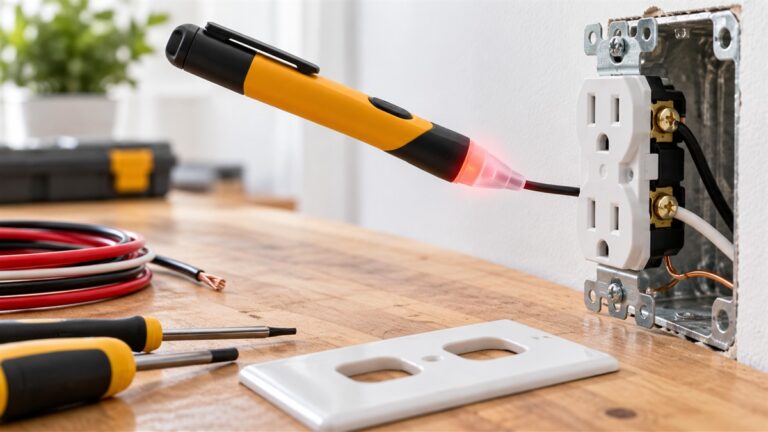
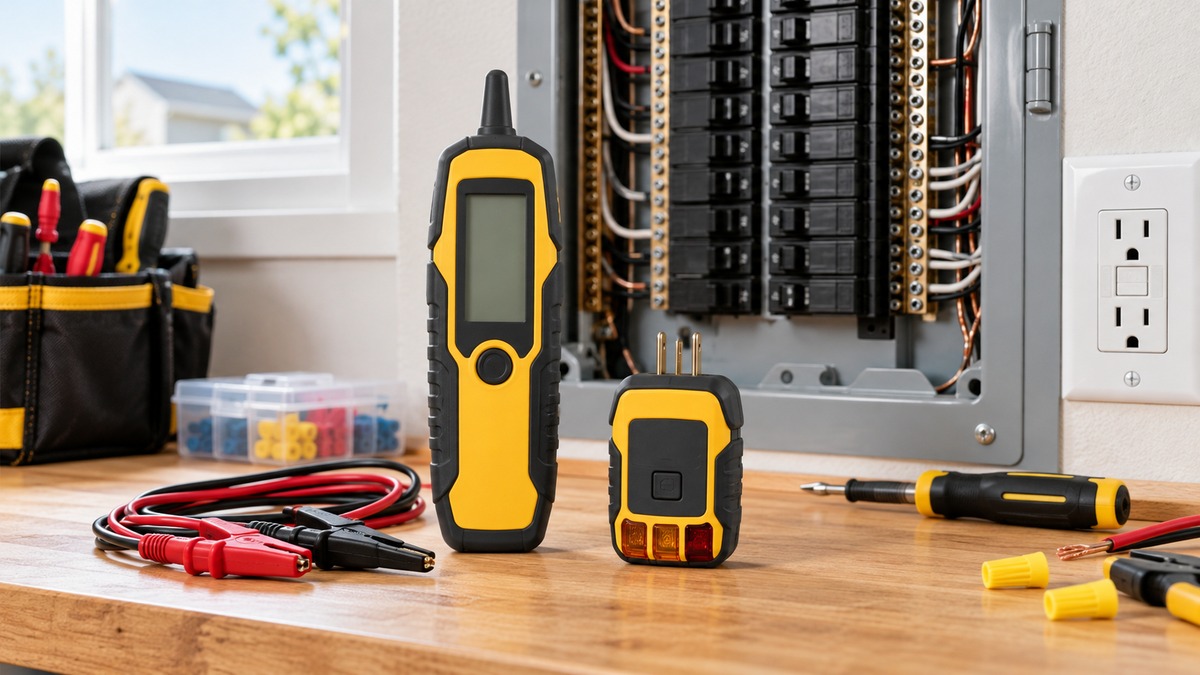
A digital circuit breaker finder with a GFCI outlet tester is a two-part tool: a transmitter that plugs into an outlet and a receiver that you sweep across the breaker panel, plus an outlet tester that reports wiring faults and, on some models, runs a GFCI trip test. The six listings below were all opened on 2026-10-17. Every specification comes from the listing text, including the places where a listing disagrees with itself. “Best for” means the best fit for the stated job, not a result from my own bench, because I have not run these tools.
The main differences are the display, the fault list, whether a trip test is stated, the voltage range and what else comes in the box.
Quick answer
If you want the clearest documented fault list and a stated automatic GFCI trip test, start with the Goldeep listing. If you want color displays and a stated trip-time readout, look at the TRAKLUME or the focemta. If you want the simplest plug-in-and-scan pair, the AstroAI is the plainest listing. If you also want a multimeter in the same case, the KUYTN kit is the only one here that bundles one. The Vansdon listing has the most internal contradictions to resolve before you trust its numbers.
| Listing | Circuit range stated | Wiring faults stated | GFCI trip test stated | Rating wording | Weight |
|---|---|---|---|---|---|
| Goldeep | 90-135V | 6 conditions: correct, open hot, open neutral, open ground, hot/ground reverse, hot/neutral reverse | Automatic trip test | CAT II 135V, ETL | 1.12 pounds |
| TRAKLUME | Not stated in the text I read | 7 conditions: 6 faults plus correct | Automatic trip test, shows the exact trip time | CAT II 135V | 1.15 pounds |
| focemta | 90-135V | 6 common wiring faults, “including open circuit/reverse polarity” | Automatic trip test, shows the time to trip | CAT II 135V, ETL | 13.7 ounces |
| AstroAI | 90-120V AC, 50/60Hz | Not itemized | States it can “confirm GFCI functionality” | Detail table: CE, ETL, NIST, UL | 14.1 ounces |
| Vansdon | 90-150V in one bullet, 90-120V in another | 7 common wiring faults | “GFCI trip test function” | CAT II 300V | 1.08 pounds |
| KUYTN kit | Outlet tester max 300V; multimeter up to 600V | Open ground, open neutral, open hot, reversed polarity, hot/ground reversal | Not stated in the text I read | Not stated | 2.02 pounds |
What these tools do
The breaker-finding half works in two pieces. You plug the transmitter into the outlet or light socket on the circuit you want to identify. You then move the receiver along the breakers in the panel, and the receiver signals when it reaches the matching breaker. The listings describe signals such as a red light, a buzzer, a beep and a vibration alert. Goldeep adds a two-pass “Learn” and “Scan” routine in which you scan the panel twice.
The outlet-testing half is the transmitter itself. The listings say it reads the wiring at the outlet and shows the result on LEDs and a screen. Several state a GFCI trip test: the tool trips the GFCI on that outlet and, on two of the listings, shows how long it took. Whether a listing makes that claim is shown in the table, and a missing claim does not prove the feature is absent. It means the listing text I read did not state it.
What to check before you choose
The circuit range
Four of the listings give a voltage range or rating in the title or bullets, and they do not agree with each other. Goldeep and focemta say 90-135V, AstroAI says 90-120V AC, and Vansdon gives two ranges in one listing. None of the listings describes use on circuits above its printed range, so do not stretch any of them beyond it.
The fault list
Goldeep spells out all six conditions. KUYTN names five faults. TRAKLUME says it identifies seven wiring conditions, which it explains as six common faults plus correct wiring. AstroAI does not itemize at all. If you want to know that open neutral or open ground will be reported, choose a listing that names them. For background on one of those faults, see the GFCI open ground guide.
The display and the receiver
Screen detail varies. TRAKLUME describes two color screens, 1.2 inches on the finder and 2.0 inches on the outlet tester, with a tri-color signal bar graph on the finder. Goldeep and focemta describe a backlit LCD. Vansdon describes an LCD on the transmitter and an analog bar graph on the receiver. AstroAI’s listing describes a receiver that beeps and flashes red and a built-in LED light, and does not describe a screen.
Batteries and accessories
Check what comes with the tool. Goldeep lists 2x AAA and 2x 9V batteries, a 3-to-2 prong adapter, a light socket adapter, an alligator clip adapter and a portable bag. focemta lists a 9V and 2x AAA batteries, a screwdriver and a carrying case. Vansdon lists 4 batteries and a case. TRAKLUME lists batteries, a screwdriver, adapters and a case. AstroAI’s detail table lists the transmitter, receiver, light socket, 3-to-2-prong and alligator clip adapters, with no batteries mentioned.
The six listings
1. Goldeep Circuit Breaker Finder with GFCI Outlet Tester (Most itemized fault list)
Specs from the listing (checked 2026-10-17):
- Circuit range in the title: 90-135V
- Faults identified: correct, open hot, open neutral, open ground, hot/ground reverse, hot/neutral reverse
- GFCI function: the transmitter has an automatic trip testing feature to verify GFCI protection
- Display: large backlit LCD with red/green LEDs; 10 seconds auto-hold of the latest result
- Receiver alerts: red light, buzzer and vibration, plus non-contact voltage detection
- Safety wording: Certified CAT II 135V with ETL compliance
- Item Weight: 1.12 pounds
- Included: outlet tester, receiver, portable bag, 2x AAA and 2x 9V batteries, 3-to-2 prong adapter, light socket adapter, alligator clip adapter, manual
Pros
- Names all six conditions, including open neutral and open ground
- States an automatic GFCI trip test
- Batteries and three adapters are listed in the box
Cons
- The listing does not describe the receiver’s range or sensitivity
- It describes only 90-135V circuits
Best for: someone who wants a documented fault list and a trip test in a single tool.
Skip if: you need a multimeter in the same case.
View on Amazon (affiliate link)
2. TRAKLUME Circuit Breaker Finder with NCV and GFCI Outlet Tester (Color displays and a trip-time readout)
Specs from the listing (checked 2026-10-17):
- Finder display: 1.2-inch color display with a green/yellow/red signal strength bar graph, a green/red LED and a beeper that changes frequency with signal strength
- Outlet tester display: 2.0-inch color screen that identifies 7 wiring conditions (6 common faults plus correct wiring)
- GFCI function: performs an automatic GFCI trip test and displays the exact trip time
- Data hold: locks the reading on screen for 10 seconds after unplugging
- Non-contact voltage: integrated NCV sensor on the finder
- Safety wording: meets CAT II 135V
- Item Weight: 1.15 pounds
- Included: finder, outlet tester, light socket adapter, 3-prong to 2-prong grounding adapter, alligator clip adapter, batteries, screwdriver, manual, carrying case
Pros
- States both a trip test and the trip time on screen
- Two color screens, with sizes stated
- Accessories and batteries listed
Cons
- The title says “detects 6 wiring faults” while the bullet says 7 conditions, so the count depends on whether “correct” is counted
- The text I read does not state the circuit voltage range
Best for: someone who wants larger color screens and a timed trip test.
Skip if: you want the voltage range stated in the text.
View on Amazon (affiliate link)
3. focemta Circuit Breaker Finder and GFCI Outlet Tester (Lightest listing, trip time stated)
Specs from the listing (checked 2026-10-17):
- Circuit range: 90-135V, with a dual-function LCD showing real-time voltage and signal strength
- Faults identified: 6 common wiring faults, “including open circuit/reverse polarity”
- GFCI function: automatic trip testing that can display the time taken to trip
- Safety wording: Certified CAT II 135V with ETL compliance; transmitter described with an IEC61010-1 screw-sealed battery compartment
- Item Weight: 13.7 ounces (the bullet says 0.9 pounds)
- Item Dimensions: 8.7 x 5.1 x 1.8 inches
- Included: transmitter, receiver, 1x 9V and 2x AAA batteries, screwdriver, manual, carrying case
Pros
- States the voltage range and a timed trip test
- Weight and dimensions are stated
Cons
- The fault list is not itemized beyond “open circuit/reverse polarity”
- The detail table labels the measurement type “Voltmeter,” which does not match the rest of the listing
Best for: someone who wants a lighter tool with a stated voltage range and a timed trip test.
Skip if: you need each fault named individually.
View on Amazon (affiliate link)
4. AstroAI Circuit Breaker Finder with GFCI Outlet Tester (Plainest listing)
Specs from the listing (checked 2026-10-17):
- Circuit range in the title: 90-120V AC, 50/60Hz in the bullets
- Receiver: beeps and flashes red at the matching breaker; built-in LED light for dark panels
- GFCI function: “Integrated GFCI Tester: check wiring conditions and confirm GFCI functionality”
- Other: auto-shutdown and low-battery alerts
- Item Weight: 14.1 ounces
- Item Dimensions: 9.33 x 5.51 x 2.56 inches
- Details table: Specification Met: CE, ETL, NIST, UL; Model ABCBFET120BK
- Included Components (as listed): transmitter, receiver, light socket, 3-to-2-prong and alligator clip adapters
Pros
- Simple two-part description, with weight and dimensions stated
- Adapters listed in the box
Cons
- No wiring-fault list and no screen described
- The details table says “Measurement Type: Multimeter,” while the rest of the listing describes a breaker finder and outlet tester
- The label list in the table (CE, ETL, NIST, UL) is the listing’s own wording and I did not verify it
Best for: someone who mainly wants to find breakers and wants the least complicated description.
Skip if: you want to know which wiring faults the tester reports.
View on Amazon (affiliate link)
5. Vansdon Circuit Breaker Finder with LCD and GFCI Outlet Tester (Most conflicts to resolve)
Specs from the listing (checked 2026-10-17):
- Voltage range: one bullet says 90-150V; another says 90-120V AC for the receiver’s non-contact test
- Faults identified: the LCD “can diagnose seven common wiring faults”
- GFCI function: a GFCI trip test function; auto-hold keeps the last result after unplugging
- Receiver: analog bar graph, visual indicators, audible alarm, built-in flashlight and a non-contact voltage test
- Safety wording: complies with the CAT II 300V safety standard
- Item Weight: 1.08 pounds
- Item Dimensions (as listed): 10 x 2 x 50 inches, which cannot be right for a handheld tool
- Details table: Model BF-2000, manufacturer Oudong, 2-year warranty described
- Included: transmitter, receiver, 3-to-2 prong adapter, light socket adapter, alligator clip adapter, 4 batteries, carrying case
Pros
- Names a trip test, an LCD and a seven-fault count
- States a warranty length in the details table
Cons
- Two different voltage ranges in the same listing
- The listed dimensions are implausible, and the seven faults are not named
Best for: someone willing to confirm the voltage range with the seller before buying.
Skip if: you want a listing with consistent numbers.
View on Amazon (affiliate link)
6. KUYTN Circuit Breaker Finder Kit with Digital Multimeter and GFCI Outlet Tester (Only one with a multimeter)
Specs from the listing (checked 2026-10-17):
- Kit: circuit breaker finder, GFCI outlet tester and digital multimeter in one carrying case
- Faults identified: open ground, open neutral, open hot, reversed polarity, hot/ground reversal
- Outlet tester: the upgraded Model 2027, “max 300V detection supported”
- Multimeter: up to 600V detection; AC/DC voltage, resistance, capacitance, diodes, transistors, continuity, battery voltage and NCV
- Item Weight: 2.02 pounds
- Included Components (as listed): adapter
Pros
- Adds a digital multimeter to the breaker finder and outlet tester
- Five faults are named
Cons
- The details table lists only “adapter” as included, while the bullets describe a three-piece kit, so the box contents are unconfirmed
- The text I read does not state a trip test or a CAT rating
Best for: a toolbox that has no multimeter yet.
Skip if: you already own a multimeter and want the lightest tool, or want a stated trip test.
View on Amazon (affiliate link)
Worked example: mapping an unlabeled panel
For example, suppose a panel has 20 breakers and only half of them are labeled. A planning approach that fits the listings: take the transmitter to a room, plug it in, and sweep the receiver along the breakers until it signals. With a two-pass tool such as the Goldeep, you do the “Learn” sweep and then the “Scan” sweep. Mark the result on a list, move to the next room and repeat. At each outlet you can also read the tester’s wiring report before you plug anything in. A panel with 20 breakers can mean up to 20 circuits to confirm, so a lighter tool such as the 13.7-ounce focemta may be easier to carry from room to room than the 2.02-pound KUYTN kit. That is a planning comparison from listed weights, not a measured result.
If an outlet reports a fault, follow the tool’s own manual for what the pattern means, and leave panel or wiring repairs to a licensed electrician.
Related guides
For other breaker-finding tools, see the Klein Tools ET310 circuit breaker finder, the breaker circuit finder guide and the GFCI open ground guide.
Frequently asked questions
Which of these states an automatic GFCI trip test?
The Goldeep, TRAKLUME and focemta listings state an automatic trip test, and the Vansdon listing states a trip test function. The TRAKLUME and focemta listings also say the screen shows how long the trip took. The AstroAI listing says only that the tool can confirm GFCI functionality, and the text I read for the KUYTN kit does not state a trip test.
Which ones name open neutral?
Goldeep and KUYTN name open neutral explicitly. The others describe a number of wiring faults without listing them, or say “open circuit/reverse polarity” in the focemta case.
What is the difference between the voltage ranges?
Goldeep and focemta state 90-135V, AstroAI states 90-120V AC, and Vansdon states both 90-150V and 90-120V. TRAKLUME’s listing text does not give a range. KUYTN states a 300V maximum for the outlet tester and up to 600V for the multimeter.
Do any of these include a multimeter?
Only the KUYTN kit. Its listing describes a three-piece set, though its details table lists only “adapter,” so confirm the contents before you order.
Final recommendation
For a named fault list and a trip test, the Goldeep. For color screens and a timed trip test, the TRAKLUME. For a lighter tool with a stated range and a timed trip test, the focemta. For the plainest description, the AstroAI. For a multimeter in the same case, the KUYTN kit. The Vansdon needs its voltage range confirmed before you rely on it. Whichever you choose, read the tool’s manual for its light and screen patterns, and call a licensed electrician for anything the tool flags inside a wall or panel. For background on one fault these testers name, OSHA’s interpretation letter from July 7, 2003 says a GFCI may not trip in an open-neutral condition unless it is specifically designed to.