Best Breaker Circuit Finder for Outlets and Panels
As an Amazon Associate we earn from qualifying purchases. Details
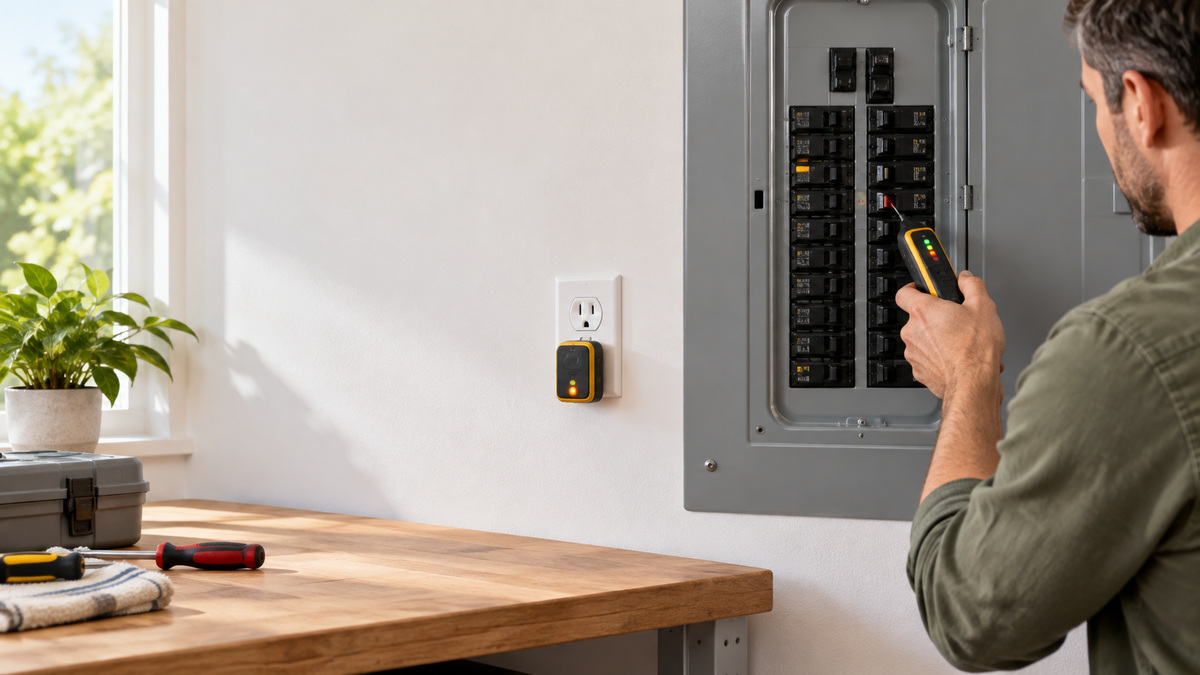
A breaker circuit finder helps you match an outlet, light or fixture to the right breaker without flipping breakers at random. You plug a transmitter into the circuit, then scan the panel with a receiver until it signals the correct breaker.
This guide helps you decide which digital circuit breaker finder fits your home, rental work or small shop tasks. It covers an outlet circuit breaker finder with GFCI testing, models with LCD readouts and NCV, and an electronic circuit breaker finder with panel learning. Work on mains circuits can kill. The meter CAT rating must suit the circuit, and panel or service work belongs to a licensed electrician. Follow the manual and local rules.
Quick answer
For most homeowners, a two-piece outlet-based circuit finder with GFCI testing and adapters is the simplest choice. Plug the transmitter into a 90-120V AC or 90-135V AC outlet, then scan the panel with the receiver for audio and visual alerts.
If you want panel learning and outlet diagnostics, the Klein Tools ET350 4-in-1 Digital Circuit Breaker Finder with LED Work Light adds a Learn mode, Locate mode, wiring fault display, voltage display and GFCI trip time. If you want a Fluke-built 4-in-1 tool with socket testing and dual-sensitivity NCV, consider the Fluke BK120 SmartTrace Breaker Finder and Socket Tester. For an LCD that shows 90-135V and signal strength, look at the focemta and Goldeep kits. For background on safe use, see how to use a digital circuit breaker finder before you start.
What matters for a breaker circuit finder
1. Outlet fit and voltage range
A circuit finder is useful only if the transmitter fits the circuit you need to trace. Most transmitters plug into a standard grounded outlet. Adapters extend use to light sockets, 2-prong outlets and clip leads.
Check the stated AC range. The AstroAI listing states 90–120V AC at 50/60Hz. The focemta listing states 90-135V. The Goldeep listing states 90-135V. The RAINLEONID listing states 90–120V AC, 50/60Hz. Do not use a transmitter outside its stated range. Check the listing for use on switches, lights or bare wires. For outlet-specific help, see best outlet breaker finder.
2. Receiver signals and display
Receivers use beeps, flashing LEDs, bar graphs or an LCD signal-strength readout. An LCD helps when two adjacent breakers both beep. Backlit screens help in dark panels.
The focemta kit lists a dual-function LCD screen that displays real-time voltage and signal strength. The Goldeep kit lists a large backlit LCD display with voltage and signal tracking strength. The Klein ET350 lists a backlit LCD plus Learn and Locate modes. Choose a simple beep-and-flash receiver if you trace one outlet at a time. Choose an LCD or learning receiver if your panel labels are missing or crowded.
3. GFCI and wiring diagnostics
Many transmitters also work as a GFCI outlet tester and wiring checker. Common readouts include correct wiring, open ground, open neutral, open hot and reversed polarity. Some add GFCI trip testing or trip time.
The Klein ET350 lists outlet diagnostics for wiring faults, voltage and GFCI trip time. The Goldeep listing describes 6 common wiring faults. The RAINLEONID listing describes 7 common line faults. If you maintain rentals or older homes, this function saves a second tool. Learn the indicator pattern in the manual before you trust a green light. Related reading: best digital outlet tester.
4. NCV, light and panel usability
NCV means non-contact voltage detection. In simple terms, the receiver can sense nearby AC voltage without touching bare metal. A built-in flashlight or work light helps at indoor panels.
The Klein ET350 lists non-contact voltage testing plus a work light. The Fluke BK120 lists dual-sensitivity NCV mode plus a bright LED flashlight. The Goldeep, RAINLEONID and VENLAB style kits list NCV and a flashlight or LED. Dual sensitivity matters when you want to separate a strong breaker signal from nearby wiring. If your panel is in a garage or basement, prioritize backlight and light.
5. Safety rating and manual limits
Measurement category, often written CAT, classifies live circuits used in measurement and testing of installations and equipment. The categories account for continuous energy and impulse voltages at the measurement point. Measurement category II covers circuits directly connected to the low-voltage installation, while measurement category IV covers measurements at the source of the high-voltage installation.
Quote a CAT rating only from the listing or manual. The focemta data mentions CAT II 135V. The Goldeep kit states Certified CAT II 135V Safety Rating. The RAINLEONID kit states CAT II 120V. The AstroAI, Klein ET350 and Fluke BK120 data in this article do not state a CAT rating in the fields provided, so the listing does not state a CAT rating here — check the product listing and manual before use on household mains. Never open a panel cover unless you are qualified and allowed to do so. See air circuit breaker testing for why service-level work is different from branch-circuit tracing.
How to choose for your situation
- One outlet, clear panel: Choose a basic two-piece digital circuit breaker finder with audio-visual alerts and auto-shutdown.
- Old labels, full panel: Choose a receiver with LCD signal strength or Learn/Locate modes.
- Rental turnovers: Choose a transmitter with GFCI trip testing and clear wiring-fault LEDs.
- Lights and 2-prong outlets: Choose a kit that includes a light socket adapter, 3-to-2-prong adapter and alligator clip adapter.
- Low-light panels: Choose a backlit LCD, LED panel light or flashlight function.
- Uncertain rating: If the listing does not state a CAT rating, check the listing and manual. Do not call the tool safe for household mains without that rating.
For Klein-specific background, see best Klein digital breaker finder and best circuit finder Klein.
1. Circuit Breaker Finder Kit with GFCI Outlet Tester for 90-135V AC Circuits,includes Light Socket (Compact LCD pick)
Specs from the listing (checked 2026-10-10):
- Brand: focemta
- Model: FTCT 01
- Item Weight: 3 ounces
- Included Components: 1 circuit breaker finder kit,3 batteries,1 user manual,1 accessory kit
- Specification Met: ETL
Pros
- LCD shows 90-135V plus signal strength
- Includes light socket, 3-to-2 prong and clip adapters with batteries
- ETL-noted kit with screw-sealed transmitter battery compartment
Cons
- CAT wording is brief, check manual for allowed circuits
- Compact tool still needs slow repeat scans on crowded panels
Best for: DIYers tracing outlets who want voltage plus signal numbers
Skip if: Skip if you need Learn/Locate panel learning or GFCI trip-time readout.
View on Amazon (affiliate link)
2. AstroAI Circuit Breaker Finder Tool with GFCI Outlet Tester for 90–120V AC (Simple alerts pick)
Specs from the listing (checked 2026-10-10):
- Brand: AstroAI
- Model: ABCBFET120BK
- Item dimensions L x W x H: 9.33 x 5.51 x 2.56 inches
- Included Components: transmitter,receiver,light socket, 3-to-2-prong, alligator clip adapters
- Specification Met: CE, ETL, NIST, UL
Pros
- Beep plus red flash with LED panel light
- Includes light socket, 3-to-2-prong and clip adapters
- Auto-shutdown and low-battery alerts
Cons
- Listing does not state a CAT rating, check manual before mains use
- No LCD voltage readout in the stated data
Best for: Homeowners tracing one outlet at a time
Skip if: Skip if you want LCD signal strength or GFCI trip time.
View on Amazon (affiliate link)
3. Goldeep Circuit Breaker Finder, GFCI Outlet Tester with Digital LCD Display (Backlit display pick)
Specs from the listing (checked 2026-10-10):
- Brand: Goldeep
- Included Components: Circuit Breaker Finder Kit
- Part Number: CBF05-OR
Pros
- Backlit LCD for dim panels
- GFCI plus 6-fault wiring diagnosis from listing
- Full adapter set with 2x AAA and 2x 9V batteries
Cons
- 1.12 lb kit is heavier to carry than minimal sets
- Learning-style double scans take extra time
Best for: Users with dark panels who want backlit diagnostics
Skip if: Skip if you want dual-sensitivity NCV or panel-learn history.
View on Amazon (affiliate link)
4. Klein Tools ET350 4-in-1 Digital Circuit Breaker Finder with LED Work Light (Best overall)
Specs from the listing (checked 2026-10-10):
- Brand: KLEIN TOOLS
- Model: ET350
- Item Weight: 8.32 ounces
- Item Dimensions: 11.98 x 2.13 x 1.36 inches
- Included Components: 4-in-1 Digital Circuit Breaker Finder
Pros
- Learn plus Locate modes for unlabeled panels
- Transmitter shows faults, voltage and GFCI trip time
- NCV testing plus work light and bar graph
Cons
- Larger 11.98 x 2.13 x 1.36 inch tool for simple jobs
Best for: Crowded or mislabeled panels needing learning scan
Skip if: Skip if you only need a basic outlet beeper.
View on Amazon (affiliate link)
5. Fluke BK120 SmartTrace Breaker Finder and Socket Tester (NCV versatility pick)
Specs from the listing (checked 2026-10-10):
- Brand: Fluke
- Model: FLUKE-BK120
- Item dimensions L x W x H: 11 x 6 x 2.25 inches
- Included Components: BK120 Receiver and Transmitter
- Specification Met: Ul 61010-1, Iec 61010-2-030, Ul, Ce
Pros
- Dual-sensitivity NCV for cords and terminal strips
- Socket tester LEDs for standard and GFCI outlets
- Audible plus visual alerts with LED flashlight
Cons
- Fields provided do not state CAT rating or range, check listing
- No adapter set or LCD voltage number in stated data
Best for: Users wanting Fluke socket testing plus flexible NCV
Skip if: Skip if you need included lamp-socket adapters or LCD voltage.
View on Amazon (affiliate link)
6. Circuit Breaker Locator, GFCI Outlet Tester, Digital Circuit Finder (Adapter kit pick)
Specs from the listing (checked 2026-10-10):
- Brand: RAINLEONID
- Model: RAINLEONID NF-827S
- Compatible Devices: Any electrical system within 90-120V AC range
- Included Components: NF-827 Circuit Breaker Finder Tool
- Specification Met: Ul, Cat II 120v
Pros
- CAT II 120V stated in listing
- Three adapters plus EVA case and flashlight
- GFCI auto trip test with 7-fault LCD info
Cons
- Receiver uses 2 AA batteries, keep correct spares
- Supports 90-120V AC, check listing for other uses
Best for: Renters and DIYers wanting complete adapter kit
Skip if: Skip if you need trip-time numbers.
View on Amazon (affiliate link)
Picks: what each breaker circuit finder offers
Focemta — compact kit with voltage and signal LCD
This focemta kit is a battery powered circuit finder aimed at DIYers who want numeric feedback. The transmitter plugs into the outlet circuit, and the handheld receiver scans the panel with audio and visual alerts. It suits users tracing a bedroom, garage or kitchen outlet before replacing a receptacle or switch, with power off after identification.
Three specifics from its data: the LCD displays real-time voltage covering 90-135V and signal strength, the item weight is 3 ounces, and the kit includes 1x 9V and 2x AAA batteries plus a light socket adapter, 3-prong to 2-prong grounding adapter and alligator clip lead. The bullets also list ETL certification and an IEC61010-1 screw-sealed battery compartment on the transmitter.
Limit: the CAT wording in the data is short — CAT II 135V rating ensures safe resi — without full details in the fields provided, so check the manual for allowed circuits. Skip it if you need full panel-learning or GFCI trip-time numbers. Check the listing for fuse, cord and adapter limits.
AstroAI ABCBFET120BK — beep-and-flash tracing with case and adapters
This AstroAI tool is a two-part circuit finder for 90–120V AC outlets and light sockets. You plug in the transmitter, then scan breakers with the receiver until it beeps and flashes red. A built-in LED light helps in dark panels. It suits homeowners who want a direct outlet circuit breaker finder workflow without reading signal graphs.
Three specifics from its data: it measures 9.33 x 5.51 x 2.56 inches, supports 90–120V AC at 50/60Hz, and includes transmitter, receiver, light socket, 3-to-2-prong and alligator clip adapters. The listing also notes auto-shutdown and low-battery alerts. The specification field lists CE, ETL, NIST, UL.
Limit: the fields provided do not state a CAT rating, so the listing does not state a CAT rating here — check the product listing and manual before household mains use. Skip it if you want an LCD voltage readout or stated GFCI trip time. Check the listing for GFCI test procedure details.
Goldeep CBF05-OR — backlit LCD with NCV and GFCI diagnostics
This Goldeep kit combines a circuit breaker finder, GFCI tester and outlet tester in one compact set. The workflow uses two panel scans described as Learn-style passes in the listing, then audio plus visual alerts. It suits users who want a digital circuit breaker finder with a bright display for dim panels and tight spaces.
Three specifics from its data: the dual-function LCD shows outlet wiring status, precise voltage and signal tracking strength, the construction is listed as impact-resistant ABS housing with 1.12 lb construction, and the kit includes 2x AAA and 2x 9V batteries plus 3-to-2 prong, light socket and alligator clip adapters. The listing states Certified CAT II 135V Safety Rating.
Limit: it is bulkier to carry than a 3-ounce transmitter-only style tool, and bright-display tracing still needs slow, repeated passes on crowded panels. Skip it if you want Klein ET310-style panel learning history or Fluke-style dual-sensitivity NCV. For another digital option, compare best digital circuit finder.
Klein Tools ET350 — Learn and Locate 4-in-1 for crowded panels
This Klein Tools ET350 is a 4-in-1 digital circuit breaker finder, outlet fault detector, non-contact voltage tester and GFCI tester with LED work light. It suits users with missing or wrong panel labels. The receiver learns the panel with a single scan, then a second scan in Locate mode finds the target breaker.
Three specifics from its data: it measures 11.98 x 2.13 x 1.36 inches, weighs 8.32 ounces, and the transmitter shows wiring faults, voltage and GFCI trip time. The receiver adds bar-graph signal strength with audible and visual cues. The model is ET350 and part number is 157410KLE.
Limit: the fields provided do not state a CAT rating, so the listing does not state a CAT rating here — check the product listing and manual before mains use. Skip it if you only need a basic outlet beeper or want the older Klein ET310 workflow. If you own ET310 accessories, see best Klein ET310 accessories.
Fluke BK120 SmartTrace — 4-in-1 with dual-sensitivity NCV
This Fluke BK120 SmartTrace is a breaker finder, NCV detector, socket tester and LED flashlight. It suits users who already trust Fluke test tools and want careful socket verification plus flexible NCV. The transmitter has built-in socket testing with LEDs for standard and GFCI outlets.
Three specifics from its data: it measures 11 x 6 x 2.25 inches, the specification field lists Ul 61010-1, Iec 61010-2-030, Ul, Ce, and the kit includes BK120 Receiver and Transmitter under part number FLUKE-BK120. The bullets describe audible and visual alerts and a unique dual-sensitivity NCV mode for terminal strips and supply cords.
Limit: the fields provided do not state a CAT rating or voltage range, so the listing does not state a CAT rating here — check the product listing and manual. Skip it if you need an LCD voltage number or an included light-socket and clip adapter set. For Fluke context, see best Fluke circuit finder.
RAINLEONID NF-827S — CAT II 120V kit with adapters and case
This RAINLEONID NF-827S is a portable electronic circuit breaker finder with GFCI testing, NCV and flashlight functions. It suits renters and DIYers working on 90–120V AC branch circuits who want adapters and storage in one purchase. The transmitter plugs into the outlet, and the receiver scans for the strongest signal.
Three specifics from its data: it supports 90–120V AC, 50/60Hz, meets CAT II 120V safety standards, and includes a three-prong to two-prong adapter, lamp holder adapter, alligator clip adapter, 9V batteries for the transmitter and 2 AA batteries for the receiver. The specification field lists Ul, Cat II 120v.
Limit: the receiver runs on AA cells while some rivals use AAA, so keep the right spares. Skip it if you need a numeric GFCI trip-time display. Check the listing for the exact seven-fault code table.
Comparison table built only from listing data
| Model | Stated AC range | Display and alerts | GFCI / wiring check | Extras from data | Size / weight from data |
|---|---|---|---|---|---|
| Focemta FTCT 01 | 90-135V | LCD voltage plus signal strength, audio/visual alerts | Outlet tester plus GFCI tester | Light socket, 3-to-2 prong, clip adapters; 1x 9V and 2x AAA batteries | 3 ounces |
| AstroAI ABCBFET120BK | 90–120V AC, 50/60Hz | Beep plus red flash, LED panel light | GFCI functionality check | Light socket, 3-to-2 prong, clip adapters; auto-shutdown | 9.33 x 5.51 x 2.56 inches |
| Goldeep CBF05-OR | 90-135V | Backlit LCD, voltage plus signal strength | GFCI tester, 6 wiring faults | NCV, ABS housing, 1.12 lb construction, 2x AAA plus 2x 9V batteries | 1.12 lb kit weight noted |
| Klein Tools ET350 | Check the listing | Backlit LCD, Learn/Locate, bar graph | Wiring faults, voltage, GFCI trip time | NCV testing, work light | 11.98 x 2.13 x 1.36 inches; 8.32 ounces |
| Fluke BK120 | Check the listing | Audible plus visual alerts | Socket tester with LEDs for standard and GFCI | Dual-sensitivity NCV, LED flashlight | 11 x 6 x 2.25 inches |
| RAINLEONID NF-827S | 90–120V AC, 50/60Hz | LCD line info, red LEDs, NCV | GFCI auto trip test, 7 line faults | 3 adapters, EVA case, flashlight | CAT II 120V stated |
If you are comparing Klein ET310 variants, see best Klein Tools ET310 circuit breaker finder, best ET310 breaker finder and how to use Klein ET310.
Worked planning example with slow panel passes
Breaker tracing time example for a 20-breaker panel
This is our planning estimate for a homeowner mapping two bedroom outlets. It shows why a learning receiver or LCD signal readout can reduce repeat trips to the panel. Numbers below are assumed for planning only.
Assumed setup:
- Panel size: 20 breakers
- Outlets to trace: 2 outlets
- Scan time per breaker pass: 4 seconds
- Passes per outlet with basic beeper: 3 passes
- Passes per outlet with Learn plus Locate: 2 passes
- Walk time between outlet and panel per round trip: 60 seconds
- Trips needed: 2 round trips
Step 1 — basic receiver scan time:
2 outlets × 3 passes × 20 breakers × 4 seconds = 480 seconds
Convert to minutes:
480 ÷ 60 = 8 minutes
Step 2 — Learn/Locate receiver scan time:
2 outlets × 2 passes × 20 breakers × 4 seconds = 320 seconds
Convert to minutes:
320 ÷ 60 = 5.33 minutes, rounded to about 5.3 minutes
Step 3 — time difference:
480 − 320 = 160 seconds
160 ÷ 60 = 2.67 minutes, rounded to about 2.7 minutes
Step 4 — add walking time:
2 trips × 60 seconds = 120 seconds, or 2 minutes
Step 5 — total planning totals:
Basic method: 8 + 2 = 10 minutes
Learn method: 5.3 + 2 = 7.3 minutes
Re-verified: 2×3×20×4 = 480, 2×2×20×4 = 320, 480−320 = 160, 160/60 ≈ 2.7. The arithmetic checks twice. This does not include GFCI testing or adapter changes. It only shows that fewer repeat scans matter on a full panel.
5 common mistakes with a circuit finder
1. Scanning too fast
Move the receiver slowly along each breaker row. Fast passes cause missed peaks and false highs on adjacent breakers. Repeat the scan from the opposite direction. If two breakers signal, rescan with the LCD signal-strength view and keep the receiver flat against the panel directory area as directed by the manual.
2. Ignoring nearby loads
Running heaters, vacuums or shop tools can add interference. Turn off major loads on the circuit under test when the manual allows it. Unplug sensitive electronics nearby. Repeat the scan after loads settle. This is a common rule of thumb for cleaner tracing, not a guarantee of accuracy.
3. Using the wrong adapter or outlet
A transmitter must make solid contact. A loose light-socket adapter or worn 2-prong adapter can drop the signal. Seat the transmitter fully. Check the listing for adapter limits. For outlet-centered work, review test wall outlet and best electrical outlet finder.
4. Trusting one beep on a crowded panel
Adjacent breakers often pick up signal. Mark the strongest candidate, then turn off that breaker and confirm the outlet is dead with a separate tester. Confirm with a lamp or outlet tester after shutoff. Never assume a silent receiver means a dead circuit.
5. Working beyond the rating or skill level
Do not remove the panel cover to clamp or probe bus bars unless you are qualified. A plug-in circuit finder is for branch-circuit identification, not panel repair. If the listing does not state a CAT rating, check the product listing and manual. Panel or service work belongs to a licensed electrician. For related checks, see best test circuit breaker with multimeter.
Care, storage and limits
Store the transmitter and receiver together with adapters in the case. Remove batteries for long storage if the manual directs it. Replace weak 9V, AA or AAA cells promptly because low voltage can weaken the signal. The AstroAI and RAINLEONID listings note low-battery or auto-shutdown behavior, which helps prevent mid-scan dropouts.
These tools do not replace a multimeter, clamp meter or insulation tester. A clamp meter measures current without breaking the circuit, while many plug-in finders only identify the breaker. Many cannot measure small DC currents. State each model’s actual capability from the listing before buying. Keep user manuals with adapter tables. Follow the instrument manual and local electrical rules.
FAQ
What does a breaker circuit finder do?
It sends a signal from a transmitter plugged into an outlet or fixture onto the branch circuit. You scan the panel with a receiver to find the breaker carrying that signal. Then you switch that breaker off and verify the outlet is dead with a separate tester. It does not repair wiring.
What is the difference between a circuit finder and a digital circuit breaker finder?
The terms overlap. Circuit finder is the short name. A digital circuit breaker finder usually means a model with an LCD, signal-strength readout, GFCI outlet testing or Learn/Locate modes. Both use the same two-piece transmitter-and-receiver method. Check whether the listing includes GFCI testing and adapters.
Will an outlet circuit breaker finder work on light switches?
Sometimes, with the right adapter. Many kits include a light socket adapter and an alligator clip adapter for fixtures. The focemta, AstroAI, Goldeep and RAINLEONID kits list those adapters. Check the product listing for switch, ballast and dimmer limits. Turn power off before changing adapters.
What is Klein ET310 circuit breaker finder, and how is ET350 different?
The Klein ET310 circuit breaker finder is an earlier Klein plug-in finder often searched as ET310 circuit breaker finder or Klein circuit breaker finder ET310. The ET350 in this guide adds a listed 4-in-1 function set with Learn mode, Locate mode, outlet diagnostics with GFCI trip time, NCV testing and a work light. If you need ET310 details, open best Klein Tools ET310 circuit breaker finder.
Do I need true RMS or counts for a breaker finder?
No. True RMS and counts describe multimeters, not plug-in finders. True RMS describes accurate AC measurement on distorted waveforms. Counts describe display resolution. For a breaker finder, prioritize signal strength display, GFCI testing, adapters and the stated 90–120V AC or 90–135V range.
Can a breaker finder test GFCI protection?
Many transmitters include a GFCI test button or automatic trip test. They check whether the GFCI device trips when tested from that outlet. They do not certify shock protection. After a trip, check what lost power and reset per the manual. For GFCI background, see checking GFCI outlet.
Is it safe to scan a panel with the cover on?
For most plug-in finders, yes when you follow the manual: keep the cover on, move the receiver slowly across breakers, and do not touch exposed wiring. Work on mains circuits can kill. If you must remove the cover, that task belongs to a licensed electrician. If the listing does not state a CAT rating, check the listing and manual first.
Why does my finder point to two breakers?
Adjacent breakers can share signal through close wiring. Rescan slowly, try the opposite direction, and compare LCD signal-strength peaks. Turn off one candidate and recheck the outlet. Multi-wire or shared-neutral circuits can also confuse basic receivers. If results stay unclear, ask an electrician rather than guessing.
Bottom line
Choose by panel and outlet needs, not by brand alone. Choose the RAINLEONID NF-827S if you want adapters, case and LCD help on 90–120V AC circuits. Choose the Goldeep kit if you want adapters, case and LCD help on 90-135V circuits. Choose the AstroAI or focemta kit if you want a simpler outlet-to-panel workflow with clear alerts. Choose the Klein ET350 if crowded labels demand Learn plus Locate and GFCI trip-time diagnostics. Choose the Fluke BK120 if you want dual-sensitivity NCV and socket testing in one tool. Rule: if the listing does not state a CAT rating, check the listing and manual — do not use it on household mains until the rating is confirmed.
Sources
- Measurement category: CAT II vs CAT IV definitions, energy and impulse basis, and IEC 61010 marking rule