Test Circuit Breaker With Multimeter: Top Kits and How to Choose
As an Amazon Associate we earn from qualifying purchases. Details
Testing a circuit breaker with a multimeter is the question you ask when an outlet goes dead, a breaker trips again, or you need to know which breaker feeds a room before you touch anything. This guide explains which tool does which job and compares five breaker finder kits, two of which include a digital multimeter. The kits are made for branch circuits and outlets. Work on mains circuits can kill, so read the limits below first.
Quick answer
First find the correct breaker with a finder, then check voltage at the outlet with a meter. For most homeowners, a finder plus a GFCI outlet tester plus a basic multimeter covers the job. The Klein Tools 80101 kit fits that need: its listing states the multimeter measures up to 600V AC/DC voltage, 10A DC current and 2MOhms resistance, and also tests batteries, diodes and continuity.
If you only need to map outlets to breakers and check GFCI trips, the smaller finder kits from Goldeep and AstroAI, or the 90-135V kit, take less space. Check the supported voltage on the product page before using any transmitter. A panel or service job belongs to a licensed electrician, and the meter CAT rating must suit the circuit.
Comparison table
| Kit | What the listing states | Voltage range for the transmitter | CAT wording | Includes a multimeter? |
|---|---|---|---|---|
| Finder kit with digital multimeter and GFCI tester | Transmitter, receiver, adapter | Not stated in the listing | Not stated here | Yes, per the title |
| Klein Tools 80101, 4-piece | Finder, multimeter MM320, NCVT3P voltage tester, GFCI tester RT250 | Not stated here | One line lists both CAT II 135V and CAT IV 1000V, which is unclear | Yes, up to 600V AC/DC, 10A DC, 2MOhms |
| Finder kit with GFCI tester, 90-135V, light socket | Display, light socket, battery powered | 90-135V AC | Not stated here | No |
| Goldeep finder with LCD | LCD, GFCI tester, NCV receiver, 1.12 lb | 90-135V | CAT II 135V Safety Rating stated | No |
| AstroAI ABCBFET120BK | GFCI tester, receiver LED light | 90-120V AC | Not stated | No |
What matters when you test a breaker
Finder, multimeter and outlet tester do different jobs
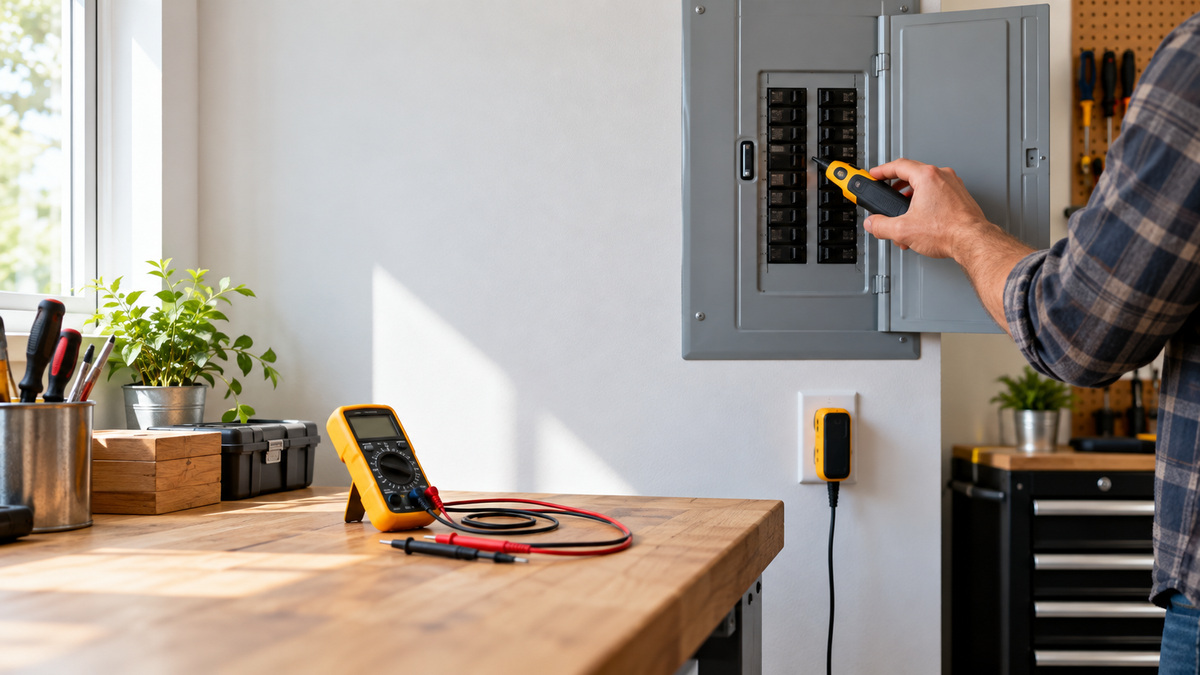
A breaker finder has a transmitter you plug into an outlet and a receiver you scan across the panel to find the matching breaker. A multimeter measures AC/DC voltage, continuity, resistance and sometimes current. An outlet tester shows wiring faults such as open ground or reversed polarity. Use the finder to avoid flipping breakers one by one, then use the meter or outlet tester to confirm power. After you locate the breaker, learn how to test an outlet with a multimeter.
Voltage range
The listings state different supported voltage ranges. Match the tester’s stated range to your outlet, and do not use a transmitter on a circuit above its range. Higher-voltage appliance circuits and anything outside the stated range need a check of the listing and manual first.
CAT rating
CAT is a classification of live circuits used in measurement and testing, usually in relation to a building. Higher categories reflect higher available energy. Check the listing for the exact CAT marking. If the listing does not state a CAT rating, do not call the tool safe for household mains. For background on outlet checks, see best test electrical outlet with multimeter.
Adapters for lights and older outlets
Kits with a light socket adapter, a 3-to-2 prong adapter and an alligator clip lead let you connect the transmitter to a lamp holder, an older two-slot outlet or exposed wire ends. If every test point is a standard three-prong outlet, you may not need them.
Display and alerts
Panels sit in dim basements and garages. A backlit display, beeps and flashing lights on the receiver help you confirm the match, and a built-in flashlight helps when room power is off.
Kit reviews
Circuit Breaker Finder Kit with Digital Multimeter and GFCI Outlet Tester
What it is: A kit whose title names an electrical circuit tracer, a digital multimeter and a GFCI outlet tester. The listing mentions only an included adapter and a transmitter and receiver pair.
Who it suits: Someone who wants outlet mapping and a multimeter in one purchase.
Pros
- Combines outlet mapping with a multimeter
- Includes a transmitter and receiver
Cons
- The transmitter’s voltage range is not stated, so confirm it on the product page
Skip if: You need a voltage range that you cannot confirm on the product page.
View the finder kit with digital multimeter on Amazon (affiliate link)
Klein Tools 80101 Circuit Breaker Finder Kit, 4-Piece
What it is: A kit that combines a breaker finder, a digital multimeter (MM320), a non-contact voltage tester (NCVT3P) and a GFCI receptacle tester (RT250) with leads. The multimeter measures up to 600V AC/DC voltage, 10A DC current and 2MOhms resistance, and tests batteries, diodes and continuity. The voltage tester detects 12 to 1000 VAC or 70 to 1000 VAC. The GFCI tester has a large backlit LCD that shows voltage and wiring conditions. Item weight is 1.8 pounds and item dimensions are 20 x 14 x 4 inches.
Who it suits: A homeowner who wants outlet mapping plus a real multimeter for later jobs, such as measuring DC voltage with a multimeter.
Pros
- The only kit here whose listing states multimeter ranges for voltage, current, resistance, diodes and continuity
- Lists both AC and DC voltage capability
Cons
- The CAT specification line lists both CAT II 135V and CAT IV 1000V, which is unclear, so check the listing and manual for the exact marking
- At 20 x 14 x 4 inches it takes more storage than the others
Skip if: You only want a pocket-size finder.
View the Klein Tools 80101 kit on Amazon (affiliate link)
Circuit Breaker Finder Kit with GFCI Outlet Tester for 90-135V AC Circuits
What it is: A battery-powered finder kit with a GFCI outlet tester and a light socket. The title states it is for 90-135V AC circuits. The listing also mentions a display but gives no details about it.
Who it suits: Mapping standard receptacles inside its stated range.
Pros
- Operating range is stated
- Light socket included
Cons
- The 135V upper limit excludes higher-voltage circuits
Skip if: Your circuit voltage is unknown.
View the 90-135V finder kit with GFCI tester on Amazon (affiliate link)
Goldeep Circuit Breaker Finder with GFCI Outlet Tester and LCD
What it is: A finder with a dual-function LCD that shows wiring status, precise voltage and signal tracking strength. The transmitter works as a GFCI outlet tester with automatic trip testing and red and green LED indicators. The listing names 6 common wiring faults, includes NCV detection in the receiver, and describes impact-resistant ABS housing at 1.12 lb. The kit includes the outlet tester, receiver, portable bag, 2x AAA and 2x 9V batteries, adapters and a manual. A Certified CAT II 135V Safety Rating is stated in the bullets.
Who it suits: Renters and homeowners who map 90-135V outlet circuits in dim panels and want faults named.
Pros
- Batteries and a bag are included
- Names 6 wiring faults
- CAT II 135V rating stated
Cons
- Not a multimeter, and no resistance, current or continuity ranges are stated
- A good outlet result does not diagnose the breaker itself
Skip if: You need to measure current or need internal panel diagnosis.
View the Goldeep breaker finder on Amazon (affiliate link)
AstroAI Circuit Breaker Finder with GFCI Outlet Tester (ABCBFET120BK)
What it is: A two-part tester: plug the transmitter into an outlet or light socket, then scan the panel with the receiver. The receiver beeps and flashes red on the correct breaker and has a built-in LED light for dark panels. It has an integrated GFCI tester, and its title states 90-120V AC. Item dimensions are 9.33 x 5.51 x 2.56 inches, and the kit includes a light socket, a 3-to-2-prong adapter and an alligator clip adapter. It has auto-shutdown with low-battery alerts.
Who it suits: Users who want simple sound and light alerts for straightforward outlet-to-breaker identification.
Pros
- Receiver has its own LED light
- Three adapters included
Cons
- No CAT rating is stated and no multimeter is included
Skip if: You need measured voltage values or resistance checks.
View the AstroAI breaker finder on Amazon (affiliate link)
Buying checklist
- Start with the circuit, not the tool. One dead outlet in a home with labeled breakers may only need a basic finder with a GFCI test.
- If you also want to check cords, batteries, fuses or low-voltage wiring later, choose a kit with a digital multimeter.
- Confirm the transmitter’s supported voltage on the product page and stay inside it.
- Look for a stated CAT rating. If there is none, choose another tool for mains work.
- Check adapters if you will test lights or older outlets.
- Think about carrying and storage: the Goldeep is 1.12 lb, while the Klein kit is 1.8 pounds at 20 x 14 x 4 inches.
Never open a panel cover or touch service conductors to test a breaker. Finders work from the outlet side and the panel face. If the job means removing a cover, measuring inside a panel or working near the service entrance, hire a licensed electrician. See also how to test a live wire with a multimeter, best testing electrical circuits with multimeter and circuit tester vs multimeter.
FAQ
Can a multimeter test a circuit breaker safely?
A multimeter can confirm voltage at an outlet, but a breaker finder is the tool that identifies which breaker feeds it. Work on mains circuits can kill.
What is the difference between a breaker finder and a meter?
A breaker finder uses a plug-in transmitter and a receiver you scan across the panel to locate the matching breaker, while a multimeter measures voltage, continuity and resistance. Use the finder first, then confirm power at the outlet with the meter.
Which transmitter voltage range fits a receptacle circuit?
The kits state different limits: 90-135V AC for the Goldeep and the 90-135V GFCI kit, and 90-120V AC for the AstroAI. Check the supported voltage on the product page before using a transmitter.
Why can a finder indicate more than one breaker?
Adjacent breakers can give a similar signal, so scan the panel twice, adjust sensitivity if the listing states that control, and confirm by switching the suspect breaker off.
Does non-contact detection prove power is off?
No. Non-contact detection only helps you check for live AC voltage without direct contact, so treat it as a first check. Confirm voltage at the outlet with a multimeter, and leave panel work to a licensed electrician.
When should breaker diagnosis go to an electrician?
Call a licensed electrician when a breaker keeps tripping or you would need to open the panel. Work on mains circuits can kill.
Closing note
A basic finder with a GFCI tester is enough to map unlabeled outlets, and the Klein Tools 80101 kit is the only one whose listing states multimeter ranges for voltage, current, resistance, diodes and continuity. Check the supported voltage on the product page, and if a listing does not state a CAT rating, choose another tool for mains work.