Klein MM320 Multimeter: Specs, Uses and Limits
Klein MM320 Multimeter: Specs, Uses and Limits
As an Amazon Associate we earn from qualifying purchases.
The Klein MM320 is a manual-ranging digital multimeter. You turn the function selector yourself instead of letting the meter choose the range. Klein describes it as measuring AC and DC voltage, DC current, and resistance, and it also tests batteries, diodes, and continuity. Its stated safety rating is CAT III 600V. The sections below set out what the manufacturer says, how to use the current inputs with care, and what the documents do not cover.
Quick answer
- The Klein MM320 is a manual-ranging meter. You select the range with the function switch.
- It measures AC and DC voltage, DC current up to 10A, and resistance. It also has battery, diode, and audible continuity functions.
- The manual states a CAT III 600V safety rating, indoor use, and an operating temperature of 0 to 40 C.
- The manual says the current inputs are fused, and gives the fuse ratings and the time limits for high-current readings.
What the MM320 measures
The MM320 manual describes the meter as a manual-ranging digital multimeter that measures AC and DC voltage, DC current, and resistance. It can also test batteries, diodes, and continuity. The front of the meter and the kit documents list the same core functions, along with data hold and an automatic power-off feature.
The MM320 does not measure AC current, according to the manual’s own summary of functions. A clamp meter is the usual tool for AC current, because it measures current without breaking the circuit. If you need AC amps, the MM320 is not the right model, and the best clamp meter roundup on this site is a better starting point. The difference between a multimeter and a clamp meter is covered in the guide on clamp meter versus multimeter.
Manual ranging means the function switch sets the measuring range. The manual notes that for some readings you can turn the switch to a lower range to get higher resolution. That is a practical point: a higher range can hide small changes, so a lower range may be more useful for a small reading, as long as the input is within that range.
Ratings Klein publishes
The figures below come from the manual, the Klein sell sheet, and the Spanish-language datasheet. They are manufacturer figures, not measurements taken for this article.
- Safety rating: CAT III 600V, Class 2, double insulation, pollution degree 2.
- Voltage: AC and DC voltage up to 600V, as stated on the sell sheet and datasheet.
- DC current: up to 10A. The manual says not to attempt to measure more than 10A.
- Resistance: the front label shows 2M. The manual’s resistance range table is the place to confirm the exact ranges.
- Operating temperature: 0 to 40 C (32 to 104 F). Storage: -10 to 60 C (14 to 140 F).
- Operating altitude: up to 2000 m (6562 ft). Relative humidity below 80 percent, non-condensing.
- Accuracy: stated for 18 to 28 C (65 to 83 F). Outside that range, the manual says a correction is required.
- Size and weight: 162 x 79.4 x 45.7 mm (6.39 x 3.12 x 1.80 in), 230 g (8.1 oz).
- Drop protection: 2 m (6.5 ft). Calibration: stated as accurate for one year.
The manual also gives the accuracy formula used in its tables, which is a percentage of the reading plus a number of least significant digits. Read the table for the function you are using, because the percentage and the digit count change from range to range.
Current inputs and fuses
The current inputs are where most people get into trouble, so read this part of the manual before you measure current. The manual describes two current jacks. One is for mA and smaller current readings. The other is a 10A jack. The manual says to remove power from the circuit, open the circuit at the measuring point, connect the meter in series using the test leads, and then apply power.
The manual gives these fuse ratings for replacement:
- The V (A/mA) jack is protected by a 200mA/600V fast-blow fuse, interrupting rating 1kA, Klein Cat. No. 69031.
- The 10A jack is protected by a 10A/600V fast-blow fuse, interrupting rating 10kA, Klein Cat. No. 69032.
The manual warns that a fuse may blow if more than 200mA is applied to the V jack, or more than 10A is applied to the 10A jack. A blown fuse is a sign that the meter was connected wrong or to a circuit with more current than the input allows. Do not replace a fuse with a different rating, and do not bypass one.
For high current, the manual says that when you measure above 6A, you should take a reading of no longer than 30 seconds, and then allow 10 minutes of recovery time. Build that rest period into your work. A reading that runs longer than the stated limit is outside the manufacturer’s instructions.
Safety steps before any measurement
Electrical measurement can kill, and the MM320 is rated for circuits connected to the building’s low-voltage distribution part, not for work on the service equipment itself. The manual is clear about several points, and each one applies every time you use the meter.
- Check the function switch and the lead position before you connect anything. A lead left in the wrong jack is a common cause of error and of blown fuses.
- Follow the manual’s order for current readings: remove power from the circuit, open the circuit, connect the meter in series, and only then apply power.
- Remove the leads from any voltage source before you open the battery door or access the fuses. The manual gives the same warning for the battery door and the back housing.
- Do not operate the meter with the battery door or back housing removed.
- Use the meter indoors only. The manual says to keep it away from moisture, rain, and snow.
The manual also includes a CAT III and CAT II explanation. CAT III shields may be removed for CAT II locations, and the manual says that leaving a CAT III shield off in a CAT III location increases arc-flash risk. Keep the shield in place when you work in a CAT III location.
Auto power-off and battery checks
The MM320 powers itself off after 15 minutes of inactivity, according to the manual. The manual also explains how to turn that feature off when you need the meter to stay on, by holding a button while powering it on. When auto power-off is deactivated, the matching symbol is not shown.
The battery test is a separate function. It is described as a battery test in the front-of-meter labels and the manual. Use it for the kind of battery the manual describes, and do not treat a battery test result as a load test. A load test checks how a battery behaves under current, and the MM320 is not described as a load tester.
How to use the basic functions
For a simple voltage check, set the function switch to the voltage function you need, plug the black lead into COM and the red lead into the voltage jack, and read the display. Start on a range above the expected value. Because the MM320 is manual-ranging, a reading that is too high for the selected range will not be corrected by the meter.
For resistance, use the resistance setting and a circuit with no power applied. For continuity, use the audible continuity setting. For diodes, use the diode test setting, which the manual describes in its own section. Each function has its own steps in the manual. Follow those steps, not a general routine.
Buying checklist
- Confirm you need a manual-ranging meter. If you prefer the meter to pick the range, look at an auto-ranging model instead.
- Confirm you do not need AC current. The MM320 is described as measuring DC current, not AC current.
- Check that the CAT III 600V rating matches your work, and do not use the meter above its stated limits.
- Check the fuse ratings and keep a spare of the correct rating if you use the current inputs.
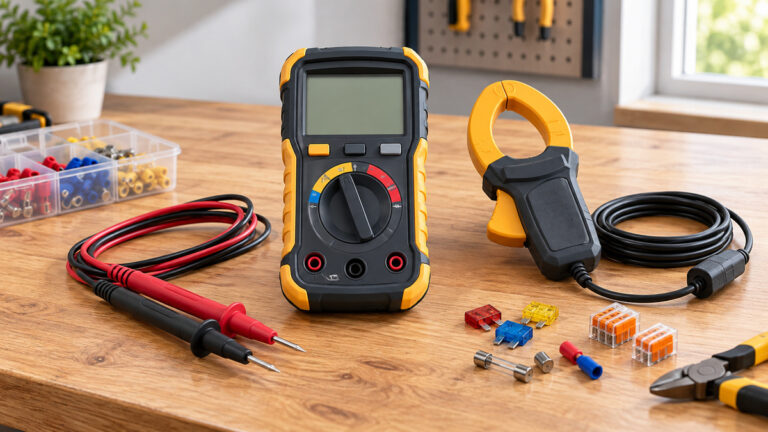
- Look at the kit contents. The sell sheet shows the MM320 in a kit with other testers, so the kit may include items you do not need. For a wider comparison of meters, see the best multimeter roundup.
Mistakes to avoid
- Measuring current with the leads in the voltage jack. The manual says the fuse may blow in that case.
- Exceeding 10A on the 10A jack, or holding a high-current reading past 30 seconds.
- Assuming the MM320 measures AC current. The manual lists DC current.
- Leaving the meter in a high range and reading a small value as zero.
- Using the meter in damp or outdoor conditions. The manual states it is for indoor use.
How we chose
This guide does not rank the MM320 against other meters, and it does not claim the model is the best choice for any task. It describes one model from Klein’s own manual and its published sell sheet and datasheet. The criteria are the questions a buyer or a new user is likely to ask: what the meter measures, what its safety and environmental ratings are, how the current inputs are protected, and what the manual says about each function. Each figure comes from one of the three documents listed in the Sources section, with the date each was opened.
What we could not verify
The documents do not give independent measurements of the meter, and they do not show how it compares with other multimeters on accuracy or durability. The sell sheet and datasheet are marketing and reference documents, so they do not add test data. The manual gives accuracy tables, but this guide does not reproduce them in full, and it does not state accuracy figures as measured results. The documents also do not give a price or stock status, and this guide does not include either. Where a question falls outside what Klein states, the answer here is that the sources do not say.
FAQ
Is the Klein MM320 auto-ranging?
No. The manual describes it as manual-ranging, so the range is set with the function switch.
Can the MM320 measure AC current?
The manual describes DC current up to 10A and does not list AC current among its functions. For AC current, look at a clamp meter.
What fuses does the MM320 use?
The manual lists a 200mA/600V fast-blow fuse for the V (A/mA) jack, Klein Cat. No. 69031, and a 10A/600V fast-blow fuse for the 10A jack, Klein Cat. No. 69032.
How long can I measure high current?
The manual says that above 6A, a reading should be no longer than 30 seconds, followed by 10 minutes of recovery time.
When does the MM320 turn off by itself?
The manual states that it powers off after 15 minutes of inactivity, and that the feature can be deactivated at power-on.
What is the safety rating?
The manual and datasheet state CAT III 600V, Class 2, double insulation. Use the meter only within those ratings and the conditions the manual describes.
Bottom line
The Klein MM320 suits a user who wants a manual-ranging meter for AC and DC voltage, DC current up to 10A, resistance, and basic checks. Read the fuse and high-current limits before you measure current, and keep the rated fuses in place. If you need AC current, choose a clamp meter instead.
Sources
- Klein Tools, MM320 Digital Multimeter Instruction Manual. https://data.kleintools.com/sites/all/product_assets/documents/instructions/klein/MM320-1390422ART%20-%20WEB.pdf (opened 2026-10-27)
- Klein Tools, MM320KIT and CL120VP electrical test kits sell sheet. https://data.kleintools.com/sites/all/product_assets/documents/brochures/klein/CL120VP_MM320KIT_NCVT3PKIT_SellSheet_WR.pdf (opened 2026-10-27)
- Klein Tools, MM320KIT Digital Multimeter Electrical Test Kit datasheet (Spanish). https://data.kleintools.com/sites/all/product_assets/documents/brochures/klein/kleintools_datasheet_es_mm320kit.pdf (opened 2026-10-27)