Fluke 17B+: What the Fluke Documents State
Quick answer
- Display: 4000 counts, updating three times per second, per Fluke’s datasheet.
- What the 17B+ adds: the datasheet attributes a temperature probe, overload protection and an over-voltage indicator to the 17B+, and not to the 15B+.
- Safety: IEC 61010-1 and IEC 61010-2-030, CAT III 600 V, Pollution Degree 2. The datasheet also lists a maximum voltage of 1000 V between any terminal and earth ground.
- Power and fuses: two AA batteries, and two Fluke-specified fast fuses rated 440 mA and 11 A, both at 1000 V.
What the 17B+ adds over the 15B+
Fluke’s datasheet covers the 15B+ and 17B+ in one document. For the 17B+, the datasheet says the model “allows you to tackle even more applications” and lists three features that it does not attribute to the 15B+: a temperature probe, overload protection and an over-voltage indicator. The datasheet’s package list includes a temperature probe for the 17B+. The 15B+ is listed without the probe.
A temperature probe lets the meter read a temperature rather than only an electrical value. The datasheet does not give the probe’s own accuracy figure in the sections we opened, so check the probe’s own sheet or the manual before you rely on a temperature reading for a specific job.
Overload protection and an over-voltage indicator are the other two extras. The manual describes an overload (OL) indication and a hazardous-voltage alert LED. Treat that LED as a warning to stop and check the circuit, not as a reading.
What the meter measures
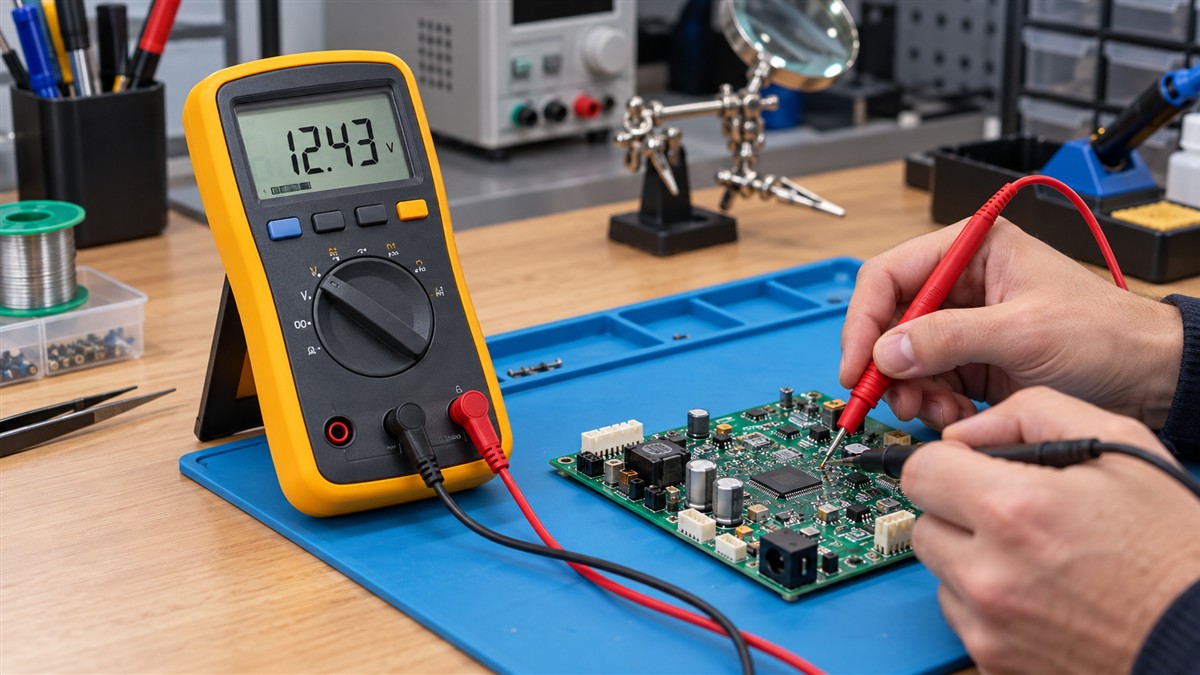
The datasheet lists AC and DC voltage, AC and DC current, resistance, capacitance, frequency, duty cycle and continuity. Voltage ranges start at 400 mV and run up to the 1000 V input. The current ranges include a 400 mA range and a 10 A range. The datasheet gives an accuracy line for each range, written as a percentage of the reading plus a number of least significant digits.
The accuracy figures apply for one year after calibration, between 18 °C and 28 °C and at 0% to 75% relative humidity. The datasheet notes that AC, frequency and duty-cycle figures apply from 1% to 100% of range, and that inputs below 1% of range are not specified. Use the line for the range you are measuring, not a single headline figure.
The datasheet lists DC volts input impedance above 10 MΩ and below 100 pF. High input impedance means the meter draws very little current from the circuit, which reduces the chance of loading a sensitive circuit. The datasheet also gives common-mode rejection figures for AC and DC volts, which matter on noisy circuits.
Safety rating and what it means
Work on mains circuits can kill. A category rating tells you the transient voltage and voltage to earth the meter is designed to withstand in that category. Fluke states that the 17B+ is rated CAT III 600 V under IEC 61010-2-030, with Pollution Degree 2, and the datasheet gives a 1000 V maximum voltage between any terminal and earth ground.
A rating describes the meter’s design limit. It does not make the meter safe on every circuit up to that value. Match the category to the point where you are working. If you cannot say which category a panel, service entrance or outlet falls into, stop and call a licensed electrician. Panel and service work belongs to a licensed electrician.
The manual describes a hazardous-voltage alert LED that lights when the meter sees a voltage of 30 V or more, or an overload condition. Do not dismiss the LED because the display shows a number.
Fuses, battery and build
The current inputs are protected by two fuses. The low-current input uses a 440 mA, 1000 V fast fuse. The high-current input uses an 11 A, 1000 V fast fuse. Fluke states that both are Fluke-specified parts. Replace them only with the parts Fluke specifies.
The meter runs on two AA batteries. The datasheet lists a battery life of 500 hours minimum, and about 50 hours in LED test mode without load. Replace the batteries when the meter shows a low-battery indication.
The datasheet gives the weight as 455 g, the size as 183 × 91 × 49.5 mm, and the IP rating as IP40. The operating range is 0 °C to 40 °C, and storage is -30 °C to 60 °C. The datasheet’s humidity figures are 90% RH at 10 °C to 30 °C and 75% RH at 30 °C to 40 °C.
Skip if
- You do not need a temperature probe, overload protection or an over-voltage indicator. In that case the shared datasheet shows the same core electrical specifications for the 15B+, so compare the two model pages.
- You need a clamp for current. The sources describe the 17B+ as a multimeter with test-lead inputs, not a clamp meter.
- You need true-RMS measurement. The sources we opened do not state true-RMS measurement for the 17B+. Confirm the function list in the manual before you buy.
How we chose
This article covers one model. It uses three documents opened on 27 October 2026: the shared 15B+/17B+ datasheet, the 15B+/17B+/18B+ users manual and the 17B+ product page. The criteria are the figures and safety statements those documents publish, and the features they attribute to the 17B+. It does not rank the 17B+ against other meters, and it does not describe any test by the author.
What we could not verify
- The sources do not state whether the 17B+ measures true RMS.
- The sources do not give the accuracy of the temperature probe. Check the probe’s own documentation.
- The sources do not state a warranty length, a country-specific price or a shipping time.
FAQ
What does the 17B+ have that the 15B+ does not?
Fluke’s datasheet attributes a temperature probe, overload protection and an over-voltage indicator to the 17B+. The 15B+ is listed without them.
How many counts does the 17B+ display?
4000 counts, updating three times per second, according to the datasheet.
What CAT rating does the 17B+ carry?
IEC 61010-2-030, CAT III 600 V, Pollution Degree 2. The datasheet also gives a 1000 V maximum voltage between any terminal and earth ground.
What batteries does it take?
Two AA batteries, NEDA 15A and IEC LR6, with a stated battery life of 500 hours minimum.
Which fuses protect the current inputs?
A 440 mA, 1000 V fast fuse on the low-current input and an 11 A, 1000 V fast fuse on the high-current input. Both are Fluke-specified parts.
What is the IP rating?
IP40, according to the datasheet.
Bottom line
The Fluke 17B+ is a battery-powered digital multimeter with the same published core specifications as the 15B+, plus the temperature probe, overload protection and over-voltage indicator that Fluke attributes to it. Before you buy, confirm that you need those extras, the category you will work in, and whether you need a true-RMS function.
Related guides
- Best Fluke 1507 Test Leads: What to Check Before You Buy covers leads and their ratings for a Fluke meter.
- Fluke Multimeter Lineup: 7 Meters Compared by Stated Function compares Fluke meters by the functions their makers state.
- Best Fluke 117 Case: 4 Hard Cases Compared covers cases for a Fluke meter kit.
Sources
- Fluke Corporation, “TECHNICAL DATA Fluke 15B+/17B+ Digital Multimeters”, https://media.fluke.com/13f4f547-c677-44dc-af90-b1380151359c_original%20file.pdf (opened 2026-10-27)
- Fluke Corporation, “15B+/17B+/18B+ Digital Multimeters Users Manual”, https://media.fluke.com/f8ca9de4-481a-4125-8a46-b2d9006f431f_original%20file.pdf (opened 2026-10-27)
- Fluke Corporation, “Fluke 17B+ Digital Multimeter” product page, https://www.fluke.com/en-us/product/electrical-testing/digital-multimeters/fluke-17b-plus (opened 2026-10-27)