Klein RT210 Outlet Tester: What It Checks and What It Limits
Klein RT210 Outlet Tester: What It Checks and What It Limits
As an Amazon Associate we earn from qualifying purchases.
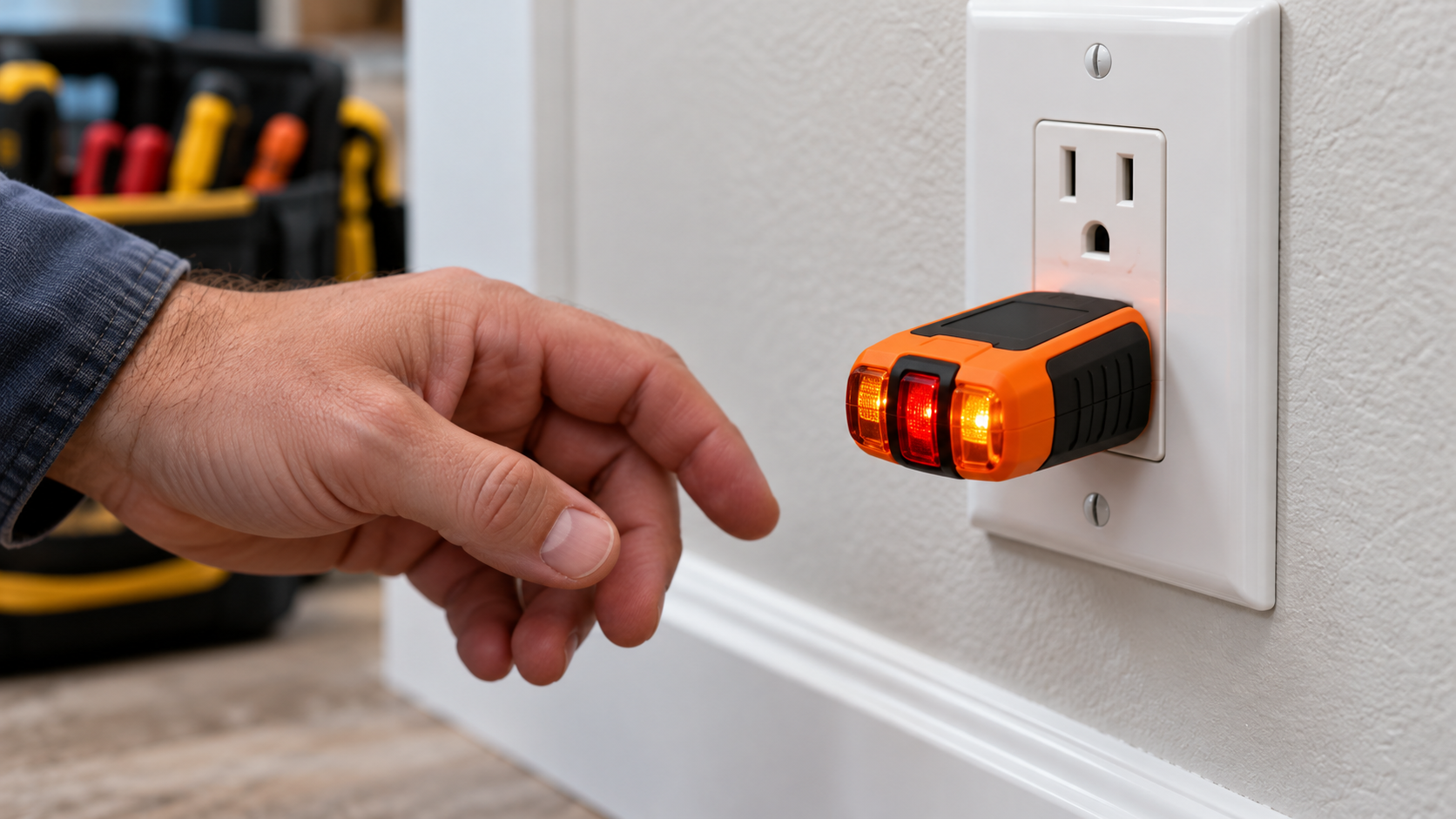
The Klein RT210 is a plug-in receptacle tester for standard and GFCI outlets rated 110-125V AC at 50/60Hz in a 3-wire outlet. Its indicator lights show whether the outlet is wired correctly, or which common fault it reports. It does not check ground quality, multiple hot wires, or combinations of faults, so a clean reading is not a full electrical inspection. Read the limits below before you rely on it.
Quick answer
- The Klein RT210 checks for open ground, reverse polarity, open hot, open neutral, and hot/ground reversed, and reports a correct wiring result when none of these is present.
- Its manufacturer rating is CAT II 300V and the instructions say it is for indoor use only.
- For a GFCI outlet, the instructions say to check the GFCI receptacle manual first, then use the tester to run a 7-second test.
- If the tester shows a wiring fault, the instructions tell you to consult a qualified electrician.
What the RT210 is designed to detect
The Klein Test & Measurement brochure describes the RT210 as a tester that detects the most common wiring problems in standard and GFCI receptacles. The RT210 instructions list the conditions it indicates: wiring correct, open ground, reverse polarity, open hot, open neutral, and hot/ground reversed. Each condition has its own light pattern, and the printed key code on the tester is what you compare against.
The instructions also list the conditions the tester does not indicate. These are the quality of the ground, multiple hot wires, combinations of defects, and reversal of the grounded and grounding conductors. In plain terms, a receptacle can show a correct light pattern and still have a problem the tester cannot see. The tester is a quick wiring check, not a load test and not an inspection of the building wiring behind the outlet.
The key terms are simple. Hot is the black or live conductor that carries voltage. Neutral is the white return conductor. Ground is the bare or green safety conductor that should carry fault current away from metal parts. Open ground means the ground contact is not connected. Reverse polarity means hot and neutral are swapped. Open hot means the hot contact is not connected, and open neutral means the neutral contact is not connected.
Specifications stated by Klein
Klein states the following in the RT210 manual and datasheet. These are manufacturer figures, not measurements taken for this article.
- Nominal voltage: 110-125V AC at 50/60Hz in a 3-wire outlet, with mains supply fluctuations of plus or minus 10 percent.
- Safety rating: CAT II 300V, pollution degree 2.
- Operating temperature: 0 to 40 C (32 to 140 F). Storage temperature: -10 to 50 C (14 to 122 F).
- Operating altitude: up to 2000 m (6562 ft). Relative humidity below 85 percent, non-condensing.
- Drop protection: 2 m (6.6 ft). Weight: 33 g (1.2 oz).
- Use: indoor use only.
The RT210 datasheet is a short document. It lists the tester as a GFCI and standard receptacle tester with a 110/125V AC rating for a 3-wire outlet, and it lists the CAT II 300V rating. Where the datasheet and the instruction manual state the same figure, the figures match. The datasheet does not add a second rating.
A CAT rating describes the installation location the tester is designed for. CAT II refers to circuits connected to a wall outlet or similar final branch circuit. A rating is a limit, not a guarantee, and a CAT rating does not make a tester suitable for work inside a panel or on a service feed. Use the rating the manufacturer states, and do not treat a CAT II rating as a promise that the tester is safe in every location.
How the standard outlet test works
The RT210 instructions give a short sequence for a standard receptacle. Follow the same order each time, so the result is comparable from one outlet to the next.
- Verify the tester first by plugging it into a known live and correctly wired receptacle. The instructions say to do this before each use, and they say not to use the tester if it looks damaged.
- Plug the tester into the receptacle under test.
- Compare the lights that stay on with the key code printed on the tester.
- If the tester indicates that the receptacle is not wired correctly, consult a qualified electrician.
Before you start, unplug appliances and equipment on the same circuit. The instructions say this helps reduce the chance of erroneous readings. Equipment still connected to the circuit can interfere with the tester, so clear the circuit before testing.
How the GFCI test works
A GFCI receptacle has a built-in test button, and the RT210 instructions combine that button with the tester’s own test button. The procedure is longer than the standard one, and it has more steps where you need to stop and act. The steps below follow the printed instructions.
- Check the GFCI receptacle user manual for how that specific receptacle operates before you use the tester.
- Insert the tester into the receptacle to check for correct wiring. The lights on the tester should illuminate.
- Press the TEST button on the GFCI receptacle. If the GFCI trips and the lights on the tester go dark, reset the GFCI by pressing the reset button and go on to step 4. If it does not trip, the GFCI is not operating properly or the receptacle is miswired, and you should consult a qualified electrician.
- Press and hold the test button on the tester for 7 seconds. If the GFCI trips and the tester lights go dark, reset the GFCI. The instructions then say the GFCI appears to be operating properly. If the GFCI does not trip, the GFCI is not operating properly or the receptacle is miswired, and you should consult a qualified electrician.
A GFCI that does not trip is a safety problem, not a minor glitch. Stop using that receptacle for anything that needs ground-fault protection and have it checked. Do not work around a receptacle that fails the test.
Safety before you plug in
Electrical work carries real risk. The RT210 instructions open with a warning that failure to follow the instructions could result in death or serious injury. Read the full manual before you use the tester, and keep these points in mind every time.
- Check the tester on a known live, correctly wired receptacle before you rely on it. A tester that gives no light on a live outlet, or that looks cracked, should not be used.
- Use the RT210 only on 110-125V AC outlets of the type the manual describes. The manual lists 110-125V AC at 50/60Hz in a 3-wire outlet as the nominal voltage.
- Use it indoors only. The manual states that it is intended for indoor use only.
- Do not open the tester. The manual says there are no serviceable parts inside and that the tester should not be repaired by the user.
- A panel, a breaker, or any wiring behind the receptacle belongs to a licensed electrician. A tester that reports a fault is telling you to stop and call one.
The RT210 is not a substitute for a voltage check with a meter that is rated for the circuit you are measuring, and it does not replace a qualified inspection. If you need to know whether a circuit is dead before you touch it, use a voltage tester rated for that work and follow its own instructions.
How to read the common results
Each light pattern corresponds to a specific condition in the printed key code. The table below restates the conditions named in the RT210 instructions. It does not add conditions Klein does not list.
| Result named in the instructions | What it means | Next step |
|---|---|---|
| Wiring correct | The tester reads the receptacle as correctly wired for the conditions it checks. | Still limited to the conditions in the next section. |
| Open ground | The ground contact is not connected. | Consult a qualified electrician. |
| Reverse polarity | Hot and neutral are reversed. | Consult a qualified electrician. |
| Open hot | The hot contact is not connected. | Consult a qualified electrician. |
| Open neutral | The neutral contact is not connected. | Consult a qualified electrician. |
| Hot/ground reversed | Hot and ground connections are reversed. | Consult a qualified electrician. |
A single light pattern is a snapshot. If you move the tester to a second outlet on the same circuit and get a different result, do not average the two. Treat each receptacle separately, and check the tester again on a known good outlet before you trust the next reading.
Limits the RT210 does not cover
The instructions are direct about the limits, and they matter more than the feature list. The RT210 does not indicate the quality of the ground. It does not indicate multiple hot wires. It does not indicate combinations of defects, so a receptacle with two faults may show only one pattern or a pattern that is hard to read. It also does not indicate reversal of the grounded and grounding conductors in the way a full installation inspection would.
The instructions also say the tester only detects common wiring problems and that you should always consult a qualified electrician to resolve wiring problems. The tester is a first check. It is not a certificate that a circuit is safe, and it does not measure voltage, current, or resistance.
How the RT210 compares with a multimeter
A multimeter measures values such as voltage, current, and resistance. The RT210 reports wiring conditions with lights. Those are different jobs. If you want a number for voltage on an outlet, a multimeter is the right kind of tool, but it must be rated for the work and used with the usual precautions. If you want a quick look at whether an outlet is wired in a common way, the RT210 is designed for that narrower task. For a meter-based outlet check, see how to test an outlet with a multimeter.
Use the RT210 for the question it answers and do not stretch it to answer others. For a wider set of receptacle testers, see the best receptacle tester roundup on this site.
Buying checklist
- Confirm the outlet voltage matches the tester’s stated nominal voltage of 110-125V AC at 50/60Hz in a 3-wire outlet.
- Confirm the outlet type. The RT210 is a receptacle tester for standard and GFCI outlets, not for 240V appliance outlets.
- Check that you have the manual, or know where to download it from the manufacturer.
- Check the CAT rating against your use. The stated rating is CAT II 300V.
- Plan to test the tester on a known live, correctly wired outlet before each use.
Mistakes to avoid
- Skipping the check on a known live outlet. The manual says to verify the tester before each use, and a tester that does not work on a known outlet tells you nothing about the outlet under test.
- Reading a clean pattern as proof that the whole circuit is safe. The conditions not indicated list includes ground quality and multiple hot wires.
- Running the GFCI test without first reading the GFCI manual. The instructions say to check that manual first.
- Leaving the GFCI tripped and assuming it is fine. A GFCI that does not trip on test should be treated as faulty until a qualified electrician checks it.
- Using the tester outdoors or in damp locations. The instructions limit it to indoor use.
How we chose
This guide does not rank the RT210 against other testers, and it does not claim a best-in-class position. It describes one model using three documents Klein publishes: the combined ET40/RT210 instruction manual, the RT210 datasheet, and the Test & Measurement brochure. The criteria are the ones a reader is likely to ask about: what the tester detects, what it does not detect, what standard the manufacturer lists, and what the safe use steps are. Each figure in this article comes from one of those documents, and the Sources section gives the URL and the date each one was opened.
What we could not verify
The sources we opened do not cover every question a buyer might have. The documents do not give independent measurements of the tester, and they do not state how it performs across every receptacle design. They do not give a price or a stock status, and this guide does not include either. The manuals describe light patterns, but they do not show every possible wiring combination. Where a question falls outside the stated conditions, the honest answer is that the manufacturer documents do not say.
FAQ
What does the Klein RT210 check?
The instructions say it checks for open ground, reverse polarity, open hot, open neutral, and hot/ground reversed, and it reports a correct wiring result when none of those conditions is present. It is designed for standard and GFCI receptacles.
Does the RT210 test whether an outlet is grounded well enough?
No. The instructions list quality of ground as a condition the tester does not indicate. A tester that shows a ground connection is present does not confirm the quality of that ground.
Can the RT210 be used on a 240V outlet?
The stated nominal voltage is 110-125V AC at 50/60Hz in a 3-wire outlet. The sources this guide opened do not list a 240V use, so do not use it on 240V outlets.
What is the CAT rating of the RT210?
The manual and datasheet both state CAT II 300V. Use the tester only within the conditions the manufacturer describes.
What should I do if the GFCI does not trip during the test?
The instructions say the GFCI is not operating properly or the receptacle is miswired, and that you should consult a qualified electrician. Stop relying on that receptacle for ground-fault protection until it has been checked.
Is the RT210 safe to use without reading the manual?
The manual includes warnings that failure to follow the instructions could result in death or serious injury. Read it before use, check the tester on a known live outlet, and treat any fault result as a reason to call a qualified electrician.
Bottom line
Use the Klein RT210 as a quick wiring check for standard and GFCI outlets, verify it on a known live outlet first, and treat any fault result as a reason to call a qualified electrician. It does not check ground quality, multiple hot wires, or combinations of faults.
Sources
- Klein Tools, ET40/RT210 Electronic AC/DC Voltage Tester and GFCI Receptacle Tester Instructions. https://data.kleintools.com/sites/all/product_assets/documents/instructions/klein/ET40_RT210_instructions_WEB.pdf (opened 2026-10-27)
- Klein Tools, Catalog No. RT210 GFCI Outlet Tester datasheet. https://data.kleintools.com/sites/all/product_assets/documents/brochures/klein/kleintools_datasheet_rt210.pdf (opened 2026-10-27)
- Klein Tools, Test & Measurement brochure (Ed. 161). https://data.kleintools.com/sites/all/product_assets/documents/brochures/klein/KleinTools_TestandMeasurement_Ed161.pdf (opened 2026-10-27)