Best Multimeter to Check a Live Wire: 5 Meters Compared
As an Amazon Associate we earn from qualifying purchases. Details
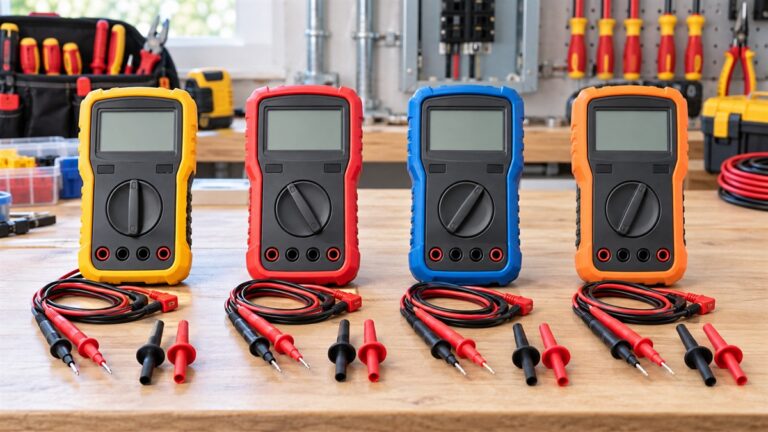
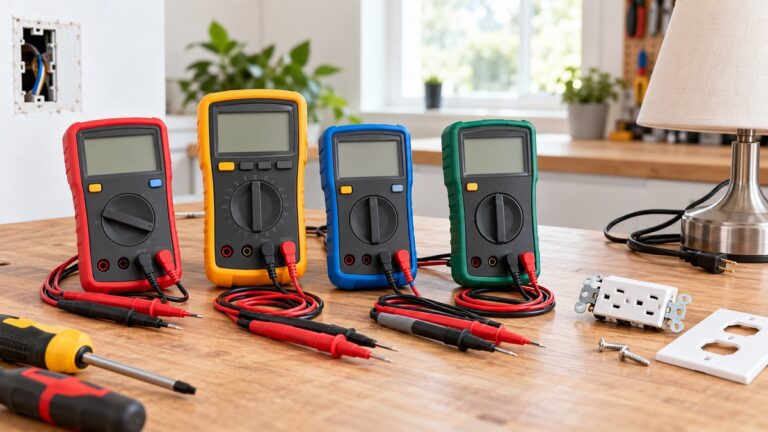
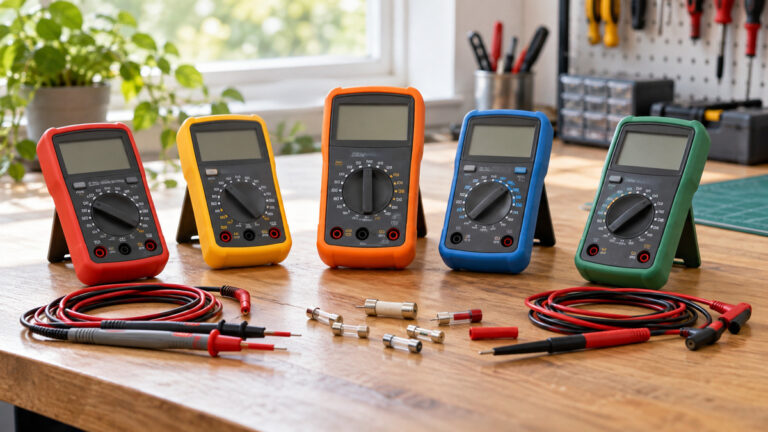
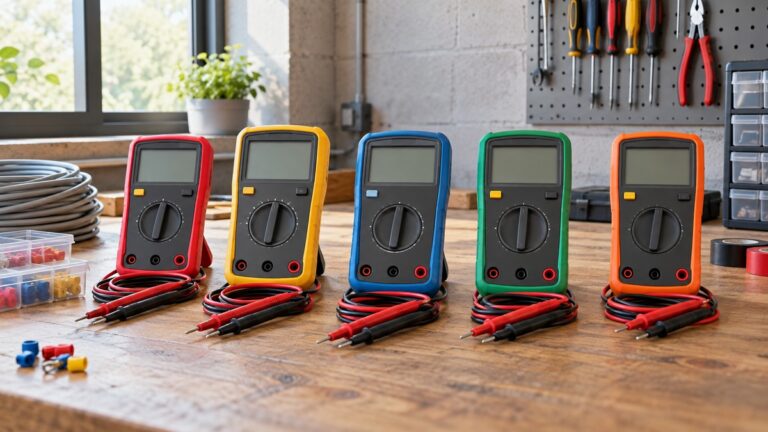
This guide compares five meters for checking whether a wire is live. Start with the listing: a meter should state both a live wire function and a CAT rating that suits your circuit. Treat a beep or live-wire mode as a first screen, and do not read it as proof that a wire is dead. Mains work carries real risk, so match each meter’s category rating to the circuit and leave panel or service work to a licensed electrician.
Quick answer
Pick a multimeter whose listing states both a live wire function and a CAT rating that suits your circuit. For household use, the Crenova MS8233D lists CAT III 600V, non-contact voltage detection and a live wire function. The MAYILON MY8906B explains its single-probe LIVE mode most clearly. A live wire mode or a beep is a first screen, not proof that a wire is dead.
Work on mains circuits can kill. Match the meter’s category rating to the circuit, and leave panel or service work to a licensed electrician.
How a multimeter checks for a live wire
The listings in this group use two different methods, and they are not the same thing.
- Non-contact voltage (NCV). You bring the meter’s sensor near a wire and an alarm sounds when it senses AC voltage. The Crenova listing says the buzzer beeps faster as the detected AC voltage gets stronger. The AstroAI clamp meter listing describes a green light and slow beep for a weak AC signal, and a red light and quick beep for a strong one.
- Single-probe LIVE mode. You turn the selector to LIVE and touch one probe to the wire to identify the live conductor. The MAYILON listing describes this mode, and describes NCV as a separate mode where you remove the probes and bring the sensor close to the wire.
- A measured reading with two probes. This is the ordinary AC voltage setting. It gives a number, but it requires you to touch two points and to know the category of the circuit.
A quiet meter is not proof that a conductor is de-energized. Test the meter on a known live source first, and confirm with a measured reading and the right procedure before you touch anything. For a plain-language look at the procedure, see our guide to testing AC voltage with a multimeter.
Decision guide
- Household outlets and switches, with a basic live check: a meter with NCV and a live wire function and a CAT III 600V rating, such as the Crenova MS8233D.
- You want the LIVE and NCV methods described step by step: the MAYILON MY8906B.
- You need to carry a meter in a pocket: the ZIBOO 101, listed at 5.12 x 2.6 x 1.3 inches and 0.05 kg.
- You want more measurements, including temperature and capacitance, and a thermocouple in the box: the TESMEN TSM-599.
- You also need to read AC current without breaking the circuit: a clamp meter such as the AstroAI, which lists AC current ranges up to 400A and cannot measure DC current.
- Heavy-duty or panel work: do not rely on the CAT II meters on this list. Check the rating for the circuit, and call a licensed electrician for service work.
Five meters compared
Crenova MS8233D: CAT III 600V with NCV and live wire
The Crenova MS8233D lists True RMS with 6000 counts, auto-ranging with a manual option, and measurements of AC and DC voltage, AC and DC current, resistance, capacitance, frequency, duty cycle, continuity, diode and temperature. It also lists non-contact voltage detection with sound and light alarms, and a live wire function. The safety specification is IEC 61010-1 CAT III 600V, with two built-in fuses for overload protection and an insulated rubber holster. It weighs 0.55 kg, measures 5.51 x 2.76 x 1.57 inches, and has a one-year warranty. The package lists the meter, 2 AAA batteries, a carry bag, test leads and alligator clips.
Limitation: it is heavier and larger than the ZIBOO 101 (0.05 kg) and the AstroAI clamp meter (about 203 g). The listing gives a sampling speed of 3 times per second, so the display updates in steps rather than continuously.
MAYILON MY8906B: the clearest explanation of NCV and LIVE modes
The MAYILON MY8906B is a True RMS meter listing AC and DC voltage and current, resistance, capacitance, diode, transistor (hFE), frequency, continuity, NCV and LIVE wire. It lists a maximum of 1000V DC and 750V AC, an IEC 61010-1 CAT II 600V rating, double insulation, fuse protection, overload protection and a silicone rubber casing. It has a manual range selector dial. The listing describes NCV mode (remove the probes, rotate the selector to NCV, bring the sensor near the wire, and a buzzer sounds when AC voltage is detected) and LIVE mode (rotate to LIVE and touch the red probe to the wire to identify the live conductor).
Limitation: CAT II 600V is a lower category than the Crenova’s CAT III 600V, and the listing does not give a weight or dimensions. The included components are the meter, test probes, batteries and a manual.
ZIBOO 101: pocket-size with NCV and live wire testing
The ZIBOO 101 is the smallest meter here at 5.12 x 2.6 x 1.3 inches (130 x 66 x 33 mm) and 0.05 kg. It lists True RMS with 4000 counts and auto-ranging, AC and DC voltage up to 600V, AC and DC current up to 400mA, resistance up to 40 MOhm, capacitance up to 4000 uF, frequency, a 1.5V and 9V battery test, a built-in NCV sensor and a live wire function. The rating is CAT II 600V with overload input protection, and it lists CE, EMC and RoHS marks. It has a backlit LCD, Data Hold and a continuity beeper.
Limitation: current measurement stops at 400mA, so it is not suited to checking household load. The listing includes one test lead according to the included components field, so check the product page for the exact accessories before you buy.
TESMEN TSM-599: auto and manual modes with temperature
The TESMEN TSM-599 is a True RMS 6000-count meter with two modes. In Auto mode it tests DC and AC voltage, resistance and continuity with no selection. In Manual mode it measures DC and AC current, diode, capacitance, Hz percent, temperature, NCV and live wire. It lists a 10A, 250V fuse, an insulated silicone casing, a 15-minute auto-off, a low-battery indicator, Data Hold, a flashlight, a stand and a colour LCD with an analog bar. The specification field lists CSA and ETL. The package lists the meter, 2 test leads, a thermocouple, a storage bag, 4 AAA batteries and a manual.
Limitation: NCV and live wire are listed under Manual mode, so the meter needs to be set on the dial first. The product data does not give a CAT rating, so check the product page before you rely on it for mains work.
AstroAI clamp meter: live wire and non-contact voltage with a clamp
The AstroAI digital clamp meter lists 2000 counts, AC and DC voltage, AC current, resistance, capacitance, continuity, diode, live wire tests and a non-contact voltage function with sound and light alarms. The voltage ranges run to 600V, and AC current ranges are 2A, 20A, 200A and 400A. It lists CAT III 600V, pollution degree 2, and a weight of about 203 g. The size is 8.46 x 4.53 x 1.77 inches. It includes two 1.5V AAA batteries, has a flashlight, Data Hold, Max/Min and auto shut-off.
Limitation: the listing states this clamp meter cannot test DC current. It is larger than the pocket meters, and 2000 counts is a lower resolution than the 4000 and 6000 count meters above.
Mistakes that make a live check unreliable
- Treating a quiet meter as proof. A beeper that stays silent does not confirm the absence of voltage. The result also depends on the sensor distance and the setting you chose.
- Skipping the known-live check. Verify the meter on a source you know is energized before and after you use it, so you can trust a negative result.
- Mixing up the modes. NCV and LIVE are different positions on the MAYILON dial. Using the wrong one gives a misleading result.
- Ignoring the category rating. A CAT II 600V meter and a CAT III 600V meter are not described as equivalent by their listings.
- Using a pocket meter for current. The ZIBOO 101 reads current only to 400mA.
Frequently asked questions
Can a multimeter check whether a wire is live?
Yes, all five listings state NCV or a live wire function. The method differs: NCV uses a sensor near the wire, and LIVE mode on the MAYILON uses one probe on the wire. For a dedicated tool, see our live wire tester guide.
What does a CAT rating tell me?
It describes the electrical environment a meter is designed for. The Crenova and AstroAI list CAT III 600V. The MAYILON and ZIBOO list CAT II 600V. The TSM-599 data does not give a CAT rating.
Can I use these meters for current checks?
Yes, with limits. The AstroAI clamp meter lists AC current to 400A but no DC current. The ZIBOO 101 lists current only to 400mA. The Crenova and MAYILON list AC and DC current in general terms, so confirm the exact range on the page.
Is a meter better than a separate live-dead-live tester?
They suit different jobs. A meter gives readings and many functions, while a dedicated tester is built around the live check. Our live dead live tester guide covers that tool.
Bottom line
For a household live check with a rating suited to outlets and switches, the Crenova MS8233D is the best-documented choice here. The MAYILON MY8906B is easiest to learn from its listing, the ZIBOO 101 is the pocket option, the TESMEN TSM-599 adds temperature and a thermocouple, and the AstroAI clamp meter adds AC current. Check the CAT rating and the included leads on the product page before you buy.