Fluke LVD2 Voltage Tester: Uses, Limits and Stated Specs
As an Amazon Associate we earn from qualifying purchases.
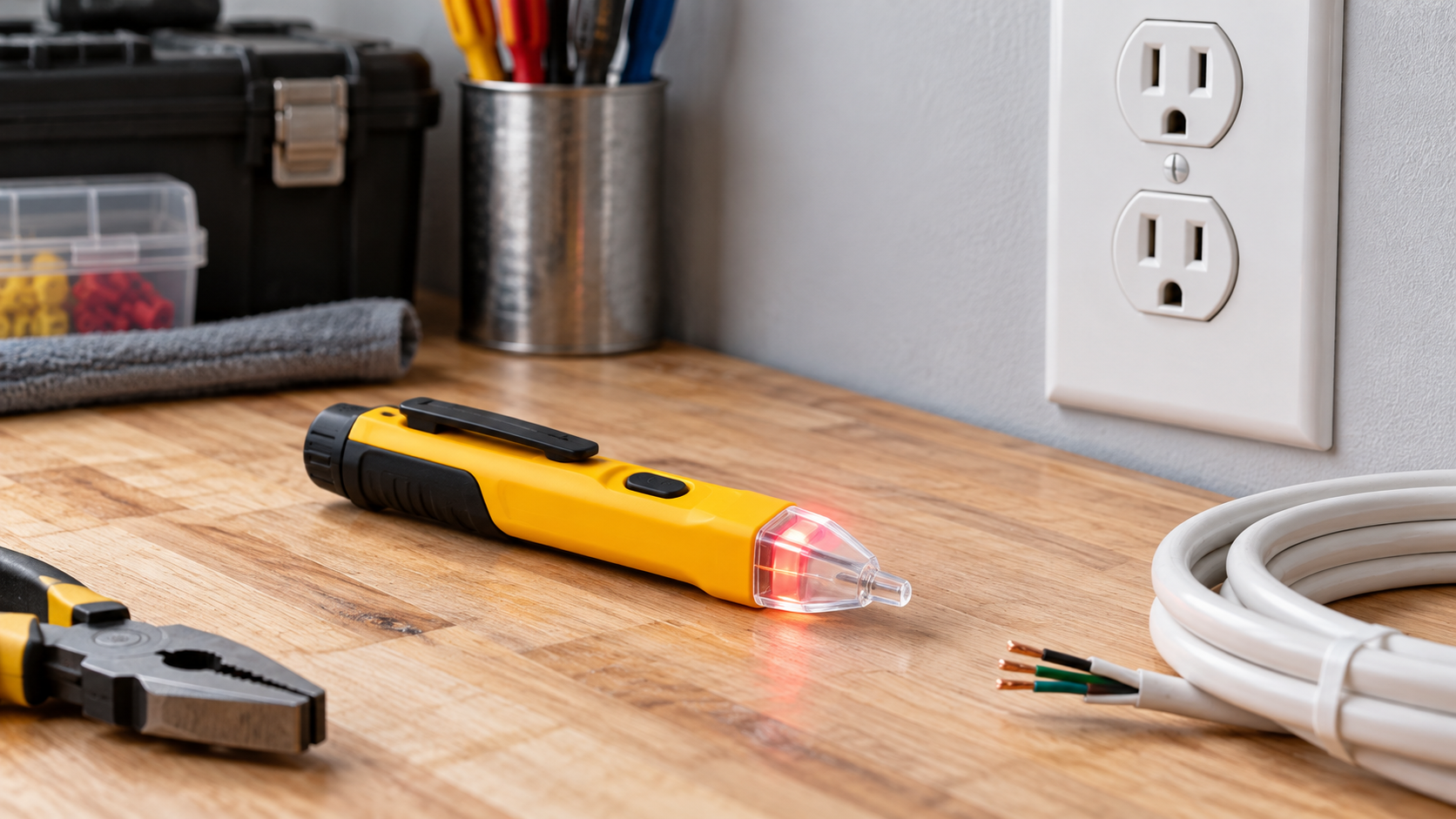
The Fluke LVD2 is a pen-style non-contact AC voltage tester with an LED flashlight. Fluke’s data sheet says it detects AC voltage from 90 V to 600 V without touching the conductor, and that it is rated CAT IV 600 V. It is a detector, not a meter: it shows that voltage may be present, and it does not show the voltage value or prove that a circuit is dead. Fluke’s own safety sheet says a voltmeter or two-pole detector is needed to confirm that hazardous voltage is absent.
Quick answer
- What it does: detects AC voltage from 90 V to 600 V without contact, with a blue light for proximity and a red light at the source.
- Rating: CAT IV 600 V, per Fluke’s data sheet. The safety sheet lists the same 600 V limit.
- Limits: not for DC detection, not for voltages above 600 V, and not near variable motor drives, per the safety sheet.
- Before you rely on it: test it on a known voltage, and confirm the absence of voltage with a voltmeter or two-pole detector.
What the LVD2 does and how it indicates
The LVD2 combines a non-contact AC voltage detector and an LED flashlight in one pen-style body. Fluke’s data sheet describes dual-sensitivity detection, with two levels of response. The tester shows a blue light when it is one to five inches (2.54 to 12.7 cm) from an AC source, and a red light when it is at the source. The data sheet also lists an ultra-bright white LED with a 100,000-hour bulb life, and an operating temperature of 0 °C to 50 °C.
The LVD2 uses one AAA battery, which Fluke includes. The safety sheet lists the battery as a 1.5 V LR03 AAA cell, and it notes that battery leakage can damage the product. The safety sheet’s battery warnings apply: keep the polarity correct and repair the product before use if the battery leaks.
Because the LVD2 detects an electric field, its response depends on the wiring and the surroundings. Fluke’s safety sheet lists factors that can prevent detection, including shielded wire or cables, the thickness and type of insulation, the distance from the source, fully isolated users that prevent an effective ground, recessed sockets or differences in socket design, and the condition of the product and its battery. A lack of indication does not prove the absence of voltage.
Safety rating and what it means
Fluke rates the LVD2 CAT IV 600 V in its data sheet, and the safety sheet repeats the 600 V limit. The safety sheet describes CAT IV as the category for test and measuring circuits connected at the source of a building’s low-voltage mains installation. Fluke also lists a maximum voltage to earth ground of 600 V, an altitude limit of 2000 m, and a humidity limit of 80 % for temperatures up to 31 °C, decreasing linearly to 45 % at 50 °C.
The rating tells you where the tester is designed to be used. It does not mean the tester will work the same way in every installation, and it does not turn a detector into a meter. Fluke’s safety sheet warns that the tester should not be used for DC voltage detection, or around voltages exceeding 600 volts, or in the presence of variable motor drives.
Safe use steps
High voltage can kill. Work on energized panels, service equipment and any circuit you are not trained to handle belongs to a licensed electrician. The steps below follow the safety sheet’s instructions for the tester.
- Inspect the tester. Do not use it if it is damaged. The safety sheet says to disable the product if it is damaged.
- Check the battery and light. The safety sheet says not to use the tester if the flashlight does not operate. Check the battery indicator before you start.
- Detect a known voltage first. The safety sheet says to detect a known voltage to make sure the tester works. A working outlet is a common choice, if you can reach it safely.
- Hold the tester behind the tactile barrier. The safety sheet says to use the product with the arrow visible and to hold it behind the tactile barrier.
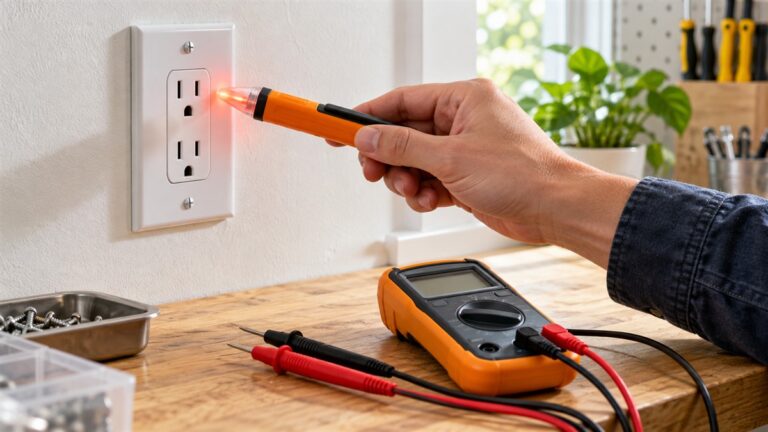
- Test the target. Hold the tip near the conductor or outlet and watch the light. Blue signals proximity to the source, and red signals that the tip is at it.
- Do not stop at no light. If the tip does not glow, voltage could still be present. Confirm the absence of voltage with a voltmeter or two-pole voltage detector, as the safety sheet requires before work begins.
- Test the known source again. Repeat the check on a known voltage after the test to confirm the tester still works.
The safety sheet also warns of a shock hazard above 30 V AC, and it says the tester should be used with approved protective equipment where hazardous live conductors are exposed. Fluke’s sheet lists rubber gloves, face protection and flame-resistant clothing for that situation. Your site’s procedures take priority over any general guide, including this one.
Specifications Fluke states
The table below uses only figures that appear in the documents listed at the end of this article. Where a figure is not in those documents, the cell says so.
| Item | Fluke states for the LVD2 |
|---|---|
| Detection range | 90 V to 600 V AC |
| Safety rating | CAT IV 600 V |
| Proximity indication | Blue light at 1 to 5 inches (2.54 to 12.7 cm) |
| At-source indication | Red light |
| Flashlight | Ultra-bright white LED, 100,000-hour bulb life |
| Operating temperature | 0 °C to 50 °C |
| Battery | One AAA, 1.5 V (LR03), included |
| Maximum voltage to earth ground | 600 V |
| DC detection | Not for DC voltage detection, per the safety sheet |
| Ingress protection | Not stated in the documents we opened |
| Response time | Not stated in the documents we opened |
Checks before you buy
- Match the detection range to your work. The LVD2 detects 90 V to 600 V AC. Lower voltages and DC voltages are outside the stated range.
- Plan a second check. Because the LVD2 cannot prove the absence of voltage, every job needs a voltmeter or two-pole detector in the kit.
- Consider the environment. The safety sheet warns about variable motor drives and recessed sockets. If your work involves those, expect the detector to behave differently and check with a meter.
- Keep spare batteries and check the light. The flashlight is part of the safety check, so a dead battery leaves you without a function you rely on.
Mistakes to avoid
- Treating no light as proof of no voltage. The safety sheet says lack of indication does not confirm absence.
- Using it for DC. The safety sheet says not to use the tester for DC voltage detection.
- Skipping the known-source check. The safety sheet asks you to detect a known voltage first.
- Using it near high-voltage or motor-drive equipment. The safety sheet limits its use there.
How we chose
This guide covers one model, the Fluke LVD2, because the keyword names it directly. We opened three Fluke documents. The first is the Fluke LVD2 Non-Contact Voltage Tester technical data sheet, dated 11/2022 and hosted by TestEquity. The second is the Fluke 1AC II, 2AC, LVD1 and LVD2 volt alert sheet, publication 11751-eng, hosted by RS Online. The third is the LVD2 VoltAlert Safety Sheet, part number 4572337, Rev. 1, 10/19, hosted on manualsnet.com. The first two are Fluke data sheets, and the third is a Fluke safety sheet. We did not use retailer listings for any figure.
What we could not verify
- The documents we opened do not give an ingress protection rating for the LVD2.
- The documents do not give a response time or a detection distance for each voltage.
- We did not find a full LVD2 user manual in the documents we could open. The safety sheet is the most detailed Fluke document we read for this model.
Frequently asked questions
Is the Fluke LVD2 a multimeter?
No. It is a non-contact voltage detector with a flashlight. It shows that voltage may be present. It does not measure the voltage value.
What voltage does the LVD2 detect?
Fluke’s data sheet states 90 V to 600 V AC.
Can I use the LVD2 on DC circuits?
The safety sheet says not to use it for DC voltage detection.
What does the blue light mean?
Fluke’s data sheet describes blue as the proximity indication, shown when the tester is one to five inches from the source. Red means the tester is at the source.
If the LVD2 shows no light, is the circuit dead?
Not necessarily. The safety sheet says a lack of indication does not prove the absence of voltage. Confirm with a voltmeter or two-pole detector.
What battery does it use?
One AAA, 1.5 V LR03 cell. The data sheet says a AAA battery is included with the tester.
Bottom line
The Fluke LVD2 is a CAT IV 600 V rated non-contact AC detector with a flashlight. It is useful as a quick first look, but Fluke’s own safety sheet requires a voltmeter or two-pole detector to confirm that voltage is absent. Test it on a known source before and after each use, and leave work on energized equipment to a licensed electrician.
Related guides
- Best Non Contact Voltage Tester compares detectors and explains their limits.
- Best Multimeters for Electricians covers the meters to pair with a detector.
- Best Multimeter for DIY covers a basic meter for home checks.
Sources
- Fluke Corporation, “Fluke LVD2 Non-Contact Voltage Tester, Technical Data”, dated 11/2022. Copy hosted by TestEquity: https://assets.testequity.com/te1/Documents/pdf/fluke/Fluke_LVD2_Volt_Light_Data-Sheet.pdf, opened 27 October 2026. Third-party copy of a Fluke document.
- Fluke Corporation, “1AC II, 2AC, LVD1, LVD2 Volt Alerts and Volt Lights”, publication 11751-eng. Copy hosted by RS Online: https://docs.rs-online.com/8dce/0900766b81432632.pdf, opened 27 October 2026. Third-party copy of a Fluke document.
- Fluke Corporation, “LVD2 VoltAlert Safety Sheet”, PN 4572337, Rev. 1, 10/19. Copy hosted on manualsnet.com: https://manualsnet.com/fluke/lvd2, opened 27 October 2026. Third-party copy of a Fluke document.