Best Live Line Testers: 3 Picks for Live Wire Checks
As an Amazon Associate we earn from qualifying purchases. Details
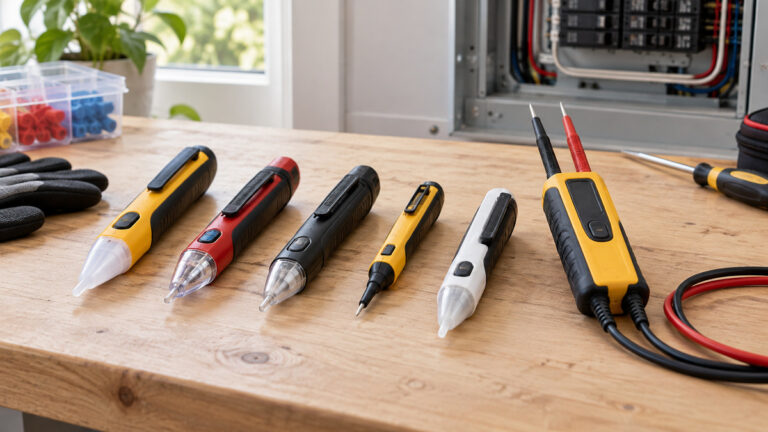
A live line tester shows whether a conductor carries AC voltage. Non-contact models sense voltage through insulation and signal with a light and an alarm. Treat every wire as live until a tester and your own checks show otherwise. This guide compares three picks by voltage range, sensitivity, alarm style and CAT rating.
A live check is a first step, not a full safety test. Read the tester manual before use, confirm the CAT rating suits the circuit, and remember that mains work can kill. Panel or service work belongs to a licensed electrician, and a quick live-wire check does not replace one.
Quick answer
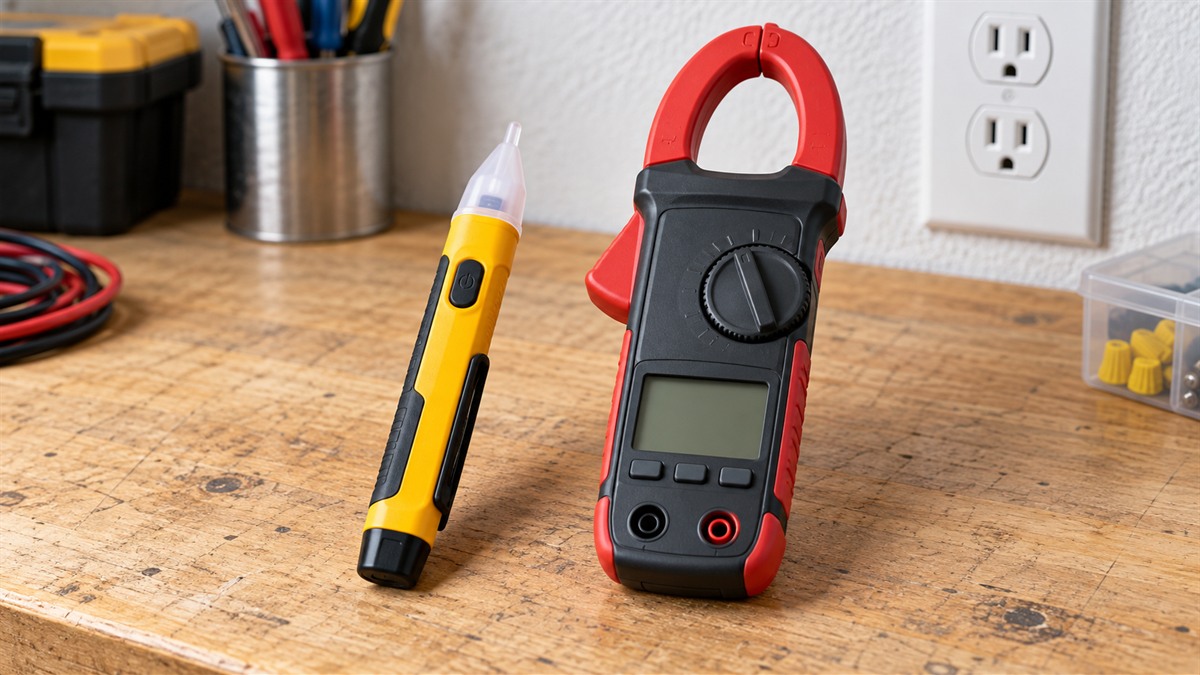
Choose a non-contact live line tester whose voltage range covers the circuits you check, and whose sensitivity and alarm you can use in a noisy room. The MXCOIRTP is a pocket pen with three ranges in its title, from 12V to 1000V, and three sensitivity steps. The VENLAB is a dual-range pen whose high setting covers 12V-1000V and whose low setting covers 48V-1000V. The AstroAI is a clamp meter with a live wire test, and it also reads AC current. For a quick presence check, either pen works. For AC current, the clamp is the tool to choose.
What matters for a live line test
Four features change which tester fits your checks. Compare them in this order.
Voltage range and the low-voltage setting
The range sets what the tester will detect. The MXCOIRTP title lists 12V, 48V and 70V ranges up to 1000V. The VENLAB runs 12V-1000V on its high setting and 48V-1000V on its low setting. The AstroAI bullets describe non-contact voltage testing for AC signals, alongside its meter functions. If your work includes low-voltage fixtures, check that the lowest range in the listing starts where you need it.
Sensitivity and alarm style
Sensitivity controls how weak a signal must be before the tester alarms. The MXCOIRTP has three sensitivity steps, and its bullets say the buzzer sounds one, two or three times as you move up. The VENLAB tip glows red with a fast beep for high voltage, and it glows yellow with a slow beep for low voltage. Those are signals, not readings. Learn what each alarm means before you rely on it. The MXCOIRTP starts in its low sensitivity mode each time you power it on, according to its bullets, so set the level again before each check.
Presence versus measurement
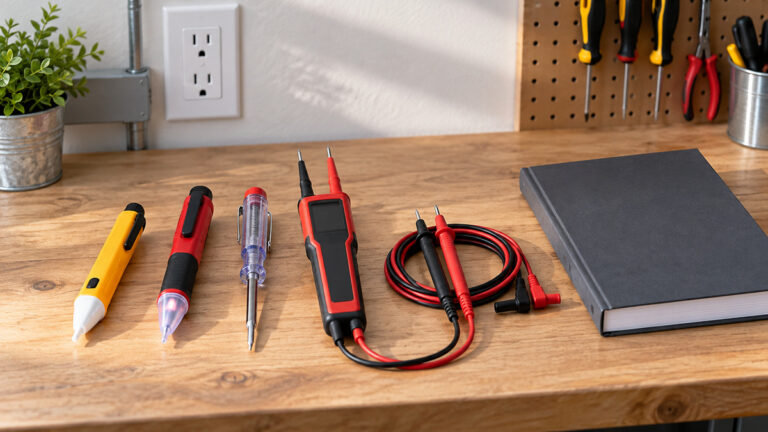
A live line tester tells you that a signal is present. It does not give you a voltage reading. A test light, also called a voltage tester or mains tester, checks for the presence of electricity and is simpler than a measuring instrument such as a multimeter. Non-contact test lights can detect voltage on insulated conductors, which is why they suit quick checks on cords and switches. When you need a value, use a meter with leads. The AstroAI clamp combines both ideas: its clamp and meter functions return values, while its non-contact voltage function only signals, through a sound and light alarm.
CAT rating and power
The AstroAI Safety/Compliances field lists CAT.III 600V and pollution level 2. The MXCOIRTP specs show no CAT field, and the VENLAB Specification Met field shows only the Beep mark. Measurement category II is for measurements performed on circuits directly connected to the low-voltage installation. Measurement category IV is for measurements performed at the source of the high-voltage installation. Match the rating to the circuit, and do not assume a pen is rated for mains work because it is small.
How to choose
Use these rules, then compare the three picks below. Only three listings in this group fit a live line check, so this guide covers three.
- Choose the MXCOIRTP for a pocket pen with three sensitivity steps and a flashlight that works when the tester is off.
- Choose the VENLAB for a dual-range pen with a red pointing light and a three-year warranty stated in its bullets.
- Choose the AstroAI if you need AC current readings along with the live wire test.
- Choose the AstroAI if you need a CAT rating stated on the tool, since only its specs show one.
If you work on both household and automotive circuits, check the voltage range first and the alarm style second. The VENLAB low setting starts at 48V, so use its high setting for 12V circuits. Check each tester’s range against the circuit you plan to test, not against the setting you remember from a previous job.
At a glance: the 3 picks, by their own spec fields
| Pick | Range | CAT rating | Flag |
|---|---|---|---|
| MXCOIRTP (best pocket live/null wire pen) | 3 ranges: AC 12V, 48V, and 70V through 1000V | Not stated | Tail flashlight only works when the tester is off |
| VENLAB (best dual-range pen with alarm) | High setting 12V-1000V, low setting 48V-1000V | Not stated — specs show only a Beep mark, not a CAT rating | Do not treat as a mains meter without a CAT label |
| AstroAI clamp meter (best clamp with live wire test) | AC current 2A, 20A, 200A, 400A; cannot test DC current | CAT III 600V, pollution level 2 | Weight field reads 203g, item weight field reads 415g — the two figures disagree, rely on neither |
Specs are from each product’s Amazon listing. Only the AstroAI clamp meter states a CAT rating (CAT III 600V) — the two pen-type testers show no CAT label, so do not treat them as mains-rated meters.
1. MXCOIRTP Voltage Tester, Non-Contact Voltage Detector, Electrical Tester, 3 Ranges AC (Best pocket live and null wire pen)
Specs from the listing (checked 2026-10-11):
- Measurement Type: Voltmeter
- Warranty Description: 1 year warranty
- Included Components: Voltage Tester
- Power Source: Battery Powered
Pros
- Its bullets describe three sensitivity modes, with the buzzer sounding one, two or three times.
- Its title gives 3 ranges, AC 12V, 48V and 70V through 1000V, for live and null wire checks.
- Its warranty field gives a 1 year warranty.
Cons
- Its bullets say the tail flashlight works only when the tester is off.
- Its bullets say the power indicator flashes 3 times and the buzzer sounds below 2.5V before it shuts off.
Best for: Owners who want a pocket live-wire check with three sensitivity levels.
Skip if: Skip it if you need a flashlight that runs while the tester is on, since its tail light is off-only.
View on Amazon (affiliate link)
2. VENLAB Voltage Tester, Non Contact Voltage Detector, Circuit Tester Dual Range Voltage Sniffer (Best dual-range pen with alarm)
Specs from the listing (checked 2026-10-13):
- Power Source: Battery Powered
- Specification Met: Beep
- Included Components: 1*Voltage Tester 2*AAA Batteries
- Item Weight: 0.05 kg
Pros
- Its bullets say the high setting tests 12V-1000V and the low setting tests 48V-1000V.
- Its tip glows red with a high-frequency beep for high voltage, and yellow with a low-frequency beep for low voltage.
- Its bullets give 3 years warranty and lifetime technical support.
Cons
- Its specs list the Beep mark and no CAT rating, so do not treat it as a mains meter.
- Its red pointing light is a pointing aid, according to its bullets, not a test function.
Best for: Homeowners and electricians who want a dual-range non-contact tester with an alarm and a flashlight.
Skip if: Skip it if you need a CAT label on the tool, since its specs show only the Beep mark.
View on Amazon (affiliate link)
3. AstroAI Digital Clamp Meter Multimeter 2000 Counts Amp Voltage Tester Auto-ranging with AC/DC (Best clamp with live wire test)
Specs from the listing (checked 2026-10-11):
- Safety/Compliances: CAT.III 600V; Pollution Level: 2; Altitude <2000m
- Working Environment: 32°F~104°F (0°C~40°C); <80% RH
- Power: 1.5V AAA Batteries x 2 Included
- Weight: Approx. 203g
Pros
- Its Safety/Compliances field lists CAT.III 600V and pollution level 2.
- Its AC current specs list 2A, 20A, 200A and 400A ranges, and the clamp reads current without breaking the circuit.
- Its bullets describe non-contact voltage testing with a green light for weak AC and red for strong AC.
Cons
- Its bullets say it cannot test DC current.
- Its Weight field reads 203g while its Item Weight field reads 415 g, so rely on neither figure.
Best for: Electricians and homeowners who want a clamp meter with a live-wire test and AC current readings.
Skip if: Skip it if you need a pocket pen, since this is a clamp meter rather than a pen.
View on Amazon (affiliate link)
The three picks, one at a time
The MXCOIRTP is a compact pen with a 1 year warranty listed in its warranty field. Its title gives 3 ranges, AC 12V, 48V and 70V through 1000V, for live wire and null wire checks. Its bullets describe three sensitivity modes: low by default with one buzz, medium with two and high with three. It has a built-in detection light and a tail flashlight. The tail flashlight works only when the tester is off, according to its bullets. When the battery drops below 2.5V, the power indicator flashes three times and the buzzer sounds before the tester shuts off. Skip it if you want a flashlight that runs while the tester is on.
The VENLAB is a dual-range pen. Its high setting tests 12V-1000V, and its low setting tests 48V-1000V, according to its bullets. A red tip glows with a high-frequency beep when high voltage is detected, and a yellow light with a low-frequency beep marks low voltage. Its bullets describe a red pointing light for aiming at something at a job site. The bullets say that light is for pointing, not for testing. The kit includes two AAA batteries, and its item weight is 0.05 kg. Its specs list a Beep mark and no CAT rating, so do not treat it as a mains meter. Skip it if you need a CAT label on the tool.
The AstroAI is a clamp meter with a 2000-count display. Its Safety/Compliances field lists CAT.III 600V and pollution level 2. The AC current specs list 2A, 20A, 200A and 400A ranges, and the clamp measures current without breaking the circuit. Its bullets describe non-contact voltage testing, with a green light for weak AC and a red light for strong AC, plus a sound alarm. The bullets say it cannot test DC current. Its Weight field reads approximately 203 g, while its Item Weight field reads 415 g, so rely on neither figure. Skip it if you need DC current.
Where a live check stops
A live indication means voltage was detected. It does not tell you how much voltage is present or whether the wire is safe to touch. Follow the maker’s manual for the detection limits and the test sequence, and ask a licensed electrician when a result is unclear. Do not use a pen as the only check before you open a panel. For a wider set of non-contact tools and how they compare, the contactless voltage tester guide is a useful companion to this page.
OSHA lists the most frequent causes of electrical injuries as contact with power lines, lack of ground-fault protection, a path to ground that is missing or discontinuous, equipment not used as prescribed, and improper use of extension and flexible cords. OSHA also says listed equipment should be installed and used in accordance with the instructions included in the listing. Read the instructions before the first use.
A residual-current device, also called a ground fault circuit interrupter, interrupts a circuit when the current in the line and neutral conductors is unequal. A live check does not test that protection. Use the device’s own test function, and follow its instructions.
Reading the indicator safely
Read the alarm or light, then confirm what it means in your manual. An alarm tells you a signal is present at the sensitivity you chose. No alarm does not prove a conductor is dead, so treat silence as unknown until a different check confirms the result. If you cannot explain a reading, stop and call a licensed electrician rather than continuing.
Keep the tester clean and dry, and check the batteries before a job. A low-battery indication is a reason to change batteries before you rely on the tool, not a reason to ignore it.
Write down the tester model, the sensitivity level, the circuit you checked and the time of the check. A short note lets you compare results later, and it tells a colleague exactly what you tested. If you repeat a check after a repair, the note shows whether the indication actually changed.
A hallway check
Suppose a hallway has 5 spots to check. Each check is repeated once for confirmation, so 5 checks times 2 equals 10 pen touches in total. Those touches stay at the surfaces you can reach safely, and any unclear result goes to a licensed electrician.
Mistakes to avoid
Trusting silence. No alarm is not proof of a dead conductor. Follow the maker’s detection limits and get a second check.
Ignoring the sensitivity setting. Set the sensitivity the manual describes before you check, and note which level you used. The MXCOIRTP returns to its low mode at power-on, so a setting from the last job will not carry over.
Using a pen for current. The MXCOIRTP and VENLAB are pens with alarms. Use the AstroAI clamp when you need AC current.
Assuming a CAT rating. The VENLAB specs show only the Beep mark, so do not assume a mains rating.
Relying on a conflicting weight. The AstroAI lists two different weights, so do not treat either figure as fact.
FAQ
Can a live line tester tell me a wire is live without touching it?
Non-contact models sense voltage through insulation and signal with an alarm and a light. They indicate presence and do not give a reading. Use a meter with leads for values.
What does sensitivity do?
It sets how strong a signal must be before the tester alarms. Use the setting your manual describes for the check you are making, and note the level you used.
Which pick covers 12 volts?
The first pick’s title lists a 12V range, and the second pick’s high setting covers 12V-1000V. Confirm the range in the listing before you check a low-voltage fixture.
Do I need a CAT rating?
Check it for any mains work. The third pick lists CAT.III 600V in its specs. The first and second picks show no CAT rating in their specs, so treat them as indicators only.
Can I use the flashlight while I test?
Not on the first pick. Its tail flashlight works only when the tester is off. The second pick’s red light is a pointing aid, according to its bullets.
What is a clamp meter for?
A clamp meter measures current without breaking the circuit. A current clamp has jaws that open around a conductor, and some clamp meters measure 1000 A and more. The third pick’s specs cover AC current, not DC.
Can a pen replace a multimeter?
No. A pen shows whether a signal is present at its sensitivity setting. A multimeter gives values you can compare with the manual, so keep one for readings and use the pen for quick presence checks.
What should I do if a result is unclear?
Stop, follow the manual, and call a licensed electrician. Do not open a panel or service equipment yourself.
Bottom line
Choose a pen for a fast live check, the VENLAB if you need 12V-1000V coverage with an alarm, and the AstroAI if you also need AC current and a stated CAT rating. Match the CAT rating to the circuit, and treat silence as unknown rather than safe. For a wider look at pens, see the pen voltage detector guide and the live wire tester guide.
Sources
- Test light, Wikipedia: a test light checks for the presence of electricity and detects voltage on insulated conductors.
- Measurement category, Wikipedia: category II and category IV describe where a measurement may be taken.
- Current clamp, Wikipedia: a clamp measures current without breaking the circuit; some clamp meters measure 1000 A and more.
- Residual-current device, Wikipedia: an RCD interrupts a circuit when line and neutral currents are unequal.
- OSHA electrical safety: the most frequent causes of electrical injuries, and safe work practices.
- OSHA 29 CFR 1910.303(b)(2): listed equipment should be installed and used in accordance with the listing instructions.