Volt Amp Tester: 7 Meters Compared by Current and CAT
As an Amazon Associate we earn from qualifying purchases. Details
A volt amp tester measures voltage and current, and most also read resistance and continuity. This page covers seven meters and clamp meters whose listings name both volts and amps. Two USB testers and a voltage-only pen share the same search, but they measure a different quantity or only one quantity, so they are left out.
Each pick is judged on three listed points: its current range, its CAT rating where the listing gives one, and whether it is a clamp or a meter. Check those before you connect any meter to a live circuit, and skip a listing that leaves the current range or CAT rating unclear.
Quick answer
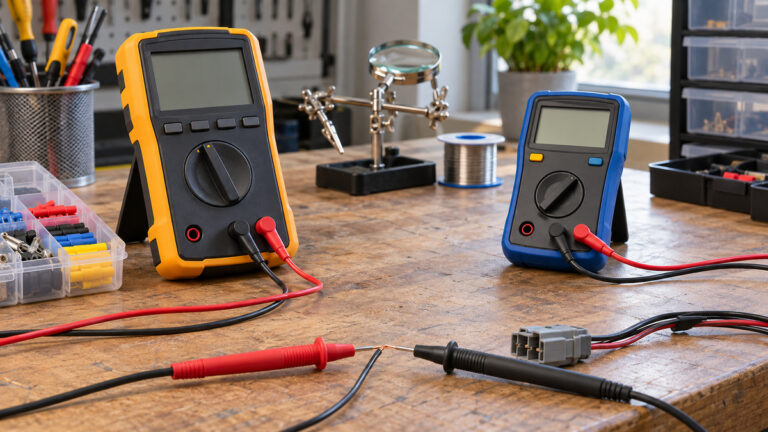
Choose the format first. A clamp meter reads current by clamping around one conductor, so you do not break the circuit. A multimeter reads current only when its leads are placed in series, which means the circuit has to be opened. For most household and automotive checks, a clamp meter is the safer and faster choice for current. For a small DC current in a line you can open, a multimeter with a fused current range is the right tool. Check the listed CAT rating against the circuit. None of the picks is a substitute for a licensed electrician on panel or service work.
Safety first
Work on mains circuits can kill. The meter’s CAT rating must suit the circuit, and a meter whose listing gives no CAT rating should not be used on household mains. Panel and service work belongs to a licensed electrician.
Current measurement has its own trap. When a multimeter is set to a current range, its leads are in series with the load. Connecting those leads across a voltage source can blow the meter’s fuse, and it can damage the meter. Set the function and the lead socket before you touch the circuit, and never leave a meter in a current range when you switch to a voltage check.
OSHA lists contact with power lines, missing grounding and misuse of cords among frequent causes of electrical injury. Its recommended controls are insulation, guarding, grounding and safe work practices. Follow the meter’s manual and your local rules, and stop if a fuse keeps opening.
What matters for a volt amp tester
Clamp or multimeter for current
A clamp meter measures current without breaking the circuit, because the jaws read the magnetic field around one conductor. Many clamp meters cannot read small DC currents, so check the listing before you rely on one for a small DC load. A multimeter measures current through its own fused circuit. That lets it read small currents, but it means opening the line.
CAT rating and true RMS
The CAT rating shows the circuit category and voltage the meter is built for. The listings in this set name CAT III and CAT IV ratings, some at 600 volts and some at 1000 volts. True RMS matters when the waveform is not a clean sine wave. A true RMS reading is more correct than an averaging meter for distorted signals, because averaging meters depend on a sine wave.
Current range and fuse protection
The current range sets the largest current the meter can read. One listing gives 10 A for a multimeter range, and a clamp listing gives 600 A. Fuse protection on a multimeter range protects the meter, not the circuit. A fuse is a sacrificial device, and once it has operated it must be replaced with one of the correct rating.
Display and auto ranging
An auto-ranging meter picks the range for you, which helps a beginner. A manual meter gives you control and reads the same way. Several listings name a backlit LCD for dim work, and one names a color display. Choose the display that you can read in your work light.
Picks
The cards below show each meter’s stated ratings, current range, pros, cons and a skip note. The order does not rank them.
1. AstroAI Digital Multimeter Tester 2000 Counts with DC AC Voltmeter and Ohm Volt Amp Meter; Measures (Handheld multimeter with a fused 10 A range)
Specs from the listing (checked 2026-10-11):
- Environmental Conditions: CAT II 600 V; CAT Ill 300 V
- Fuse Protection: mA: F250 mA/250 V Fuse;10 A: F10 A/250 V Fuse
- DC Current: 200µA/200mA/10A ±(1.2% +3)
- Power: 2 x 1.5 V AAA Batteries
Pros
- The listing states CAT II 600 V and CAT III 300 V
- The fuse protection names a 250 mA fuse and a 10 A fuse
- The listing names a 3 year warranty
Cons
- The bullets list AC and DC voltage and DC current, but no AC current range
- The range selection is manual only, so auto ranging is not offered
Best for: Bench and household checks where a small fused current range is enough.
Skip if: You need AC current or auto ranging.
View on Amazon (affiliate link)
2. Digital Multimeter Voltmeter Battery Voltage Multi Tester Continuity Ohm Volt Amp DC AC Current (Backlit multimeter with a stand)
Specs from the listing (checked 2026-10-11):
- Specification Met: Safety Standards Met
- Included Components: multimter
- Item Weight: 166 g
- Color: Orange&Black
Pros
- The listing names a large backlit LCD for dim work
- The stand folds out so the meter can sit upright
- The listing names a 2 year quality guarantee
Cons
- The listing gives no CAT rating, so it is not for mains
- The included components field reads multimter only, while a bullet says a 9V battery is included
Best for: Basic bench and car checks in dim light where a stand helps.
Skip if: You need a CAT rating or a stated current range.
View on Amazon (affiliate link)
3. ST181 Multimeter 600V Clamp Amp Meter with Non Contact Voltage Tester Kit (Clamp and voltage tester kit)
Specs from the listing (checked 2026-10-13):
- Unit Count: 2 Count
- Included Components: Voltage Tester with Clamp Multimeter(AC Current)
- Power Source: Battery Powered
- Model: MT05
Pros
- The set includes a clamp meter and a non-contact voltage pen
- The meter reads 4000 counts with auto and manual ranging
- The clamp opens to a wire diameter of 1.42 inches
Cons
- The bullets give AC current up to 400A and up to 600A, which conflict
- The set has two tools, and the bullets name the pen as a separate model
Best for: DIY owners who want a clamp, NCV and a voltage pen in one set.
Skip if: You need a single clear current range before buying.
View on Amazon (affiliate link)
4. Digital Clamp Meter Multimeter, TRMS 6000 Counts 600A Current Amp Volt Meter, Auto-Ranging Voltage (True RMS clamp meter with CAT III 600 V)
Specs from the listing (checked 2026-10-16):
- Specification Met: Iec 61010-1, Cat Iii 600v, Cat Iv 600v, Cat Iii 1000v
- AC Current: 60A/600A ±(3.0%+10dgt)
- DC Current: 60A/600A ±(3.0%+10dgt)
- Warranty Description: 2 year manufacturer
Pros
- The listing names true RMS for non-linear loads
- The current range reaches 600 A AC and DC
- The listing states CAT III 600 V and CAT IV 600 V
Cons
- The listing names a clamp for current but gives no small DC current figure
- The part number field reads MESTEK while the brand is Temirup
Best for: Clamp work on electrical loads where true RMS and a stated CAT rating matter.
Skip if: You need a small DC current range.
View on Amazon (affiliate link)
5. Inrush Digital Clamp Meter Multimeter 1000A TRMS 6000 Counts, Amp Voltage Tester with VFD, LOZ Mode (High-current clamp with surge mode)
Specs from the listing (checked 2026-10-16):
- Style: Testers
- Compatible Devices: All devices requiring electrical testing or measurement
- Part Number: 2566D-V1
- Color: Orange
Pros
- The listing names a surge current mode for start-up checks
- The listing names a low impedance mode for drive work
- The listing names NCV detection and a backlit screen
Cons
- The surge function is AC only, which the listing states
- The listing gives no CAT rating
Best for: Start-up current checks on motors and drives where a 1000 A range helps.
Skip if: You need a CAT rating or a DC surge reading.
View on Amazon (affiliate link)
6. UEi DL369 Digital Clamp Meter HVAC Auto-Ranging 4000 Counts Volt Meter AC Amp Meter Measures AC (Clamp meter with microamp range)
Specs from the listing (checked 2026-10-16):
- Specification Met: Ce Conformity, Ul Listed
- Warranty Description: 3 year limited warranty
- Item Dimensions: 1.49 x 2.98 x 8.7 inches
- Style: Clamp-On Meter
Pros
- The dual display reads 4000 counts on each line
- The listing names auto ranging and min and max functions
- The listing gives a 3 year limited warranty
Cons
- DC current is listed only in microamps, not in amps
- The safety wording names CAT III and CAT II figures in one line, which is ambiguous
Best for: AC clamp work where a microamp DC range is useful.
Skip if: You need DC current in amps.
View on Amazon (affiliate link)
7. FS899S Smart Digital Multimeter, Automatic True RMS 6000 Counts, USB Rechargeable Voltmeter (True RMS multimeter with USB battery)
Specs from the listing (checked 2026-10-16):
- Specification Met: Iec 61010-1, Cat III 1000v, Cat IV 600v
- Power Source: Battery Powered
- Model: Auto-Ranging Digital Multimeter
- Brand: Generic
Pros
- The listing names true RMS with auto ranging
- The listing states CAT III 1000 V and CAT IV 600 V
- The listing names a 4.8 inch color screen
Cons
- The current range is 300 mA to 10 A, so high current needs a clamp
- The brand is Generic and the manufacturer field reads Susilks, so confirm the maker
Best for: Bench work where true RMS and a USB battery matter.
Skip if: You need current above 10 A.
View on Amazon (affiliate link)
How to choose
Use these rules in order.
First, choose a clamp meter if you need current in a live conductor and you cannot open the line. Check that the clamp reads AC, DC or both, because the listing says which.
Second, choose a multimeter with a fused current range if you need a small DC current in a line you can open. Check the current range and the fuse rating before you connect it.
Third, check the CAT rating against the circuit. A meter whose listing gives no CAT rating is not a choice for household mains.
Fourth, choose true RMS if you measure on electronics, motor drives or other circuits with distorted waveforms. A true RMS meter is more accurate on those signals than an averaging meter.
Fifth, skip any meter whose listing contradicts itself on the current or voltage range. Ask the seller, or choose a clearer listing.
Power is voltage times current, so 12 volts times 2 amps = 24 watts. A meter with a 10 A current range covers the 2 A draw, with 10 A minus 2 A = 8 A of headroom. A 20 A clamp range covers the same draw with 20 A minus 2 A = 18 A of headroom. Choose the range with headroom above your expected current, but keep the meter’s fuse and CAT rating in view, because a higher range does not make a low-rated meter safe on a higher-voltage circuit. Write the expected current on the job sheet before you start, and compare it with the range you chose, so the choice is recorded rather than guessed.
A 2 amp load on a 12 volt circuit
Take a 2 A load on a 12 V circuit. Its power is 12 V x 2 A = 24 W. On the 10 A multimeter range listed for the AstroAI multimeter, the headroom is 10 A – 2 A = 8 A, so the load sits well inside that range.
Mistakes to avoid
Measuring current in parallel is the first mistake. A meter in current mode across a voltage source can blow its fuse.
Using a voltage-only pen for a current check is the second. A pen tells you whether voltage is present; it does not read current.
Ignoring the CAT rating is the third. The rating must suit the circuit, not just the voltage you expect.
Forgetting to reset the range is the fourth. A meter left on a current setting can be damaged by the next voltage check.
Trusting a clamp for a small DC current is the fifth. Many clamp meters cannot read small DC currents, so use a multimeter with a fused current range for those.
Replacing a blown fuse with a larger one is the sixth. The fuse is the protection. A larger fuse removes it.
Reading a clamp around a whole cord is the last. Clamp around one conductor only, as the listings say, or the reading will not show the load.
Pick notes
Handheld multimeter with a 10 A range
This multimeter reads AC and DC voltage, DC current and resistance. Its listing states CAT II 600 V and CAT III 300 V, and its current range is fused. Choose it for a bench or a basic household check where the current range is small.
Backlit multimeter with a stand
This multimeter has a large backlit LCD and a fold-out stand. Its listing says a 9 volt battery is included, although the included components field reads multimter only. The listing states no CAT rating, so do not use it on mains.
Clamp and voltage tester kit
This two-piece set includes a clamp meter and a non-contact voltage pen. The clamp lists AC current up to 400 A and 600 A, which conflict, so confirm the range. Choose it for a kit with NCV and a clamp, after you confirm the range.
True RMS clamp meter with CAT III 600 V
This clamp meter lists true RMS, a 600 A range, automatic ranging and a CAT III 600 V rating. Its listing gives a 2 year warranty. Choose it for clamp work where true RMS and a stated CAT rating matter.
High-current clamp with a surge mode
This clamp meter reads AC and DC current to 1000 A, with a surge mode for start-up current. The surge function reads AC only. Its listing states no CAT rating. Choose it for start-up current checks, after you confirm the rating.
Clamp meter with a microamp range
This clamp meter has a dual display, auto ranging and a 3 year limited warranty. It reads AC current to 400 A and DC only in microamps. Choose it for AC clamp work where a microamp DC range is useful.
True RMS multimeter with a USB battery
This multimeter lists true RMS, auto ranging and CAT III 1000 V with CAT IV 600 V. Its current range runs from 300 mA to 10 A. Choose it for bench work with true RMS and a USB battery, and use a clamp for high current.
FAQ
What is the difference between a volt amp tester and a clamp meter?
A volt amp tester is a broad term for a meter that reads voltage and current. A clamp meter reads current around one conductor without opening the circuit. The picks here include both formats.
Can I measure current with a multimeter on a live circuit?
Only with care, and only in the current mode the meter provides. A multimeter reads current in series, so you must open the circuit. Follow the manual, and do not connect the meter across a voltage source in a current setting.
Does a higher amp rating make a meter safer?
No. A higher current range gives headroom for a larger current. The CAT rating and the fuse rating decide what the meter is safe to use on.
What does true RMS mean?
True RMS gives a correct reading for distorted waveforms, where an averaging meter depends on a sine wave. For more, see the true RMS converter facts.
How do I clamp a wire that sits inside a cord?
Clamp around one conductor only, not around the whole cord. A clamp around a cord with two conductors cancels out the current, so the reading can be near zero even when the load is running. One listing says this directly, and it is the most common clamp mistake.
What does auto ranging do?
Auto ranging picks the measuring range for you as the reading changes. Manual ranging keeps the range fixed until you change it. Auto ranging suits a quick check, and manual ranging suits a set-up where you know the expected current.
Do I need a clamp if I already have a multimeter?
A multimeter reads current only in series, so it is not a choice for a live conductor you cannot open. A clamp reads current without breaking the circuit. Many people keep both: a multimeter for small currents and a clamp for live work. For more clamp options, see the best Fluke clamp tester.
Why do some clamp meters not read small DC currents?
Clamp meters use different sensing methods. The current transformer type reads AC or pulse waveforms, and the Hall effect type reads both DC and AC. Check the listing for the type and the range.
How do I know the fuse is correct?
Use the rating printed on the fuse or in the manual, and replace like with like. A fuse that keeps opening points to a fault or an overload that needs fixing.
Is a USB tester a volt amp tester?
A USB tester reads voltage and current at a USB port. It is a different use from a general meter, so it is left out of this guide.
Bottom line
Choose a clamp meter when you need current in a live conductor, and a multimeter with a fused range when you need a small current in an open line. Check the CAT rating against the circuit, and leave panel and service work to a licensed electrician. Read the current range and the fuse rating before you measure. For a basic meter comparison, see the best volt meter amp meter. For a clamp choice, see the best amp clamp. For a voltage-only option to compare, see the best voltage meter tester.
Sources
- Wikipedia, multimeter: multimeters measure voltage, resistance and current, and some models add temperature or capacitance.
- Wikipedia, current clamp: clamps read current without contact, typically AC, and the Hall effect type measures both DC and AC.
- Wikipedia, true RMS converter: averaging meters use a correction factor valid only for sinusoidal input, so distortion leads to errors.
- Wikipedia, fuse): a fuse is a sacrificial device; once it has operated it is an open circuit and must be replaced.