Best Power Probe Fuse Tester for Vehicle Circuits
As an Amazon Associate we earn from qualifying purchases. Details
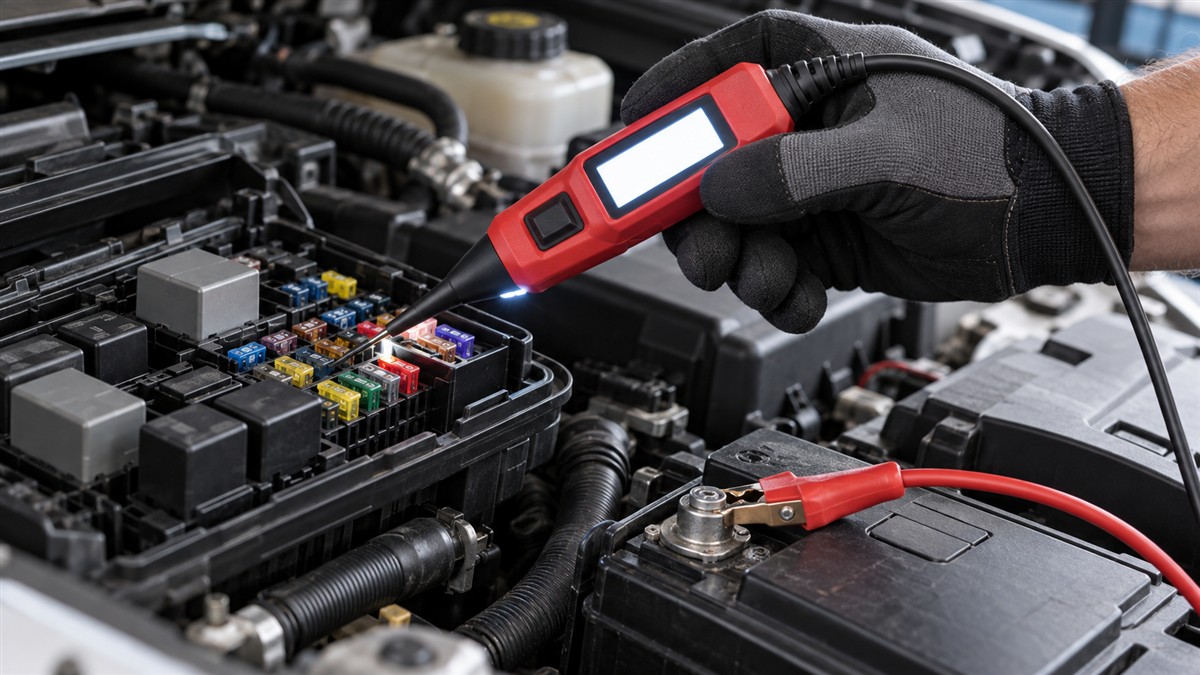
What is the best power probe fuse tester for vehicle work? A power probe fuse tester is a handheld circuit tester that checks voltage, continuity and fuses on 12V and similar DC systems. Most models are built for cars, trucks, motorcycles, boats and trailers. The right choice depends on the voltage range the listing states, whether it has overload protection, how far its lead reaches, and whether it shows a digital readout or only a light. This guide sets out those criteria, then compares six models using only what each listing says.
Quick answer
Choose a power probe fuse tester that states a voltage range covering your vehicle, with overload protection and a lead long enough for the job. Choose a digital readout if you need a number, and a test light if a go or no-go signal is enough. Check the listing’s voltage range before any use on a system above 24V. Confirm the fuse function and the power source in the manual, because listings differ on those points. Disconnect and handle the battery safely, and never work on airbag or high-voltage hybrid or EV systems.
What matters for a power probe fuse tester
Five criteria change the choice for this keyword:
- Voltage range. Listings state ranges such as 6V-24V, 3V-48V, 3-120V or 0-65V. The range must cover the system you test, and a range that stops at 24V does not cover a higher-voltage system.
- Overload protection. Some models trip a breaker or cut the circuit above a stated current. A stated current limit tells you the load the tool can take before it trips.
- Fuse testing and continuity. Fuse function names differ across listings. Check whether the listing names a fuse-test function, and whether the tool checks continuity or polarity.
- Lead length and reach. Extension leads let you reach the engine bay or the rear of a vehicle without moving the battery clips. Listed lengths range from about 13 feet to 20 feet in this group.
- Display or light. A digital readout gives a number. A bulb or LED light gives a signal. Pick the one that matches the job.
Safety on vehicle circuits
A vehicle battery is a DC source, and a short can heat a wire or cause a spark. Disconnect and handle the battery safely before you connect clips to terminals. Follow the tester’s manual on how to connect the battery clip and the probe. Keep the probe tip on the circuit you are testing, and keep your hands clear of the clip as you move along the wire.
Some circuits must never be worked on by a home user. Airbag systems and high-voltage hybrid or EV systems are outside this guide. Do not use a power probe on them. OSHA’s rule on listed or labeled equipment applies here too: 29 CFR 1910.303(b)(2) says listed or labeled equipment must be installed and used in accordance with the instructions included in the listing or labeling. Read the manual before the first connection.
Protective devices matter as well. A circuit breaker protects a circuit from current in excess of what the equipment can safely carry, and it can be reset. A fuse is a sacrificial device: once it has operated, it must be replaced with the same rating. A residual-current device interrupts a circuit when the line and neutral currents are unequal. None of these changes the rating of a tester, so check the stated overload limit of your tool before you rely on it.
How to choose
Start with the voltage of the system you test. If your vehicles run 12V and 24V systems, pick a listing whose range covers both. If you test any system above 24V, check the stated range before you buy, because some listings stop at 24V.
Next, decide between a readout and a light. A readout suits checks where a number matters, such as battery voltage under load. A light suits quick go or no-go checks on a fuse or a wire. Some models combine both, and the listing will say which.
Then check the reach. A long lead helps when the test point is far from the battery. Compare the listed lengths, and check the extension cable count in the package before you assume you have it. Finally, check the overload limit and the protection it gives the tool, not only the number on the display.
Products that fit this
Six models below cover the main styles in this group: a full circuit tester with a long extension, a power circuit probe with overload protection, a probe with an LCD readout, a fuse test light, a digital test light, and a digital pen for fuse checks. Each write-up relies on that listing’s own wording. Use the picks as a shortlist, and check the listing before you buy.
At a glance: the 6 picks, by their own spec fields
| Pick | Range | Overload / breaker | Flag |
|---|---|---|---|
| Autel PowerScan (20 ft extension) | DC 0-65V; 12.0 or 24.0V external power | Not stated | Measurement Type field blank; bullets say 6-30V systems vs. 12/24V power line — confirm working range |
| Digital Pen (3-120V DC) | 3-120V DC | No overload limit stated | Title says 3-120V DC, Measurement Type field reads only “Automotive Fuse Testing” — confirm function list |
| Power Circuit Probe Tester, 13ft lead | 6V-24V DC | Disconnects above 7A | Power source listed as “corded electric,” unusual for this tool type — confirm in manual |
| Power Circuit Probe Tester, LCD readout | 6V-24V DC (bullets); compatible devices list includes two-wheeled electric vehicles | Breaker trips above 8A | Measurement Type field blank in specs |
| Test Light, bulb indicator (6V-24V) | 6V-24V DC | Not applicable | Bulb brightness only, not a digital readout — no numeric value |
| Automotive Test Light, digital (3-48V) | 3V-48V — widest range here | Not stated | Measurement Type field reads “Voltmeter” while title says fuse tester — confirm fuse function |
Specs are from each product’s Amazon listing, checked 2026-10-11 through 2026-10-13. Most listings leave the “Measurement Type” field blank or generic (“Voltmeter”) despite the fuse-testing marketing in the title — confirm the actual function list in each manual before relying on a fuse-test capability.
1. Autel PowerScan Automotive Circuit Tester, 12-24V Power Circuit Probe Tool (Circuit tester with 20 ft extension)
Specs from the listing (checked 2026-10-11):
- Model: R-1574-Z-158
- DC Voltage Range: 0-65V +1 digit
- Resistance Range: 0 – 200 KΩ
- External Power: 12.0 or 24.0 V power provided via vehicle battery
- Specification Met: CE, IP 67, UL
Pros
- The DC voltage range is listed as 0-65V, with 0.1V resolution in its bullets
- The package includes a 20 ft extension cable, a rugged blow-molded case and battery clips
- A TFT color display and a 12.0 or 24.0 V external power input are listed
Cons
- Its Measurement Type field is blank, so confirm the function list in the manual
- Its bullets say 6-30 volt systems, while its external power line says 12.0 or 24.0 V, so confirm the working range before use
Best for: Car and trailer wiring checks that need a long reach and a voltage read on the same tool.
Skip if: You need a simple pen-style tester for quick checks on a bench.
View on Amazon (affiliate link)
2. Automotive Digital Voltage Tester Pen, 3-120V DC Circuit Tester with LED Display, Bidirectional (Digital pen for fuse checks)
Specs from the listing (checked 2026-10-13):
- Measurement Type: Automotive Fuse Testing
- Style: Digital Display Test Pen
- Included Components: Digital Voltmeter Test Pen, Spring Wire With Probe Protection Shell, Clamp
- Specification Met: Automotive Fuse Testing
Pros
- Its digital display shows readings across a 3-120V range, per its bullets
- Polarity detection shows a + or – sign on the display, as the bullets state
- A coiled spring wire with a probe protection shell and an alligator clip are included
Cons
- Its title lists 3-120V DC, but its Measurement Type field reads only Automotive Fuse Testing, so confirm the function list in the manual
- Its specs state no overload limit, so check the manual before relying on it for high-current work
Best for: Automotive fuse checks and polarity on a digital display, where a 3-120V range is wanted.
Skip if: You need a stated overload limit on the listing before you use it.
View on Amazon (affiliate link)
3. Power Circuit Probe Tester, 6V-24V DC Test Light, Automotive Circuit Tester & Short Circuit Finder (Overload cut-out at 7A)
Specs from the listing (checked 2026-10-13):
- Model: IT004
- Style: Automotive,Adult
- Measurement Type: Voltmeter
- Included Components: Clips, Probe tip, Electrical Tape, Storage Bag
Pros
- Overload protection disconnects the circuit above 7A, per its bullets
- A 13ft test lead gives reach from the front to the rear of most vehicles
- It checks polarity, continuity, switches, relays, diodes and fuses, as the bullets list
Cons
- Its power source is listed as corded electric, which is unusual for a test tool, so confirm how it is powered in the manual
- Its Measurement Type field reads Voltmeter, with no separate fuse-test function named in the specs
Best for: Cars, trucks and trailers that run 6V to 24V DC, where a 13ft lead helps.
Skip if: Your system runs above 24V DC.
View on Amazon (affiliate link)
4. Power Circuit Probe Tester, 6V-24V DC Automotive Car Electric Fuse & Voltage Tester with LED Test (LCD readout with 8A breaker)
Specs from the listing (checked 2026-10-13):
- Model: DB-Red
- Style: Multifunctional Car Circuit Tester
- Compatible Devices: Vehicles (Cars, Vans, Off-Road Vehicles, SUVs, Commercial Vehicles, Two-Wheeled Electric Vehicles, Motorcycles, Three-Wheeled Vehicles)
- Included Components: Power Circuit Probe Tester
Pros
- An LCD readout shows voltage, with a red LED and a blue display for positive detection
- A built-in light is listed for dark engine bays
- The bullets state a 157.5-inch probe length, so reach is stated
Cons
- Its bullets cite 6V to 24V systems, while its compatible devices list two-wheeled electric vehicles, so confirm the voltage range for those
- Its Measurement Type field is blank in the specs, so the function list must be checked in the manual
- Its breaker trips above 8A, so a high-current load will trip it
Best for: Quick checks on vehicles up to 24V, where an LCD readout and a light help.
Skip if: Your job needs more than 8A through the tool.
View on Amazon (affiliate link)
5. Test Light Automotive, Circuit Tester 6V-12V-24V DC Car Electrical Test Pen with Alligator Clip (Fuse test light for 6V-24V)
Specs from the listing (checked 2026-10-11):
- Model: B0DX5GMXYH
- Measurement Type: Volts
- Included Components: 6V-24V test light automotive
- Compatible Devices: Cars, Trucks, SUVs, RVs
Pros
- Its bulb brightness varies with the measured voltage, per the bullets
- A 39 inch PU wire is listed, with a flexible and lightweight build
- Bidirectional testing with an alligator clip on either terminal is stated
Cons
- Its Measurement Type field reads Volts, with no function list in the specs
- Its tool is a bulb indicator, not a digital readout, so it cannot give a number
Best for: Quick go or no-go checks on 6V-24V DC circuits, where a bulb indicator is enough.
Skip if: You need a digital voltage reading.
View on Amazon (affiliate link)
6. Automotive Test Light with 3-48V LED Digital Readout, Automotive Circuit Tester with Voltmeter (Digital readout, 3-48V range)
Specs from the listing (checked 2026-10-11):
- Style: Digital
- Measurement Type: Voltmeter
- Compatible Devices: Cars, motorcycles, trucks, boats
- Included Components: 3V-48V automotive test light
Pros
- The LED digital readout is described as clear under any lighting, per the bullets
- The listed voltage range is 3V-48V, wider than most in this group
- A 96 inch flexible spring wire gives extra reach, per its bullets
Cons
- Its Measurement Type field reads Voltmeter, while its title says fuse tester, so confirm the fuse function in the manual
- Its included components name only a 3V-48V automotive test light, with no leads or case listed
Best for: Car, motorcycle, truck and boat checks across a wide 3V-48V range, with a digital readout.
Skip if: You need the listing to name a fuse-test function.
View on Amazon (affiliate link)
Common mistakes
- Testing a system above the stated range. A range that stops at 24V cannot be trusted on a higher-voltage system.
- Assuming overload protection covers every load. Check the stated current limit, and do not run a load above it through the tool.
- Buying a light for a number job. A bulb or LED light does not give a voltage reading.
- Ignoring the power source line. Some listings name a corded or battery power source, so check how the tool is powered before the first use.
- Working on the wrong circuit. Airbag and high-voltage hybrid or EV systems are not covered by this guide.
Worked example: a long reach on a trailer
Suppose the distance is 12 feet, and the meter’s lead is listed at 13 feet. The lead covers the run, with 13 minus 12 equals 1 foot to spare. Check the arithmetic: 12 plus 1 equals 13, so the lead length matches the run. A 20-foot listing would add more slack, but it is not needed for this run. Before you connect, confirm the voltage range covers the trailer system, and handle the battery safely as the manual describes.
FAQ
What is a power probe fuse tester used for?
It checks voltage, continuity and fuses on 12V and similar DC systems. Some models also trip on overload and show polarity. For a broader look at voltage testers, see Best 12v Power Probe.
Can a power probe tester check a fuse?
Some listings name a fuse function, and others do not. Check the function list in the listing or manual before you rely on the tool for fuse checks.
What is the difference between a power probe and a test light?
A power probe usually adds a power output or overload protection, and a test light usually gives a signal only. The listing names which functions the model has.
Do I need a long lead?
Compare the listed lengths with the run you test. For a related guide, see Best Wire Tester for Car.
Is a readout better than a light?
A readout gives a number, which helps when voltage matters. A light gives a quick signal and can be enough for a go or no-go check. Choose by the job.
Can I use this on a system above 24V?
Check the stated range. Some listings cover higher voltages, and others stop at 24V. Do not use a tool outside its stated range.
Which tool should I buy first?
Start with the voltage range and the overload limit that cover your vehicles. Then choose between a readout and a light. For a fuse-focused comparison, see Best Fuse Tester Pen.
Bottom line
Choose a power probe fuse tester whose listing covers your system voltage, states an overload limit, and has a lead long enough for the job. Pick a readout for numbers and a light for quick signals. Check the power source and the fuse function in the manual, and handle the battery safely at every connection. Keep airbag and high-voltage hybrid or EV systems out of reach of any probe.
Sources
- Circuit breaker, Wikipedia: overcurrent protection that can be reset
- Test light, Wikipedia: what a voltage tester checks and how it differs from a multimeter
- 29 CFR 1910.303, Cornell LII: equipment used per the listing or label instructions
- OSHA electrical safety: most frequent causes of electrical injuries and ways to reduce risk