Best 12 Volt Non Contact Voltage Detector: Seven Picks Compared
As an Amazon Associate we earn from qualifying purchases. Details
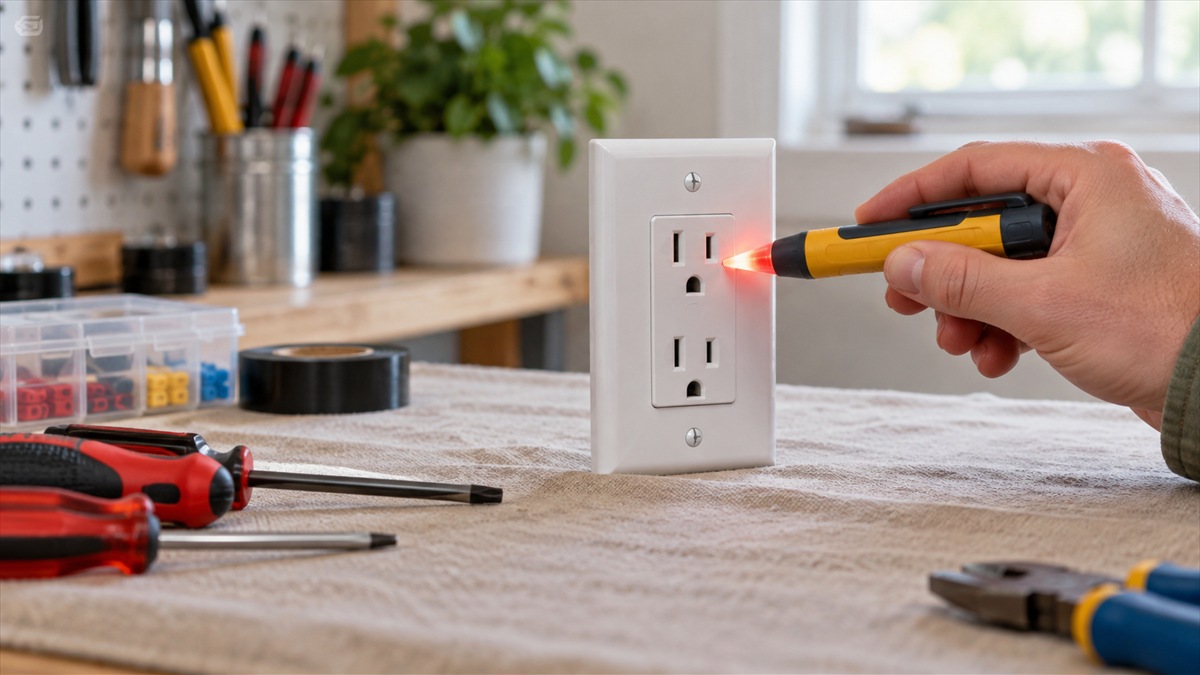
A 12 volt non contact voltage detector is a pen-style tester that flags voltage on an insulated conductor without touching bare metal. Non-contact test lights can detect voltage on insulated conductors, and each pen below states a detection range that starts at 12 volts and runs up to 1000 volts. This roundup compares seven pens whose listings name that 12 volt lower limit. It explains how to read range, CAT rating, sensitivity and battery notes, and where a non-contact pen is the wrong tool. Electrical safety comes first: work on mains circuits can kill, and panel or service work belongs to a licensed electrician.
Quick answer
Choose a pen whose listing names a 12 volt low end and lets you switch sensitivity, such as the VENLAB or MXCOIRTP pens. Choose a pen with a stated CAT rating if your work touches service equipment: the Westinghouse bullets state CAT IV 1000V and the Neoteck bullets state CAT III600V, and no other pen here gives a category. For a 12-volt battery circuit, do not rely on a non-contact pen. These listings describe AC detection, and none says it detects DC voltage, so use a meter with a DC setting and follow its manual.
What matters for this keyword
The range, not just the 12 volt label
The 12 volt figure is the bottom of each range, not a setting for a 12-volt battery. Several listings split the range into low and high settings. The VENLAB low setting covers 48V-1000V, so a reading near 12 volts belongs on its high setting. The MXCOIRTP listing names three ranges, 12V, 48V and 70V up to 1000V, and each range has its own sensitivity behavior. Check which setting you will use before you rely on a reading.
Sensitivity and what the signal tells you
Sensitivity changes how strongly the pen responds, so read the mode on the device before you trust a signal. If a pen reacts when nothing seems live, the guide on non-contact voltage tester false positives covers that problem. The MXCOIRTP pen has three modes that beep one, two or three times. The VENLAB pen shows a red tip and a fast beep when it detects high voltage, and a yellow light with a slower beep for low voltage. The Klein pen uses a three-color tip, with blue for low signal, red for high and green for none, and a bar graph that rises as the signal strengthens.
CAT rating and the circuit you will test
The CAT rating tells you which kind of circuit a meter is built for. Facts describe CAT as an IEC classification of live circuits used in measurement, with category II for circuits directly connected to the low-voltage installation and category IV for the source of a high-voltage installation. Only two listings here state a rating. The Westinghouse bullets name CAT IV 1000V, and the Neoteck bullets name CAT III600V. The other five listings give no category, so do not treat them as rated for household mains.
Battery and form factor
Battery notes vary from pen to pen. The Neoteck listing includes two AAA batteries in the box. The SNAKOL listing says it runs on two AAA batteries, but its included list names only a voltage tester. The Klein listing names a battery-powered source without a battery count. The MXCOIRTP listing says the buzzer sounds and the pen shuts off when battery voltage falls below 2.5V, so the battery needs replacing when that happens. None of these listings gives a runtime, so the battery type and count matter more than any claimed run time.
Where a non-contact pen is the wrong tool
A non-contact pen answers a yes or no question about voltage near a conductor. Facts describe a test light as simpler and less costly than a measuring instrument such as a multimeter, and often enough to check whether a conductor is live. A multimeter gives you a value you can compare with a specification, which a pen does not. Use a meter when you need a number, a DC reading or a record of what you measured. The comparison of a non-contact voltage tester and a multimeter lays out the same split in more detail.
At a glance: the 7 picks, by their own spec fields
| Pick | Range | CAT rating | Flag |
|---|---|---|---|
| Neoteck (basic AC check) | 12-1000V AC | CAT III 600V — only in a bullet, not in spec fields | AC detection only; not for Christmas light testing |
| VENLAB (switchable sensitivity) | High 12V-1000V, low 48V-1000V | Not stated anywhere | Specification Met field names only “Beep” |
| MXCOIRTP (3 sensitivity modes) | 3 ranges AC | Not stated | Low-battery alert below 2.5V; no weight or dimensions given |
| Klein Tools NCVT7 (signal strength bar) | Not stated as a number | Not stated | Warranty field says “see manufacturer website”; no battery type/count named |
| Westinghouse (CAT IV in bullets) | 12V-1000V, split at 100V in the bullets | CAT IV 1000V — bullet only | Title says “hot stick,” style field says “pen” — form factor unclear; no weight given |
| Zoyi DB02 (break-point testing) | Dual-range | Not stated — CE only | Brand field says ZOTEK, manufacturer field says ZOYI — conflict; title mentions temperature tester but no bullet describes it |
| Laser Breakpoint Locator SK-C01A | 12V-1000V AC | Not stated | Included components list only “Voltage Tester,” bullets separately say it runs on 2 AAA batteries; laser usage not explained |
Specs are from each product’s Amazon listing, checked 2026-10-11. Only Neoteck and Westinghouse mention a CAT rating, and both only in bullet text rather than the formal spec fields — verify the rating directly with the seller before mains use.
1. Neoteck Non Contact Voltage Detector 12-1000V AC Voltage Tester (Basic AC check)
Specs from the listing (checked 2026-10-11):
- Style: AC 12-1000V
- Measurement Type: AC Voltage
- Included Components: 2×1.5V AAA batteries
- Warranty Description: 18 Months
- Item Weight: 65 g
Pros
- The listing states a 12-1000V AC range.
- Two 1.5V AAA batteries are listed as included.
- The listing gives a weight of 65 g and an 18 Months warranty.
Cons
- CAT III600V appears in one bullet, not in the spec fields.
- The listing says it is not suitable for Christmas light testing.
- The listing describes AC detection only.
Best for: Readers who want a basic AC check with batteries in the box.
Skip if: Skip it if you need a rating in the spec fields or a DC check.
View on Amazon (affiliate link)
2. VENLAB Voltage Tester, Non Contact Voltage Detector, Circuit Tester Dual Range Voltage Sniffer (Switchable sensitivity)
Specs from the listing (checked 2026-10-11):
- Style: Voltage Tester
- Specification Met: Beep
- Included Components: 1*Voltage Tester 2*AAA Batteries
- Item Weight: 0.05 kg
- Model: VD-200
Pros
- The listing offers high and low sensitivity, with high for 12V-1000V.
- The listing describes a red pointing light for job sites.
- The listing gives a 3 years warranty and lifetime technical support.
Cons
- The listing gives low sensitivity as 48V-1000V, so 12-volt readings belong on high.
- No CAT rating appears anywhere in the listing.
- The Specification Met field names only Beep.
Best for: Readers who want to switch between a 12 volt range and a 48 volt range.
Skip if: Skip it if you need a CAT rating or a fixed range that does not need switching.
View on Amazon (affiliate link)
3. MXCOIRTP Voltage Tester, Non-Contact Voltage Detector, Electrical Tester, 3 Ranges AC (Three sensitivity modes)
Specs from the listing (checked 2026-10-11):
- Style: Compact
- Measurement Type: Voltmeter
- Warranty Description: 1 year warranty
- Included Components: Voltage Tester
- Model: MT01
Pros
- The listing describes three sensitivity modes, with buzzer counts of 1, 2 and 3.
- The tail flashlight works only when the tester is off, according to the listing.
- The listing gives a 1 year warranty.
Cons
- The listing gives no CAT rating.
- The listing says the pen gives an alert below 2.5V, so the battery needs watching.
- The listing does not give a weight or dimensions.
Best for: Readers who want several sensitivity steps on a compact pen.
Skip if: Skip it if you need a rated category or dimensions to compare with other pens.
View on Amazon (affiliate link)
4. Klein Tools NCVT7 Non-Contact Voltage Tester with LCD Signal Strength Display, 3-Color LED Tip (Signal-strength bar graph)
Specs from the listing (checked 2026-10-11):
- Model: NCVT7
- Warranty Description: See Manufacturer Website
- Item Weight: 1.6 ounces
- Item Dimensions: 5.7 x 1.14 x 0.93 inches
- Power Source: Battery Powered
Pros
- The LCD bar graph shows signal strength, rising with voltage or closeness to the source.
- The three-color tip shows blue for low, red for high and green for none.
- The listing gives a weight of 1.6 ounces and dimensions of 5.7 x 1.14 x 0.93 inches.
Cons
- No CAT rating appears in the listing.
- The warranty field says see manufacturer website instead of giving a term.
- The listing names no battery type or count for a battery-powered pen.
Best for: Readers who want to read signal strength as well as a beep.
Skip if: Skip it if you want a printed rating or a DC check.
View on Amazon (affiliate link)
5. Westinghouse Non-Contact Voltage Tester Pen with Flashlight & Worklight, Dual Range 12V-1000V AC (Only CAT IV in the bullets)
Specs from the listing (checked 2026-10-11):
- Style: 12-1000V Pen
- Specification Met: CSA, IP 67, UL
- Model: 850024390041
- Item Dimensions: 6.3 x 0.9 x 1 inches
Pros
- A bullet states a CAT IV 1000V safety rating.
- A bullet states IP67 dust and water protection.
- The listing says it powers off automatically after five minutes of inactivity.
Cons
- The title says hot stick, while the style field says pen, so the form factor is unclear.
- The bullets split the range at 100V, with 12V-100V as the low range.
- The listing gives no weight for this pen.
Best for: Readers who need a stated CAT IV figure and a sealed pen body.
Skip if: Skip it if you need a true hot stick for reach, because the form factor is unclear.
View on Amazon (affiliate link)
6. Zoyi DB02 AC Voltage Detector – Non-Contact Voltage Tester Pen with Break-Point Testing, Dual-Range (Break-point testing)
Specs from the listing (checked 2026-10-11):
- Brand: ZOTEK
- Manufacturer: ZOYI
- Model: ZT-DB02
- Item Dimensions: 6.14 x 0.9 x 1.1 inches
- Specification Met: CE
Pros
- The listing names break-point testing for locating breaks in wires and cables.
- The listing describes a built-in flashlight for dim areas.
- The listing gives dimensions of 6.14 x 0.9 x 1.1 inches.
Cons
- The brand field says ZOTEK, but the manufacturer field says ZOYI.
- The title names a temperature tester, but no bullet describes temperature measurement.
- No CAT rating appears, and the specification field says CE only.
Best for: Readers who want break-point testing on a dual-range pen.
Skip if: Skip it if you need a rated category or a temperature function.
View on Amazon (affiliate link)
7. Non Contact Voltage Tester Pen, 12V-1000V AC Electrical Tester with Laser Position, Live Neutral (Laser breakpoint locator)
Specs from the listing (checked 2026-10-11):
- Style: Compact
- Item Weight: 40.3 g
- Item Dimensions: 0.87 x 1.18 x 6.5 inches
- Model: SK-C01A
- Included Components: Voltage Tester
Pros
- The listing describes 12V-1000V AC detection with adjustable high and low sensitivity.
- The listing says a laser locates hidden wire breakpoints.
- The listing gives a weight of 40.3 g and a compact pen shape.
Cons
- The included list names only a voltage tester, while the bullets say the pen runs on two AAA batteries.
- The listing does not explain how the laser is used.
Best for: Readers who want a laser pointer on a 12-1000V AC pen.
Skip if: Skip it if you want a rated category or do not plan to use the laser.
View on Amazon (affiliate link)
How to choose
Choose the Neoteck pen if you want a basic AC check with batteries included and do not need a stated CAT rating in the spec fields. Its range is 12-1000V AC, and the listing puts CAT III600V in a bullet, not in the spec fields.
Choose the VENLAB or MXCOIRTP pen if you want to switch sensitivity. VENLAB uses two settings, high for 12V-1000V and low for 48V-1000V. MXCOIRTP uses three modes, and it starts in the lowest one each time it powers on.
Choose the Klein pen if you want a bar graph that shows signal strength. Its three-color tip and audible alert change together, so you can read the strength without looking closely at the screen.
Choose the Westinghouse pen if a stated CAT IV 1000V rating matters to you, along with IP67 dust and water protection and a 6.5 foot drop rating. Check the form factor first, because its title says hot stick while its style field says pen.
Choose the ZOTEK pen if break-point testing is the feature you need. Check its brand and manufacturer fields before you order, since they differ.
Choose the SNAKOL pen if you want a laser that points to a suspected breakpoint. The listing does not describe how to use the laser, so read the manual first.
Whatever you choose, read the range on the listing and compare it with the voltage you expect to meet. A pen whose lower end starts at 48V will not answer a question about 12 volts in the same way. A short walk-through of the pen format is in how to use a voltage detector pen.
Reading a listing before you buy
Read four fields and one bullet before you order. First, the lower end of the range, since the title and the bullets can disagree on it. Second, the CAT figure, and whether it sits in a spec field or only in a bullet. Third, the battery type and count, which several listings leave out. Fourth, the warranty term, because some listings point to a manufacturer website rather than stating a term. Finally, read the sensitivity description, since each listing defines its modes in its own way. Write down what each listing states before you compare them side by side.
Its low setting is 48V-1000V, so 120 sits inside that range. The distance from the bottom of the low setting is 120 minus 48, which equals 72 volts. On its high setting, which starts at 12V, the distance is 120 minus 12, which equals 108 volts. Check: 72 plus 48 equals 120, and 108 plus 12 equals 120, so both differences are right. The setting you choose changes the lowest voltage the pen covers, and that matters more on low-voltage wiring than on a standard outlet.
Safety first
OSHA lists contact with power lines among the most frequent causes of electrical injuries, along with a lack of ground-fault protection and improper use of extension and flexible cords. The ways to reduce the risk include insulation, guarding, grounding, electrical protective devices and safe work practices. OSHA’s rule for listed equipment says to install and use it according to the instructions in its listing or labeling. Read the maker’s manual for what the pen can and cannot tell you, and ask a licensed electrician for any panel or service work.
Worked example: the 12 volt and 48 volt settings
The VENLAB high setting starts at 12 V and the low setting starts at 48 V. The gap between the two lower limits is 48 V – 12 V = 36 V, so a 12 volt reading falls below the low setting and needs the high setting. The high setting spans 1000 V – 12 V = 988 V above its lower limit.
Mistakes to avoid
- Reading 12 volt as a battery rating. The figure is the low end of an AC detection range, and the listings describe AC detection.
- Choosing by the bullets alone. The Neoteck CAT III600V figure appears only in a bullet, while the spec fields give no category.
- Ignoring the Christmas-light note. The Neoteck listing says it is not suitable for Christmas light testing, so do not assume it works on that load. The related guide on voltage testers and Christmas lights explains the difference.
- Confusing a pen with a GFCI tester. A residual-current device, or GFCI, interrupts a circuit when current in the line and neutral conductors is unequal. A voltage pen does not do that job.
- Trusting a laser as a measurement. The SNAKOL laser locates a suspected breakpoint, which is a different job from measuring voltage.
- Assuming batteries come in the box. Only the Neoteck listing names batteries among the included items; the SNAKOL included list names only a voltage tester.
- Expecting a CAT figure from the maker’s reputation. The Westinghouse and Neoteck bullets are the only ones here that name a CAT figure, and a brand alone does not tell you the category.
FAQ
Is a non contact voltage detector the same as a multimeter?
No. A detector tells you that voltage is present near a conductor. A multimeter gives a value you can compare with a specification. If you need a number, a DC reading or a record, use a meter and follow its manual.
Can a non contact pen detect 12 volts from a car battery?
The listings in this set describe AC detection, and none says it detects DC voltage. For a car battery, use a meter with a DC setting and follow the vehicle manual, and leave airbag and high-voltage hybrid or EV systems to trained technicians.
What does CAT III or CAT IV mean?
CAT is an IEC classification of live circuits. Category II covers circuits directly connected to the low-voltage installation, and category IV covers the source of a high-voltage installation. Match the rating to the circuit you will work on, and check the listing and manual for the exact figure.
Why does one listing mention Christmas lights?
The Neoteck listing says it is not suitable for Christmas light testing. Read that note as a limit on the use the pen was described for, not as a general safety claim.
How do I know which sensitivity mode I am in?
Read the mode on the device. The MXCOIRTP listing describes three modes with buzzer counts of one, two and three, and it starts in the lowest mode after power-on. The VENLAB listing switches between high for 12V-1000V and low for 48V-1000V.
Do these pens need their batteries changed?
Some do. The MXCOIRTP listing says the pen buzzes and shuts off when battery voltage drops below 2.5V, so replace the battery when that happens. Check the battery type and count in the manual, since several listings do not state them.
Is the laser on one pen useful?
The SNAKOL listing says its laser locates hidden wire breakpoints. The listing does not explain how to use the laser, so read the manual before you rely on it for that job.
Do the flashlights on these pens work when the pen is on?
Six of the seven listings mention a flashlight: the Neoteck, VENLAB, MXCOIRTP, ZOTEK, SNAKOL and Westinghouse pens. The MXCOIRTP listing says its tail flashlight works only when the tester is off. Check how each light behaves on the pen you choose, so you know what to expect before you need it in a dark space.
Bottom line
Pick by range, CAT rating and sensitivity first, then by the feature you will actually use. For a basic AC check with batteries included, the Neoteck listing is the most direct. For switchable sensitivity, choose VENLAB or MXCOIRTP. For a CAT IV figure in the bullets, Westinghouse is the pen to check. For any 12-volt battery circuit, use a DC meter instead of a non-contact pen.
Sources
- Measurement category, Wikipedia: CAT is an IEC classification of live circuits; category II covers low-voltage installation circuits and category IV covers the high-voltage source.
- Test light, Wikipedia: a test light checks for the presence of electricity and can detect voltage on insulated conductors.
- OSHA electrical safety: the most frequent causes of electrical injuries and the ways to reduce the risk.