Fluke 375 FC Clamp Meter: What It Does and What the Manual Says
As an Amazon Associate we earn from qualifying purchases.
Quick answer
- The Fluke 375 FC is a True-RMS AC/DC clamp meter. The manual says it measures true-rms AC current and voltage, and it adds DC current and voltage, frequency and DC millivolts for this model.
- The manual states a jaw opening of 34 mm, and an AC and DC current range of 600.0 A.
- The manual rates the meter IEC 61010-2-032 and 61010-2-033: CAT III 1000 V and CAT IV 600 V.
- The manual says not to use the meter in CAT III or CAT IV environments without the protective cap on the test probe.
What the Fluke 375 FC measures
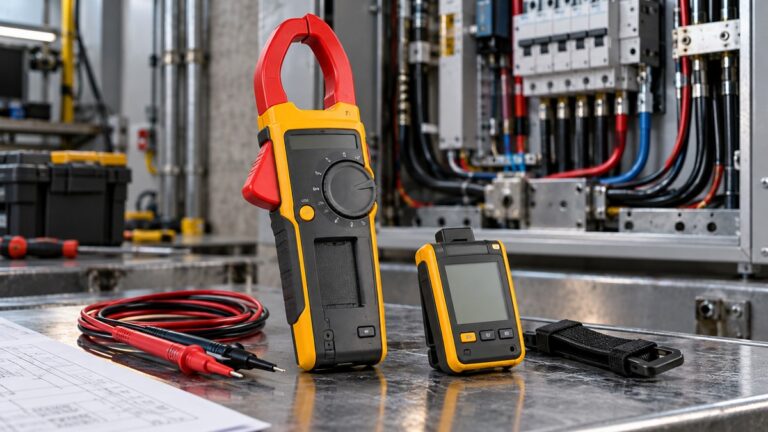
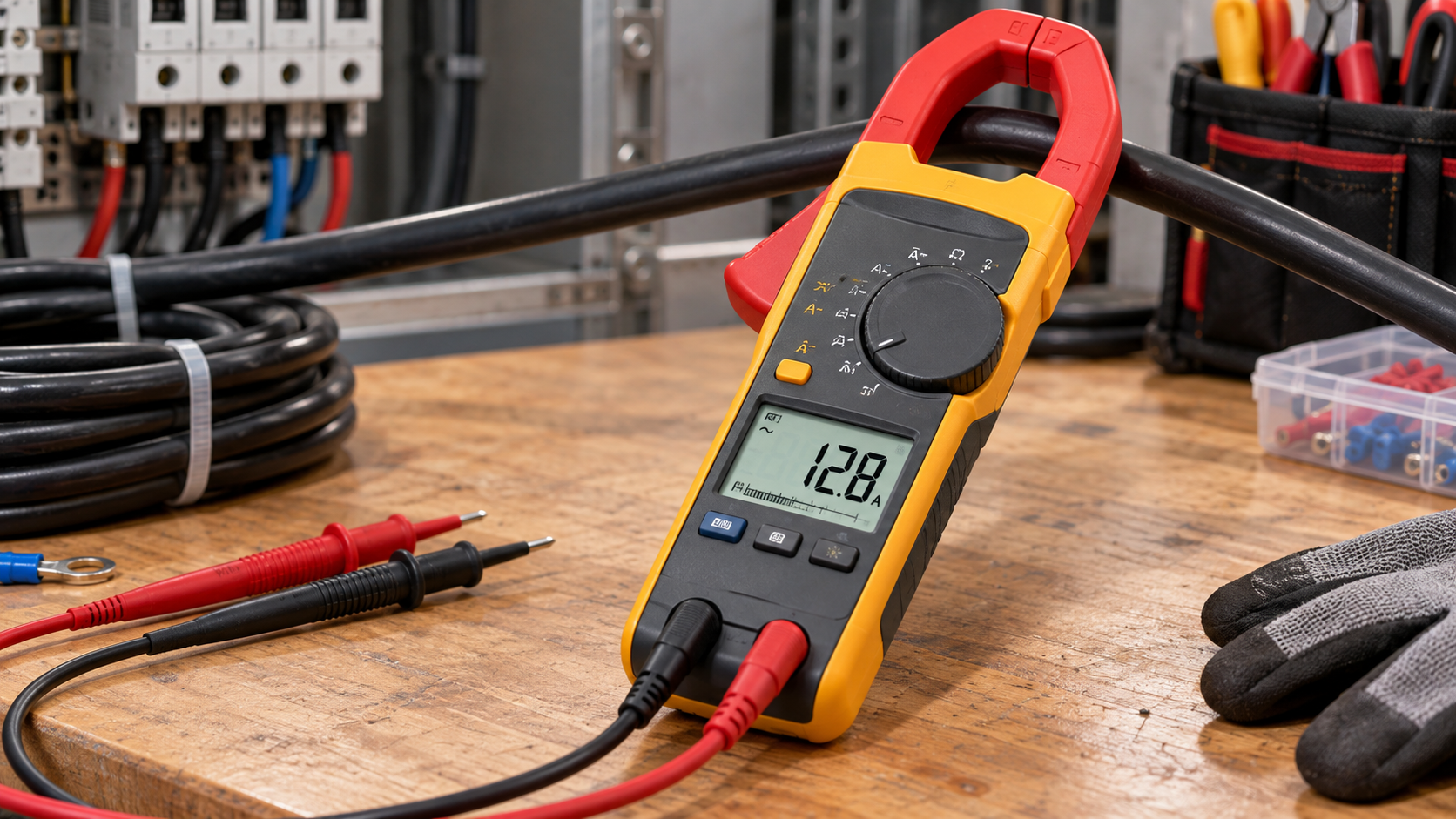
A clamp meter measures current without breaking the circuit. You open the jaw, close it around one conductor, and read the current the conductor carries. The Fluke 375 FC does this for alternating current and direct current through its jaw. For voltage and other functions, the test leads go into the input jacks instead, and the meter reads through the probes. The manual’s specification section lists these measurement ranges for the 375 FC:
- AC current through the jaw: a range of 600.0 A, with a resolution of 0.1 A. The manual gives an accuracy of 2% ±5 digits from 10 Hz to 100 Hz, and 2.5% ±5 digits from 100 Hz to 500 Hz.
- DC current through the jaw: a range of 600.0 A, with a resolution of 0.1 A and an accuracy of 2% ±5 digits.
- AC current through the flexible probe: a range of 2500 A, with a resolution of 0.1 A up to 999.9 A and 1 A above that. The manual gives an accuracy of 3% ±5 digits from 5 Hz to 500 Hz.
- AC voltage: a range of 1000 V, with resolution of 0.1 V up to 600.0 V and 1 V up to 1000 V. The manual gives an accuracy of 1.5% ±5 digits from 20 Hz to 500 Hz.
- DC voltage: a range of 1000 V, with the same resolution steps, and an accuracy of 1% ±5 digits.
- DC millivolts: the manual lists a 500.0 mV range for the 375 FC and 376 FC models.
- Frequency: the manual lists the jaw frequency range for the 375 FC and 376 FC models, and the frequency function is named in the product description.
The manual gives crest factor limits for AC current. For the 374 FC and 375 FC, the manual lists a crest factor of 2.5 at 350 A and 1.42 at 600 A through the jaw. The manual adds 2% to the stated accuracy when the crest factor is above 2. Crest factor matters when current has sharp peaks, such as the output of some variable-speed drives.
Manufacturer specifications in one place
Every figure below is printed in the Fluke users manual, PN 4705494, or in the Dutch Rev. 3 copy of the same manual. Where a figure is not printed, the cell says so.
| Item | What Fluke states | Where it is stated |
|---|---|---|
| Safety standard | IEC 61010-1, pollution degree 2 | Manual, specifications |
| Measurement category | IEC 61010-2-032 and 61010-2-033: CAT III 1000 V / CAT IV 600 V | Manual, specifications |
| Maximum voltage, any terminal to earth | 1000 V | Manual, specifications |
| Jaw opening | 34 mm | Manual, specifications |
| Flexible probe diameter | 7.5 mm; cable length 1.8 m from head to electronics connector | Manual, specifications |
| Flexible probe range | 2500 A AC | Manual, specifications |
| Size | 249 mm x 85 mm x 45 mm | Manual, specifications |
| Weight | 410 g | Manual, specifications |
| Batteries | 2 AA, NEDA 15A, IEC LR6 | Manual, specifications |
| Operating temperature | -10 °C to +50 °C | Manual, specifications |
| Storage temperature | -40 °C to +60 °C | Manual, specifications |
| Operating altitude | 2000 m; storage altitude 12,000 m | Manual, specifications |
| Ingress protection | IP30 (IEC 60529) | Manual, specifications |
| Wireless | 2412 MHz to 2462 MHz; output power below 100 mW | Manual, specifications |
| Warranty | Three years from the date of purchase, as stated in the manual’s limited warranty | Manual, limited warranty |
| Counts | Not stated as a count figure; the manual gives resolution per range | Manual, specifications |
How to use the meter safely
Current and voltage work can injure you through shock, arc flash or a short circuit. The manual asks the user to read all safety information before use, and several of its warnings bear directly on a clamp meter’s most common mistakes.
- Use the right category for the circuit. The manual says to use only the correct measurement category, voltage and amperage rating. It also says the category and voltage rating of the whole combination, meaning the probe, any accessory and the meter, is set by the lowest-rated part. A meter’s CAT rating does not make a lower-rated probe safe.
- Put the protective cap on the probe in CAT III and CAT IV work. The manual says not to use the product in CAT III or CAT IV environments without the protective cap on the test probe, because the cap reduces the exposed probe metal to less than 4 mm.
- Do not measure current with the leads in the input jacks. The manual says not to measure current while the test leads are in the input jacks.
- Connect and disconnect leads in order. The manual says to connect the common test lead before the live test lead, and to remove the live test lead before the common test lead.
- Keep the battery door closed and locked. The manual says the battery door must be closed and locked before the product is used, and that the calibration seal must be replaced when batteries are changed.
- Do not place a magnet inside a CAT IV panel. The manual says to place it outside the panel instead.
- Stop if the meter looks damaged. The manual says to inspect the clamp housing and the output cable insulation before use, and to repair the product before use if the battery leaks.
- Work at the right level. Panel, service entrance and utility work belongs to a licensed electrician. Most homeowners and many DIY users should not open a live panel to read a clamp.
Flexible probe and jaw
The jaw takes conductors up to a 34 mm opening, and the manual’s position sensitivity figures show how the reading changes when the conductor sits off-centre in the jaw. The manual lists three positions, A, B and C, with a measurement error of ±0.5% at the closest position, ±1.0% at the middle position and ±2.0% at the farthest position for the flexible probe at the distances it states. The figures apply within the stated assumptions: a centred primary conductor, no external electrical or magnetic field, and operation within the rated temperature range.
The optional iFlex flexible probe extends the reach to larger or awkward conductors. The manual states that the probe is optional with the 374 FC and 375 FC models, and it gives the probe diameter and cable length above.
What to check before you buy
- Your highest voltage. The manual states a 1000 V range. Its CAT rating is CAT III 1000 V and CAT IV 600 V, so the CAT IV figure is lower. If your work is in a CAT IV location at more than 600 V, the 375 FC is outside its stated rating.
- Your highest current. The stated jaw range is 600.0 A. The 376 FC in the same family lists a higher jaw range in the manual, so check the model number before you buy.
- Your conductor size. The jaw opening is 34 mm. If you need the flexible probe, the optional iFlex accessory is part of the purchase decision.
- Your waveform. The 375 FC is True-RMS. Crest factor limits apply, and the manual lists the accuracy penalty above a crest factor of 2.
- Your use indoors or outdoors. The IP30 rating in the manual is a low ingress protection level. Keep the meter dry and out of rain and dust.
- Your probe set. The CAT rating of a combination depends on the lowest-rated part. Check each lead and accessory for its own category.
How we chose
This article covers one model, the Fluke 375 FC. It does not compare the 375 FC with other clamp meters and does not rank it. The sources were chosen because each one is a copy of the same Fluke users manual, PN 4705494, in English, Spanish or Dutch, and each copy identifies Fluke as the manufacturer and gives a part number, a revision or a date. The English copy is the primary source for the figures quoted above. The Spanish and Dutch copies were opened to confirm the part number, the revision and the presence of the same CAT and voltage figures.
What we could not verify
- The sources are copies hosted by distributors and reseller sites, not by Fluke. They identify the manufacturer, the part number and the date. The Dutch copy is a later revision, Rev. 3 dated 4/23, and the English copy is dated September 2015. The two are not the same revision.
- The sources do not state a counts figure for the display. The manual gives resolution per range.
- The sources do not state a battery life figure for the 375 FC.
- The sources do not give a full list of the accessories that come with the meter, beyond the optional iFlex probe the manual describes.
- The sources do not describe how the wireless function is used. They state only the frequency band and output power.
FAQ
What is the Fluke 375 FC?
The Fluke 375 FC is a True-RMS clamp meter. The manual describes it as a clamp meter for AC and DC current and voltage, with an optional flexible current probe for larger or awkward conductors.
What CAT rating does the Fluke 375 FC have?
The manual states CAT III 1000 V and CAT IV 600 V under IEC 61010-2-032 and IEC 61010-2-033. The CAT IV figure is the lower of the two for the highest-category work.
Can the Fluke 375 FC measure DC current?
Yes. The manual lists a DC current range of 600.0 A through the jaw, with an accuracy of 2% ±5 digits.
Do I need the protective cap?
The manual says to use the protective cap on the test probe when working in CAT III or CAT IV environments. Without the cap, the manual says not to use the product in those environments.
What batteries does the Fluke 375 FC use?
The manual lists 2 AA batteries, NEDA 15A and IEC LR6.
Is the Fluke 375 FC the same as the Fluke 376 FC?
No. The manual covers the 374 FC, 375 FC and 376 FC in one document, and it states different jaw current ranges for the 376 FC. Check the model number printed on the meter before you buy.
Bottom line
The Fluke 375 FC is a CAT III 1000 V and CAT IV 600 V True-RMS clamp meter with a 600.0 A jaw range and a 34 mm jaw opening, according to Fluke’s manual. Match the CAT rating to the circuit, fit the protective cap when the work calls for it, and keep panel and service work with a licensed electrician.
Sources
- Fluke Corporation, 374 FC/375 FC/376 FC Clamp Meter Users Manual, PN 4705494, September 2015, English. Opened 2026-10-27 from a copy hosted by Rapid Online (third-party copy): https://static.rapidonline.com/pdf/85-4296m_v1.pdf
- Fluke Corporation, 374 FC/375 FC/376 FC Clamp Meter Users Manual, Rev. 3, 4/23, Dutch. Opened 2026-10-27 from a copy hosted by euro-index.be (third-party copy): https://euro-index.be/files/secured/documents/fluke-374-375-376-fc-hl-vl.pdf
- Fluke Corporation, 374 FC/375 FC/376 FC Clamp Meter Users Manual, PN 4705494, September 2015, Spanish. Opened 2026-10-27 from a copy hosted by Conrad (third-party copy): https://asset.conrad.com/media10/add/160267/c1/-/es/001405219ML04/instrukcja-obslugi-1405219-miernik-cegowy-fluke-376-fc-cat-iii-1000-v-cat-iv-600-v.pdf