Fluke v87: What the Name Covers and What the Ratings Mean
As an Amazon Associate we earn from qualifying purchases.
When people search for fluke v87, they almost always mean the Fluke 87V, a handheld true-RMS digital multimeter sold by Fluke for industrial troubleshooting. The name is also used loosely for a small family: two base meters (the 87V and the 87V MAX) and several bundles that add leads, a clamp, a holster or a case. The listings we opened state a CAT III 1000 V and CAT IV 600 V rating for the meter, and that rating is the first thing to check before you connect it to any mains circuit.
Quick answer
- “Fluke v87” usually means the Fluke 87V family. Check the model number on the box: the listings separate the 87V from the 87V MAX.
- The listings state CAT III 1000 V and CAT IV 600 V. A CAT rating limits where the meter may be used, not just the voltage it reads.
- The listings state true-RMS, 1000 V AC and DC, a switchable 6000 to 20000 count display, and a 2000 m operating altitude.
- Bundles change the accessories, not the core meter. Compare the included items before paying for a bundle.
What “Fluke v87” refers to
The Fluke 87V is a handheld digital multimeter that its listings describe as an industrial troubleshooting tool. The product family in the listings we read includes:
- Fluke 87V: the base meter, with TL75 test leads, AC175 alligator clips and an 80BK temperature probe listed as included.
- Fluke 87V MAX: a version the listings describe as IP67 rated, with a 4 m (13 ft) drop rating, a built-in thermometer, and TL175 test leads listed as included.
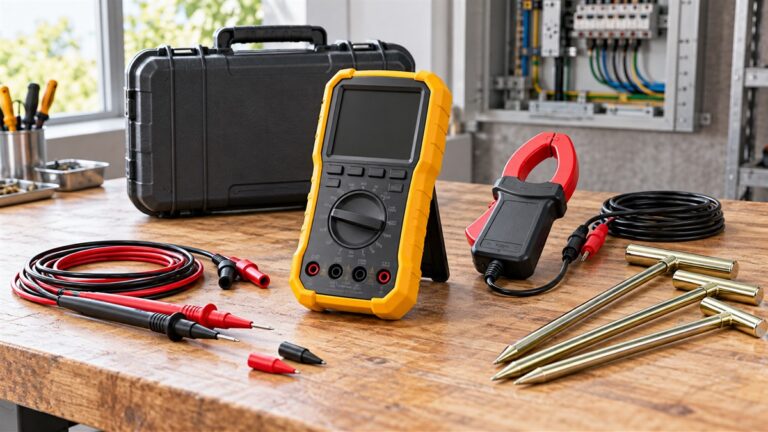
- Bundles: combinations with an i400 AC current clamp, a solar MC4 lead kit, or a combo kit with premium leads, a hanging kit and a soft case.
The listings do not agree on every feature for every bundle, so read the included-items line on the exact listing you are considering. A bundle name that includes “87V” does not guarantee the base meter’s full set of features.
The ratings: what CAT III 1000 V and CAT IV 600 V mean
The CAT rating in the listings comes from the overvoltage category system in the IEC 61010 family of standards. Fluke’s own catalog explains that each category describes where a circuit sits in an installation and how much fault energy is available there. The higher the category number, the closer the circuit is to the utility supply, and the more energy a fault can release.
| Category | Where it applies (per Fluke’s catalog) | Example from the source |
|---|---|---|
| CAT II | Single-phase loads at the outlet | Appliances, portable tools and similar household loads |
| CAT III | Fixed installations inside a building | Switchgear and polyphase motors |
| CAT IV | Origin of the installation, where low-voltage service meets the utility | The service connection itself |
Fluke’s catalog also says a meter’s real limit depends on both the category and the voltage rating together. Its example: a CAT III 600 V meter is checked against 6000 V transients, while a CAT III 1000 V meter is checked against 8000 V transients. A CAT II 1000 V meter is not equivalent to a CAT III 600 V meter, even though both see 6000 V transients. The Fluke 87V product page also states that the meter is designed to withstand spikes of more than 8000 V.
In practice, this means the rating on the meter has to match or exceed the category of the point you are measuring. A meter rated CAT III 1000 V is the listed rating for the 87V family, which covers distribution equipment inside a building. It does not make the meter suitable for every task, and it does not replace the protective equipment, training and procedures that electrical work requires.
Key specifications the listings state
The table below uses only figures that appear in the listing text or the Fluke product page. Where a listing does not give a figure, the cell says so.
| Feature | 87V family, as the listings state it |
|---|---|
| Voltage range | Up to 1000 V AC and DC (listing) |
| Safety rating | CAT III 1000 V, CAT IV 600 V (listing and Fluke page) |
| Peak capture | As fast as 250 µs (listing) |
| Resolution | Switchable 6000 to 20000 counts (listing) |
| Operating altitude | 2000 m (listing and Fluke page) |
| Ingress and drop | 87V MAX: IP67 and 4 m (13 ft) drop (listing); base 87V: not stated |
| Battery life | 87V MAX: “up to 800 hour” battery capacity (listing title); base 87V: not stated |
| Frequency filter | Low-pass filter for adjustable speed drives (listing) |
The resolution row is worth reading carefully. A count is one step of the display, and the step size on any range equals the range’s full-scale value divided by the count number. For example, on a 6 V range, a 6000-count display steps by 6 ÷ 6000 = 0.001 V (1 mV), while a 20000-count display steps by 6 ÷ 20000 = 0.0003 V (0.3 mV). The listings do not say which range the switchable resolution applies to, so the calculation shows the principle rather than a measured result for this meter.
Choosing between the 87V, the 87V MAX and the bundles
Use the listings’ own differences to decide. The base 87V is the right starting point if your work is mainly indoor building wiring, motors and drives, and you already have leads or a case. The 87V MAX is the better fit if the listing’s ingress and drop ratings matter to you, for example on job sites where a meter gets dropped or exposed to dust and water. The 87V MAX title also lists a built-in thermometer, which the base 87V listing does not state in the same way.
Skip the bundle if you do not need the extra item. The i400 clamp bundle adds a current clamp rated for AC current up to 400 A according to its listing, but a clamp is a separate measurement method, and the listing does not say how it integrates beyond the bundled connection. The solar MC4 kit is useful only for PV array voltage work, which the listing describes, and is not needed for ordinary household troubleshooting.
Limitations to note. The listings do not state a battery life for the base 87V, and they do not give an ingress or drop rating for it either. Where a bundle listing does not restate the CAT rating, read the rating from the meter itself and do not assume it from the bundle name.
If you also want a clamp meter for live current checks, our guide on best true-RMS digital clamp meters covers the clamp side of the decision, and our overview of auto-ranging digital multimeters explains why auto-ranging meters are easier for beginners.
Listings in the research file
These are the two listings the research file records for the Fluke 87V family as direct purchase options. The link is provided for reference and does not change the ratings or features described above.
- View on Amazon – Fluke 87V base meter listing
- View on Amazon – Fluke 87V MAX listing
Safety before you measure
Measuring mains voltage can cause a serious shock or arc flash. Confirm the meter’s CAT rating is at least equal to the category of the circuit, use leads rated for the same category, and keep fingers behind the probe guards. Work on distribution panels and service equipment belongs to a licensed electrician. A rating printed on a meter tells you the limit of the meter, not whether a particular job is safe.
How we chose
The research file for this topic records five Fluke 87V family listings, read on 2026-10-17, and two related models it excluded: the Fluke 88 V/A automotive kit and the Fluke 117, which are different model families. We kept the 87V family listings and used only the figures they state. Ratings were cross-checked against the Fluke product page and the Fluke catalog, both opened on 2026-10-27. We did not rank the listings by price or by any review count, and we did not give a recommendation beyond the differences the listings state.
What we could not verify
- The full user manual for the 87V was not among the sources we opened, so the procedures for each range are not described here.
- The Fluke product page gives two different resolution figures for DC and AC voltage (10 µV and 0.1 mV). The sources we opened do not reconcile them, and we do not pick one.
- Battery life for the base 87V is not stated by the listings or the page we opened.
- Real-world accuracy, drop survival and bundle compatibility beyond what the listings state were not checked by us.
FAQ
Is the Fluke v87 the same as the Fluke 87V?
In most listings, yes. “v87” is a shortened form of the Fluke 87V. Check the exact model number, because the 87V MAX and the bundles are separate products with different included items.
What does CAT III 1000 V mean on the Fluke 87V?
It means the meter is rated for measurements in fixed building installations such as distribution equipment, up to 1000 V, with a transient withstand defined by the standard. It does not mean every task at that voltage is safe for an untrained user.
Is the Fluke 87V true-RMS?
The listings state true-RMS for the 87V family, and the 87V MAX listing describes true-RMS accuracy with all functions of the 87V.
Does the Fluke 87V measure current?
The base listings describe voltage, resistance and related functions. The i400 bundle adds a clamp that the listing describes as measuring AC current up to 400 A, which is one way to measure current with this family. Check each listing for the current functions it includes.
Which Fluke 87V should a beginner buy?
A beginner with mains work in mind should pick a meter whose CAT rating matches the circuit and whose instructions they will read. The listings do not state that the 87V is the best starter meter, so compare it with simpler auto-ranging models before deciding.
Can the Fluke 87V be used on solar panels?
One bundle lists PV array voltage measurement with MC4 leads. Check the lead ratings listed for that bundle, since the leads, not just the meter, need to match the system.
Bottom line
Treat “Fluke v87” as the Fluke 87V family, check the model number, and read the CAT rating against the circuit you plan to measure. Pick the base meter or the 87V MAX by the ingress, drop and battery details the listing states, and skip a bundle whose extra parts you will not use.
Sources
- Fluke. “Fluke 87V Industrial Digital Multimeter.” https://www.fluke.com/en-us/product/electrical-testing/digital-multimeters/fluke-87v (opened 2026-10-27)
- Fluke Learn. “What is a clamp meter?” https://www.fluke.com/en-ca/learn/blog/clamps/abcs-of-clamp-meters (opened 2026-10-27)
- Fluke. “TTC-2014 Catalog, page 12: overvoltage categories.” https://content.fluke.com/pdf/catalog/catalog-eng/files/assets/basic-html/page12.html (opened 2026-10-27)