Fluke 381: What the Fluke Documents State
Quick answer
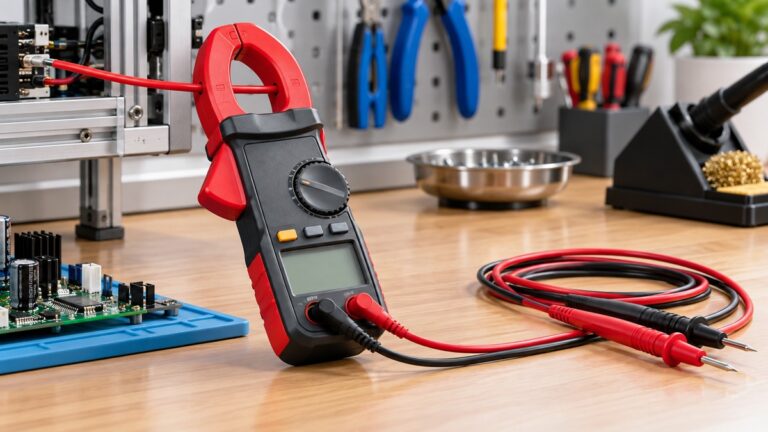
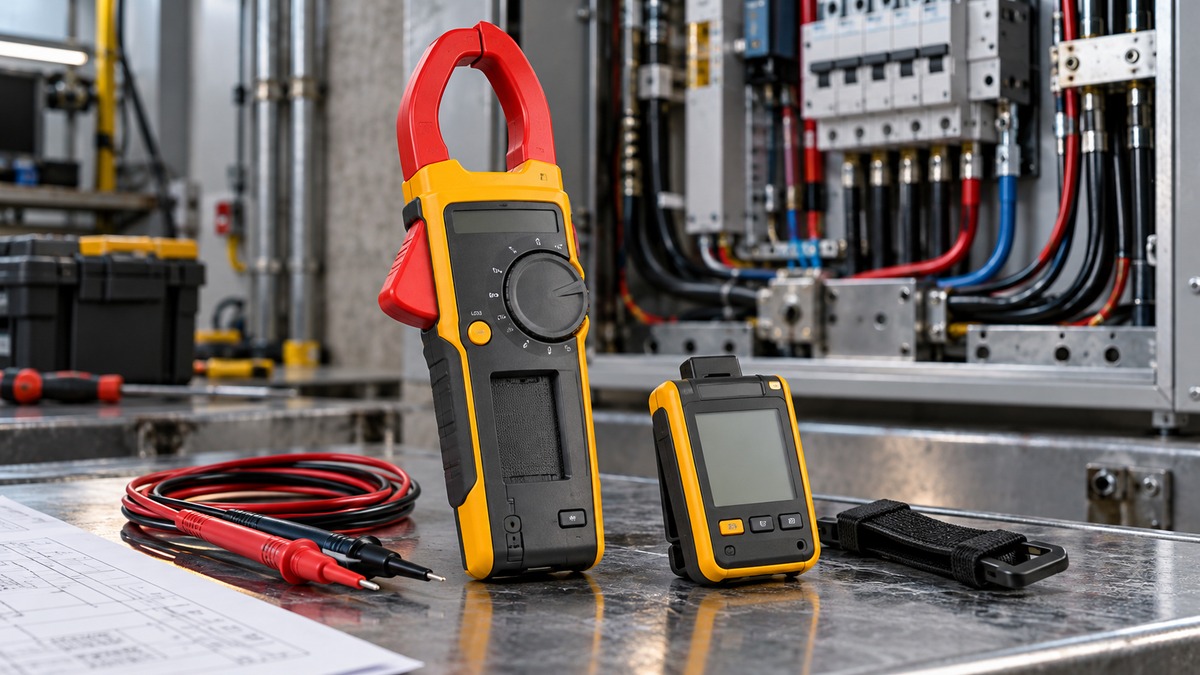
- What it is: a handheld clamp meter with a remote-display module and a detachable iFlex flexible current probe, per the Fluke users manual.
- Current: the jaw has a stated range of 999.9 A AC and DC. The iFlex probe has a stated AC range of 2500 A, for 45 Hz to 500 Hz.
- Voltage: the manual lists AC voltage at 600 V and 1000 V ranges, and DC voltage at 600.0 V and 1000 V.
- Safety markings: the Fluke brochure lists the 381 as CAT IV 600 V and CAT III 1000 V. The manual’s front-panel drawing shows the same two CAT marks.
What the jaw measures
The Fluke 381 has a fixed jaw. The users manual gives a DC current range of 999.9 A with 0.1 A resolution and an accuracy of 2% plus 5 digits. For AC current through the jaw, the manual gives the same 999.9 A range. Its accuracy figure changes with frequency: 2% plus 5 digits from 10 Hz to 100 Hz, and 5% plus 5 digits from 100 Hz to 500 Hz.
The jaw is the right tool when the conductor fits inside the opening and the load is in the range the manual lists. A jaw meter clamps around one conductor at a time. When two or more conductors sit inside the jaw, the reading is the sum of their currents and does not show each one separately. Read the manual’s measurement notes before using the jaw in a crowded panel.
The manual also states an uncertainty note for clamp readings. It assumes the conductor sits centred in the jaw, with no external electrical or magnetic field, and within the stated operating temperature range. Off-centre placement and nearby conductors can move the reading away from the stated accuracy.
What the iFlex probe adds
The iFlex is a flexible probe that wraps around a conductor. The Fluke users manual describes it as the way to measure higher current and larger cables than a jawed meter can close around. The manual’s specifications list a flexible-probe AC range of 999.9 A and 2500 A, for 45 Hz to 500 Hz.
The product page says the meter comes with an 18-inch iFlex flexible current probe. The brochure says the 381 is compatible with Fluke i2500 iFlex probes, which extend the measurement range to 2500 A AC. Check the probe length you need before you buy, because the probe is a separate part of the measurement, not a jaw extension.
The manual lists a crest factor of 3 at 500 A for the flexible probe, and a crest factor of 3.0 at 1100 A. A crest factor describes how sharp the peaks of a current waveform are compared with a sine wave. Loads with distorted waveforms, such as variable-speed drives, can sit above the range where the stated accuracy applies, so the manual’s crest factor line is the number to check for those loads.
Voltage, frequency and the remote display
The manual lists AC voltage ranges of 600 V and 1000 V with 0.1 V and 1 V resolution, and an accuracy of 1.5% plus 5 digits from 20 Hz to 500 Hz. DC voltage is listed at 600.0 V and 1000 V with an accuracy of 1% plus 5 digits. Frequency can be measured through the jaw from 5.0 Hz to 500.0 Hz, with 0.1 Hz resolution. The manual lists different trigger levels for different frequency bands, so a low-current load may not register until it reaches the trigger level for its band.
The remote display is a separate module that the manual says can be removed from the meter body and read away from the measurement source. The manual describes this as useful in hazardous environments or tight spaces. The meter base and the display communicate by a 2.4 GHz radio. The manual states that the meter base and display can be a maximum of 10 metres apart before the radio link is lost. A reader who plans to stand well back from a panel should measure that distance and check the link before relying on it.
The manual also includes Min Max Avg mode, which records minimum, maximum and average readings over a period, and a DC zeroing function. Read the manual’s section on the zero function before you measure small DC currents, because the result depends on the zeroing step.
Safety before you measure
Work on mains circuits can kill. Before you use any clamp meter on a live circuit, confirm that the meter’s category rating is at least the category of the point where you are working. Fluke’s brochure lists the 381 as CAT IV 600 V and CAT III 1000 V. Those marks define the highest transient voltage and the highest voltage to earth the meter is rated to handle in each category. They do not make the meter safe for any voltage in that category, and they do not replace the instructions in the printed safety sheet.
Use only the leads, probes and accessories the manual specifies. If you are unsure of the category of a panel or service entrance, stop and call a licensed electrician. Panel and service work belongs to a licensed electrician, not to a first-time user with a clamp meter.
The manual lists the batteries as AAA cells, and its battery replacement section gives the battery count. Check the section that applies to your unit before you change the batteries.
Skip if
- You only need to measure currents inside a small cable. A smaller, lower-cost jaw clamp covers that case, and you do not need the iFlex or the remote display.
- You work mainly on small cables and never need a remote display. The sources do not compare the 381 with cheaper jaw meters, so compare the ranges above against your own loads first.
- You need a meter with a documented traceable calibration certificate as standard. The product page says the 381 does not come with a certificate as standard, and that one can be requested.
How we chose
The criteria here are narrow. This article covers one product and asks what Fluke’s own documents say about it. It uses three documents opened on 27 October 2026: the users manual, the product page and the brochure. It does not compare the 381 with other clamp meters, and it does not rank it. The question it answers is which current, voltage and safety figures Fluke publishes, and which points a buyer should check against their own work.
What we could not verify
- The sources we opened do not state a price, a shipping time or a warranty length for the 381 in any region. Check Fluke’s current warranty page before you buy.
- The users manual’s front-panel drawing shows CAT marks, and the brochure lists CAT IV 600 V and CAT III 1000 V. The manual text we read does not restate the full category wording in one sentence, so read the printed safety sheet that ships with your unit.
- The manual lists two battery counts in its replacement steps. The sources do not say which one applies to every production run.
- The sources do not state the weight or the dimensions of the complete kit, including the remote display and the iFlex probe.
FAQ
Does the Fluke 381 measure true RMS?
The users manual names the meter as a Remote Display True-rms Clamp Meter. The manual’s measurement notes describe true-RMS readings, and the label uses the same term. For a precise answer on a specific waveform, check the accuracy and crest-factor lines in the manual.
What is the largest current the 381 can measure?
The jaw range is listed as 999.9 A. Fluke states that the iFlex flexible probe extends AC measurement to 2500 A over 45 Hz to 500 Hz.
Can I read the display away from the conductor?
Yes. The manual describes the remote display as removable and says it can be read away from the source. The meter base and display communicate by radio, and the manual gives a maximum separation of 10 metres.
What CAT rating does the 381 carry?
Fluke’s brochure lists CAT IV 600 V and CAT III 1000 V for the 381. The manual shows the same two CAT marks on its front-panel drawing. The rating applies to the category of the point where you are measuring, so match it to the installation before you connect.
Does the 381 come with a calibration certificate?
The product page says the 381 does not come with a NIST-traceable certificate as standard, but that one can be requested. Confirm the option at the time of purchase.
Should I use the jaw or the iFlex probe?
Use the jaw when the conductor fits the opening and the current is within the jaw range. Use the iFlex probe for larger conductors, bus bars or current above the jaw range, and check the crest factor and frequency lines in the manual for distorted loads.
Bottom line
The Fluke 381 is a jaw-and-probe clamp meter with a removable display. Its published current range is wide, and its published CAT markings are CAT IV 600 V and CAT III 1000 V. Before you buy, confirm the category you will work in, the probe size you need, and the display distance you plan to use.
Related guides
- Best Fluke 117 Case: 4 Hard Cases Compared covers protective cases for a Fluke meter kit.
- Best Fluke 1000 Amp Clamp Meter covers the other high-current clamp option in the Fluke line.
- Best Fluke Non Contact Voltage Tester Picks and Alternatives covers a separate tool for checking voltage before you touch a conductor.
Sources
- Fluke Corporation, “381 Remote Display True-rms Clamp Meter Users Manual”, https://media.fluke.com/13bf493d-48ed-4f96-bc80-b2c600f9e640_original%20file.pdf (opened 2026-10-27)
- Fluke Corporation, “Fluke 381 Remote Display True RMS AC/DC Clamp Meter with iFlex”, https://www.fluke.com/en-us/product/electrical-testing/clamp-meters/fluke-381 (opened 2026-10-27)
- Fluke Corporation, “381 Fluke Clamp Meters Solutions for every need” brochure, https://media.fluke.com/bc57ba24-a417-4abc-a087-b10600678a37_original%20file.pdf (opened 2026-10-27)