What Is a Millivolt (mV)
As an Amazon Associate we earn from qualifying purchases.
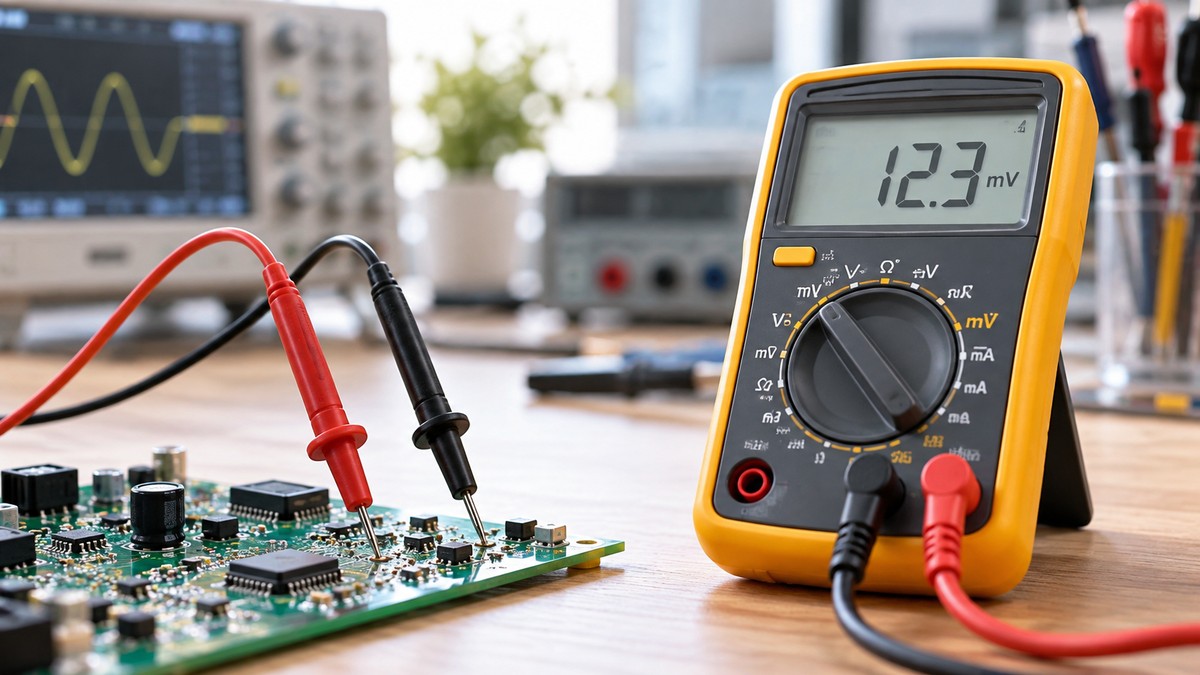
What is a millivolt? A millivolt (mV) is one thousandth of a volt, so 1 mV equals 0.001 V. It is the same unit of voltage on a smaller scale, not a separate quantity. Meters show it on a dedicated millivolt range, and that range matters when the signal is small, such as the output of a thermocouple. This post explains what the unit means, how a meter’s millivolt range is listed, why the range matters for small signals, and what the sources we opened do not say. It does not cover mains work.
Electrical safety
Work on mains circuits can kill. This post gives no steps for mains, outlets, panels or service wiring. The examples stay at low voltage on a bench, such as a battery, a DC circuit, a component or a thermocouple pair that is not connected to a supply. OSHA’s electrical standards, by its own description, guard workers against electric shock and electrocution, and its work-practice standard requires safety-related practices to prevent electric shock when work is performed near or on energized equipment. Teledyne LeCroy explains that source impedance drops closer to the utility supply, and that the likelihood of death is higher at very low source impedance.
Before any measurement, confirm that the CAT rating on the meter fits the circuit in front of you, and take that rating from the listing or the manufacturer’s manual. The CAT rating comes with a voltage rating, and both have to suit the circuit. Fluke advises choosing a meter rated for the highest category you could potentially use it in, with a voltage rating to match or exceed those situations, and says the ratings are usually located near the input jacks. B&K Precision gives an example of a meter rated for safety up to 1000 V in a category I environment, and only 300 V in a category II environment. GAMBICA’s guide describes measurement category as a way of classifying test equipment terminals by the type of mains circuit they are meant to connect to.
A meter that reads millivolts is not thereby safe for household mains. The sources we opened do not present a millivolt range as a safety rating. The millivolt range is a measurement specification, and the category and voltage ratings are the separate limits that decide where a meter can be connected. A voltage tester and a multimeter are different tools with different jobs, as explained in how voltage testers work.
On this site, panel and service work is reserved for a licensed electrician. The sources we opened do not set a US licensing rule for that work. OSHA’s training standard covers employees who face a risk of electric shock, and its work-practice standard says live parts shall be deenergized before an employee works on or near them, with exceptions the standard lists. A New Brunswick regulator page shows that licensing rules differ by place: under that province’s rules, and on conditions the page lists, an employee doing energized work limited to minor repairs or replacements does not have to be a licensed electrician. That rule does not change the scope of this post, which gives no steps for panel work under any rule.
Quick answer
- Units: one millivolt equals 0.001 volt.
- Mains work is outside this post. Check the meter’s CAT rating against the circuit before any measurement.
- A millivolt range gives a finer step for small signals. The Fluke 117 listing gives 0.1 mV on its 600.0 mV range.
- The sources we opened do not describe what happens when millivolts are read as volts.
What a millivolt is
The SI prefix milli is defined with the symbol m and a factor of 10 to the minus 3. NIST’s text describes the prefix as meaning one-thousandth. A millivolt is therefore one thousandth of a volt, and a volt is 1,000 millivolts. Our own arithmetic gives the same relation for other values: 250 mV is 0.25 V, and 0.5 V is 500 mV. A range labelled 600 mV therefore covers 0.6 V.
Two consequences follow. First, a millivolt reading is still a voltage measurement, only at a smaller scale. Second, the digits alone do not tell you the scale. The same digits stand for a value 1,000 times smaller in millivolts than in volts, so the unit has to travel with every reading you write down.
How meters list a millivolt range
A meter’s listing states its ranges and their resolution. The Fluke 117 product page lists DC millivolts with a range of 600.0 mV and a resolution of 0.1 mV. On the same page, DC volts appear on separate rows, and the 6.000 V range has a resolution of 0.001 V. The listed accuracy for DC millivolts is 0.5% of reading plus 2 counts, on a display the page describes as 6,000 counts. These are specifications for one model, not a rule for every meter.
Resolution is the smallest step a meter can show on a given range. Because the two ranges have different resolutions, the millivolt range can show a finer step than the lowest volt range on the same meter. Using the listed figures, the 600.0 mV range steps by 0.1 mV, while the 6.000 V range steps by 0.001 V, which is 1 mV. Our own calculation: on that listing the millivolt range is ten times finer. The listing does not state why the manufacturer chose these steps.
For a broader look at basic meter use, see the step-by-step guide to using a voltmeter.
Why the range matters for thermocouple output
A thermocouple produces a voltage that depends on temperature. Tektronix describes the output as a voltage proportional to the temperature difference between the conductor ends, and says the cold junction compensation sensor compensates for the thermocouple effect where the thermocouple connects to the measurement circuit. The sources we opened do not explain how a handheld meter handles that compensation.
The UPenn-hosted reference table for Type K thermocouples, with the reference junction at 0 °C, lists 4.096 mV at 100 °C and 4.509 mV at 110 °C. At 800 °C, it lists 33.275 mV. The header of that table reads Type K. Between 100 °C and 110 °C the table moves by about 0.041 mV per degree. Our own calculation from those figures: a 0.1 mV step on the 600.0 mV range corresponds to about 2.4 °C of Type K output near 100 °C, and a 1 mV step on the 6.000 V range corresponds to about 24 °C. No source states those two figures; they follow from the listed resolution and the table.
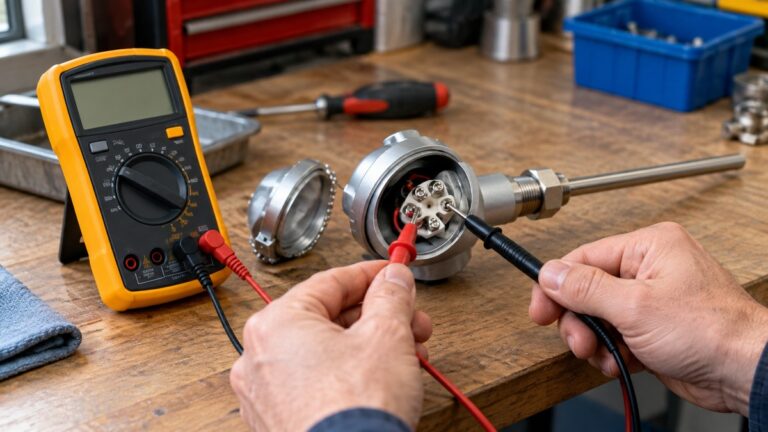
The millivolt range therefore matters for small thermocouple signals, because a finer step lets a reading show smaller changes in temperature. Keysight’s note on accurate temperature measurement with a data acquisition switch relies on an isothermal reference to make accurate temperature measurements. That note covers a different instrument from a handheld meter, so it supports the general principle, not a figure for a meter. For a worked thermocouple reading with a meter, see testing a thermocouple with a multimeter.
A thermocouple table is specific to one type. The sources give no single figure that applies to every thermocouple type, so a millivolt reading cannot be turned into a temperature without knowing the type and the reference junction. The UPenn table assumes the reference junction is at 0 °C, so a reading taken against a different reference has to be corrected before it is compared with the table. The sources we opened do not give that correction for a handheld meter, and this post does not interpolate between table rows.
Reading the display: mV against V
This is where the sources say the least. The Fluke 117 page lists millivolt and volt ranges as separate rows, each with its own resolution, so the unit is part of the specification. None of the sources we opened describe what happens when a user reads a millivolt figure as volts, and none gives a rate for that mistake. The listed resolution is the step the display can show on each range, so the unit and the decimal place have to be read together.
The arithmetic carries the risk. A display reading of 4.1 on the millivolt range means 0.0041 V. The same digits read as volts would be 4.1 V, which is 1,000 times larger. That is our own calculation from the definition, not a claim from a source. For a small thermocouple signal, the consequence of reading the wrong unit is the same factor of 1,000, in either direction.
Common mistakes
- Writing down the number without the unit. A figure shown in millivolts is 1,000 times smaller than the same digits in volts.
- Treating a millivolt range as a safety rating. The sources we opened present millivolt ranges as measurement specifications and tie the CAT category to the type of circuit.
- Using a Type K table for another thermocouple type. The UPenn table is for Type K, and the sources give no figures for other types.
- Reading resolution as accuracy. The Fluke 117 listing gives 0.1 mV as the step and 0.5% of reading plus 2 counts as the accuracy, and those answer different questions.
- Assuming a listing applies to other models. The figures above come from the Fluke 117 product page, and the sources we opened do not say whether another model shares them.
How we chose
This post covers what a millivolt is, how a meter’s millivolt range is listed, why the range matters for small signals such as thermocouple output, and what the sources say and do not say about reading the unit. We started from an SI reference for the definition. Then we looked for manufacturer pages that state ranges and resolution, a manufacturer note on temperature measurement, a university table for thermocouple output, and standards and regulator pages for the electrical safety section.
All sources were opened with curl on 2026-10-22. A quote was used only if the exact text appeared in the fetched body; otherwise the point is paraphrased. A page counted as a source only if it returned readable content. We set aside pages that returned 403 or 404, three Fluke blog addresses that resolved to a generic blog index, a PDF that the text extractor could not read, forum threads, and reseller pages. Of the 33 candidate URLs we opened, 13 are cited. Each safety claim in the electrical safety section is supported by three of the opened sources, named in that section. Where two sources gave a figure for the same point, the manufacturer or standards page was preferred. Forum threads gave rough thermocouple slopes; none of those figures appears in this post.
What we could not verify
The sources we opened do not cover the points below, and this post does not fill those gaps with estimates.
- A CAT rating for the Fluke 117 or for any other meter named here. The Fluke product page we opened has a comparison block of CAT ratings for several models, and the extracted text does not tie a rating to one model.
- Thermocouple output figures for types other than Type K.
- How a handheld meter’s millivolt input handles noise, lead resistance or thermal voltages at the millivolt level. The Keysight note we opened covers a data acquisition switch, not a handheld meter.
- How often millivolt readings are misread as volts, and what follows from that in practice.
- Licensing rules for panel or service work in US states.
In plain words, the sources we opened give the definition, one meter’s listed ranges, one thermocouple table, and general CAT and electrical safety rules. They do not give a CAT rating for the meter in the example, a full thermocouple data set, or any measure of how often the unit is misread.
FAQ
Is a millivolt the same as a volt?
No. A millivolt is a smaller scale of the same unit. NIST’s prefix text describes milli as one-thousandth.
Can a millivolt range check a household outlet?
No. This post gives no steps for household outlets. A millivolt range is a measurement range, and the sources treat CAT ratings and circuit categories as the test of suitability for mains.
Why does a meter need a millivolt range at all?
Small signals such as thermocouple output sit on the millivolt scale. On the Fluke 117 listing, the 600.0 mV range steps by 0.1 mV, against 1 mV on its 6.000 V range.
How much output does a Type K thermocouple make?
It depends on temperature. The UPenn-hosted table, with the reference junction at 0 °C, lists 4.096 mV at 100 °C and 33.275 mV at 800 °C. The sources we opened give no figures for other thermocouple types.
What happens if I read millivolts as volts?
The sources we opened do not describe that outcome. The arithmetic is clear: the same digits read as volts are 1,000 times larger than their millivolt value.
Who should do panel or service work?
The site rule is that panel and service work belongs to a licensed electrician. The sources we opened tie energized work to qualified persons, and they do not set a US licensing rule.
Bottom line
A millivolt is one thousandth of a volt. Keep the unit with every reading you write down, and check the CAT rating before you connect a meter to any circuit. A millivolt range is a measurement range, not a safety rating.
Sources
- NIST SI prefix table (milli, 10 to the minus 3): https://physics.nist.gov/cuu/Units/prefixes.html (opened 2026-10-22)
- Fluke 117 product specifications page (DC millivolt and DC volt rows): https://www.fluke.com/en-us/product/electrical-testing/digital-multimeters/fluke-117 (opened 2026-10-22)
- Fluke learn article on multimeter safety and category ratings: https://fluke.com/en-us/learn/blog/safety/multimeter-guide (opened 2026-10-22)
- Keysight application note 5988-8152EN on accurate temperature measurement with a switch: https://www.keysight.com/jp/ja/assets/7018-01133/application-notes/5988-8152.pdf (opened 2026-10-22)
- Tektronix application note on temperature measurement with a Model 2110: https://www.tek.com/en/documents/application-note/making-temperature-measurements-model-2110 (opened 2026-10-22)
- University of Pennsylvania-hosted Type K reference table, reference junction at 0 C: https://medesign.seas.upenn.edu/uploads/Courses/thermocouple_reference.pdf (opened 2026-10-22)
- OSHA electrical topic overview page: https://www.osha.gov/electrical (opened 2026-10-22)
- OSHA regulation text, 1910.332 (training for electrical hazards): https://www.osha.gov/laws-regs/regulations/standardnumber/1910/1910.332 (opened 2026-10-22)
- OSHA regulation text, 1910.333 (electrical work practices): https://www.osha.gov/laws-regs/regulations/standardnumber/1910/1910.333 (opened 2026-10-22)
- B&K Precision knowledge base note on input CAT ratings: https://www.bkprecision.com/knowledge/technical-notes/5/what-do-the-input-cat-ratings-mean (opened 2026-10-22)
- GAMBICA technical guide on overvoltage and measurement categories: https://www.gambica.org.uk/static/d96bb734-348d-478e-b0cba3b50fc35940/Guide-to-Overvoltage-Categories-and-Measurement-Categories.pdf (opened 2026-10-22)
- Teledyne LeCroy blog post on probe safety and CAT categories: https://blog.teledynelecroy.com/2020/06/probe-safety-demystified-cat-ratings.html (opened 2026-10-22)
- WorkSafeNB interpretation on the qualified person definition for electrical work: https://www.worksafenb.ca/policy-and-legal/legal/interpretations/electrical-work-qualified-person-definition (opened 2026-10-22)