How to Test a Golf Cart Battery With a Multimeter
As an Amazon Associate we earn from qualifying purchases.
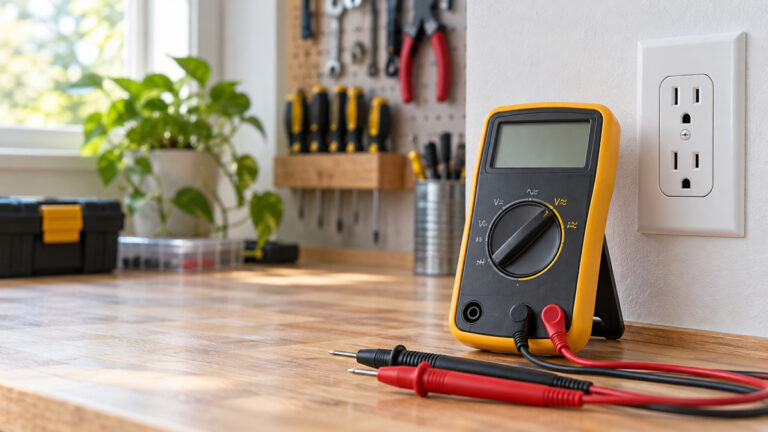
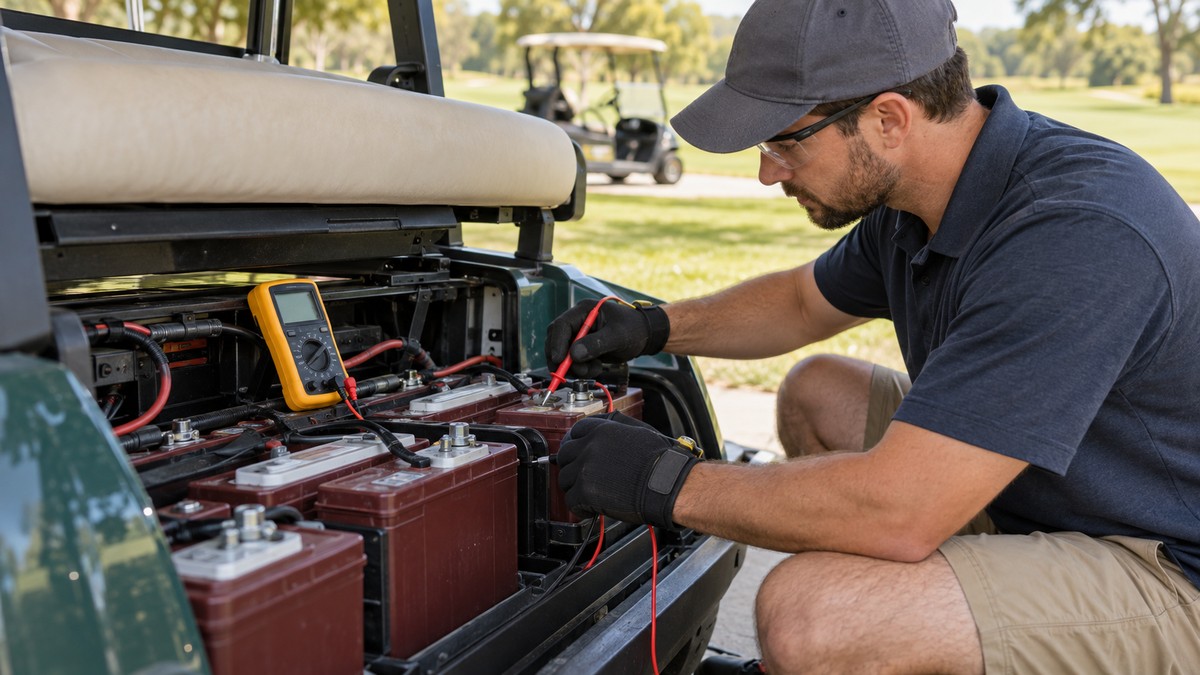
How to test a golf cart battery with a multimeter comes down to a few steps: charge the pack fully, let it rest, set the meter to DC volts, and read each battery on its own from positive post to negative post. Compare each reading with the resting value for that battery’s voltage, then compare the batteries with each other. One battery that sits well below the rest is the usual sign of a weak unit. A multimeter gives a resting check only, so a load check comes after it.
Quick answer
- Charge the pack fully and let it rest. The sources range from one hour to eight hours.
- Set the meter to DC volts and read every battery. At rest, a healthy 6V battery reads about 6.3 to 6.4 V and an 8V battery about 8.4 to 8.5 V.
- A battery that sits 0.5 V or more below the others is a sign of a failing unit. The sources disagree on smaller gaps.
- A resting reading can miss a battery that fails under load, so follow it with a drive or load test.
Electrical safety
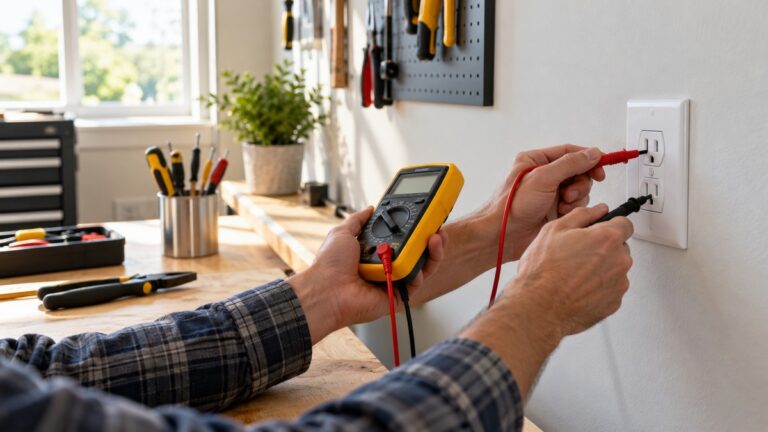
Work on mains circuits can kill. Before you measure anything, check that the meter’s CAT rating suits the circuit you are testing, and read the rating from the listing or the manufacturer’s manual. Panel and service work belongs to a licensed electrician.
This guide covers only the low-voltage DC battery pack on the cart. It does not cover household outlets, breaker panels, or the charger’s connection to the wall. Fluke’s multimeter safety guide explains that CAT-rated meters are designed to reduce the risk of an arc flash inside the meter. The sources opened for this guide do not give a CAT rating for golf cart battery work, so check the rating printed on your own meter. For a plain comparison of meters and dedicated voltage testers, see how voltage testers work.
Lead-acid batteries need their own rules. EnerSys’s maintenance manual says to charge a battery only in a well-ventilated area, with the cover or compartment raised. It says every battery gives off hydrogen and oxygen during recharge, so smoke, open flames, and sparks should stay away from the battery. It also asks you to remove all jewelry before you work on a battery. If acid reaches your eyes, flush them with clean water for at least 15 minutes and get medical attention.
What you need
- A digital multimeter with a DC voltage range high enough for the whole pack. Check the meter’s manual for its range.
- Safety glasses and acid-resistant gloves. Hartville Golf Carts advises gloves along with eyewear.
- A terminal brush and a baking soda and water mix for corroded posts. c2vehicles suggests this mix for cleaning the tops of the cells.
- A notebook to record each reading in order.
Step 1: Charge the pack fully
A resting-voltage check only means something on a fully charged battery. Charge the pack with the cart’s own charger and wait for the charge cycle to finish. c2vehicles says to unplug the charger and put the cart in tow mode before you work on the batteries.
Then let the pack rest. The sources do not agree on how long. Trojan’s FAQ says at least one hour, so the voltage can stabilize. Canyon Lake Mobile recommends at least four hours. c2vehicles, Lithium Rhino, and Hydrocell say six to eight hours. Where the sources differ, the battery maker’s manual decides, and a longer rest is the safer choice when you can wait.
A battery fresh off the charger carries a surface charge. Hawkeev says this can add 0.1 to 0.3 V to each battery’s reading, enough to hide a weak unit.
Step 2: Set the meter and clean the posts
Turn the dial to DC volts. If DC settings are new to you, see our guide to using a voltmeter. Golf Cart Tire Supply says to touch the red probe to the positive terminal and the black probe to the negative terminal of the same battery. c2vehicles says to check the terminals for white or green crust and scrub it off before you test. Batteryskills warns against touching both terminals at once, because that can cause a short circuit.
Step 3: Read each battery one at a time
Golf Cart Tire Supply, Mentor Golf Carts, and Hawkeev all say to read every battery in the pack, not only the pack total. Write each reading down in the order the batteries sit in the cart.
Hawkeev gives about 6.3 to 6.4 V for a fully charged 6V battery, about 8.4 to 8.5 V for an 8V battery, and about 12.6 to 12.7 V for a 12V battery. Golf Cart Tire Supply gives a slightly wider 8V band of 8.4 to 8.6 V. Canyon Lake Mobile gives 8.40 to 8.52 V for an 8V battery. Copow Battery’s state-of-charge chart is below, and its figures are the same type of resting value.
| State of charge | 6V battery | 8V battery | 12V battery | 36V system | 48V system |
|---|---|---|---|---|---|
| 100% | 6.37 V | 8.49 V | 12.73 V | 38.2 V | 50.9 V |
| 75% | 6.25 V | 8.33 V | 12.50 V | 37.5 V | 50.0 V |
| 50% | 6.12 V | 8.16 V | 12.24 V | 36.7 V | 49.0 V |
| 25% | 5.98 V | 7.97 V | 11.96 V | 35.9 V | 47.8 V |
| 0% | 5.75 V | 7.67 V | 11.51 V | 34.5 V | 46.0 V |
Source: Copow Battery, “How to Test Golf Cart Batteries” (opened 2026-10-21). The chart does not say which row matches a given model, so use the battery maker’s figures if they differ.
For the whole pack, Copow says to measure from the first battery’s positive terminal to the last battery’s negative terminal. Golf Cart Tire Supply gives about 36 to 40 V for a 36V pack and about 48 to 52 V for a 48V pack.
Step 4: Compare the batteries with each other
In a healthy pack the batteries sit close together. The sources do not agree on the gap that counts as a fault, so the table shows each threshold with its source.
| Source | Threshold given | Context |
|---|---|---|
| Trojan Battery FAQ | Spread above 0.15 V for a 6V battery, or 0.22 V for a 12V battery | Fully charged, one hour rest |
| Hawkeev | Within about 0.2 V of each other; a volt or more low is the prime suspect | Rested, fully charged pack |
| Lithium Rhino | More than 0.3 V below its neighbors is failing | Rested pack |
| Okmotech | 0.5 to 1.0 V lower than the others is likely bad | Rested pack |
| Copow Battery | 0.5 V or more lower than the others usually indicates a failing battery | Individual reading |
| c2vehicles | A gap above 0.5 V often shows a failing cell | Attributed to Leoch Lithium |
A difference near 0.2 V is small by the Hawkeev and Trojan figures. A difference of 0.5 V or more is treated as a fault by every source in the table. The sources do not say what to conclude between those two points. This guide suggests repeating the test after a full charge and a longer rest, then running the load check.
Step 5: Check under load
A resting battery can look fine and still fail under current. Canyon Lake Mobile says a weak battery can rest at the right voltage and then collapse once current is drawn. It also gives a healthy 6V flooded battery at about 6.37 V when full, not dropping below about 5.6 V in a 30-second load test with a load tester. Golf Cart Tire Supply lists a load tester among its tools.
Without a load tester, the sources describe a drive test. Lithium Rhino says to connect the meter across the whole pack or one suspect battery, drive uphill or accelerate hard, and note the drop. Canyon Lake Mobile describes driving under moderate load for 5 minutes, parking, and measuring each battery again within 2 minutes. Hydrocell says a healthy battery should not drop more than 0.5 V under moderate load.
The drop thresholds disagree too. Lithium Rhino says a lead-acid pack that drops more than 3 to 5 V points to a failing cell. Copow says a drop of more than 2 to 3 V shows declining storage capacity. Use the drive test to compare batteries with each other. The battery that drops much more than its neighbors is the one to check first.
Reading the results
- All batteries near the table values and close to each other: the resting check looks healthy. c2vehicles says regular testing helps catch small issues early.
- One battery a clear step below the rest: that battery is the first suspect. Okmotech says it is likely bad and draining the pack.
- Every battery low by about the same amount: the pack may be discharged rather than damaged. Charge it fully, rest it, and test again.
- Good resting readings but a large drop under load: treat it as a failing battery, and check the battery maker’s guidance before you replace it.
Common mistakes
- Reading a battery right after charging. The surface charge can hide a weak battery.
- Reading a battery right after driving. Hawkeev says a battery fresh off a drive reads low.
- Checking only the pack total. Okmotech warns that one low battery can drain the whole pack.
- Testing while the cart is charging. c2vehicles says to unplug the charger first.
- Mixing up battery types. The sources give separate values for 6V, 8V, and 12V batteries.
Frequently asked questions
Is a multimeter enough to test a golf cart battery?
A multimeter gives a resting voltage for each battery and for the pack, and it can show a weak battery by comparison. The sources also say a resting reading can look fine when a battery fails under load, so a load check gives a fuller picture.
Is a hydrometer a better check?
Trojan’s FAQ says the state of charge of a flooded lead-acid battery is most accurately determined by measuring the specific gravity of the electrolyte with a hydrometer. Trojan gives a reading of 1.277 or greater as full charge for most of its batteries, at 80 degrees F. c2vehicles says a multimeter and a hydrometer are plenty for a basic check. This guide uses the multimeter because the question asks about it, and the sources treat the hydrometer as a separate check.
What reading should a fully charged 6V battery show?
About 6.3 to 6.4 V after a rest, according to Hawkeev. Copow’s chart lists 6.37 V at 100 percent charge.
How far apart can two batteries in one pack read?
The sources do not agree. Trojan gives 0.15 V for a 6V battery, Hawkeev says about 0.2 V, and Copow and Okmotech treat 0.5 V or more as a sign of a failing battery. The sources do not say what to conclude between 0.2 and 0.5 V.
Does this method work on a lithium golf cart battery?
No. This guide covers lead-acid batteries only. Lithium Rhino says lithium voltage stays nearly flat under load, and a sudden drop to 0 V can mean the battery management system has tripped. Check the pack’s own manual for its readings.
What protection should I wear?
EnerSys says to wear a face shield and acid-resistant gloves when handling sulfuric acid. c2vehicles recommends goggles and thick gloves. Wear them for every step that touches the posts or any leaking acid.
How we chose
The steps follow what the opened golf cart sources describe, with the car-battery guide used only where the golf cart sources are silent. The resting-value chart comes from one source so its figures are consistent with each other. The threshold tables list each figure with its source so the disagreements stay visible. The safety section comes first because the EnerSys manual names charging, ventilation, and acid contact as the main risks.
What we could not verify
The sources we opened do not cover the following points, so this guide does not state them as facts:
- A single rest time or a single gap threshold. The sources give the figures shown in the tables above, and they differ.
- A single load-drop threshold. Lithium Rhino gives 3 to 5 V, Copow gives 2 to 3 V, and Hydrocell gives 0.5 V under moderate load.
- Resting values from a battery maker for a specific 8V model. The sources give retailer ranges and one chart, not a datasheet.
- The CAT or voltage rating a meter needs for golf cart pack work. The listing does not state one, and the sources do not give one.
- A full procedure for lithium golf cart packs.
- The official service manual for a specific golf cart model. The battery maker’s manual for your pack is the authority.
Sources
- Golf Cart Tire Supply, How to Test Golf Cart Batteries: https://www.golfcarttiresupply.com/how-to-test-golf-cart-batteries/ (opened 2026-10-21)
- c2vehicles, How to Test Golf Cart Batteries: https://c2vehicles.com/blogs/news/how-to-test-golf-cart-batteries (opened 2026-10-21)
- Trojan Battery, FAQs: https://www.trojanbattery.com/faqs/ (opened 2026-10-21)
- Lithium Rhino, How to Test Golf Cart Batteries: https://lithiumrhino.com/blogs/news/how-to-test-golf-cart-batteries (opened 2026-10-21)
- Canyon Lake Mobile, How to Test a Golf Cart Battery (2026 Guide): https://canyonlakemobile.com/blogs/news/how-to-test-a-golf-cart-battery-2026-guide-voltage-load-test-hydrometer-soc (opened 2026-10-21)
- Hawkeev, Golf cart battery voltage chart and multimeter test: https://www.hawkeev.com/us/repairs/guides/batteries-and-charging/golf-cart-battery-voltage-chart (opened 2026-10-21)
- Mentor Golf Carts and Trailers, How To Test Golf Cart Batteries: https://www.mentorgolfcartsandtrailers.com/how-to-test-golf-cart-batteries/ (opened 2026-10-21)
- Okmotech, How to Test Golf Cart Batteries: https://okmotech.com/blogs/news/how-to-test-golf-cart-batteries (opened 2026-10-21)
- Copow Battery, How to Test Golf Cart Batteries: https://www.copowbattery.com/news/how-to-test-golf-cart-batteries-85344155.html (opened 2026-10-21)
- Hydrocell, How to Test Golf Cart Battery: Complete Step-by-Step Guide 2026: https://www.hydrocellenergy.com/news/how-to-test-golf-cart-battery/ (opened 2026-10-21)
- Hartville Golf Carts, How To Test Golf Cart Batteries: https://hartvillegolfcarts.com/how-to-test-golf-cart-batteries/ (opened 2026-10-21)
- EnerSys, Iron Clad maintenance manual: https://www.enersys.com/49eba1/globalassets/documents/product-documentation/ironclad/amer/amer-en-om-iron-lh-0625.pdf (opened 2026-10-21)
- Batteryskills, How to test your car battery with a multimeter: https://www.batteryskills.com/how-to-test-your-car-battery-with-a-multimeter/ (opened 2026-10-21)
- Fluke, Multimeter safety guide: https://fluke.com/en-us/learn/blog/safety/multimeter-guide (opened 2026-10-21)