How to Test a Blown Fuse on a Car
As an Amazon Associate we earn from qualifying purchases.
How to test a blown fuse on a car: switch the ignition off, pull the fuse, and check it with the multimeter on continuity or ohms. A beep, or a reading close to 0 ohms, means the fuse is intact. No beep, or an OL reading, means it is blown. For a fuse still in the car, the sources describe a voltage check with the ignition on instead. This guide stays with low-voltage automotive circuits and does not cover airbag or high-voltage hybrid and EV systems.
Electrical safety first
Work on mains circuits can kill. Before you measure anything, check that the meter’s CAT rating suits the circuit you are testing, and read the rating from the listing or the manufacturer’s manual. Panel and service work belongs to a licensed electrician. Read the rating before you start and keep the meter in the right mode.
The sources give three rules that matter most for a car. First, disconnect the battery or isolate the circuit before a continuity test. Fluke says to “disconnect battery power or isolate the circuit before testing for continuity.” Second, never connect a meter in continuity or resistance mode to an energized circuit. Third, do not test continuity on a live fuse. This guide names no meter and no listing, so it gives no CAT rating. Read the rating for your own meter from its label or manual.
Quick answer
- Pull the fuse, probe both ends, and read the meter: a beep or near-zero ohms is a good fuse.
- No beep, or OL, marks a blown fuse.
- With the fuse still installed, an ignition-on DC volts check compares each side of the fuse to ground.
- Replace a blown fuse with one of the same amperage, never a higher rating.
Preparation
Find the fuse box first. Many vehicles have two fuse boxes: one under the hood and the other under the dash. The lid of each fuse box usually has a chart that shows what each fuse protects and how many amps it is. Owner’s manuals list the fuse panels and their labels. Motorist.org says to “consult the owner’s manual for the location and type of the blown fuse.” Hyundai’s manual says that “inside the fuse panel cover, you can find the fuse/relay label describing fuse/relay names and ratings,” and it adds that “not all fuse panel descriptions in this manual may be applicable to your vehicle.” Kia’s manual says the label sits inside the fuse/relay panel covers. Read the label on your own car, not a generic chart.
Gather a fuse puller or a pair of needle-nose pliers. Motorist.org says to “use a fuse puller or pliers to remove the blown fuse.” Dummies notes that if you are lucky, the automaker has provided a puller right in the fuse box.
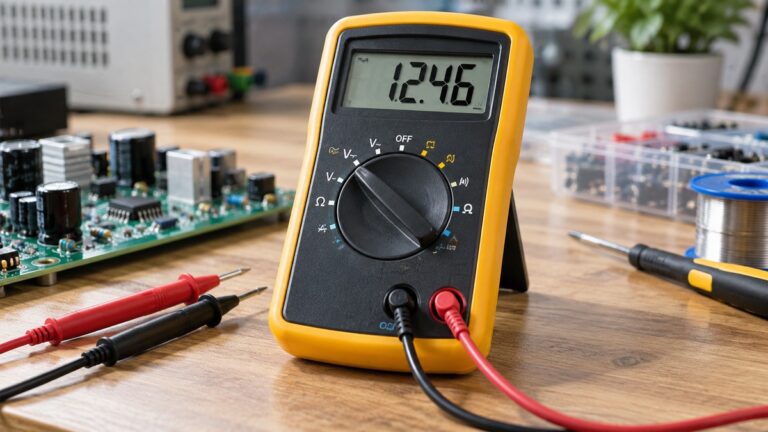
Set the meter to continuity or ohms. Before you test the fuse, touch the two probes together. Fluke says the meter should emit a beep in continuity mode, which shows it is working. Cloudspress makes the same point in its advice to prove the meter on a known source before testing. If the continuity setting is new to you, read the continuity tester basics first.
Step-by-step test
Step 1: Switch the ignition off. Dummies advises that “before you open or work on a fuse box, be sure that your vehicle’s ignition is turned off.” The YouCanIC guide also says to turn off the vehicle and remove the keys from the ignition before testing.
Step 2: Pull the fuse. Use the fuse puller or pliers and pull the fuse straight out. Fluke’s automotive guide says that if you test a removed component such as a fuse, power disconnection is not required. Its example uses for continuity include “across a fuse,” so the probes go on the two ends once the fuse is out.
Step 3: Check the meter. Touch the probes together in continuity mode. A beep confirms the meter is working.
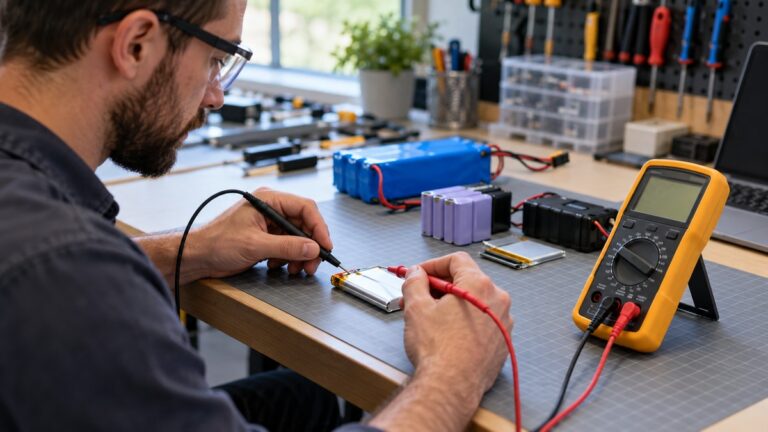
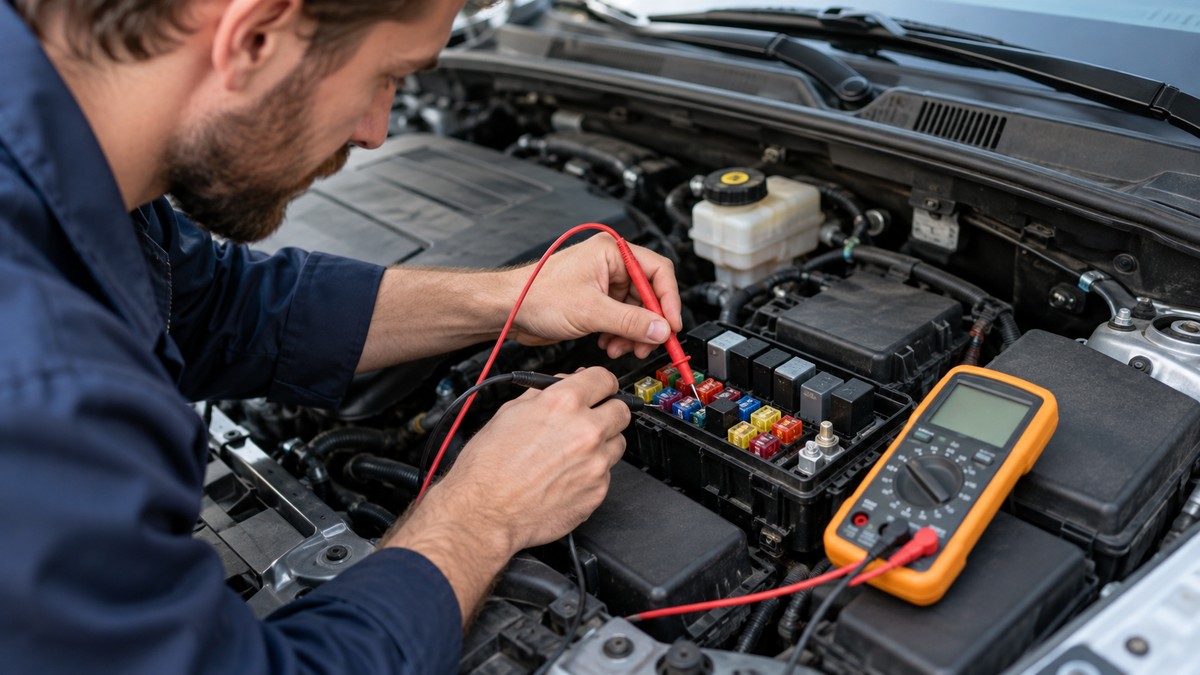
Step 4: Probe both ends. Place one probe on each end of the fuse. Fluke says to “position the multimeter probes on each end of the fuse” and to hold firm contact with the terminals.
Step 5: Read the display. Fluke says that “a beep in continuity mode or a low resistance reading indicates the fuse is good.” Fluke’s automotive guide puts the beep threshold at “typically, resistance below ~25–50 ohms.” If the meter shows OL or 1 with no beep, the fuse is blown, because “an infinite resistance reading (often displayed as ‘OL’ or ‘1’ on digital multimeters) indicates that the fuse is blown.”
Step 6: Look at the fuse. Motorist.org says to check “for any blown fuses by looking for a broken filament or discoloration.” A blown blade fuse can show a broken wire or a darkened, burnt look. Dummies says you can tell by “looking at the filaments visible in its little window.” Visual checks are not final. VIOX adds that some fuses open internally without obvious marks. Fluke says that “sometimes, a fuse can look intact but still be faulty internally.” VIOX says that “visual inspection is useful, but it is not final proof,” and that a ceramic fuse “usually cannot be judged from the outside.” Use the meter result as the decision.
In-circuit voltage check with the ignition on
The Cloudspress guide describes a check that does not remove the fuse. Turn the ignition on or switch on the load, set the meter to DC volts, and touch the probes to the two exposed metal test pads on top of a blade fuse. Measure each pad to ground. The guide says that “battery voltage on both pads when each is measured to ground” means the fuse is likely good. Dannys Engine Portal gives the same first step: turn the ignition switch to the run position and read both sides of the fuse. For the basic voltmeter steps, see the voltmeter how-to.
The Cloudspress guide also explains what to do with the other readings. Voltage on only one pad points to an open fuse or poor fuse-holder contact. No voltage on either pad means the vehicle may be asleep, the load may be off, or power may be missing upstream. The guide adds that voltage on both pads “does not prove the load, wiring, or ground is good.” Keep the meter in volts mode for this check, and do not switch to ohms while the circuit is live.
If you have a test light rather than a meter, YouCanIC describes a simple version of the check. Connect the clip or clamp on the test light to any good ground on the car, usually the metal frame. Touch the probe to both ends of the fuse. “If the test light illuminates on both ends, the fuse is good.” If it lights on only one end, the fuse is blown.
Reading the results
| Reading | What the sources say it means |
|---|---|
| Beep, or near 0 ohms, with the fuse removed | The fuse is intact (Fluke). |
| No beep, or OL, with the fuse removed | The fuse is blown (Fluke, YouCanIC). |
| Battery voltage on both test pads, ignition on | The fuse is likely good, but the load, wiring or ground is not proven (Cloudspress). |
| Voltage on one pad only, ignition on | Open fuse or poor fuse-holder contact (Cloudspress). |
| No voltage on either pad, ignition on | The vehicle may be asleep, the load may be off, or power may be missing upstream (Cloudspress). |
A good fuse does not prove the circuit works. The sources treat a blown fuse as a symptom. VIOX says that “a blown fuse is a symptom, not the root cause,” and that is the main point to keep in mind after a replacement.
Replacing the fuse
Replace the blown fuse with one of the same amperage. Motorist.org says to insert “a new one that matches the amperage rating.” Dummies says “never replace a fuse with one that has different amperage than the original,” and it notes that a fuse with a different rating from the chart may mean someone replaced it wrongly. The new fuse should also match the old one in color and size. Motorist.org says to “insert the new fuse firmly into the slot.”
Do not step up the rating. VIOX answers “can I replace a blown fuse with a higher amp fuse?” with “No.” YouCanIC says to “never use a fuse with a higher rating as this can cause a fire.” If the new fuse blows straight away, do not keep replacing it. VIOX says, “if a replacement fuse blows immediately, do not keep replacing it.” The fault is in the circuit and needs diagnosis. YouCanIC adds that if a fuse blows immediately after being replaced, “this is usually an indication of a more serious electrical problem and professional help should be sought.”
Finish the job
Once the correct fuse is in, Motorist.org says to double-check all connections and secure the fuse box before restoring power to the electrical system. If you disconnected the battery to do the check, reconnect the battery cable to restore power. YouCanIC says to place the fuse box cover back on once you are done testing the fuses. Dummies adds that after you have replaced all of the burned-out fuses, you should test the part that malfunctioned to see whether it operates properly again.
Common mistakes
- Testing a fuse in ohms with the circuit live. Fluke and Cloudspress both say to keep continuity and resistance mode for de-energized circuits.
- Judging a fuse by looks alone. VIOX says a blown ceramic fuse “may look completely normal.”
- Using a higher-rated fuse to stop it blowing. See the replacing section above.
- Trusting the chart on the lid without checking it matches the car. The Hyundai and Kia manuals both say their panel descriptions may not apply to every vehicle.
- Skipping the battery and ignition steps. Fluke’s automotive guide ties continuity checks to disconnecting battery power or isolating the circuit.
How we chose
We kept sources that state a procedure, a reading or a rule for car fuses, and that we could open with curl on 2026-10-21. Fluke pages cover the meter steps. Motorist.org, Dummies and the Hyundai and Kia manuals cover fuse location, amperage and replacement. Cloudspress and Dannys Engine Portal cover the in-circuit voltage check. VIOX and YouCanIC are used for the limits of visual inspection and the test-light method. Retailer product listings were not used for any procedure or safety claim.
What we could not verify
The sources we opened do not give a manufacturer procedure for testing automotive fuses. The Littelfuse page returned HTTP 403, and an Eaton search returned only product listings. The sources do not give a fuse color chart that we could check against a manufacturer document. They do not say how a fuse blown by a short should be located beyond general advice to get professional help after repeated blowing. The listing does not state a CAT rating for any meter, and no source we opened covers hybrid or EV high-voltage systems or airbag circuits. For any of these, use the manufacturer’s manual for your vehicle.
FAQ
Can I test a fuse without taking it out? The voltage check described by Cloudspress works with the fuse in place and the ignition on. The continuity check needs the fuse removed, or the circuit isolated and de-energized, as Cloudspress and Fluke both say.
What does OL mean on the meter? OL, or over limit, means no continuity. Fluke describes it as an infinite resistance reading that means the fuse is blown.
Can a blown fuse be seen? Sometimes. A glass or blade fuse may show a broken wire or darkened glass. A ceramic fuse usually cannot be judged from the outside, according to VIOX.
Where is the fuse box? Many vehicles have one under the hood and another under the dash. The owner’s manual shows the exact location and the fuse label.
What rating should the new fuse be? The same amperage as the blown fuse. Check the lid chart or the label in your owner’s manual.
What if the fuse keeps blowing? VIOX says a blown fuse is a symptom. Repeated blowing points to a fault that needs diagnosis, not a stronger fuse.
Sources
- https://www.fluke.com/en-us/learn/blog/digital-multimeters/how-to-check-fuse-with-multimeter
- https://www.fluke.com/en-us/learn/blog/digital-multimeters/how-to-perform-automotive-continuity-checks-with-a-multimeter
- https://www.fluke.com/en-us/learn/blog/digital-multimeters/how-to-test-for-continuity
- https://motorist.org/how-to-replace-fuses-in-your-car/
- https://www.dummies.com/article/home-auto-hobbies/automotive/car-repair-maintenance/general-car-repair-maintenance/how-to-change-a-vehicles-fuses-196466/
- https://viox.com/how-can-you-tell-if-a-fuse-is-blown/
- https://www.youcanic.com/video/how-to-check-fuses-on-a-car/
- https://ownersmanual.hyundai.com/full_webhelp/DN8/2025/en_AU/id4df25f244f1.html
- https://ownersmanual.kia.com/full_webhelp/SW1K/2026/en_RG/topics/t00767.html
- https://www.cloudspress.com/?p=613575
- https://dannysengineportal.com/automotive-fuses-know-how-they-work-and-why-they-blow/