How to Check a Car Charging System With a Multimeter
As an Amazon Associate we earn from qualifying purchases.
How to check a car charging system with a multimeter comes down to three readings: battery voltage with the engine off, voltage at the battery with the engine running, and AC ripple. Measure the battery first, then measure it again with the engine running and with electrical loads switched on. A healthy system raises the reading at the battery into the low-to-mid 13 V range when the engine runs. Fluke says that above 13.0 V with the engine running indicates charging voltage, and it gives 13.7 to 14.7 V as the normal range for a good alternator. The other sources in this guide give slightly different limits, so read the numbers as a guide, not a pass/fail line.
Quick answer
- Check the battery at rest first. Fluke gives about 12.6 V as fully charged.
- With the engine running, a good alternator should produce about 13.7 to 14.7 V, according to Fluke, Batteryskills and Toolengineers.
- Test under load with the headlights and accessories on. Toolengineers says the voltage should stay above 13 V.
- Check AC ripple at the battery. Fluke’s fault range starts at 0.30 V AC.
Electrical safety first
Work on mains circuits can kill. Before you measure anything, check that the meter’s CAT rating suits the circuit you are testing, and read the rating from the listing or the manufacturer’s manual. Panel and service work belongs to a licensed electrician.
This guide covers only the 12 V automotive circuit at the battery, the alternator output, and the charging wires. It does not cover household outlets, panels, breakers or service wiring. Fluke’s multimeter safety guide explains that CAT-rated meters are designed to reduce the possibility of an arc flash, and it gives a worked example that matches a meter’s category to the place where it will be used. The same guide says that working with electricity always carries a risk and that spikes and arc flashes must be considered.
The listing or manual for your meter should state the CAT rating. If it does not, write that down and do not use the meter for any test that needs one. Do not treat any automotive meter as rated for household mains.
Automotive safety before you start
Keep your hands, leads and clothing clear of the belt, pulleys and cooling fan while the engine runs. Fluke advises safety glasses and says that if the alternator B+ stud is awkward or carries exposed current, you should probe at the battery posts instead, because the two points are electrically equivalent. Do not disconnect the battery while the engine is running. One vendor guide warns that the voltage spike from that test can damage the alternator and sensitive electronics. Do not work on airbag or high-voltage hybrid or EV systems; the sources in this guide do not cover those systems.
How we chose this method
This guide uses three checks that appear in the sources we opened: a resting battery voltage, a running voltage at the battery, and a load check with the headlights and accessories on. We added an AC ripple check because the Fluke ripple article and two other guides describe it as a way to find a bad rectifier diode that a DC reading can miss. We did not include any check that none of the opened sources described. The sources we opened are three Fluke articles, a battery-care guide, and two alternator guides, one from a parts seller and one from a repair site. We gave the most weight to Fluke because its procedures are written for multimeters. The Fluke ripple article is a product article, so its thresholds need to be checked against your vehicle’s service information.
What you need
- A digital multimeter with a DC volts range that covers at least 20 V, and an AC volts setting for the ripple check. Fluke’s ripple article says a true-RMS meter gives accurate AC readings when the waveform is not a pure sine wave, and ripple is one of those waveforms.
- Access to the battery terminals.
- For a quick 12 V check of the battery before you start, see our guide to battery voltage testers. For a simpler lamp-style check of the circuit, see our 12 V tester light guide.
- Safety glasses, and a helper if you need to raise the engine speed while you watch the meter.
If you are choosing a meter for car work, our digital voltage meter for car guide covers the features to compare. The listing does not state a CAT rating for any meter in this guide. Check each listing or manual before you buy or use a meter.
Step 1: check the battery with the engine off
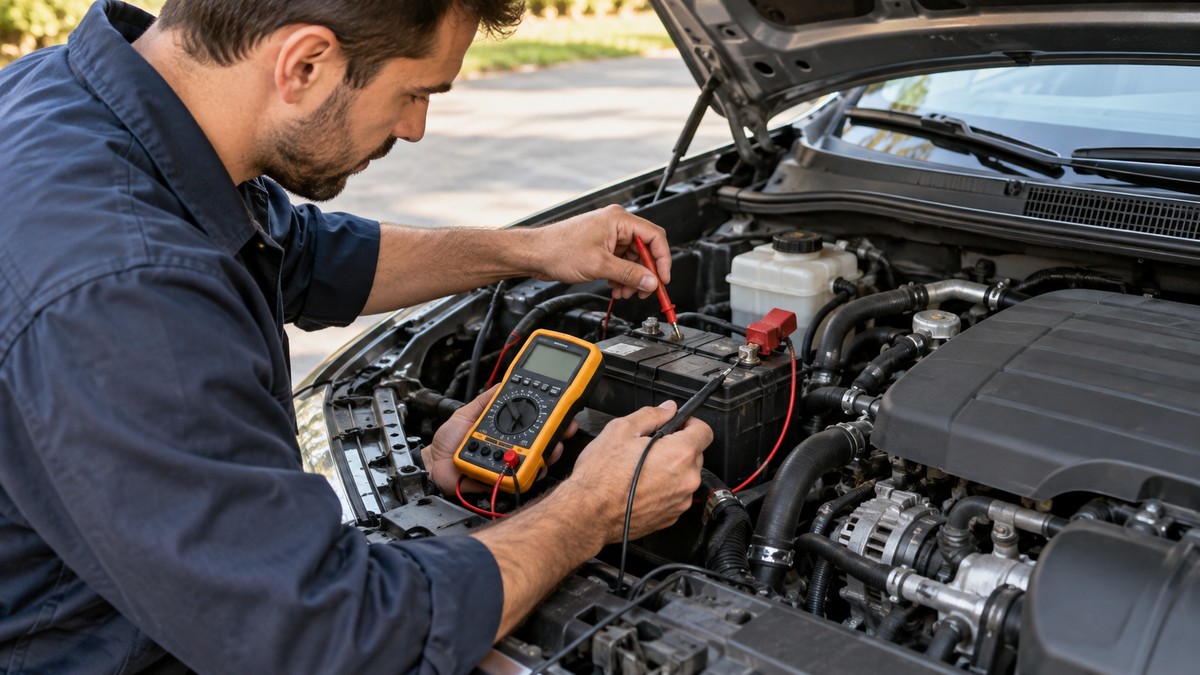
Set the meter to DC volts and touch the red lead to the battery positive post and the black lead to the negative post. Fluke’s battery guide says that if the vehicle was recently running, you should turn on the headlights for about 1 minute and then turn them off before you read the battery. It lists about 12.6 V as fully charged, about 12.4 V as about 75 percent charged, about 12.2 V as about 50 percent charged, and below 12.0 V as likely discharged or weak. Batteryskills gives 12.6 to 12.8 V as fully charged and says that a reading over 12.9 V with the engine off may mean overcharging from an alternator fault.
If the battery is below about 12.2 V, charge it before you judge the alternator. Toolengineers says a very low battery can confuse the results. The Fluke ripple article does not cover the battery check, so this step relies on the battery guide and the other sources named here.
Step 2: read the voltage with the engine running
Start the engine and let it warm up. Fluke’s battery guide says to repeat the test at the terminals, and that a good alternator should produce 13.7 to 14.7 V under normal conditions. Toolengineers gives the same 13.7 to 14.7 V range and says that a reading over 15 V is a warning sign that the regulator may be failing. Batteryskills also gives 13.7 to 14.7 V for a running engine. The js-alternators guide gives 13.5 to 14.8 V and says that a reading below 13.0 V means the alternator is not charging properly. Because the sources disagree on the lower and upper limits, a reading near the edge of a range should be retested or checked by a shop.
If the voltage stays near the engine-off reading, the alternator may not be charging. Toolengineers notes that a loose belt, a bad connection or a blown fuse in the charging circuit can cause the same symptom, so check those before you replace the alternator.
Step 3: raise the engine speed
With the meter still connected, raise the engine speed slowly. Toolengineers suggests about 1,500 to 2,000 RPM and says the reading should stay fairly stable. It adds that a reading that jumps up and down may point to a bad alternator, a slipping belt or poor wiring. Fluke’s ripple article suggests 2,000 to 2,500 RPM for the ripple check, where a healthy alternator may hold ripple steady or let it drop slightly.
Step 4: add electrical load
Turn on the headlights, the blower fan and the rear defroster. Toolengineers says that with several loads on, a healthy system should usually stay above 13 V and recover quickly. It adds that if the voltage falls near battery voltage or below, the alternator may not have enough output. The js-alternators guide describes a similar load test with the air conditioning on maximum and gives the same 13 V limit. Batteryskills and Fluke do not give a load limit, so the 13 V figure rests on the two sources that state it.
Step 5: check AC ripple at the battery
Switch the meter to AC volts and start on the lowest range. Fluke’s ripple article says to turn the rotary switch to V~ and press Range until the 600 mV AC range appears, then step up to 6 V AC if the reading over-ranges. Connect the red lead to the alternator B+ terminal or the battery positive post, and the black lead to the battery negative post or a clean chassis ground. Fluke explains that AC mode blocks the 14 V DC level and shows only the ripple.
Fluke gives 50 mV AC or less as desirable at idle with load, 0.05 to 0.10 V AC as a caution zone, and 0.30 to 0.50 V AC as a fault range that usually indicates at least one bad diode or stator fault. Toolengineers says ripple is often under 0.5 V AC, and that higher readings may suggest diode trouble. The two sources agree that high ripple points to a fault, but their figures are not the same limit, and neither is a service specification for a particular vehicle.
Reading the results
- Engine off, about 12.4 to 12.7 V: the battery is near full charge.
- Engine running, about 13.7 to 14.7 V: the alternator is charging, according to Fluke, Batteryskills and Toolengineers.
- Engine running, near battery voltage: the alternator may not be charging, according to Toolengineers.
- Engine running, above 15 V: the regulator may be overcharging, according to Toolengineers.
- Voltage below 13 V under load: the alternator may be struggling, according to Toolengineers and js-alternators.
- AC ripple of 0.30 to 0.50 V AC or more: a fault range in Fluke’s ripple article.
Common mistakes
- Testing the alternator on a weak battery. Toolengineers says a weak battery can pull the system voltage down and make a good alternator look bad.
- Reading only the idle voltage. Js-alternators says an idle test does not show how the alternator performs under real electrical demand.
- Ignoring the ground side. Fluke’s ripple article says high ripple can come from poor alternator or battery grounds, so check tight, clean ground straps before you replace the alternator.
- Judging a modern vehicle by one number. Toolengineers and js-alternators say some vehicles lower charging voltage on purpose at highway cruise to save fuel, so check the vehicle’s service information.
Frequently asked questions
What voltage should a car alternator produce?
Batteryskills and Fluke give about 13.7 to 14.7 V with the engine running. Js-alternators gives 13.5 to 14.8 V. Read these as general ranges, and use the vehicle’s service information for an exact figure.
Can I test the alternator with the battery disconnected?
Keep the battery connected while the engine is running. Js-alternators says the voltage spike from that test can damage the alternator and electronics. This guide does not describe any other method.
What does a high ripple reading mean?
Fluke’s ripple article says a single open rectifier diode lets AC leak into the system and that stator faults also raise ripple. Toolengineers says a higher reading may suggest diode trouble.
Why does the voltage change with RPM?
Toolengineers says that on most modern cars the voltage regulator controls output, so the reading should stay steady as RPM rises. Fluke says a healthy alternator may hold ripple steady or let it drop slightly at 2,000 to 2,500 RPM.
Does a normal reading prove the alternator is good?
The sources do not say that one reading proves the whole charging system is good. Js-alternators says an alternator can pass an idle test and still fail under load, so the load and ripple checks are needed.
Which meter setting should I use for the ripple check?
Fluke says to use AC volts on the lowest range, such as 600 mV AC, and to step up if the reading over-ranges. Fluke also says a true-RMS meter gives accurate AC readings on a non-sine waveform.
What we could not verify
The sources we opened do not give one charging voltage for every vehicle, and they do not agree on exact limits. The sources we opened do not give an OEM alternator output specification for any make or model. The sources we opened do not state a CAT rating for any meter named here. The sources do not describe how to test smart-charging or start-stop systems in detail. The sources do not cover hybrid or EV charging systems, and this guide does not describe them. The sources we opened do not give a ripple limit from a vehicle manufacturer. The AC ripple thresholds come from one meter manufacturer’s article, so treat them as a guide and check your vehicle’s service information.
Sources
- https://www.fluke.com/en-us/learn/blog/digital-multimeters/how-to-test-a-battery-with-a-multimeter
- https://www.fluke.com/en-us/learn/blog/digital-multimeters/how-to-test-alternator-ripple-voltage-with-a-multimeter
- https://fluke.com/en-us/learn/blog/safety/multimeter-guide
- https://batteryskills.com/how-to-test-your-car-battery-with-a-multimeter/
- https://toolengineers.com/how-to-test-car-alternator-with-multimeter/
- https://js-alternators.com/blogs/blog/how-to-test-alternator