Best 12v Tester Light for Automotive Circuit Checks
As an Amazon Associate we earn from qualifying purchases. Details
A 12v tester light helps you check power, polarity, fuses, bulbs, and wiring in low-voltage vehicle circuits. Some use a simple bulb. Others show a digital voltage reading. This guide helps you decide which style fits your car, truck, SUV, RV, motorcycle, boat, or other listed DC application.
You will compare voltage range, display type, polarity indication, probe design, and lead length. The product specifications come from the listings. Work on mains circuits can kill. These automotive testers do not have a stated CAT rating, so keep them away from household wiring and panels. Panel or service work belongs to a licensed electrician.
Quick answer
For a simple power-or-no-power check, choose the bulb-style pick with a 6-24V DC range and 39 inch lead. Choose the JASTIND pick if reach matters most; its listing states a 3-65V DC range, LCD display, and 140 inch PU spring wire. Choose the AWBLIN pick for listed 12V or 24V vehicle systems and a spring wire that stretches up to 102 inches.
The WINAMOO pick adds an LED digital display, 0.1V resolution, polarity indication, and a 96 inch spring wire. The ATOBLIN pick has the widest listed DC range, up to 120V, with a digital display and a spring wire that stretches up to 96 inches. None has a stated CAT rating. Do not use any of them on household mains.
For related automotive tools, see Best 12v Automotive Tester and Best 12v Tester Probe. Follow the tester and vehicle manuals. Handle batteries carefully, and do not probe airbag wiring or high-voltage hybrid or EV systems.
What matters for a 12v tester light
A 12v tester is a low-voltage DC diagnostic tool, not a general-purpose household voltage tester. For this use, five details affect the buying decision.
Voltage range
The listed DC range must include the circuit you plan to check. A 6-24V tester suits the vehicle systems named in its listing. A 3-48V, 3-60V, or 3-65V tester provides a higher listed upper limit. The ATOBLIN listing states a maximum of 120V DC.
Do not select a wider range as proof that a tester is suitable for every electrical job. These listings describe automotive or low-voltage DC work. They do not establish suitability for AC mains. If a product listing does not state a CAT rating, do not call it safe for household mains.
CAT categories classify live circuits used in measurement and testing. CAT II applies to circuits directly connected to a low-voltage installation, while CAT IV applies to measurements at the source of a high-voltage installation. The required impulse withstand voltage can vary from 500V to 12,000V depending on category and rated voltage. These automotive testers have no stated CAT rating. See Best Voltage Tester for Home Use for a different type of tool.
Bulb or digital display
A bulb tester gives a quick visual indication. The FEAOXYO listing says its bulb brightness varies with measured voltage. That can help with a fast check, but it does not provide a stated voltage number or accuracy specification.
A digital display gives more information at the probe. The WINAMOO listing states 0.1V resolution. The JASTIND listing states .1V resolution and accuracy to ±0.2V. Resolution describes the displayed step size; it does not automatically establish accuracy for every reading.
Choose the bulb style for simple checks. Choose a digital display when comparing readings or looking for a voltage number. For battery condition or charging decisions, use a suitable battery tester and follow its manual.
Polarity indication
Several picks use bidirectional testing. This means the listing says the alligator clip can be connected to either positive or negative ground while the tester indicates polarity.
Polarity indication is useful when checking wiring, grounds, trailer circuits, or reversed connections. The AWBLIN and ATOBLIN listings describe red light indication for positive polarity. The WINAMOO listing describes a bidirectional light-emitting diode. If you only need a basic bulb glow, polarity may be less important.
For more specialized vehicle checks, see Best 12v Power Tester or Best 12v Wire Tester.
Lead length and probe access
Lead length determines how far you can place the clip from the test point. The picks list leads or stretch lengths from 39 inches to 140 inches. A short lead may work well at one fuse box. A longer lead can help when the ground point and test point are far apart.
A sharp probe can reach fuse contacts and tight wiring areas. Several listings specify stainless steel probes. A guard or sleeve protects the point during storage. Do not pierce airbag wiring, high-voltage cables, or sealed harnesses unless the vehicle manual specifically allows the procedure.
Check whether the listed length is relaxed or stretched. A spring wire described as stretching up to a stated length may not provide that distance in every routing position.
Clip, handle, and construction
A large alligator clip helps hold a ground or power connection while you use the probe. An insulated or non-slip handle can make the tool easier to hold, but those descriptions do not replace safe work practices.
The listings describe different bodies and wires. WINAMOO lists a premium ABS body. JASTIND lists a premium acetate fiber body. FEAOXYO lists an insulated handle and PU wire. AWBLIN and ATOBLIN describe a built-in circuit board chip and needle guard. Treat these as listing descriptions, not as permission to test circuits outside the stated use.
1. WINAMOO Automotive Test Light with 3-48V LED Digital Voltage Display, Auto Circuit Tester (Best overall)
Specs from the listing (checked 2026-10-11):
- Brand: WINAMOO
- Power Source: Corded Electric
- Style: Compact
Pros
- Lists Brand as WINAMOO
- States Power Source as Corded Electric
Cons
- No CAT rating is stated, so keep it off household mains; the 96 inch spring wire is also shorter than the JASTIND lead.
Best for: Readers who want an LED digital display with 0.1V resolution and polarity indication on a 3V-48V range.
Skip if: You need a lead longer than 96 inches, a bulb-style indicator, or a stated CAT rating.
View on Amazon (affiliate link)
2. Heavy Duty 3-65V DC Test Light Automotive, 140″ Spring Wire Circuit Tester (Best for long reach)
Specs from the listing (checked 2026-10-11):
- Brand: JASTIND
- Power Source: Battery Powered
- Style: Electronic
Pros
- Lists Brand as JASTIND
- States Power Source as Battery Powered
Cons
- No CAT rating is stated, so it is not for household mains; a sharp probe can also damage insulation if misused.
Best for: Jobs where reach matters most, with a 140 inch PU spring wire, a 3-65V DC range and a blue backlit LCD with 0.2V accuracy.
Skip if: You only want a simple bulb check or need a stated CAT rating.
View on Amazon (affiliate link)
3. AWBLIN Automotive Test Light 3-60V DC Digital LED Circuit Tester (Best compact option)
Specs from the listing (checked 2026-10-11):
- Brand: AWBLIN
- Power Source: Battery Powered
- Style: Circuit Testers
Pros
- Lists Brand as AWBLIN
Cons
- The spring wire stretches up to 102 inches, which may not be reached in every routing position, and no CAT rating is stated.
Best for: Listed 12V or 24V vehicle systems up to 60V, with bidirectional LED indication and a red light for positive polarity.
Skip if: You need more than 102 inches of reach or a stated CAT rating.
View on Amazon (affiliate link)
4. Test Light Automotive, Circuit Tester 6V-12V-24V DC Car Electrical Test Pen with Alligator Clip (Best for simple controls)
Specs from the listing (checked 2026-10-11):
- Brand: FEAOXYO
- Power Source: Battery Powered
- Style: Compact
Pros
- Lists Brand as FEAOXYO
Cons
- The bulb gives no voltage number or accuracy specification, and the PU wire is only 39 inches long.
Best for: Simple power-or-no-power fuse checks on 6-24V DC, where bulb brightness varies with measured voltage.
Skip if: You need a voltage number, a longer lead or a range above 24V.
View on Amazon (affiliate link)
5. Test Light Automotive 3-120V DC LED Digital Circuit Tester with Voltage Display, Auto Bidirectional (Best for flexible setup)
Specs from the listing (checked 2026-10-11):
- Brand: ATOBLIN
- Power Source: Battery Powered
- Style: LED Digital Display
Pros
- Lists Brand as ATOBLIN
Cons
- The spring wire stretches up to 96 inches, and no CAT rating is stated despite the 120V upper limit.
Best for: Readers who want the widest listed DC range, up to 120V, with an LED digital display and bidirectional polarity indication.
Skip if: You need more than 96 inches of reach or a stated CAT rating.
View on Amazon (affiliate link)
How to choose a 12v tester light
Start with the work you actually do. For one vehicle and basic fuse checks, the FEAOXYO bulb tester covers 6-24V DC and gives a direct light indication. It is the most straightforward choice when you do not need a number.
For mixed vehicle work, compare the listed upper limits. AWBLIN explicitly lists vehicles with 12V or 24V electrical systems. WINAMOO lists 3V-48V systems. JASTIND lists 3-65V DC systems. ATOBLIN lists a maximum of 120V DC. Match the range to the manual and the equipment you will test.
Next, decide whether you need polarity. A bidirectional tester can make it easier to distinguish positive and negative connections. That matters more for wiring diagnosis than for a simple fuse check.
Then compare reach. The 140 inch JASTIND lead is the longest listed option. AWBLIN stretches up to 102 inches. WINAMOO and ATOBLIN list 96 inch stretch or spring-wire measurements. FEAOXYO lists a 39 inch PU wire. Compare those figures with the distance between your chosen ground and the farthest test point.
Finally, check the listing for the details that matter to you. Confirm the display type, probe guard, included components, compatible devices, and stated electrical range. If the listing does not state a CAT rating, do not use the tester on mains. If the listing does not state a feature, check the manual rather than assuming it is included.
You may not need a test light if you already own a suitable multimeter. A multimeter can show voltage and may provide continuity or resistance functions. A test light can be faster for repeated live power checks. Neither tool removes the need to follow the vehicle manual.
Comparison of the five picks
| Pick | Listed range | Display or indicator | Lead | Other listed details |
|---|---|---|---|---|
| WINAMOO | 3V-48V systems | LED digital display, 0.1V resolution | 96 inch spring wire | 200 g; 11.1 x 4.2 x 1.4 inches; CE, UL |
| JASTIND | 3-65V DC | LCD blue backlight; .1V resolution; ±0.2V accuracy | 140 inch PU spring wire | 140 g; NIST, UL |
| AWBLIN | Up to 60V; listed for 12V or 24V systems | Bidirectional LED indication | Up to 102 inches | 0.16 kg; Ul, Iec, Ce |
| FEAOXYO | 6-24V DC | Bulb; brightness varies with measured voltage | 39 inch PU wire | Compact style; insulated handle |
| ATOBLIN | Up to 120V DC | LED digital display; bidirectional | Up to 96 inches | 5.91 x 1.18 x 5.91 inches; CE, RoHS |
The table compares only listed features. It does not establish electrical safety for household circuits. None of the five listings states a CAT rating.
Comparing reach and voltage range for a driveway check
Take a driveway check as the scenario; it is not a measurement claim. Assume you need a 110 inch routing path from a battery ground point to a rear-light test point. You also plan to check a 24V circuit later.
First compare the listed lead lengths:
- JASTIND: 140 inches minus 110 inches equals 30 inches of planned slack.
- AWBLIN: 102 inches minus 110 inches equals negative 8 inches, or 8 inches short.
- WINAMOO: 96 inches minus 110 inches equals negative 14 inches, or 14 inches short.
- ATOBLIN: 96 inches minus 110 inches equals negative 14 inches, or 14 inches short.
- FEAOXYO: 39 inches minus 110 inches equals negative 71 inches, or 71 inches short.
Recheck the arithmetic:
- 140 – 110 = 30 inches.
- 102 – 110 = -8 inches.
- 96 – 110 = -14 inches.
- Check the same result in reverse: 110 – 96 = 14 inches short.
- 39 – 110 = -71 inches.
The unit remains inches in each calculation. With a 110 inch route, only the 140 inch listing leaves positive slack.
Now compare a later 24V requirement. FEAOXYO lists 6-24V DC, so 24V minus 24V equals 0V of upper-range margin. JASTIND lists up to 65V, so 65V minus 24V equals 41V. Rechecking gives 65V minus 20V equals 45V, then minus 4V equals 41V.
The choice is clear: choose the longest lead when the ground point is far from the test point. Choose a tester with a higher listed upper limit when future work may exceed the bulb tester’s range. Confirm whether the listed length is stretched before relying on it.
Five common mistakes
Using an automotive tester on mains
Work on mains circuits can kill. These products are described for low-voltage DC automotive circuits, and none has a stated CAT rating. Do not use one on an outlet, breaker panel, service equipment, or household wire. Panel and service work belongs to a licensed electrician.
Ignoring the ground connection
A clip attached to paint, rust, or grease may produce a false no-power result. Use a known-good connection allowed by the vehicle manual. Prove the tester on a known point before diagnosing a fuse or wire.
Piercing sensitive wiring
A sharp probe can damage insulation or contact the wrong circuit. Avoid airbag wiring and high-voltage hybrid or EV cables. Use approved test points and follow the vehicle manual.
Treating a display as exact
A display with 0.1V resolution shows increments, not guaranteed precision. The JASTIND listing states ±0.2V accuracy. Other listings do not state an accuracy figure. Recheck unusual readings with the correct instrument and procedure.
Buying by range alone
A higher maximum does not solve a reach problem. A 120V upper limit does not provide the 140 inch lead listed by JASTIND. Compare range, display, polarity, probe access, and lead length together.
Basic use and safety
Follow the tester’s manual and the vehicle manual. Before connecting, identify the circuit and confirm that the tester is intended for its voltage type and range. Keep the probe away from moving parts, hot surfaces, battery terminals that could cause a short, and wiring you are not meant to test.
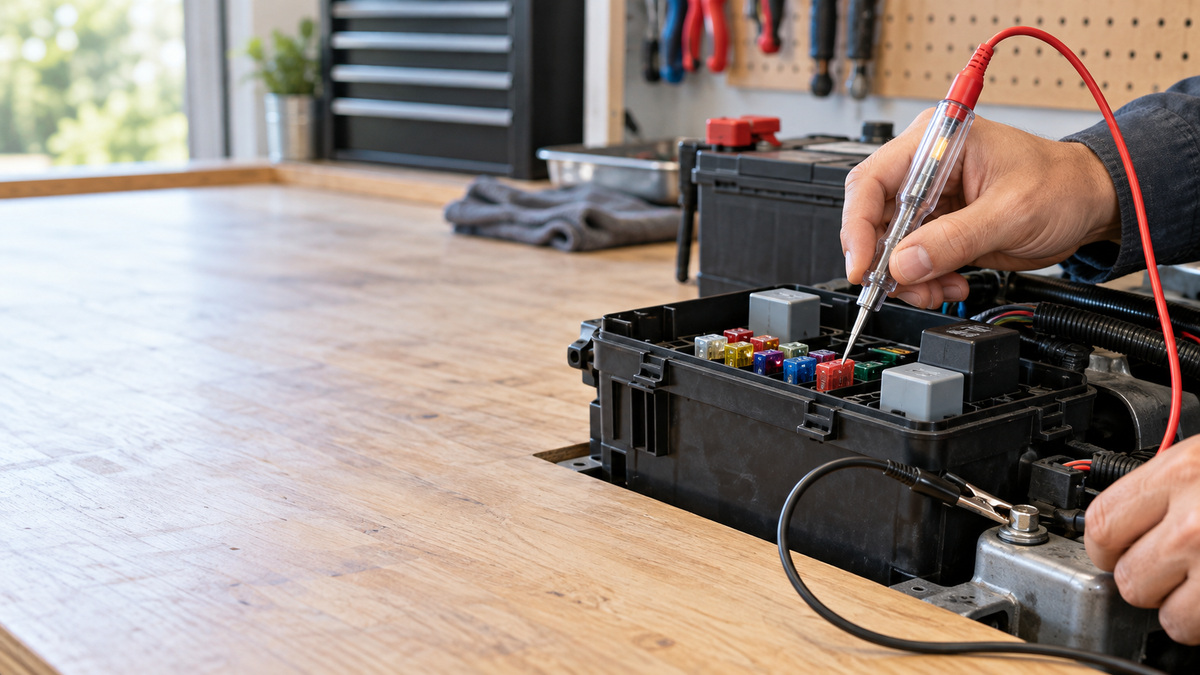
For a typical low-voltage check, connect the alligator clip to an approved known-good reference point. Touch the probe to a known test point to confirm the indicator. Then test the fuse, socket, or wire. On a blade fuse, compare both test points rather than relying on one side.
If the tester stays dark, check the clip connection, circuit switch, probe contact, and tester range. A no-light result can come from a disconnected ground or an unpowered circuit. Do not keep probing randomly when the circuit involves an airbag, hybrid or EV high-voltage system, damaged insulation, smoke, or heat.
For trailer circuits, see Best 7 Way Trailer Light Tester. For fuse work, see Best 12v Fuse Tester. For household electrical work, use a tool specifically designed and rated for that work.
FAQ
What range or circuit limit should I verify before use for 12v tester light?
Check the listed DC range first. The FEAOXYO bulb tester lists 6-24V DC, WINAMOO lists 3V-48V, AWBLIN lists up to 60V for 12V or 24V systems, JASTIND lists 3-65V DC and ATOBLIN lists up to 120V DC. None of the five states a CAT rating, so none is suited to household mains.
Does the tester state a CAT rating for 12v tester light?
No. None of the five listings states a CAT rating, and the WINAMOO listing gives its power source as Corded Electric while the others are battery powered. Treat all five as low-voltage DC automotive testers and keep them away from outlets, panels and household wiring.
Can this tool replace a multimeter for 12v tester light?
Not fully. A test light is faster for repeated live power checks, while a multimeter can show voltage and may add continuity or resistance functions. The WINAMOO is listed as a compact style with a digital voltage display. Follow the vehicle manual either way.
What included parts matter for this electrical check for 12v tester light?
Check the probe, clip and wire. AWBLIN and ATOBLIN describe a built-in circuit board chip and needle guard, FEAOXYO lists an insulated handle and PU wire, and JASTIND lists a 140 inch PU spring wire. Confirm what ships in the box on the product page before ordering.
How do I avoid choosing the wrong detector type for 12v tester light?
Choose a bulb tester such as the FEAOXYO for simple power-or-no-power checks, and a digital display such as the WINAMOO, JASTIND or ATOBLIN when you want a voltage number. Listed weights are 200 g for the WINAMOO and 140 g for the JASTIND.
When should a licensed electrician handle the job for 12v tester light?
Call a licensed electrician for panel work, service equipment or any household wiring. These testers are for low-voltage DC automotive circuits only, and work on mains circuits can kill. Never pierce airbag wiring or work on high-voltage hybrid or EV systems with them.
Bottom line
Choose the FEAOXYO bulb tester for simple 6-24V DC power checks, the JASTIND when you need the 140 inch lead and a 3-65V DC range, and the ATOBLIN when you want a digital display with a range up to 120V DC. The WINAMOO and AWBLIN suit vehicle work with polarity indication. None states a CAT rating, so keep all of them off household mains.
Sources
- Measurement category overview: supports the CAT classification and electrical-safety discussion