How to Use a Clamp Ammeter
As an Amazon Associate we earn from qualifying purchases. Details
Safety first: a clamp ammeter measures current on conductors that may be live at mains voltage. Use a clamp whose listing states a CAT rating that covers the circuit, keep your fingers behind the jaw guard, and never open a panel or service cable to fit the clamp. Most listings in our research file state no CAT rating, so check the product page before you use one on mains. Panel and service work belongs to a licensed electrician.
Someone typing “how to use a clamp ammeter” wants to take a current reading without breaking the circuit, and wants to know how that differs from a multimeter. This guide covers the steps for a reading on one conductor, the one rule that most often gives a wrong number, and what the three clamps in our research file can and cannot do.
Quick answer
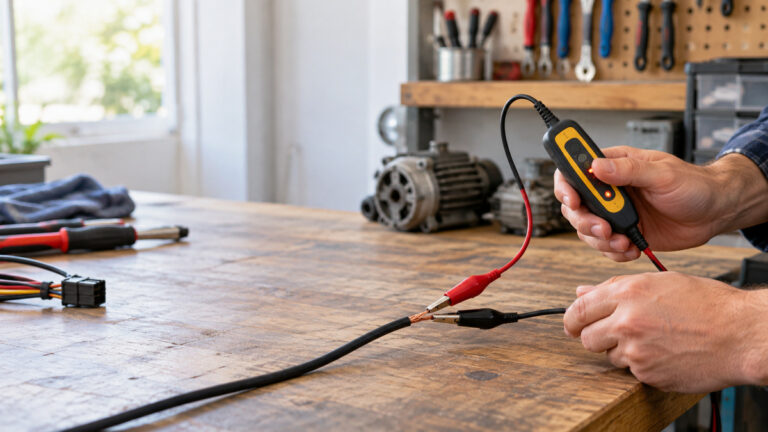
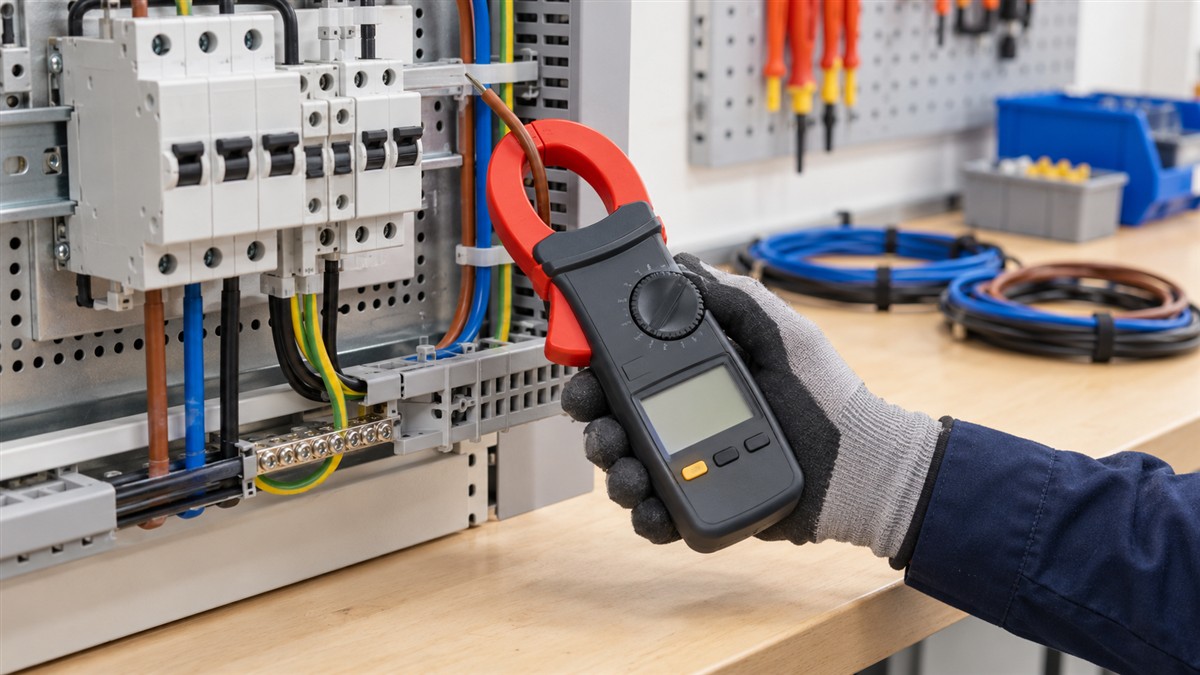
Choose AC or DC current on the meter. Open the jaw, close it around one insulated conductor, and read the display. Close the jaw fully. Clamp only one conductor at a time: Fluke’s clamp guidance says current flowing in opposite directions cancels inside the jaw, so a clamp around both hot and neutral reads close to zero on a balanced load.
What the three clamps in our research can read
All three listings describe current through the jaw, but the details differ. Specifications are from the listings, checked 2026-10-11.
- Klein Tools CL120 (B08CP6GL49): “Measures AC current via clamp” and auto-ranging. The title gives a 400 amp AC range. The listing states “Double Insulation Safety Rating” and gives no CAT rating. Voltage and resistance use the test leads.
- Fieldpiece SC260 (B00KLYJG78): “higher accuracy VAC & AAC readings, True RMS.” The listing does not state a current range or a CAT rating.
- FNIRSI DMC-100 (B0DP2L9CFR): AC/DC current up to 600 amps, with True RMS. The listing states “UL 61010-1″ and notes that voltage must be measured with the test leads, because “The clamp jaws are for current measurement only.” It gives no CAT rating.
Step by step: a current reading on one conductor
Step 1: Check the meter
Inspect the jaw and the leads for damage, and check the battery. Confirm the meter’s current range is above the load you expect. The Klein CL120 is auto-ranging, so it picks the range for you. The Fieldpiece listing does not state a current range, so check its manual before you rely on it for a specific load.
Step 2: Select the function
Set the meter to AC current, usually marked A with a tilde. Use DC current only on a meter whose listing says it reads DC through the jaw. The FNIRSI listing states AC/DC current; the Klein listing describes AC current through the clamp.
Step 3: Isolate one conductor
Clamp around one insulated conductor. Do not put both the hot and neutral of a cord in the jaw at once. Close the jaw fully, because a partly closed jaw can give a low or unstable reading.
Step 4: Read the display
Read the current. The Klein CL120 listing describes a data hold function, so you can hold the reading and remove the clamp. The FNIRSI listing describes real-time curve recording, which is a different feature from data hold.
Step 5: Remove the jaw
Open the jaw, lift the clamp off the conductor, and store the meter with the jaw closed.
The one-conductor rule, and why it matters
Fluke’s clamp guidance says current in opposite directions cancels inside the jaw, and tells the user to place just one conductor within the clamp when current moves in opposite directions. On a balanced load, the current in the hot and neutral of a cord is equal and opposite, so a clamp around both reads near zero. That is a wrong number for the load. A near-zero reading on a cord you know is loaded means the clamp is probably around both wires.
A third-party electrical reference, Electrical A2Z, gives the same method and adds one point: when nearby conductors may affect the reading, take several readings at different points along the conductor. That is competitor-reported, not a manufacturer statement.
What a clamp ammeter cannot do
A clamp reads current through its jaw, not voltage. The Klein and FNIRSI listings both say voltage needs the test leads, so use a meter with a stated CAT rating for any voltage check. A clamp reads only what passes through the jaw, so a conductor outside the jaw is not included in the reading.
Three clamp meters we compared
At a glance: the 3 clamp meters, by their own spec fields
| Pick | Current type / range | CAT rating | Flag |
|---|---|---|---|
| Klein Tools CL120 (basic auto-ranging AC clamp) | AC only, 400 amps (title) | Test leads have CAT III/CAT IV safety caps; the meter itself has no stated CAT rating | Clamp reads AC current only — confirm before a DC job |
| Fieldpiece SC260 (True RMS with magnet) | Not stated — no current range given | Not stated | Confirm both current range and CAT rating before use |
| FNIRSI DMC-100 (AC/DC with recording) | AC/DC, up to 600 amps, 9999 counts | Not stated (lists UL 61010-1 and CE only) | Voltage needs test leads; no CAT rating for mains |
Specs are from each product’s Amazon listing, checked 2026-10-11. None of the three states a meter-level CAT rating — confirm before using any of them for panel or mains work.
1. Klein Tools CL120: best for a basic auto-ranging AC clamp
Specs (from the listing, checked 2026-10-11): auto-ranging; 400 amps AC (title); AC current through the clamp; AC/DC voltage, resistance and continuity through the test leads; non-contact voltage detection in the jaw; backlit LCD; data hold; auto power-off after 10 minutes; test leads with CAT III/CAT IV safety caps. The meter’s own listing gives no CAT rating.
Pros: one meter for current, non-contact voltage and basic resistance. Cons: the listing describes AC current through the clamp, so check the product page before a DC job; no CAT rating for the meter.
Best for: an electrician or DIYer who wants an auto-ranging AC clamp. Skip if: you need a meter-level CAT rating for panel work.
View on Amazon (affiliate link)
2. Fieldpiece SC260: best for a True RMS clamp with a magnet
Specs (from the listing, checked 2026-10-11): True RMS; AC volts and amps readings; non-contact voltage and amperage readings; temperature; capacitance; backlight; swivel magnet for hands-free use. The listing states no current range and no CAT rating.
Pros: True RMS; swivel magnet for hands-free readings. Cons: no current range or CAT rating in the listing, so confirm both before use.
Best for: HVAC and refrigeration technicians. Skip if: you need a stated current range or CAT rating before you buy.
View on Amazon (affiliate link)
3. FNIRSI DMC-100: best for AC and DC current with recording
Specs (from the listing, checked 2026-10-11): 9999 counts; True RMS; AC/DC current up to 600 amps; 2-inch TFT display; real-time curve recording; rechargeable 1500 mAh battery with Type-C charging. The listing states “UL 61010-1″ and CE, and no CAT rating.
Pros: AC and DC current through the jaw; recording for intermittent faults. Cons: voltage needs the test leads; no CAT rating in the listing.
Best for: automotive and home troubleshooting that needs DC current through the jaw. Skip if: you need a stated CAT rating for mains.
View on Amazon (affiliate link)
Mistakes to avoid
- Clamping both hot and neutral. On a balanced load the reading is near zero, which is wrong for the current you want.
- Clamping bare conductors. Clamp only insulated wire, and keep the jaw off exposed metal.
- Reading voltage through the jaw. Use the test leads for voltage, as the listings say.
- Ignoring the CAT rating. Most listings in our research file do not state one.
Who should skip a clamp ammeter
If you only check outlet voltage, a multimeter with a stated CAT rating is enough. If the circuit is in a panel or service entrance, call a licensed electrician.
Worked example: one conductor, then both
For example, suppose a 120 volt cord carries a 10 amp load on one conductor, and its branch is protected by a 15 amp breaker. Clamping that one conductor on a range that covers 10 amps should show about 10 amps. Now clamp both the hot and neutral together on the same cord. On a balanced load, the two currents cancel and the display reads near zero. The reading did not change the load; the jaw changed what it measured. Clamp one conductor, and the number matches the load you expect.
Sources
The one-conductor rule and the opposing-current statement come from Fluke’s clamp meter resources: Fluke clamp meter resources. The reference to several readings along a conductor comes from Electrical A2Z, a third-party reference: Electrical A2Z: how to use a clamp meter to measure amps.
Related guides
- How does a current clamp work covers how a clamp reads current.
- Amp clamp covers clamp meters for current readings.
- True RMS digital clamp meter covers clamp meters with true RMS readings.
FAQ
Can I clamp both wires of a cord?
Not for a normal current reading. Clamp one conductor at a time, because current in opposite directions cancels in the jaw.
Does a clamp meter need the circuit off?
No. A clamp reads current without breaking the circuit, which is the main reason to use one. Keep your hands and the jaw clear of exposed metal.
Can a clamp read DC?
Only some models. The FNIRSI DMC-100 listing states AC/DC current. The Klein CL120 listing describes AC current through the clamp.
Do these clamps have CAT ratings?
The meter listings in our research file do not state one. The Klein test leads are described with CAT III/CAT IV safety caps. Check the listing before you use a meter on mains.