Best Plug Tester for Outlets and GFCI Checks
As an Amazon Associate we earn from qualifying purchases. Details
A plug tester helps you check a wall outlet for common wiring faults in seconds. You plug it in, read the lights, and see if the outlet shows correct wiring, an open wire, or a reversed connection. This guide helps you decide which plug-in type fits standard outlets, GFCI outlets, home checks, or rental inspections.
Work on mains circuits can kill. Use a plug tester only on outlet faces you can reach safely, follow the instrument manual and local electrical rules, and leave panel or service work to a licensed electrician. The meter CAT rating must suit the circuit you check, so confirm the rating before you buy.
Quick answer
If you want a plug tester for fast outlet checks, start with the type of outlet you have. For standard 3-wire North American AC outlets, a basic socket plug tester with LED codes covers open ground, open neutral, open hot, and reversed wires. For GFCI protection, you need a gfci plug tester with a test button that trips the GFCI device when wiring and grounding are correct.
The Klein Tools RT210 suits GFCI and standard outlets, lists Cat Ii 300v, supports 110/125V AC at 50/60Hz, and survives a 6.6-foot drop. The Fluke ST120+ suits users who want a beeper for breaker finding, lists Cat Iii 300 V, and uses bright LEDs. The Ideal 61-502 suits 120V AC circuits, is cULus certified to UL 1436, and confirms GFCI operation. The Southwire 40022S lists 7 test functions and compact size at 1 x 1.7 x 3.6 inches. The Goldeep ST20 suits readers who want an LCD display with real-time voltage, while the EOHELGRO T0530 and NHIDKU tester suit simple power plug tester checks on 125V AC and 120V outlets. For breaker hunting from one room, choose a beeper model. For rental checks, choose an LCD or hold feature. For simple correct-or-not checks, choose a three-light model.
What matters for a plug tester
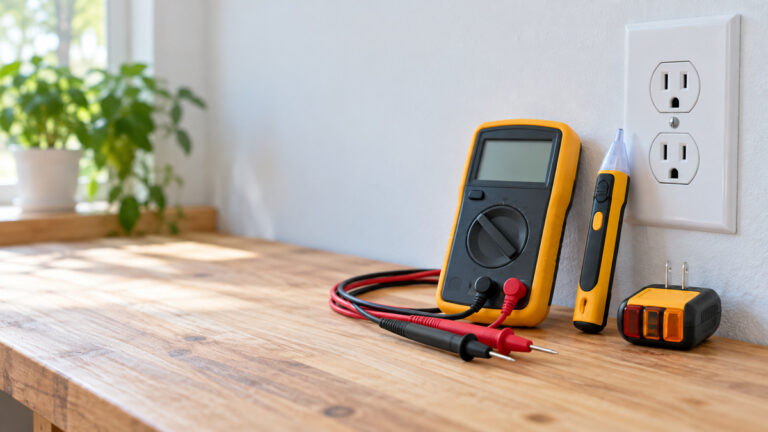
A plug tester is different from a plug in voltage tester or non-contact stick. It must make firm contact with a 3-wire outlet, draw power from the outlet, and translate voltage between slots into a light code. These five points change your choice.
1. Outlet type and voltage
Most picks here fit standard North American AC 3-wire outlets. The Klein plug tester data states 110/125V AC at 50/60Hz in 3-wire outlets. The EOHELGRO data states 125V AC, 50/60Hz, 3-wire outlet. The Goldeep data states North American 3-wire 120V outlets. The Ideal data states 120V AC circuits. The Southwire data states Standard Electrical Outlets, 120V AC. The NHIDKU data states 120V 3-prong US outlets.
Check your outlet before you buy. If you have 2-slot ungrounded outlets, a 3-light ac plug tester cannot give a full reading. If you travel, these picks do not fit other plug shapes. Check the product listing for voltage and outlet shape.
2. GFCI test function
A plug tester gfci model adds a button that creates a small ground fault to trip a GFCI receptacle or breaker. The Klein RT210 listing states it works on GFCI outlets and verifies proper operation of the ground fault protective device. The Fluke ST120+ listing states an integrated GFCI test button to verify correct operation of GFCI equipped outlets. The Ideal 61-502 listing notes the receptacle must be properly grounded for the GFCI test to work properly.
That last point matters. A GFCI test from a plug-in tester needs a ground path. On an ungrounded outlet, the button may not trip the device even if the GFCI itself works. If GFCI checks are your main job, pick a model that names GFCI testing in its style and bullets, and read the light chart first.
3. Display: lights versus LCD
Most power plug tester models use three LEDs. You compare the on-off pattern to a chart on the tester. The EOHELGRO, NHIDKU, Southwire, Klein, Fluke, and Ideal models use this style. It is fast and easy to read in daylight.
The Goldeep ST20 uses a color LCD display plus bottom indicator lights. The listing states green for good, red for faults, plus real-time voltage, plus an auto-hold function that locks data for about 10 seconds after removal. Choose lights if you want simple pass-fail. Choose LCD if you want to note voltage while you walk room to room.
4. Safety rating and build
Measurement category is a method of classification by the International Electrotechnical Commission of live electric circuits used in measurement and testing. The categories take into account total continuous energy and impulse voltages. Category II covers circuits directly connected to the low-voltage installation, while Category IV covers measurements at the source of the high-voltage installation.
For plug testers, read what the listing states and do not assume more. The Klein RT210 lists Cat Ii 300v. The Fluke ST120+ lists Cat Iii 300 V. The EOHELGRO lists ETL, UL. The NHIDKU lists UL. The Ideal lists CSA, UL and cULus Certified to UL 1436. The Southwire lists EN 61010-1. The Goldeep listing does not state a CAT rating. If the listing does not state a CAT rating, do not call the meter safe for household mains beyond a basic outlet face check, and follow the manual.
Build also matters for drops and heat. The Klein RT210 states it withstands a 6.6-foot drop and works from 32-Degree to 140-Degree Fahrenheit. The Goldeep ST20 weighs 2.88 ounces and measures 4.09 x 2.01 x 1.18 inches. The Fluke ST120+ measures 2.28 x 2.9 x 0.98 inches. The Southwire measures 1 x 1.7 x 3.6 inches. Smaller bodies fit tight spots behind furniture.
5. Extra aids: beeper, hold, and grip
A beeper helps when you flip breakers alone. The Fluke ST120+ beeper helps identify if the breaker is switched on or off, so you avoid extra trips. An auto-hold helps when the outlet sits behind a bed. The Goldeep auto-hold locks data for about 10 seconds. A textured grip helps in cold garages. The NHIDKU listing notes textured sides for grip, and the Southwire notes compact carry size.
Pick extras based on your home. Breaker hunting alone favors a beeper. Dark outlets favor bottom lights or bright LEDs. Rental documentation favors LCD plus hold.
Plug tester picks that fit outlet checks
The models below are all plug-in receptacle types for North American 3-wire outlets. Read the light chart before you press any GFCI button.
1. Klein Tools RT210 Outlet Tester, Receptacle Tester for GFCI / Standard North American AC Electrical (Best overall)
Specs from the listing (checked 2026-10-11):
- Specification Met: Cat Ii 300v
- Compatible Devices: Standard and GFCI Receptacles
- Item Weight: 1.9 ounces
- Item Dimensions: 5.3 x 3.8 x 1.5 inches
- Power Source: Hand Powered
Pros
- States GFCI plus standard receptacle coverage
- States 110/125V AC 50/60Hz 3-wire support
- States 6.6-foot drop build and wide temperature range
Cons
- Light codes only, no voltage number display
- No beeper or hold feature stated
Best for: Homeowners checking standard and GFCI outlets
Skip if: You want LCD voltage or audible breaker finding — this lists lights only.
View on Amazon (affiliate link)
2. Fluke ST120+ GFCI Socket Tester with Audible Beeper (Best for breaker finding)
Specs from the listing (checked 2026-10-11):
- Specification Met: Cat Iii 300 V
- Style Name: SOCKET TESTER WITH LEDS, GFCI TEST, BEEPER
- Item Dimensions: 2.28 x 2.9 x 0.98 inches
- Item Weight: 0.07 kg
- Brand: Fluke
Pros
- Beeper helps identify breaker on/off solo
- Bright LEDs for miswired outlets
- Compact body and Cat III 300 V language
Cons
- No numeric voltage readout stated
- Voltage range and drop rating not stated — check listing
Best for: Solo breaker mapping across rooms
Skip if: You need exact volts — this uses LEDs, skip it.
View on Amazon (affiliate link)
3. Outlet Tester, Socket Tester for Standard North American AC Electrical Outlets, Receptacle Tester (Best simple checker)
Specs from the listing (checked 2026-10-11):
- Compatible Devices: Standard North American AC electrical outlets (125V AC, 50/60Hz, 3-wire)
- Specification Met: ETL, UL
- Style Name: Compact
- Power Source: Corded Electric
Pros
- Covers six common wiring faults on chart
- Fast LED pattern reading for 125V AC 3-wire outlets
- Compact style with durable ABS housing for quick plug-in checks
Cons
- No GFCI trip button named
- Size and weight not stated — check listing
Best for: Fast correct-wiring screens
Skip if: GFCI trip testing is the main job — this style is Compact, skip it.
View on Amazon (affiliate link)
4. Southwire GFCI Receptacle Tester – Push-Button Outlet Tester for Fast & Accurate Wiring Checks (Best compact push-button)
Specs from the listing (checked 2026-10-11):
- Compatible Devices: Standard Electrical Outlets, 120V AC
- Item Dimensions: 1 x 1.7 x 3.6 inches
- Item Weight: 1.92 ounces
- Specification Met: EN 61010-1
Pros
- 7 test functions in one tool
- Very compact 1 x 1.7 x 3.6 inch body
- Light 1.92 ounce carry weight
Cons
- No voltage numbers, lights only
- CAT class and temp range not stated — check listing
Best for: Inspectors wanting many modes in small size
Skip if: You want LCD voltage — this has lights only, skip it.
View on Amazon (affiliate link)
5. Outlet Tester with Electrical Receptacle Test,Socket Tester for North American Outlets (Yellow) (Best for grounding screen)
Specs from the listing (checked 2026-10-11):
- Compatible Devices: All devices compatible with North American outlets
- Specification Met: UL
- Style Name: Grounding
- Measurement Type: Ohmmeter
Pros
- Grounding focus before using equipment
- Detects six wiring faults plus ground status
- Textured grip sides and hi-impact housing
Cons
- GFCI trip sequence not detailed — check listing
- Size and weight not stated
Best for: Pre-checks for grounding products on 120V outlets
Skip if: You need timed GFCI trip test — detail not stated, skip it.
View on Amazon (affiliate link)
6. Goldeep GFCI Outlet Tester Plug in,Receptacle Tester Outlet Ground Tester (Best LCD display)
Specs from the listing (checked 2026-10-11):
- Item Highlight: LCD Display, Voltage Test for AC 120V, gfci circuit tester, Automatic shutdown, for home user、electricians、rental room check
- Item Dimensions: 4.09 x 2.01 x 1.18 inches
- Item Weight: 2.88 ounces
- Included Components: GFCI Outlet Tester*1、battery*2、User Manual*1
Pros
- Color LCD with real-time voltage
- Auto-hold locks data about 10 seconds
- Auto shutdown after about 3 minutes idle
Cons
- No CAT rating stated — outlet-face use only per manual
- Battery-powered design ships with 2 batteries that must be installed and replaced for field use
Best for: Rentals and notes needing voltage plus fault color
Skip if: You want a rated no-battery tool — this needs batteries, skip it.
View on Amazon (affiliate link)
7. Ideal Electrical 61-502 120V AC GFCI Receptacle Tester (Best certified pick)
Specs from the listing (checked 2026-10-11):
- Specification Met: CSA, UL
- Brand: Ideal Industries
- Model: 61-502
- Item Dimensions: 5.55 x 3.27 x 1.42 inches
Pros
- States cULus UL 1436 certification
- Detects common receptacle wiring problems and confirms GFCI protective device operation on 120V AC circuits
- States 2 year warranty
Cons
- Needs proper ground for GFCI test to work
- No voltage display or beeper stated
Best for: Buyers who value stated certification
Skip if: You want voltage numbers or sound — this lists lights only, skip it.
View on Amazon (affiliate link)
Klein Tools RT210 — GFCI outlet tester with wide voltage support
This Klein plug tester fits standard and GFCI receptacles. The listing names GFCI Testing as the style and states compatibility with standard and GFCI receptacles. It is designed for 110/125V AC at 50/60Hz in 3-wire outlets, which covers common home outlets.
You get three practical specifics. It detects common wiring problems in standard and GFCI receptacles. It verifies proper operation of the ground fault protective device. It is built to withstand a 6.6-foot drop and work from 32-Degree to 140-Degree Fahrenheit. Item weight is 1.9 ounces, and item dimensions are 5.3 x 3.8 x 1.5 inches. Specification met is Cat Ii 300v.
The limit is display style. It uses lights, not voltage numbers, so you will not see exact volts. The listing does not state a beeper or hold feature. Skip it if you want an LCD voltage readout or an audible breaker aid. Choose it if you want a Klein GFCI receptacle tester for home and workplace outlet checks.
Fluke ST120+ — socket tester with beeper for breaker checks
This Fluke plug in tester fits users who test many outlets alone. The style name is SOCKET TESTER WITH LEDS, GFCI TEST, BEEPER, and the bullets list an integrated GFCI test button plus bright LEDs for miswired outlets.
Three specifics stand out. The beeper helps identify if the breaker is switched on or off without walking back and forth. The LEDs give fast identification of miswired outlets. The body is compact at 2.28 x 2.9 x 0.98 inches, with item weight of 0.07 kg. Specification met is Cat Iii 300 V.
The limit is detail. The listing does not state exact voltage range or drop rating in the data given, so check the product listing before use on older wiring. It also uses LEDs, not a voltage number display. Skip it if you need a numeric voltage readout. Choose it if you want a socket tester Fluke style tool with sound for breaker work. It also fits readers comparing a Fluke power tester for outlet faces.
EOHELGRO T0530 — compact AC outlet tester for wiring patterns
This ac plug tester fits standard North American AC electrical outlets. The title states Socket Tester for Standard North American AC Electrical Outlets, and compatible devices are Standard North American AC electrical outlets in 125V AC, 50/60Hz, 3-wire form.
Three specifics help beginners. It detects open ground, open neutral, open hot, hot/ground reverse, hot/neutral reverse, and correct wiring. You plug the 3-wire receptacle tester into the outlet and note the light pattern. LED indicators allow quick checks of standard 3-wire sockets. Specification met is ETL, UL, and housing is durable ABS.
The limit is GFCI scope. The style is Compact, not GFCI Testing, and the bullets do not promise a GFCI trip button. The listing does not state item weight or dimensions in the data given. Skip it if GFCI trip testing is your main need. Choose it if you want a simple socket plug tester for correct-wiring checks.
Southwire 40022S — push-button tester with 7 test functions
This model fits home inspectors and renovators who want many checks in one small tool. The title states GFCI Receptacle Tester with 7 Test Functions, and compatible devices are Standard Electrical Outlets, 120V AC.
Three specifics matter. It offers 7 test modes through a push-button design. Item dimensions are 1 x 1.7 x 3.6 inches, so it packs in a tool pouch. Item weight is 1.92 ounces. Specification met is EN 61010-1.
The limit is chart dependence. Like other light testers, it cannot measure exact voltage, and the data given do not include a CAT class or temperature range, so check the product listing and manual. Skip it if you want an LCD voltage number. Choose it if you want a compact power socket tester with multiple wiring checks. It also fits readers comparing a GFCI socket tester for 120V outlets.
NHIDKU Outlet Tester — grounding check tester for 120V outlets
This tester fits users of grounding products who first want to confirm ground presence. The bullets state it can detect whether the socket is grounded before using grounding products, and it provides measurement for 120V 3-prong US outlets.
Three specifics stand out. It detects ground fault interruption, open ground, open neutral, open hot, hot/ground reverse, hot/neutral reverse, and correct wiring. It uses easy-to-read outlet checker indicators. Housing is hi-impact resistant with textured sides for grip. Specification met is UL.
The limit is GFCI detail. The style is Grounding, and the bullets do not describe a GFCI trip button sequence, so check the product listing if you need timed GFCI trip testing. Skip it if you need a GFCI trip button and voltage display. Choose it if you want a simple grounding-focused outlet check before you connect equipment.
Goldeep ST20 — LCD plug tester with voltage and auto-hold
This plug tester gfci option fits users who want numbers, not just lights. The item highlight states LCD Display, Voltage Test for AC 120V, gfci circuit tester, Automatic shutdown, for home user and electricians. Included components are tester, 2 batteries, and user manual.
Three specifics help documentation. The color LCD shows green for good and red for faults plus real-time voltage. Bottom indicator lights help in dark or tight spaces. Auto-hold locks data for about 10 seconds after removal, and auto shutdown occurs after about 3 minutes when idle. Item weight is 2.88 ounces, and dimensions are 4.09 x 2.01 x 1.18 inches. The GFCI function generates 6mA~9mA leakage current to trip the breaker within about 3 seconds on a correctly wired line.
The limit is rating clarity. The listing does not state a CAT rating, so do not treat it as rated for beyond outlet-face use, and follow the manual. It also needs batteries. Skip it if you want a no-battery light-only tool. Choose it if you want voltage plus fault color on one screen.
Ideal 61-502 — certified GFCI receptacle tester for 120V AC
This model fits careful buyers who value certification language. The bullets state cULus Certified to UL 1436 and CSA C22.2 no 160 for 120V AC circuits. It detects common wiring problems and confirms operation of GFCI protective devices.
Three specifics matter. Certification is stated as cULus Certified, not just a generic mark. Item dimensions are 5.55 x 3.27 x 1.42 inches. Warranty is 2 year warranty per the bullets. Specification met is CSA, UL.
The limit is ground dependence. The listing notes the receptacle must be properly grounded for the GFCI test to work properly. It uses lights, not a voltage display, and the data given do not state weight or a beeper. Skip it if you want voltage numbers or sound. Choose it if you want an Ideal GFCI tester with stated certification for 120V home circuits. It pairs well with reading about outlet and GFCI tester choices.
How to choose a plug tester for your home
Start with outlet count and age. Newer homes often have grounded 3-wire outlets plus GFCI protection in kitchens, baths, garages, and outdoors. Older homes may mix grounded and ungrounded outlets. A plug tester only gives full meaning on grounded 3-wire outlets. If many outlets lack a ground hole, fix that wiring question with an electrician first.
Then match features to tasks. For move-in checks, a basic three-light tester plus a lamp is enough. Plug in, note the code, then plug a lamp into the same outlet to confirm power. For GFCI checks, press the test button only after the lights show correct wiring and grounding. If the GFCI does not trip, stop and check the product listing and manual. Do not open the outlet.
For breaker mapping, a beeper saves steps. Plug the beeper model into a distant outlet, go to the panel, and flip one breaker at a time. Have a second person stay near the outlet if possible. Never remove a panel cover. Panel or service work belongs to a licensed electrician.
For rentals or inspections, an LCD with hold helps notes. Record room, outlet position, light code or voltage, and GFCI result. Photos of the tester face help, but do not touch conductors. If you see burn marks, buzzing, heat, or loose faces, stop testing and call an electrician.
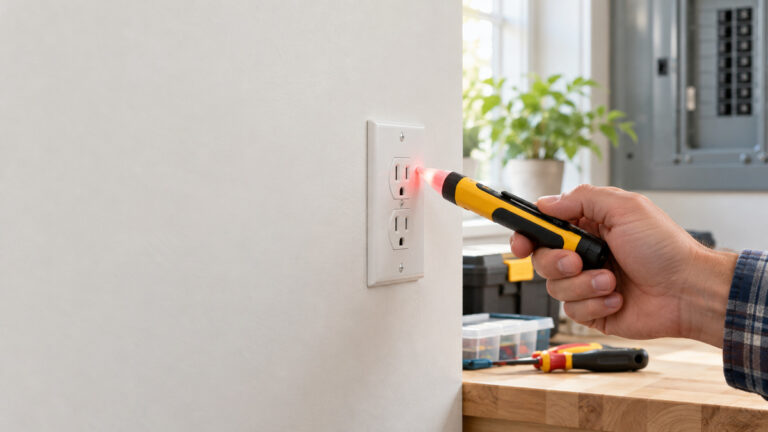
Readers who also use sticks should know the difference between a plug-in tester and a contactless voltage tester. A non-contact tester senses voltage near a wire. A plug tester needs full insertion to read wiring between hot, neutral, and ground. For outlet faces, the plug-in type gives clearer wiring codes. For first-pass live-dead checks on cords, a non-contact tester fits better.
If you compare Klein lines, note that a Klein socket tester and a Klein GFCI tester share the same plug-in idea but differ in GFCI buttons and charts. A Klein power tester may cover other power tasks, so read the title and bullets to confirm receptacle testing. The same applies to Fluke: a Fluke GFCI tester names GFCI use, while a non-contact stick does not replace a plug-in wiring check.
Comparison table built only from listing data:
| Model | Outlet fit stated | GFCI test named | Display | Rating stated | Size / Weight stated |
|---|---|---|---|---|---|
| Klein RT210 | Standard and GFCI Receptacles, 110/125V AC 50/60Hz | Yes | Lights | Cat Ii 300v | 5.3 x 3.8 x 1.5 inches, 1.9 ounces |
| Fluke ST120+ | GFCI equipped outlets, socket tester | Yes, integrated button plus beeper | Bright LEDs | Cat Iii 300 V | 2.28 x 2.9 x 0.98 inches, 0.07 kg |
| EOHELGRO T0530 | 125V AC 50/60Hz 3-wire | Not named as button | LEDs | ETL, UL | Listing does not state size/weight |
| Southwire 40022S | Standard Electrical Outlets, 120V AC | Yes, 7 test functions | Lights | EN 61010-1 | 1 x 1.7 x 3.6 inches, 1.92 ounces |
| NHIDKU | 120V 3-prong US outlets | Ground-fault detection named, button not detailed | Indicators | UL | Listing does not state size/weight |
| Goldeep ST20 | North American 3-wire 120V outlets | Yes, 6mA~9mA trip test | LCD + bottom lights | Listing does not state CAT | 4.09 x 2.01 x 1.18 inches, 2.88 ounces |
| Ideal 61-502 | 120V AC circuits | Yes, confirms GFCI operation | Lights | CSA, UL, cULus UL 1436 | 5.55 x 3.27 x 1.42 inches, weight not stated |
Planning example: mapping outlets in a small house
This worked example uses our planning estimate only to show how much time to allow. It does not change which tester is best.
Define the scenario once. Assume a one-floor home has 28 outlets to check. Assume each outlet takes 3 minutes for insertion, light reading, lamp check, and notes. Assume 6 outlets are GFCI protected and each GFCI trip plus reset adds 2 minutes. Assume walking and breaker pauses add 20 minutes total.
Step 1 — base check time. Multiply outlets by time per outlet: 28 × 3 minutes = 84 minutes. Re-verify: 30 × 3 = 90, minus 2 × 3 = 6, so 90 − 6 = 84 minutes. Correct.
Step 2 — extra GFCI time. Multiply GFCI outlets by extra time: 6 × 2 minutes = 12 minutes. Re-verify: 5 × 2 = 10, plus 1 × 2 = 2, total 12 minutes. Correct.
Step 3 — add walking time. Add base plus GFCI plus walking: 84 + 12 + 20 = 116 minutes. Re-verify: 84 + 12 = 96, 96 + 20 = 116 minutes. Correct.
Step 4 — convert to hours. Divide by 60: 116 ÷ 60 = 1.93 hours, about 1 hour 56 minutes. Re-verify: 60 × 1 = 60, remainder 56, 56 ÷ 60 = 0.93, sum 1.93 hours. Correct.
Plan about 2 hours for 28 outlets under these assumed times. If outlets sit behind furniture, add more. If any tester shows a fault code, stop and call an electrician rather than extending the test.
5 common mistakes with plug testers
1. Testing ungrounded outlets as if the code were final
A 3-light tester needs ground to judge many faults. On a 2-wire outlet with an adapter, correct lights can mislead. Check for a ground slot first. If ground is missing, do not log the outlet as safe.
2. Pressing GFCI test on a miswired outlet
Press the GFCI button only after the base wiring reads correct. The Ideal notes stress that grounding must exist for the GFCI test to work. Testing out of order wastes time and hides the real fault.
3. Ignoring the chart
Light patterns differ by brand. Do not guess from memory. Hold the tester so LEDs face you, match the exact pattern, and note open neutral versus open ground. Keep the manual with you.
4. Assuming a plug tester measures exact voltage
Most picks show wiring codes, not volts. Only the Goldeep ST20 in this set states real-time voltage on an LCD. If you need 120V versus 110V detail, pick an LCD model or use the right meter for the task and follow its manual.
5. Opening outlets or panels after a bad reading
A bad code means stop. Do not pull the receptacle or remove a panel cover to chase wires. That work belongs to a licensed electrician. Note room, outlet, pattern, and any heat or odor, then de-energize by unplugging loads and call a pro.
FAQ
What does a plug tester do?
It plugs into a 3-wire outlet and shows a light code for correct wiring, open hot, open neutral, open ground, or reversed wires. Some models add a GFCI trip button. It does not replace a multimeter for exact voltage or current.
Is a socket plug tester the same as a plug in voltage tester?
Many shoppers use both terms for the same plug-in wiring checker. Strictly, a plug-in wiring tester shows wiring faults, while a voltage stick only senses presence of voltage. For outlet wiring codes, choose the plug-in type.
Do I need a gfci plug tester if my home has GFCI outlets?
Yes if you want to confirm trip function at the outlet face. Choose a model that names GFCI testing and follow the manual. The receptacle must be grounded for the plug-in GFCI test to trip, so check wiring first.
Why did my plug tester show correct wiring but the GFCI button did nothing?
Common causes are missing ground, a GFCI device wired upstream, or a faulty device. Stop testing that outlet, note the result, check the product listing and manual, and ask an electrician. Do not repeat trip attempts many times.
Can a plug tester find every wiring fault?
No. It finds common faults listed on its chart but cannot see loose backstab connections, shared neutrals, or panel faults. It also cannot judge wire gauge or torque. Treat it as a first screen, not a full inspection.
Are Klein and Fluke plug-in testers better for beginners?
A Klein plug tester like the RT210 gives clear GFCI plus standard coverage and a stated drop and temperature range. A Fluke plug in tester like the ST120+ adds a beeper that helps solo breaker checks. Both still require chart reading and manual steps, so pick by display and rating, not brand alone.
How do I use a plug tester safely?
Insert fully into a reachable outlet, read the code without touching metal, test GFCI only if wiring reads correct, then unplug by the body. Follow the instrument manual and local rules. Never test damaged, hot, or buzzing outlets, and never open panels.
Bottom line
Choose by outlet and task, not by brand. Choose the Klein RT210 if you want GFCI plus standard coverage with stated 110/125V AC support and a 6.6-foot drop build. Choose the Fluke ST120+ if you map breakers alone and want a beeper plus Cat Iii 300 V language. Choose the Ideal 61-502 if stated cULus certification for 120V AC matters most. Choose Southwire for compact 7-function checks, Goldeep for LCD voltage plus hold, or EOHELGRO and NHIDKU for simple correct-wiring and grounding screens. If any reading shows a fault, stop and call a licensed electrician.
Sources
- Measurement category: CAT class definitions and impulse levels