Hand-Crank 1000V Insulation Tester Review
As an Amazon Associate we earn from qualifying purchases. Details
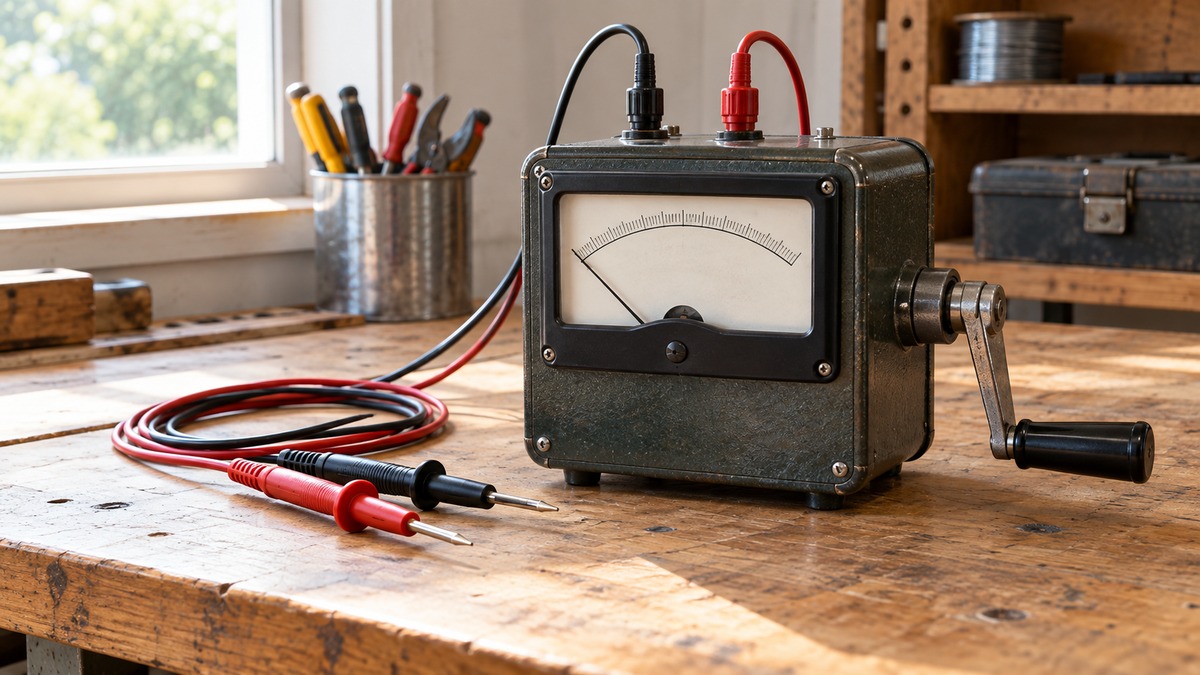
The RQG hand-crank megohmmeter is a 1000V insulation resistance tester that is powered by a hand crank rather than batteries. It has a listed measuring range of 0 to 1000 megohms, a three-terminal layout with a guard ring, and an alloy shell with stainless steel handles. It is aimed at electricians and maintenance technicians who test the insulation of motors, power cables, transformers and similar equipment. The Megger name in the listing is a search term, so confirm the brand on the live product page. This page explains what the listing states, what it leaves open and who should consider it. It does not replace the instrument’s own manual or your site’s safety procedures.
Introduction
The RQG hand-crank megohmmeter is an insulation resistance tester that takes its power from a hand crank rather than from a battery. Shoppers who search for a hand crank megger are usually looking for exactly that format. the product information uses the word “Megger” in its title as a search term, but the product is an RQG-branded instrument, not a Megger-brand model. That distinction matters for anyone comparing this tool with other insulation testers, and it should be checked on the product page before you order.
The job this instrument does is different from the job of an ordinary multimeter. An insulation resistance tester applies a high test voltage to a circuit or component and measures the very high resistance of its insulation, displayed in megohms. An ordinary multimeter’s resistance function checks continuity or low resistance in wires and components. The two instruments answer different questions. An ordinary multimeter cannot replace an insulation tester for this work, and this tool should not be used as a substitute for continuity or low-resistance checks.
the product information targets electricians and maintenance technicians who test the insulation of motors, power cables, transformers, telecommunication components, and household appliances. It also positions the instrument for technicians who want a tester that does not depend on an internal electronic power source. That is the core appeal: the crank is the power source, so the instrument’s operation does not depend on a battery charge.
This review reads the product specifications and the product information text closely, and it keeps the product information’s claims separate from its specification fields. The safety content is included because insulation resistance testing involves high voltage, and the product information’s safety information is limited.
You can view the RQG hand-crank megohmmeter on Amazon to check the current listing, the included components, and any variant differences before you buy.
Product snapshot
The specification fields and bullets together describe the following instrument:
| Attribute | Listed value |
|---|---|
| Rated voltage | 1000V |
| Measuring range | 0 to 1000 megohms |
| Tolerance | Plus or minus 10 percent |
| Accuracy class | 10 (listing) |
| Power source | Hand crank |
| Rated crank speed | 120 RPM (listing) |
| Terminals | Three-terminal layout with guard ring (listing) |
| Test leads | Test leads with alligator clips included |
| Shell | Heavy-duty alloy shell (listing) |
| Handles | Stainless steel handles (listing) |
| Dimensions | 8.1 x 4.7 x 5.7 inches |
| Weight | 3.3 pounds |
| Specification met (field) | UL, IEC |
| Included components | 1000 megohm megohmmeter and test wires |
| Warranty | None listed in the published product specifications |
The table separates the specification fields from the product information bullets. The rated voltage, measuring range, tolerance, dimensions, weight, and included components come from the specification fields. The rated crank speed, the terminal and guard description, the shell, and the handles are described in the product information. Both kinds of figure are useful, but the specification field is the one to check against your own test procedure.
Who this tester suits
the product information names motors, power cables, transformers, telecommunication components, and household appliances as the kinds of equipment the instrument is meant for. A buyer with that kind of work has a clear use case: checking whether the insulation between conductors, or between a conductor and ground, has the high resistance it should have.
The instrument is a fit for a technician who wants a crank-driven tool rather than a battery-based one. That could be because the work takes place in places where a battery may be inconvenient, or because the technician prefers a format without an internal electronic power source. the product information does not describe which environments are suited to the crank format, so the buyer should decide that based on the work itself.
It is not the right tool for shoppers who mainly need continuity checks, voltage readings, or ordinary resistance measurements. Those tasks need a different instrument. This product is for insulation resistance work only, and the product information presents it that way.
Test voltage and measuring range
the product information gives a rated voltage of 1000V and a measuring range of 0 to 1000 megohms. These are the figures to compare with your test requirements. Check the measuring range against the range your procedure needs before you buy, rather than assuming a higher upper limit is always better. A range that goes higher than your work requires does not make a reading more accurate in the range you actually use.
The rated voltage and the range are both listed values. The published product specifications do not include a calibration certificate or a method for verifying either value. Confirm that the 1000V rated voltage matches your test procedure, and compare the 0 to 1000 megohm range with the readings your work requires.
Insulation resistance readings are read against a test voltage. A tester that is rated for 1000V is the right class for some jobs and the wrong class for others. The owner should read the test procedure for the equipment and confirm that a 1000V rated tester is the one that procedure calls for. the product information does not give test-voltage recommendations for specific equipment, so that decision belongs to the procedure, not to the product page.
Hand crank operation
The product information says the hand crank is the power source and recommends a steady rated speed of 120 RPM for accurate readings. A steady crank speed is the operating requirement that the product information emphasizes. An instrument of this type depends on the operator maintaining that speed, so the crank is not a convenience feature but part of the measurement.
The product information says upgraded internal gears that operate smoothly and reduce the effort needed to keep the crank at speed. It claims up to 30 percent less effort. The 30 percent figure is a manufacturer claim. does not compare it to any other tester or describe how it was measured. Treat it as an unverified statement about the crank’s effort, not as a measured result.
Practice cranking at a consistent speed before taking readings, and follow the instrument’s documentation for the correct procedure. An operator who cranks unevenly introduces variation into the reading, and that variation is hard to separate from a real change in the insulation. A short practice session at the rated speed gives the operator a feel for the effort and the rhythm before any reading matters.
The crank format has a physical side as well. The operator needs enough room to turn the crank steadily, and the handles should be held firmly during cranking. The product information says stainless steel handles, but does not describe grip design, so check the handles in person if you can before relying on the format for long sessions.
Accuracy and tolerance
The product information says an accuracy class of 10 and a tolerance of plus or minus 10 percent. These are the listed values for the instrument. does not explain how the accuracy class is defined for this product, nor does it include a calibration certificate or a calibration interval.
Treat these figures as the listed specification. If your work requires a particular accuracy level, compare the listed class and tolerance against your documented requirements, and check whether the instrument’s documentation supports the accuracy you need. A buyer who needs traceable calibration should ask for the calibration documentation before purchase, because the product information does not supply it.
the product information’s statement that readings will always be highly accurate is a marketing claim. Accuracy depends on the connection method, the condition of the equipment under test, and environmental conditions, and none of those are controlled by the product information. A reading is only as good as the setup behind it, so the procedure, the leads, and the environment all matter as much as the instrument’s stated class.
Three-terminal layout and guard ring
The product information says a three-terminal layout with a guard ring. The guard is described as a way to reduce surface leakage errors, which The product information says matters most when testing cables in humid environments. The test leads with alligator clips are included.
A guard terminal is used as part of a specific connection method. Follow the instrument’s documentation and your test procedure when connecting the leads, and make sure the lead connections are secure before applying test voltage. the product information does not describe the connection steps in detail, so the documentation is the source to follow for the exact method.
Confirm that the guard terminal and three-lead setup match the connection method you use. A buyer who uses a two-lead method, or whose procedure does not call for a guard, should understand how the three-terminal layout is intended to be used before relying on it. the product information’s description of surface leakage reduction is a claim about the design, and No independent test data is available showing the size of the effect.
Keep the leads and clips in good order. Alligator clips that are loose, cracked, or dirty can change the connection and the reading. Check the clips and the lead insulation before each use, and replace any lead that shows damage.
Construction and handling
The product information says a heavy-duty alloy shell, a drop-resistant enclosure, and stainless steel handles for portable use. The product is listed at 8.1 by 4.7 by 5.7 inches and 3.3 pounds, which the product information presents as portable.
does not describe drop testing, ingress protection, or operating temperature range, so do not assume those conditions from the shell description alone. A drop-resistant claim is a manufacturer statement. An IP rating, a temperature range, or a drop-test result would be needed to make a decision about the instrument’s use in harsh conditions, and none is given in the published product specifications.
Handle the instrument by its insulated sections and keep it clear of energized parts during testing. The product information says stainless steel handles, which are part of the grip, so the operator should check how the grip feels during cranking. The weight of 3.3 pounds is light enough for portable use in the product information’s terms, but the operator still needs a stable position while cranking.
Store the instrument with the leads organized and the case or pouch closed, if one is included. does not describe a carrying case, so check the included components before purchase.
Standards listed
The specification field lists “UL, IEC” under specification met. Standards claims should be checked against the instrument’s markings and documentation. Ask the seller or the manufacturer for the certificate or documentation for any standard you need to meet, rather than relying on the product information field.
the product information field is a short statement, and a short statement does not tell you which edition, which clause, or which configuration of the instrument the claim covers. If a standard matters for your work, the certificate is the document that matters, and the buyer should ask for it before purchase.
A buyer whose work requires a specific standard should not treat “UL, IEC” as proof of compliance for that standard. includes the field and nothing more, so the verification step belongs to the buyer.
Safety considerations
Insulation resistance testing involves high voltage. Before testing, follow your site’s electrical safety procedures, de-energize and isolate equipment according to those procedures, and confirm that no stored charge remains before connecting leads. These steps come before any reading, and they apply whether the instrument is hand-cranked or battery-powered.
Keep leads and clips clear of energized parts, and handle the instrument by its insulated sections. the product information does not provide a safety category, so do not treat the tool as rated for any particular environment beyond what its documentation states. A safety category tells you the environments and conditions an instrument is built for, and the published product specifications do not include one.
the product information’s construction details do not replace the safety procedure. A heavy-duty shell and insulated handles are useful features, but they are not a substitute for isolation, de-energizing, and confirming that no charge remains. Read the documentation before the first use, and keep it with the instrument.
Make sure the operator understands the test procedure before connecting the leads. If the procedure calls for a specific voltage, lead layout, or sequence, follow it exactly. Do not improvise a connection to get a reading, since a wrong connection can change both the reading and the safety of the test.
Purchase decision: where this product fits
Megohmmeter 1000V Insulation Resistance Tester 1000MΩ M Egger Hand Crank is easiest to evaluate as a fit decision, not as a universal recommendation. Its stated design can be useful when the dimensions, included parts, and intended use described above match your exact setup. It is a weaker choice when you need a capability the product information does not explicitly provide.
Buy it when
- The stated size and configuration fit the space or equipment you already have.
- The included components replace separate purchases you would otherwise need.
- The limitations described in this review do not interfere with your main use case.
Avoid it when
- A missing compatibility measurement would determine whether it works at all.
- You need proof of performance beyond the manufacturer’s stated specifications.
- A simpler product would solve the same problem without unused features.
Before ordering, verify the two or three measurements that control fit. This single check is more useful than relying on a broad “works for most” description.
Worked example: the measuring span
The listing gives a measuring range of 0 to 1000 megohms. Subtracting the low end from the high end gives a span of 1000 megohms. The rated voltage of 1000V is a separate figure that sets the test voltage, so it does not change that span.
Limitations and caveats
Several limitations come directly from the supplied information:
- The “Megger” name in the product information is a search term. The product is an RQG hand-crank megohmmeter, not a Megger-brand model.
- The accuracy class of 10 and the tolerance of plus or minus 10 percent are listed values. includes no calibration details, and the product information’s statement about highly accurate readings is a marketing claim.
- No field durability data is supplied. The shell and handle descriptions are claims.
- No warranty is listed.
- the product information gives no safety category, and it does not describe drop testing, ingress protection, or an operating temperature range.
- The standards field lists “UL, IEC” without certification documents.
- The 30 percent reduction in crank effort is a manufacturer claim with no comparison or method given.
- The instrument measures insulation resistance only. It is not a substitute for an ordinary multimeter’s resistance or continuity functions.
These limitations are not reasons to avoid the tool. They do mean that the buyer should verify the standards, the calibration documents, and the safety procedure for the work in question before depending on the instrument.
Questions to put to the seller before ordering
the product information leaves several gaps. The questions below follow directly from those gaps, and a written answer to each one gives the buyer more to rely on than the bullets.
- Can the seller provide the certification or documentation for the UL and IEC claim, including the edition and the configuration it covers?
- Is a calibration certificate available, and what is the calibration interval for this instrument?
- What is the measuring range, and is the 0 to 1000 megohm range the full specified range for the 1000V test?
- Is a warranty offered, and what does it cover?
- Is a safety category or an operating environment specified for the instrument?
- What is the operating temperature range, and is there any ingress protection rating for the enclosure?
- Does the included test wire set match the three-terminal guard layout described in the product information?
- Is the 30 percent reduction in crank effort based on a documented comparison, and if so, what is the comparison?
Keep the written answers with the instrument’s documentation. If an answer differs from the product information, use the answer as the current source and confirm the instrument in hand against it.
Buyer checklist
- Confirm that the instrument is the RQG hand-crank megohmmeter you intend to buy.
- Check that the 1000V rated voltage and the 0 to 1000 megohm range match your test procedure.
- Confirm that the three-terminal guard layout matches your connection method.
- Ask for the UL and IEC certification documents, and confirm the scope of each.
- Ask for the calibration documentation if your work requires traceable accuracy.
- Plan a practice session at the 120 RPM rated speed before taking readings.
- Confirm the safety procedure for the equipment, including de-energizing, isolation, and confirming that no stored charge remains.
- Inspect the leads and clips before each use.
- Keep the instrument separate from ordinary multimeter work, since the two tools answer different questions.
Conclusion
The RQG hand-crank megohmmeter is a 1000V insulation resistance tester with a listed 0 to 1000 megohm range, a three-terminal guard layout, test leads, and a hand-crank power source. Its main appeal for technicians is the crank-powered format, which does not depend on a battery.
Its listed accuracy class, tolerance, and standards field should be checked against your own requirements and documentation. No safety category or field durability data is supplied, and no warranty is listed. The “Megger” name is a search term, not a brand claim.
this is a purpose-built insulation tester for technicians who want a crank-driven instrument rather than a battery-based one. Confirm the details above before you buy, keep the instrument separate from your ordinary multimeter work, and follow the site’s electrical safety procedure every time you test.
Frequently asked questions
Is this tester powered by batteries? No. The hand crank is the power source, with a steady rated speed of 120 RPM listed for it.
Does it have a guard terminal? Yes. The product information describes a three-terminal layout with a guard ring, and the guard is used as part of a specific connection method.
Are the standards confirmed? The specification field lists UL and IEC under specification met, but this review does not treat that short statement as proof of compliance for a specific standard.
What is the rated voltage? The listed rated voltage is 1000V, and the measuring range is 0 to 1000 megohms.
Sources
- – https://www.amazon.com/dp/B0DT9CRCMV/?tag=bestmultimeter0f-20